Slovenčina




E-book
Jozef Bavoľár - Ladislav Lovaš - Simona Ďurbisová
The process of achieving goals is one that has traditionally received significant attention in psychology. This attention is not only directed by researchers focused on motivation, with which the process of achieving goals is classically associated, but also from a wide range of other areas (e.g., emotions, personality). One aspect of goal-directed behavior that has received minimal, if not virtually no, attention is decision-making.
It is surprising to realize that various aspects of decision-making are present throughout the entire process of achieving goals - from evaluating different aspects of multiple alternative goals, through selecting among them, deciding on resource allocation (effort, time, finances, relationships...), continuously monitoring progress, to evaluating the outcome and its impact on future goal-directed behavior.
Even more surprising is that decision-making is directly addressed by one of the dominant theories explaining goal-directed behavior - the theory of mental action phases (mindset theory of action phases; Gollwitzer 1999, 2012). This theory distinguishes the pre-decisional and post-decisional phases as the first two phases of this behavior, separated precisely by the decision about which goal to pursue.
Download e-book for free (pdf)

Data sheet
E-book
Vladimír Leško, Róbert Stojka a kol.
Kolektívna monografia Leško, V. – Róbert Stojka a kol.: Heidegger, metafyzika a Gréci (Košice: UPJŠ 2016, 695 s.) je prvým historicko-filozofickým pokusom na Slovensku, ale aj v širších zahraničných kontextoch, vysporiadať sa s takto zvolenou ústrednou témou Heideggerovho diela. Práca je členená do troch základných časti. V prvej, ktorá je nazvaná od Augustína k Aristotelovi, autori jednotlivých kapitol skúmajú genézu Heideggerovho vzťahu ku gréckej filozofii a skúmanie hlavnej Heideggerovej otázky – otázky bytia - od jeho prvých prednáškových kurzov k Aristotelovej filozofii z rokov 1921/1922 až do roku 1929, keď mu vychádza práca k Aristotelovej Metafyzike. Naše skúmanie jednoznačne potvrdzuje skutočnosť, že v týchto Heideggerových raných textov (prednáškových cyklov) sa postupne rodia všetky dôležité filozofické pozície, ktoré mali svoje zavŕšenie v práci Bytie a čas.
E-book
Beáta Jurečková - Lívia Barnišinová
The e-Slovak textbook for dentists in practice - case studies is intended for foreign students of dentistry. It is primarily intended for students of the Slovak language as a foreign language, but the knowledge of the grammatical and lexical basics of the Slovak language at the A1, A2 level is needed.
The textbook consists of eight lessons, which are focused on listening comprehension (audio recordings), vocabulary expansion, systematisation of grammar and development of speech skills (case studies). The two lessons consist of repetitive, concluding exercises. The primary goal of the textbook is to connect language training with professional dental practice.
E-book
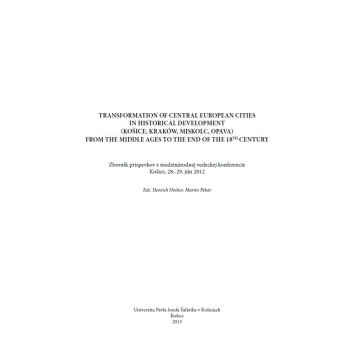
Henrich Hrehor - Martin Pekár (eds.)
(Košice, Kraków, Miskolc, Opava) : From the Middle Ages to the End of the 18th Century.
Proceedings of the International Scientific Conference, Košice, June 28–29, 2012
E-book
The publication provides a systematic overview of the core models of systemic therapy and its theoretical as well as practical foundations. The opening chapters of the textbook outline the historical development of psychotherapeutic approaches and the shift toward the systemic paradigm, which emphasizes the importance of relationships, context, and circularity in understanding psychological phenomena.
The core of the text focuses on the philosophical foundations of systemic therapy, particularly general systems theory, cybernetics, constructivism, and social constructionism, all of which have significantly shaped the understanding of reality, knowledge, and the therapeutic process. Subsequent chapters address biological and social foundations, including the concepts of autopoiesis, cognition, and communication, and their relevance to the functioning of social systems. The publication further elaborates on the practical implications of these theoretical frameworks, especially in relation to causality, language, and the construction of social reality. Systemic understanding of problems is presented as a dynamic and relational process maintained through interactional patterns within the system.