Slovenčina


E-book
Vladimír Leško - Zlatica Plašienková (eds.)
Philosophical Proceedings Kant in the Contexts of Husserl's and Heidegger's Philosophy is a presentation of the results of the Second International Philosophical Conference, which took place on November 5-7, 2008 at the UPJŠ in Košice.
The conference was prepared by the Department of Philosophy and History of Philosophy, Faculty of Philosophy, UPJŠ in very close cooperation with the Slovak Philosophical Association at the Slovak Academy of Sciences in Bratislava. The structure of the presented proceedings was divided into three basic parts. The first part contains the papers that were presented at the conference and constitute a crucial part of the content of our proceedings. The individual papers are arranged in the order in which they were presented at the conference. The second part of the proceedings contains the speeches from the inauguration ceremony of the award of the honorary title of Doctor honoris causa to Milan Sobotka and Teodor Münz. In the third part, a photo-documentation is published in which the ceremonial academic act of conferring the honorary degree of Doctor honoris causa is captured. Translated with DeepL.com (free version)

Data sheet
E-book
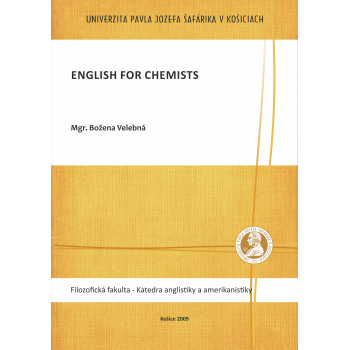
The following material has been created during the two years of teaching English for Chemists at the Faculty of Science of the Pavol Jozef Šafárik University and is therefore designed to meet the needs of this course. The main motivation was the lack of appropriate materials, especially as the groups generally comprise students with a very diverse level of English. This diversity therefore became the main criterion determining both the form and the content of this text.
In the ten units that provide material for a one semester course, the emphasis is put on teaching the students vocabulary and terminology, which is introduced via authentic texts, depending on the topic of each unit. Students are encouraged to learn the meaning of new words in context. Grammar is included too, with the aim of demonstrating and explaining grammatical rules by means of examples taken directly from the texts. For the more advanced students, grammatical exercises in this material can serve for revision while the beginners might need more supplementary materials.
I hope that this material, the preparation of which has been a challenging as well as enjoyable experience will be useful for future teachers and the students of this course.
E-book
Jana Balegová-Erika Brodňanská (eds.)
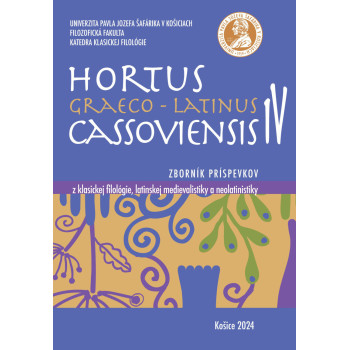
It has been eleven years since the Department of Classical Philology of the Faculty of Arts of the University of Pavol Jozef Šafárik in Košice opened the gates of its imaginary colourful garden for the first time. At that time, the Hortus Graeco-Latinus Cassoviensis provided a space to present the results of work from all fields of the classical, Latin medieval, and Neo-Latin studies to colleagues from Slovakia. Five years later, the "garden" was enriched by colleagues from Bohemia and Moravia, and this time, at its fourth opening, colleagues from Greece and Germany also honoured it with their works. Variety remained its characteristic feature. Papers on ancient history, the linguistics of classical languages, ancient and medieval literature, ancient philosophy, the history of ancient medicine and Neo-Latin studies, as well as contributions on the teaching of classical languages, are presented in the proceedings. Moreover, the volume is published as an output of two seemingly disparate VEGA projects carried out at the department: No. 1/0109/21 Poemata de se ipso by Gregory of Nazianzus and No. 1/0255/22 Medicus poeta. Neo-Latin literature of medical authors associated with Slovakia. However, appearances are deceptive, because Gregor of Nazianzus, although a church father, also wrote poetry, his works contain numerous allusions to the medical milieu, and he had a brother who was a physician. His entire work is characterised by the variety of the themes he explores. References to the Bible are not uncommon in the works of medical poets. Just as the projects differ and simultaneously overlap with each other, the themes of the individual contributions also differ and overlap.
E-bool
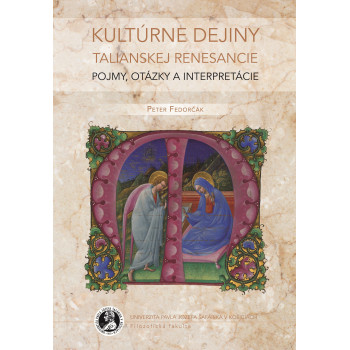
When studying the Renaissance, researchers utilize various critical and core terms and concepts which it is necessary to characterize.
However, many such points, notably the following, are problematic: The relationship between the Renaissance and the antiquity; The connection with the Middle Ages; The transformation to Mannerism and Baroque; Realism and Secularism in Renaissance art; The individualism of the Renaissance artist; The reasons for the creation of Renaissance art in Italy, its determinants and stimulators; Distinguishing between the analysis of the genesis of the Renaissance and the analysis of the creation of the period’s art generally; Regional differences in Italy and their impact on the art; Chronological limits of the Renaissance and its milestones; The terms “Medieval Ages” and “Early Modern Period”; The impact, and its extent, of the artistic influences of the Byzantine, Gothic and Romanesque arts on the Renaissance. The term “Renaissance” itself, its content and existence, are also the subject of the discussion with students, alongside learning how such terms and definitions came about and continue to evolve, how they attain their content, how this content morphs in the historical discourse, what academical pluralism and freedom of thinking look like in the discourse led by historians, what the differences are between scientists and schools of thought on the same subject and how it is possible that they are so numerous.
The students will come to recognize the leading scholars in the field, and follow their arguments and methodological approaches. They shall be invited to closely trace and scrutinize the logic which those historians use in building their argumentation. It shall be seen that the freedom to create terms, concepts and new definitions cannot stand on an ignorance of the (historical) facts, as becomes clear with expanding knowledge of those historical facts, the variability of their interpretation growing in tandem. This approach, actually used across the whole range of seminars and lectures, shall drive discussion on the topics covered, students being invited to formulate their own theses and antitheses.
E-book
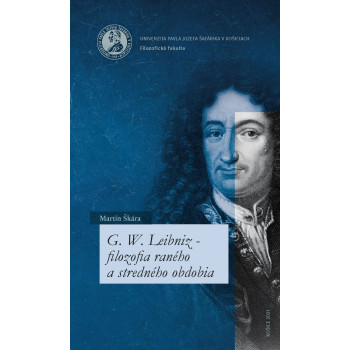
The presented university textbook is a reaction to two fundamental shortcomings. The first one is the absence of a similar, if not equivalent, textbook in the Slovak university environment. The second shortcoming is the mistake that Leibniz's philosophy is a system called monadology.
The presented textbook corrects this mistake and at the same time fills the gap of the absence of this kind of textbook with a Leibniz subject. For the above reasons, the presented textbook brings a new perspective on the philosophy of G. W. Leibniz, especially in the period of early philosophical beginnings with an overlap into the so-called Paris period and the De summa rerum period up to the first philosophical doctrinal formulation expressed in the Discours de métaphysique (Winter 1685-1686). The textbook is conceived as a selection of sections of source texts translated by the author of the textbook from French and partly from Latin and equipped with comments accessible to the target audience.
It is therefore the author's wish that this textbook not only serve as a form of correction for the misinterpretation of Leibniz's philosophy, but as an inspiring text that will introduce the reader to the world of Leibniz's philosophy in its undistorted light.
Download e-book for free (pdf)