Slovenčina


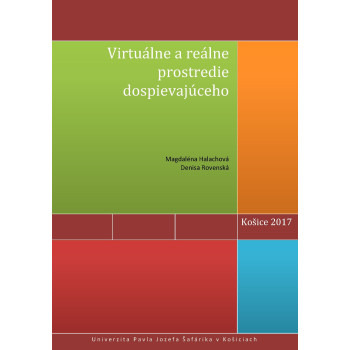
E-book
Magdaléna Halachová - Denisa Rovenská
The monograph theoretically analyzes the virtual environment and its aspects, offers insight into the identity of the child in the virtual environment, the necessity of social support and the diversity of social relationships in the real world and virtual reality.
Furthermore, it contains the fundamental training program designed to minimize the risks of the virtual reality, because adolescents are often exposed to risks uncontrollably. For that reason it focuses on adolescent and empowering optimal self-image, as well as creating and maintaining real social networks.
The set of experiential-educational activities is conceptually divided into two main areas. The first one is content-focused on the adolescent, his/her psychological capability including opinions, attitudes, emotions, competences, and self-reflection.
The second one focuses on interpersonal real and virtual relationships, the recognition of the advantages and disadvantages of internet communication and face-to-face interaction, and last but not least for more optimal use of the Internet and preference for real social interaction.
Authors

Data sheet
E-book
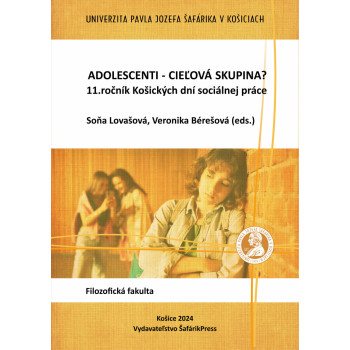
Soňa Lovašová - Veronika Bérešová (eds.)
Reviewed proceedings from the scientific conference with international participation held on December 1, 2023, in Košice.
This proceedings volume collects contributions from the 11th annual conference focused on adolescents, reflecting current interdisciplinary issues faced by this age group. It consists of 12 scholarly contributions addressing various aspects of adolescent life, including loneliness, risky behavior, and the phenomenon of radicalization. The contributions are organized into thematic sections, facilitating easier navigation for readers. Topics include prevention of radicalization, family factors, and mechanisms of cyberbullying. The proceedings offer both theoretical and practical insights valuable for professionals in social work, psychology, and other helping professions, aiming to enhance understanding of the current challenges faced by adolescents and propose effective solutions.
E-journal
Renáta Orosová (výkonný redaktor)
Vedecko-odborný časopis Edukácia je zameraný na problematiku vzdelávania a výchovy v oblasti základného, stredného a vysokého školstva. Zreteľ kladie na súčasný stav a perspektívy edukačnej praxe, aktuálne aspekty pregraduálnej prípravy učiteľov, sociálnej pedagogiky, špeciálnej pedagogiky, ako aj pedagogické a psychologické aspekty výchovy v základných výchovných inštitúciách z pohľadu širokej pedagogickej verejnosti. Je určený vedeckým pracovníkom, mladým vysokoškolským učiteľom, doktorandom, ako aj odborným a pedagogickým pracovníkom, s cieľom prezentovať trendy v edukácii a vyvolať diskusiu k aktuálnym otázkam prezentovaných oblastí výchovy a vzdelávania.
E-book
The book is the result of long-term contemplation on the relationships between the history of philosophy and its reflection in more or less systematic, or non-systematic forms of philosophizing of the most significant philosophical teachings of the 19th and 20th centuries (Hegel, Schelling, Marx, Nietzsche, Husserl, Heidegger, Fink, Patočka, and Gadamer).
The primary goal of the work is to present the most significant historical-philosophical teachings of the 19th and 20th centuries in the formation and fulfillment of strong and weak models of the philosophy of the history of philosophy in the concepts of Hegel, Schelling, Marx, Nietzsche, Husserl, Heidegger, Fink, Patočka, and Gadamer.
The results of the philosophy of the history of philosophy are presented here as a metatheoretical movement within historical-philosophical thinking, whose aim is not to empirically describe the historical-philosophical process, but to understand and explain it as an inseparable part of the most significant philosophical problems – what is philosophy, what is metaphysics, and the question of being.
Download the e-book for free (pdf)