Slovenčina


E-book
Philosophy is interwoven throughout its history with several principles that bring light and order to this kind of thinking, whether it is a systematic or a non-systematic form of philosophizing.
Each of the principles represents in its own way the origin (ἀρχή) of all deductive reasoning, but not all philosophical statements and conceptions are obliged to proceed in the same way, for not all philosophical statements and conceptions are calculus. Actually, such a form of rationalist philosophizing is really a minority in the history of philosophy. But in spite of its minority presence, it will always attract attention to some extent, whether by becoming a pillar of thought itself and finding a permanent place in its foundations, or by becoming an indispensable mainstay of philosophical reasoning. In fact, there are not many principles in the history of philosophical thought.
The state of affairs is primarily due to the heterogeneous and in many cases irrationalist nature of philosophical thinking.

Data sheet
E-book
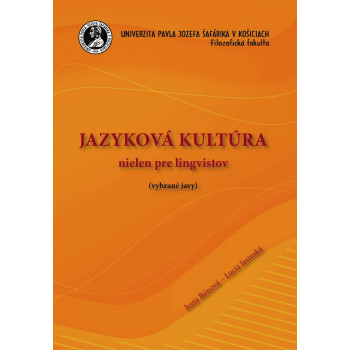
Language culture is not only for linguists; it is a professional publication suitable as a textbook, in which we attempt to describe and explain the most frequent phenomena of speech practice in an innovative way.
These phenomena are observed not only in the media environment but also in the academic sphere, which, with regard to the communication sphere (mass media communication, scientific research), are often used incorrectly and thus subconsciously penetrate the language awareness of all language users.
This includes those for whom language is a working tool with a primarily representative function (teachers at all levels of schools or radio and television workers).
E-book
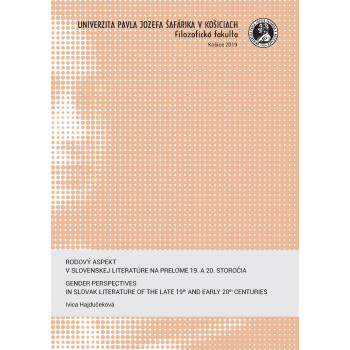
The second (supplemented and expanded) edition of the bilingual textbook Rodový aspekt v slovenskej literatúre na prelome 19. a 20. storočia (Interpretačné etudy) / Gender Perspectives in the Slovak Literature of the Late 19th and Early 20th Centuries (Interpretation Studies) offers to a wider range of recipients – students of Teaching of Academic Subjects and teachers in practice – a didactic transformation of current research issues (supported by e-literacy using online approaches and QR codes), which was developed in cooperation with the School of Applied Arts in Košice (since 2019/20 the so-called School of Art Industry) ) in the academic year 2018/2019.
Professional cooperation within the KEGA project No. 008UPJŠ-4/2017 – Science Without Barriers (Interdisciplinary Inspirations of Contemporary Literary Scholarship and Linguistics in Educational Practice at University) with teacher of Slovak Language and Literature, PaedDr. Jana Valicová, and Mgr. Renáta Novotná Markovičová of ŠUP took place in project teaching. It yielded results in two interdisciplinary outcomes:
1. Creation of the Literary Lounge in the Student Café Minerva in the premises of the UPJŠ Faculty of Arts;
2. Illustrations of the 2nd edition of the textbook Gender Aspect in the Slovak Literature at the Turn of the 19th and the 20th Centuries (2019).
E-book
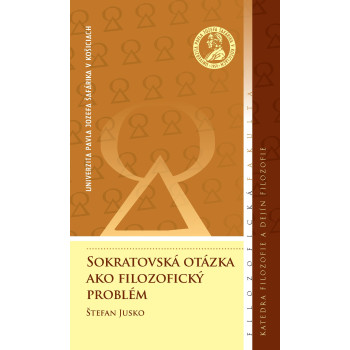
The goal of the monograph is to highlight the significant problem of interpreting the Socratic question, as its approach represents a method of interpreting the history of philosophy, specifically in our case, the interpretation of Socrates and Plato. The Socratic question can be grasped in diametrically different ways, as shown by Patočka and Nietzsche, among others. The former aligns with Socrates and innovatively updates his question for the present. The latter is ambivalent towards Socrates but ultimately labels him a decadent.
In the first part of the monograph, Patočka's characterization of human existence is presented, which he formulates as unified and morally firm. Patočka interprets the Socratic question as care for the soul, for its well-being, without deriving the concept of good from something positively defined but from the whole world, which can only be defined negatively due to its constant openness. This sphere of negativity is for Patočka something immensely positive because transcendence lifts humans from relative goods to the overall meaning, making them morally capable in the true sense. The good, i.e., the requirement for a surge, for a turn of humans from the world of things to the whole world, is for him a program that Socrates first formulated through his knowing ignorance.
The second part of the work is dedicated to Nietzsche's concept based on the non-unified nature of human existence, which is not derived from the whole world or overall meaning but from situational meaning. Nietzsche strives to prove that in every situation, human existence is exposed to two opposing perspectives, between which it is impossible to decide which is correct. He concludes that both perspectives are equally valid and mutually conditioned, meaning that the opposite of good, what threatens meaning, is a beneficial condition for situational meaning. He labels this level as immoral, as a sphere where human existence creates meaning outside the thinking of good and evil in opposition.
The conclusion of the work is open because, as it turns out, we do not have a common denominator that could decide on the correctness of one or the other concept. Precisely in this lies the fact that the Socratic question remains a serious philosophical problem even today.
E-book
Patrik Furik - Michaela Ružičková - Dávid Gajdoščík - Peter Dubóczi - Barbora Linhartová - Lucia Grieger
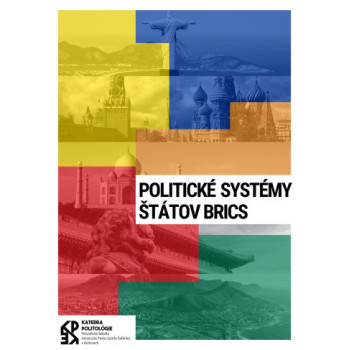
The textbook entitled Political Systems of the BRICS States is published as an output of the KEGA 014UPJŠ-4/2020 Innovative Model of Education Leading to Active Citizenship as a Prevention of the Rise of Political Extremism among Students. The aim of the given publication is to present the basic principles of the political systems of the BRICS bloc states and to provide the reader with the nature and character of the bloc's functioning.
The textbook consists of an introduction and five further chapters. All sections are written in Slovak. The individual chapters focus primarily on characterizing the historical development of the BRICS states, the evolution of their constitutionalism, public administration, and on defining the legislative, executive, and judicial branches of power
The individual chapters describe the political systems of the states: Brazil, the Russian Federation, India, China, and South Africa. The introductory chapter of the textbook contains the characteristics of the development and formation of the bloc, as well as information on the cooperation among the BRICS members.