Slovenčina


E-book
Jozef Suchoža - Ján Husár - Regina Hučková (eds.)
Collection of papers presented at an international scientific symposium LAW - COMMERCE - ECONOMY held from 23rd. – 25th. of October 2019 in High Tatras
This year's conference program and the proposed collection reflect current topics not only in domestic legal science (recodification of private law in the conditions of the Slovak legal order) but also in European and international legal science (legal and ethical aspects of artificial intelligence). The conference program is enriched this year by a section, which the organizers have prepared in cooperation with the International Arbitration Court at the Czech-Moravian Commodity Exchange and the Arbitration Court at the Chamber of Commerce of the Czech Republic and the Agrarian Chamber of the Czech Republic.

Data sheet
E-publication
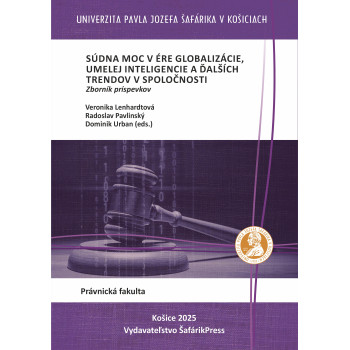
Veronika Lenhardtová-Radoslav Pavlinský-Dominik Urban
The collection Judicial Power in the Era of Globalization, Artificial Intelligence and Other Trends in Society provides a comprehensive and up-to-date perspective on the transformation of the judiciary amid rapid technological and social change. It contains 25 contributions primarily focused on the introduction and use of artificial intelligence tools in law. The authors examine not only the technical and institutional aspects of this transformation but also issues of judicial legitimacy and public trust in an independent justice system. The publication also offers a critical reflection on potential risks, limitations, and ethical dilemmas associated with the automation and digitalization of judicial processes. Several contributions compare national and supranational legal frameworks, offering valuable insights into differences in regulatory approaches around the world. All texts are united by a common question concerning the future of judicial power in a changing world. The contributions are written in an accessible manner, making the collection suitable for both legal experts and the broader public.
Download the e-book for free
E-book
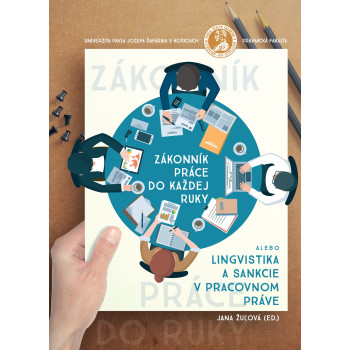
Proceedings of the Second Annual Student Symposium on Labor Law held on May 12–13, 2017 in Danišovce
The presented proceedings are the result of scientific works by students of the Faculty of Law at Pavol Jozef Šafárik University in Košice and are systematically divided into two parts.
The first part presents interdisciplinary intersections of linguistics and labor law in its creation, interpretation, and application. The second part addresses the issue of targeting the addressees of labor law norms through various sanction mechanisms. The proceedings include a questionnaire compiled by the researchers of a grant project, aimed at determining whether and in which aspects the Labor Code diverges from its addressees in terms of linguistic and stylistic processing. Indeed, there is no other legal norm that is closer to the participants of labor relations, and whose understanding at the highest possible level is justified by its everyday use.
The presented proceedings thus serve as a means of expanding the horizons of our students beyond their regular studies and as a tool for popularizing scientific research. In case of interest, the completed questionnaire can be sent to: jana.zulova (@) upjs.sk.
E-book
Anotation Within the university textbook, the author focuses on the introduction to the criminal law of procedural and criminal proceedings, especially in terms of its purpose, individual parts and stages, subjects, procedural acts, decisions, as well as the costs of criminal proceedings. This publication is intended for easier orientation in the basics of criminal procedural law, on which it is possible to build qualified knowledge within the following legal branches or legal institutes. The methodology presented in the publication represents a concentrated form of individual provisions of the relevant generally binding legal regulations, while arguments of criminal law doctrine.
E-book
Ján Klučka(ed.)
Collection of Papers from the International Scientific Conference Held on May 29–30, 2014 at the Faculty of Law, Pavol Jozef Šafárik University in Košice.
In the first half of this year, a scientific conference entitled “10 Years in the EU: Relations, Questions, Issues” was held in Košice, and the contributions from this event constitute the content of the present collection bearing the same name.
The aim of the organizers—namely, the Slovak Association of European Law, the Representation of the European Commission in the Slovak Republic, and the Institute of European Law together with the Department of International Law of the Faculty of Law at Pavol Jozef Šafárik University—was not only (even if loosely) to follow up on the previous 2009 conference “Community Law in Slovakia – Five Years ‘After’”, but, after another five years, to continue its main objective: to provide participants from both the academic and non-academic community with a space for further analysis and exchange of views on legal issues related to the membership of the Slovak Republic in the European Union and various current issues of the Union’s legal order.
From this perspective, a shift in the overall focus of the conference contributions in 2009 and 2014 can be observed. While the contributions from the first conference focused primarily on various aspects of the application of Union law in the Slovak legal system and related application problems, especially before courts and other authorities, the basic orientation of the contributions from the second conference is already different. The present collection also confirms that the contributions focus primarily on current issues of the European legal order and on certain aspects of the Union’s external policy, while the relationship of Union law to the Slovak legal system is no longer given primary attention.
Several contributions focus on areas characterized by a certain overlap or “cohabitation” of Union law with public international law, private international law, or, more broadly, international relations.