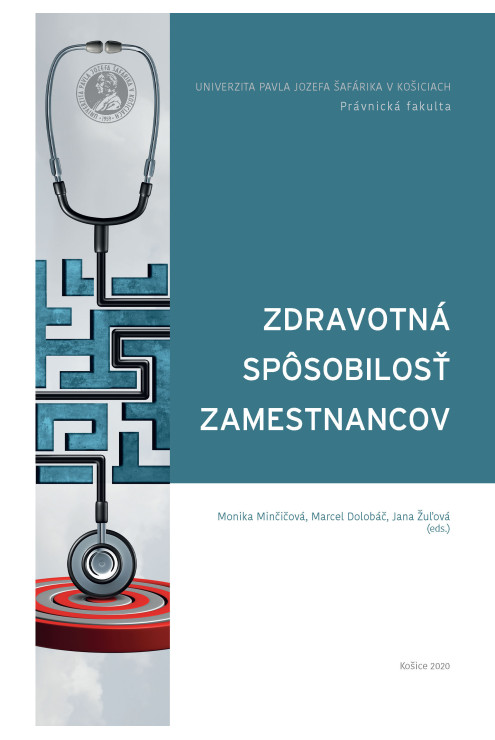
Zdravotná spôsobilosť zamestnancov

E-book

Monika Minčičová - Marcel Dolobáč - Jana Žuľová (eds.)

Peer-reviewed proceedings of the scientific conference

Health determines an individual's life in all activities and interests, including the possibility and ability to work. Work and health are in the mutual interaction. Work leads to social inclusion, financial self-sufficiency, finding confirmation of one's own usefulness or achieving personal ambitions. Work can have therapeutic effects, but at the same time it can have an adverse effect on health.

Overlapping factors of work environment, alone or in combination with non-work influences, can lead to illnesses that temporarily or permanently exclude an employee from his or her profession. For these reasons, health enjoys fundamental legal protection as one of the most important values, not only in labour relations.

Download e-book for free (pdf)

Quantity

978-80-8152-890-3

Data sheet

Method of publication:
E-book (pdf)
Editors:
Monika Minčičová - Marcel Dolobáč - Jana Žuľová
Document type:
Proceedings
Number of pages:
264
Available from:
01.10.2020
Year of publication:
2020
Edition:
1st edition
Publication language:
slovenčina, čeština, poľština
Faculty:
Faculty of Law
Note:
Projekt APVV-16-0002 – Duševné zdravie na pracovisku a posudzovanie zdravotnej spôsobilosti zamestnanca.
- Free for download

16 other products in the same category:

Nové výzvy ochrany zdravia zamestnancov

Nové výzvy ochrany zdravia zamestnancov

E-book

E-book

Katarína SkolodováMonika Minčičová (eds.)

Proceedings of the 5th Year of the Student Symposium of Labour Law

New trends in the digital age around the world do not avoid the labour market and the labour law relations. Do labour law standards and employers' practices correspond to the actual factors that influence an individual's physical or mental condition? Does digitization, including artificial intelligence, bring improvements or threats? Is the protection of employees' mental health paid equal attention that to the protection of physical health? The Department of Labour Law and Social Security Law of the Pavol Jozef Šafárik University in Košice examines and analyzes legal aspects of new risks that threaten and affect individual health in the work environment within the researching of the project APVV-16-0002 - Mental Health in the Workplace and Employee Health Assessment.

The members of the department, with the theme of the 5th year of the student symposium "New Challenges of Employees´ Health Protection" created an opportunity for students to search deeper current legal issues and reflect the results of their creative work in the submitted papers. The proceedings of papers of the student symposium is rich in content and offers the reader the space to get acquainted with interesting questions and application problems accompanying them.

Download the e-book for free  (pdf)

Niekoľko poznámok k porozumeniu Zákonníka práce

Niekoľko poznámok k porozumeniu Zákonníka práce

E-book

E-book

Jana ŽuľováMilena Barinková 

Legal norms regulate everyday life. We learn about the rights and obligations that arise for us from these norms through language. It is therefore very important that they are created in such a way that all levels of society understand them, not only recipients with legal education.

The Labour Code is a norm of everyday use, and so far there is no publication that approximates or clarifies the understanding of the provisions of this law through the prism of its language. The main goal of the publication is to apply the acquired linguistic knowledge about the pitfalls of the comprehensibility of legal language for the general public to the Labour Code and thus enable its more adequate understanding. Our ambition is not a comprehensive interpretation of the provisions of the Labour Code, which give the impression of incomprehensibility for the average addressee.

We focused on selected problematic phenomena observed and identified during the solution of the VEGA grant project no. 1/0526/17 Linguistic and Sanctioning Mechanisms in the Creation and Operation of Labor Law Norms and strived for a conceptual approach to their examination enriched by empirical research.

Download the e-book for free  (pdf)

Tvorba a realizácia pracovného práva so zreteľom na regionálne aspekty trhu práce

Tvorba a realizácia pracovného práva so...

E-book

E-book

Milena Barinková (ed.)

The researchers of the grant task ‘Creation and implementation of labour law with regard to regional aspects of the labour market’ deal in their work with the analysis of employers' attempts for legislative changes in the level of social rights of employees justified by regional differences, the analysis of possible impacts in their implementation, as well as the assessment of their compliance with the protective function of Slovak labour law and the value character of fundamental human rights inherent in the European and legal culture.

Download the e-book for free (pdf)

Zákon o národnostiach a Rada vlády Slovenskej socialistickej republiky pre národnosti (predstavy a realita)

Zákon o národnostiach a Rada vlády Slovenskej...

E-book

E-book

Jana Šutajová

From January 1, 1969, the Constitutional Act on the Status of Nationalities in the Czechoslovak Socialist Republic (ČSSR) and the Constitutional Act on the Federation came into effect. The Constitutional Act on the Status of Nationalities represented at least a formal significant step forward in the legal regulation of minority rights. However, this law was intended to serve as a foundation for further legal adjustments. It was declared that additional steps and negotiations for the adoption of implementing regulations would follow and that further laws would be enacted at both the federal and national levels. Nevertheless, no additional law or government regulation related to the constitutional act on the status of nationalities in the ČSSR was ever issued.

During the normalization period, issues concerning further legislation related to national minorities were not addressed. However, in the brief period following the adoption of the constitutional act in 1968 until the end of 1969, some institutions attempted to prepare and promote such legal norms. One of these institutions was the Government Council of the Slovak Socialist Republic (SSR) for Nationalities (hereafter referred to as the Council or the Government Council for Nationalities). The monograph provides an insight into the development of additional legal norms arising from the constitutional act on the status of nationalities in the Slovak Socialist Republic, prepared by the Government Council of SSR for Nationalities. This council was one of the institutions established in Slovakia after the formation of the Czechoslovak federation and dealt with nationality issues.

In addressing further legal norms stemming from the constitutional act on nationalities in ČSSR, it was necessary to consider prior developments. Therefore, the first part of the monograph examines the status of minorities in Czechoslovakia before adopting the constitutional act, activities of nationalities preceding its adoption, and its enactment itself. Subsequent sections focus on institutional changes in SSR following federalization, the establishment of the Government Council of SSR for Nationalities, and specific actions taken by this Council and its expert bodies in drafting proposals for laws concerning nationalities in the Slovak Socialist Republic.

The motivation for writing this monograph stemmed from the fact that this topic has so far received attention only in a few studies in Slovakia, which primarily focused on the Hungarian minority during either the Prague Spring or normalization periods.

Download the e-book for free (pdf)

Ochrana práv veriteľov v obchodných záväzkových vzťahoch

Ochrana práv veriteľov v obchodných záväzkových...

E-book

E-book

Žofia Mrázová (ed.)

Proceedings of Contributions from the V. Student Symposium on Commercial Law

The proceedings are the result of student works presented at the fifth annual student symposium organized by the Department of Commercial Law and Economic Law, Faculty of Law, UPJŠ in Košice, which took place on November 30 – December 1, 2017, at the UPJŠ educational and training facility in Danišovce.

This year’s symposium focused on problematic issues related to creditor rights protection in commercial contractual relationships.

The purpose of these annually organized symposia is to provide students with a platform to present their own opinions and improve their analytical and argumentation skills.

Download the e-book for free (pdf)

PRÁVO – OBCHOD – EKONOMIKA XI.

PRÁVO – OBCHOD – EKONOMIKA XI.

E-book

E-book

Jozef SuchožaJán HusárRegina Hučková

In 2020 and 2021, the tradition of holding the Law – Business – Economics conference was exceptionally interrupted due to the unprecedented situation associated with the spread of Covid-19. This year, the situation allows us to restore the tradition of our Tatra conference and, after two years, to once again meet in person with our traditional domestic and international participants. At the same time, we look forward to welcoming participants who are attending our conference for the first time (and we hope it will not be the last).

You are holding in your hands the proceedings of scientific papers, published in connection with the implementation of scientific projects at the scientific workplace – the Department of Commercial and Economic Law, as the main organizer of the scientific conference, as well as at other departments of the Faculty of Law at UPJŠ and at many academic institutions both at home and abroad. The proceedings are published with the support of the Slovak Research and Development Agency. The editors would like to thank everyone who contributed their scientific articles, as well as the reviewers for their valuable comments and recommendations.

Download e-book for free(pdf)

Impact of the European Union on Criminal Law of EU Member States

Impact of the European Union on Criminal Law of...

E-book

E-book

Dominika Marčoková Becková (ed.)

Reviewed collection of papers of the international scientific conference is the output of the international scientific conference held on 7th October 2022 within the framework of the project APVV-18-0421 „European Public Prosecutor's Office in Connections of the Constitutional Order of the Slovak Republic as Strengthening of the European Integration through Law“.

Unlike other areas of activities of the European Union, the European Union did not begin to enter the area of criminal law and criminal policy until much later. The reason is that the sphere of criminal law has traditionally been associated with the sovereignty of the state, which is why the Member States of the European Union are very slow to allow the European Union into it. The issue of the European Union's influence on the criminal law of its Member States is therefore becoming actual and raises many questions and application problems. In their papers, the authors address the various problems posed by the European Union's influence in the area of criminal law. Among the scientific problems and issues that the authors paid attention to in their works are the following: reasons for competence of the European Union within the field of criminal law; Impact of the EU legislation on criminal law of EU Member States; proposals to improve existing legislation, whether at European Union or national level, cooperation of the Court of Justice of the European Union and national judges via preliminary proceedings within the field of criminal law; as well as the issue of the European Public Prosecutor's Office.

Download the e-book for free  (pdf)

Public Finance, Taxation and Financial Regulation in Times of Multi-Crisis

Public Finance, Taxation and Financial...

E-book

E-book

Miroslav Štrkolec   Anna Vartašová Tímea Jančiová

This proceedings of scientific papers presents papers from the international scientific conference of the same name, which took place from 24 to 26 September 2025 at the UPJŠ in Košice and was supported by the projects APVV-23-0158 "Reform of the Customs Union in the Era of Electronic Commerce in the Slovak Republic" and VEGA 1/0698/25 "Development Fee as a Tool for the Development of Municipalities and Cities in the Slovak Republic". Individual papers are aimed at addressing current issues of tax law, budgetary law and financial market law in the context of the challenges of the ongoing multi-crisis (starting with the COVID-19 pandemic, the war in Ukraine, the extreme increase in energy and other supplies costs or inflation, and the subsequent need for consolidation of public finances). The papers are divided into two parts, where in the first part, indivídua! authors focus on national reports - a comprehensive assessment of the impacts of the aforementioned multi-crisis in individual V4 countries - in the areas of taxes, budgets and financial markets, and in the second part, individua! Authors focus on more specific issues in the aforementioned three thematic areas.

Download the e-book for free (pdf)

Aktuálne otázky trestného práva z pohľadu európskeho a medzinárodného práva

Aktuálne otázky trestného práva z pohľadu...

E-book

E-book

Dominika Marčoková Becková (ed.)

Proceedings of Papers of XVIth year of the student symposium of the Institute of International Law and European Law

Proceedings of Papers of XVIth year of the student symposium of the Institute of International Law and European Law is devoted to selected aspects of the place and role of criminal law from the point of view of contemporary EU law and international law. In their contributions, students deal with current topics of criminal law in the law of the European Union and international law. In the EU law, the most actual issue is the European Public Prosecutor's Office, a body of the EU responsible for investigateing and prosecuting criminal offenses affecting the Union's financial interests.

The first part of papers dealt with the reasons for the establishment of the European Public Prosecutor's Office, its structure and tasks, the issue of conducting the investigation of the European Public Prosecutor's Office in the conditions of the Slovak Republic, as well as with the relations of the European Public Prosecutor's Office with its closest partner, the European Anti-Fraud Office.

The second part of the contributions reflects current issues and challenges of criminal law in international law. Authors in their papers focused on the issue of the International Criminal Tribunal for Ukraine, the legal problems and challenges associated with its creation, on the issue of the crime of aggression before the International Criminal Court, as well as on issues of immunity of state representatives before national courts.

Download the e-book for free  (pdf)

Vybrané otázky sociálneho práva Európskej únie
  • -50%

Vybrané otázky sociálneho práva Európskej únie

€21.80 €10.90 -50%
Availability: 38 In Stock

 Marcel Dolobáč a kol. 

Učebnica s názvom Vybrané otázky sociálneho práva Európskej únie prierezovo spracúva najzásadnejšie otázky pracovného práva a práva sociálneho zabezpečenia v Európskej únii. V úvodných statiach učebnice sa autori zamerali na objasnenie základnej terminológie a stručne poukazujú na vývoj sociálneho práva v Únii. Ďalšie kapitoly práce postupne vysvetľujú vybranú problematiku ktorá celkovo dotvára sociálne právo Európskej únie, konkrétne – voľný pohyb zamestnancov, zákaz diskriminácie, flexibilitu pracovných vzťahov prostredníctvom atypických pracovných pomerov, dočasné pridelenie zamestnancov, ochranu osobitných kategórií zamestnancov, ochranu osobných údajov, oblasť bezpečnosti a ochrany zdravia pri práci, ochranu práv zamestnancov pri prevode, prechode zamestnávateľa a jeho platobnej neschopnosti, kolektívnu ochranu práv zamestnancov a napokon uplatňovanie systémov sociálneho zabezpečenia. Učebnica analyzuje predovšetkým úniovú úpravu s akcentom na rozhodnú judikatúru Súdneho dvora Európskej únie, vnútroštátny právny poriadok objasňuje iba vo vybraných problematických oblastiach. 

Autori

Základy zdaňovania (v interakcii ekonómie a práva)

Základy zdaňovania (v interakcii ekonómie a práva)

E-book

E-book

Karolína ČervenáAnna Vartašová

The scientific textbook in the form of an electronic interactive publication is intended for university students who are interested in an interdisciplinary view of taxation in the context of linking the basic theoretical knowledge in the field of law and economics related to taxation with an emphasis on application practice. The content of the textbook primarily covers general theoretical knowledge in the field of taxation in terms of their historical creation and characteristics in the scope of the legal and economic framework of tax system in general, as well as that currently applied in the Slovak Republic.

The textbook also includes pictures and graphs (listed in the appendix), which interactively complement the text part, as well as a set of questions in (in the context of the scope of particular chapters), whose task is to contribute to the fulfilment of didactic goals of the textbook.

Download the e-book for free  (pdf)

The loan or usury? Compulsory enforcement of judgment - roman and law foundations and problems of application practice

The loan or usury? Compulsory enforcement of...

E-book

E-book

Terézia HišemováDarina Kmecová (eds.)

Reviewed proceedings of scientific papers of Conference of Slovak and Czech law romanists, which take place at May, 10.-11.5.2018, at Faculty of Law, UPJŠ in Košice.

The submitted reviewed proceeding of scientific papers on „The loan or usury? Compulsory enforcement of roman - law basics and problems of application practice.”  is prepared within the solution of the grant project VEGA on: „The loan or usury? Compulsory enforcement of historical - law basics and problems of application practice.”, no. p. 1/0198/17.

The authors of papers are important personalities of Roman law working in the Slovak and Czech Republic, as well as PhD students and young scientists from Slovak and foreign universities who are active in the academic environment as well as in legal practice. The main goal of the editors is to help improve the current legal situation, which is assessed as unsatisfactory, and through a historical excursion of the development of the loan institute and then the forced execution of the decision, to create de lege ferenda proposals considering all areas of research.

The Proceedings trace the interrelationships between the substantive law institute in terms of the Roman law of contractus unilaterales - mutuum in its various types, often realized by the attachment of high interest rates, which bordered on the insurrection and the procedural law of individual lawsuits enforced in the legislative, formular and cognitive process. If there was no possibility to impose certain behaviour on the obligated person (the debtor, the sentenced person), then the declared general obligation to enforce the legal norms was only a legal term. It has always been the case that every internally well-organized state, whether antique or present, has to use power tools - often with the use of gross violence - but within the limits of the law, to promote what it has declared valid law. It must protect creditors on the one hand, but it must also prevent self-help and the use of illegal, unjustified and disproportionate violence.

The loan contract as a real contract has often become an integral part and relatively the most frequent reason leading to the compulsory enforcement, especially when contracting parties often agree on the connection of interest - sometimes within the legal limit, sometimes exceeding the legal framework - and in this way the potential future creditor (the plaintiff) significantly increased the insolvency risk of the debtor (the defendant, the sentenced) and of the subsequent execution. The pronounced and deepening social stratification of the Roman population and the secondary depreciation effort, the cancellation of the debts of the poor part of the population logically culminated in social unrest and revolt against the enforcement of the enforcement law.

The proceedings capture not only the rich scientific discussion of Slovak and Czech legal Romanists, but also the opinions, experience and knowledge of experts on contemporary law dealing with this type of issues. As a result, it provides a unique interdisciplinary view of the subject and raises many stimulus points for future research. This work proves that the problems encountered by the various representatives of the Roman jurisprudence and their legal and theoretical bases and solutions are undoubtedly useful and serve as a guideline also for solving legal issues in the field of modern enforcement proceedings.

Download the e-book for free (pdf)

Oslava právneho štátu (Právny štát z pohľadu teórie štátu a práva a medzinárodného práva)

Oslava právneho štátu (Právny štát z pohľadu...

E-book

E-book

Ľudmila Pošiváková Zuzana Antošová - Milan Kočan (eds.)

Proceedings from the Student Debate held on April 24, 2013, at the Faculty of Law of Pavol Jozef Šafárik University in Košice.

In the current period, the rule of law is widely debated both at the academic and political levels. This debate is not only related to the effort to establish the Rule of Law in states that have transitioned from socialist to democratic systems but also in states experiencing various unrests, whether political or religious.

However, it is not just a debate about certain characteristics of the Rule of Law that are missing in domestic law or at the level of international law, but also a debate about the very definition and meaning of the Rule of Law. The rule of law can be likened to an ideal that almost every state strives to achieve. Even in the case of the establishment of the independent Slovak Republic, the framers decided to include among the introductory provisions, which should form the core of the constitution, that the Slovak Republic is a state governed by the rule of law.

However, to achieve the ideal of the rule of law, it is necessary not only to declare it but also to adopt measures essential for an independent judiciary, democracy, the effective enforcement of human rights, the separation of powers, and many other elements that characterize a state governed by the rule of law.

Download the e-book for free (pdf)

Súdna moc v ére globalizácie, umelej inteligencie a ďalších trendov v spoločnosti

Súdna moc v ére globalizácie, umelej...

E-book

E-publication
Veronika Lenhardtová-Radoslav Pavlinský-Dominik Urban

The collection Judicial Power in the Era of Globalization, Artificial Intelligence and Other Trends in Society provides a comprehensive and up-to-date perspective on the transformation of the judiciary amid rapid technological and social change. It contains 25 contributions primarily focused on the introduction and use of artificial intelligence tools in law. The authors examine not only the technical and institutional aspects of this transformation but also issues of judicial legitimacy and public trust in an independent justice system. The publication also offers a critical reflection on potential risks, limitations, and ethical dilemmas associated with the automation and digitalization of judicial processes. Several contributions compare national and supranational legal frameworks, offering valuable insights into differences in regulatory approaches around the world. All texts are united by a common question concerning the future of judicial power in a changing world. The contributions are written in an accessible manner, making the collection suitable for both legal experts and the broader public.
Download the e-book for free

Vatican diplomacy around Trianon from a Hungarian Perspective

Vatican diplomacy around Trianon from a...

E-book

E-book

Nándor Birher-Péter Tamás Bertalan

The document, titled "Vatican Diplomacy Around Trianon from a Hungarian Perspective," is a scholarly work that examines the geopolitical and ecclesiastical changes in East-Central Europe after the Treaty of Trianon in 1920, with a focus on the role of the Vatican. The book explores the interactions between the Vatican and the reshaped geopolitical landscape, emphasizing the influence of religious and ecclesiastical issues on international relations. The monograph posits that Central Europe is not merely a geographic or economic concept but a "spiritual kingdom" with a shared destiny shaped by interdependence and cultural achievements, despite its history of conflicts. Central Europe's rich intellectual and cultural heritage, deeply influenced by religious convictions and Vatican diplomacy, continues to impact the region's identity and unity. The book suggests that the lessons from the early 20th century, including the Trianon Peace Treaty and subsequent geopolitical shifts, are still relevant in understanding the contemporary political and cultural dynamics of Central Europe. The authors encourage readers to reflect on the past and consider how historical events and decisions have shaped present-day Central Europe. The book aims to provide insights into the region's complex history and its ongoing struggle to find its place in the broader European and global context.

Download e-book for free (pdf)

1. svetová vojna a jej dôsledky v štátoprávnej rovine

1. svetová vojna a jej dôsledky v štátoprávnej...

E-book

E-book

Erik Štenpien  - Lucia PištejováIvan Svatuška

The presented publication is the proceedings of the international conference held on 29.-30. September 2022 in Košice as an output of the grant project APVV-19-0419.

The ambition of the project is to try to reconcile legal and general historians from Slovakia and Hungary in the difficult topic of looking at the Treaty of Trianon from 1920. The conference, held on 29.-30. September 2022 was the third in a series of conferences that for the purpose of assisting in the achievement of said goal. It was attended by legal historians and positive lawyers from several Central European countries. So let the collection serve as another step towards understanding between nations.

Download e-book for free (pdf)

This website uses cookies to ensure you get the best experience on our website