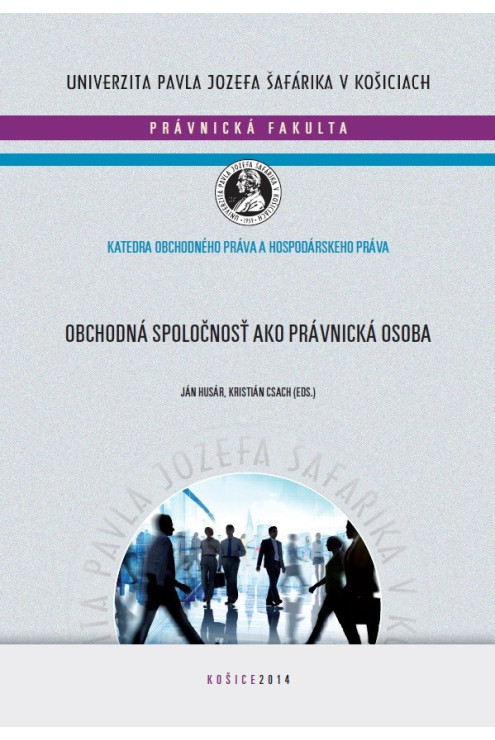
Obchodná spoločnosť ako právnická osoba

E-book

Ján Husár - Kristián Csach (eds.)

The collection contains contributions presented at the international conference held on April 1st - 3rd 2014 in Smolenice, organized by Pavol Jozef Šafárik University in Košice in cooperation with the Institute of State and Law of the Slovak Academy of Sciences and the Institute of State and Law of the Czech Academy of Sciences. Authors are high-profile Slovak and Czech scholars in the field of private law and company law, as well as representatives of new generation of young researchers. Contributions focus on contemporary issues in the field of company law, in particular theoretical basis of corporations, groups of companies, doctrine of abuse of rights, reflective loss and new tendencies in corporate law in foreign legal orders. The first part of the contributions presented at the conference have been already published in the special issue of the theoretical magazine Právny Obzor n. 4/2014. 

Download the e-book for free (pdf)

Quantity

978-80-8152-200-0

Data sheet

Method of publication:
E-book (pdf)
Editors:
Ján Husár - Kristián Csach
Document type:
Proceedings
Number of pages:
148
Available from:
15.12.2014
Year of publication:
2014
Edition:
1st edition
Publication language:
Slovak
Faculty:
Faculty of Law
Note:
Tento zborník je súčasťou riešenia projektu APVV-0809-12 „Modernizácia práva obchodných spoločností ako súčasť rekodifikácie súkromného práva“.
- Free for download

16 other products in the same category:

Nové výzvy ochrany zdravia zamestnancov

E-book

E-book

Katarína SkolodováMonika Minčičová (eds.)

Proceedings of the 5th Year of the Student Symposium of Labour Law

New trends in the digital age around the world do not avoid the labour market and the labour law relations. Do labour law standards and employers' practices correspond to the actual factors that influence an individual's physical or mental condition? Does digitization, including artificial intelligence, bring improvements or threats? Is the protection of employees' mental health paid equal attention that to the protection of physical health? The Department of Labour Law and Social Security Law of the Pavol Jozef Šafárik University in Košice examines and analyzes legal aspects of new risks that threaten and affect individual health in the work environment within the researching of the project APVV-16-0002 - Mental Health in the Workplace and Employee Health Assessment.

The members of the department, with the theme of the 5th year of the student symposium "New Challenges of Employees´ Health Protection" created an opportunity for students to search deeper current legal issues and reflect the results of their creative work in the submitted papers. The proceedings of papers of the student symposium is rich in content and offers the reader the space to get acquainted with interesting questions and application problems accompanying them.

Download the e-book for free  (pdf)

Zákon o národnostiach a Rada vlády Slovenskej...

E-book

E-book

Jana Šutajová

From January 1, 1969, the Constitutional Act on the Status of Nationalities in the Czechoslovak Socialist Republic (ČSSR) and the Constitutional Act on the Federation came into effect. The Constitutional Act on the Status of Nationalities represented at least a formal significant step forward in the legal regulation of minority rights. However, this law was intended to serve as a foundation for further legal adjustments. It was declared that additional steps and negotiations for the adoption of implementing regulations would follow and that further laws would be enacted at both the federal and national levels. Nevertheless, no additional law or government regulation related to the constitutional act on the status of nationalities in the ČSSR was ever issued.

During the normalization period, issues concerning further legislation related to national minorities were not addressed. However, in the brief period following the adoption of the constitutional act in 1968 until the end of 1969, some institutions attempted to prepare and promote such legal norms. One of these institutions was the Government Council of the Slovak Socialist Republic (SSR) for Nationalities (hereafter referred to as the Council or the Government Council for Nationalities). The monograph provides an insight into the development of additional legal norms arising from the constitutional act on the status of nationalities in the Slovak Socialist Republic, prepared by the Government Council of SSR for Nationalities. This council was one of the institutions established in Slovakia after the formation of the Czechoslovak federation and dealt with nationality issues.

In addressing further legal norms stemming from the constitutional act on nationalities in ČSSR, it was necessary to consider prior developments. Therefore, the first part of the monograph examines the status of minorities in Czechoslovakia before adopting the constitutional act, activities of nationalities preceding its adoption, and its enactment itself. Subsequent sections focus on institutional changes in SSR following federalization, the establishment of the Government Council of SSR for Nationalities, and specific actions taken by this Council and its expert bodies in drafting proposals for laws concerning nationalities in the Slovak Socialist Republic.

The motivation for writing this monograph stemmed from the fact that this topic has so far received attention only in a few studies in Slovakia, which primarily focused on the Hungarian minority during either the Prague Spring or normalization periods.

Download the e-book for free (pdf)

Ochrana (duševného) zdravia zamestnanca

E-book

E-book

Milena Barinková (ed.)

The complex of legal norms protecting work, ensuring safety and health protection at work, is very broad in scope, extending beyond the Labour Code to include other specific legal regulations, collective agreements, executive legal regulations, and internal corporate normative acts.

Health protection of employees from hazardous workplace influences is a central requirement stemming from fundamental human rights guaranteed by the Constitution of the Slovak Republic. To ensure its universal enforcement across all employers in both private and public sectors, strict regulation through cogent norms is fully justified. The European Commission’s Communication to the European Parliament, Council, European Economic and Social Committee, and Committee of the Regions on the EU Strategic Framework on Health and Safety at Work 2014–2020 (COM(2014) 332 final) addresses the need to account for labor market changes arising from demographic shifts, aging populations, and technological advancements.

Work pace demands are intensifying, and all age categories of employees must adapt to new technologies, organizational changes, and evolving job structures. This increases requirements for maintaining health fitness throughout entire professional careers. Mental health fitness, which receives insufficient specific attention, is an inherent part of health fitness requirements. Prevention plays a critical role in mental health protection.

Download the e-book for free (pdf)

Aktuálne otázky trestného práva z pohľadu...

E-book

E-book

Dominika Marčoková Becková (ed.)

Proceedings of Papers of XVIth year of the student symposium of the Institute of International Law and European Law

Proceedings of Papers of XVIth year of the student symposium of the Institute of International Law and European Law is devoted to selected aspects of the place and role of criminal law from the point of view of contemporary EU law and international law. In their contributions, students deal with current topics of criminal law in the law of the European Union and international law. In the EU law, the most actual issue is the European Public Prosecutor's Office, a body of the EU responsible for investigateing and prosecuting criminal offenses affecting the Union's financial interests.

The first part of papers dealt with the reasons for the establishment of the European Public Prosecutor's Office, its structure and tasks, the issue of conducting the investigation of the European Public Prosecutor's Office in the conditions of the Slovak Republic, as well as with the relations of the European Public Prosecutor's Office with its closest partner, the European Anti-Fraud Office.

The second part of the contributions reflects current issues and challenges of criminal law in international law. Authors in their papers focused on the issue of the International Criminal Tribunal for Ukraine, the legal problems and challenges associated with its creation, on the issue of the crime of aggression before the International Criminal Court, as well as on issues of immunity of state representatives before national courts.

Download the e-book for free  (pdf)

10 rokov v EÚ: Vzťahy, otázky, problémy

E-book

E-book

Ján Klučka(ed.)

Collection of Papers from the International Scientific Conference Held on May 29–30, 2014 at the Faculty of Law, Pavol Jozef Šafárik University in Košice.

In the first half of this year, a scientific conference entitled “10 Years in the EU: Relations, Questions, Issues” was held in Košice, and the contributions from this event constitute the content of the present collection bearing the same name.

The aim of the organizers—namely, the Slovak Association of European Law, the Representation of the European Commission in the Slovak Republic, and the Institute of European Law together with the Department of International Law of the Faculty of Law at Pavol Jozef Šafárik University—was not only (even if loosely) to follow up on the previous 2009 conference “Community Law in Slovakia – Five Years ‘After’”, but, after another five years, to continue its main objective: to provide participants from both the academic and non-academic community with a space for further analysis and exchange of views on legal issues related to the membership of the Slovak Republic in the European Union and various current issues of the Union’s legal order.

From this perspective, a shift in the overall focus of the conference contributions in 2009 and 2014 can be observed. While the contributions from the first conference focused primarily on various aspects of the application of Union law in the Slovak legal system and related application problems, especially before courts and other authorities, the basic orientation of the contributions from the second conference is already different. The present collection also confirms that the contributions focus primarily on current issues of the European legal order and on certain aspects of the Union’s external policy, while the relationship of Union law to the Slovak legal system is no longer given primary attention.

Several contributions focus on areas characterized by a certain overlap or “cohabitation” of Union law with public international law, private international law, or, more broadly, international relations.

Download the e-book for free (pdf)

Členovia orgánov obchodnej spoločnosti....

E-book

E-book

Jaroslav DolnýMonika Seilerová (eds.)

The collection of contributions from the VII. Student Symposium on Commercial Law and Labor Law held on December 5, 2019, at the Faculty of Law of Pavol Jozef Šafárik University in Košice

The theme of this year's symposium provided students with the opportunity to choose between addressing issues related to commercial law or focusing on labor law aspects concerning the position of members of the governing bodies of commercial companies, based on an analysis of legal regulations and case law.

The creative exploration of commercial law questions particularly related to areas such as the manner of acting on behalf of a commercial company, the liability of the de facto statutory body of a commercial company, information obligations of the statutory body towards its shareholders, and the remuneration for serving as a member of the board of directors of a joint-stock company. It also addressed the liability of the statutory body for the insolvency of the company and the enforcement of non-competition clauses concerning managing directors of limited liability companies.

The connection between commercial law and labor law was directed towards a legal analysis of personal data protection related to health and its misuse by members of the governing bodies of commercial companies, as well as the legitimacy of concurrently holding a position (as a member) in a statutory body with an employment relationship, and the legal status of senior employees, particularly concerning their duties and responsibilities for ensuring employee health through creating healthy working conditions.

Download the e-book for free (pdf)

KOŠICE CRIMINAL LAW DAYS 2022, VI. „The value...

E-book

E-book

Sergej RomžaVeronika TóthováBronislava Vinnerová (eds.)


The Collection of scientific contributions nationwide interdisciplinary scientific conference with international participation

The text book of scientific contributions The value direction of criminal law is the output of a nationwide interdisciplinary scientific conference with international participation organized by the Department of Criminal Law of the Faculty of Law of the UPJŠ in Košice. The proceedings contain contributions focused on issues of the value direction of criminal law, both in the field of substantive and procedural law.

This is a highly topical issue, as the values of law as such are reflected in each of its areas. In view of social events, the constant amendment of the criminal codes and, in particular, the forthcoming amendment of both the Criminal Code and the Code of Criminal Procedure, we consider the topic of the conference and the title of the text book to be highly topical, without significant limits in scientific research.

In their contributions, the participants of the national interdisciplinary scientific conference with international participation also devoted themselves to reflections de lege ferenda and offer insights into the above-mentioned amendments to the criminal codes into practice as well as their upcoming amendments.

The aim of the published proceedings is to continue to improve and develop new knowledge in the field of criminal law in the light of the new rules, while adhering to all established values, on the basis of the previous professional knowledge.

Download the e-book for free  (pdf)

Obchodné a pracovné právo: Na spoločnej vlne

E-book

E-book

Natália Kalinák-Andrej Oriňak

The Department of Commercial Law and Economic Law together with the Department of Labour Law and Social Security Law of the Faculty of Law of UPJŠ in Košice organized the 8th annual student symposium, this time on commercial, labour and private international law, which took place at the Faculty of Law of UPJŠ in Košice on 1 December 2023. The student symposium under the title Commercial and Labour Law on a Common Wave was carried out as part of the research projects VEGA 1/0259/22 and VEGA č. 1/0291/23. The aim of the annual symposia is to create a discussion platform for students under the supervision of mentors from among the members of the department, namely teachers, researchers and PhD students. The theme of this year's symposium brought about discussion of interesting theoretical and practical legal issues thematically focused on the synergy of business law and labour law. The students addressed topical issues related to the status of entrepreneurs, the conduct of companies in labour law relations as well as the duties and responsibilities of employees. The topics of the sharing economy, gender quotas in corporate bodies and unfair bribery were not forgotten. While working on individual topics, students had the opportunity to improve their analytical thinking and argumentation skills, while they could practice writing a legal professional text, which in practice often increases the success of every lawyer. Students had the opportunity to develop their critical thinking and learn how to clearly formulate their own opinions on current legal issues. After the presentation of the papers, not only the team of lecturers and researchers, but also the students themselves engaged in a fruitful discussion, asking a number of original questions. Each student participant was awarded a certificate for their active participation in the symposium. The present proceedings are the outcome of the students' work from this event.

Download e-book for free (pdf)

Medzinárodné a európske právo v kinematografii II.

E-book

E-book

Dominika Becková (ed.)

Proceedings of Contributions from the XIII. Year of the Student Symposium on International and European Law held on March 6, 2020, at the Faculty of Law of UPJŠ in Košice

The Student Symposium on International and European Law has its traditional place in the calendar of events at the Faculty of Law of Pavol Jozef Šafárik University in Košice. In the academic year 2019/2020, the Institute of International Law and European Law decided to continue this tradition and offer students an opportunity to present their professional opinions on selected topics and problematic issues of international and European law.

The XIII. edition of the student symposium continued from its previous year and once again focused students' attention on the institutions of international and European law depicted in films. The films processed by the participants of the symposium offer a wide range of institutions of international and European law.

In their contributions, participants addressed issues related to diplomatic law, terrorism, armed conflicts, the use of robots, environmental protection, and questions regarding the legal regime of outer space.

Download the e-book for free  (pdf)

LAW – COMMERCE – ECONOMY

E-book

E-book

Jozef SuchožaJán HusárRegina Hučková (eds.)

Collection of scientific works

The year 2020 has been marked globally by an unprecedented situation related to the spread of Covid-19 since its beginning. At the start of this calendar year, as our organizational team began preparing for another edition, we still hoped that our traditional autumn conference was far away, and in this maximum optimism, we launched the organization of the jubilee 10th edition of our now-traditional conference. This conference has become a stable part of scientific and professional conference events under domestic conditions and has become a stable part of many people's work programs. However, 2020 was almost entirely filled with restrictions from its start, with these restrictions affecting even the organization of conferences. Our 10th Law – Business – Economy Conference fell victim to this current situation and had to be canceled "with gritted teeth." The situation allows us nothing but hope that in 2021 we will be able to meet at our traditional location in High Tatras. We take these meetings for granted; if this situation is good for nothing else, it at least serves as a slowdown and an awareness of our own vulnerability.

See you at the next edition of Law-Business-Economics in October 2021.

You are receiving a collection of scientific papers published in connection with the resolution of scientific projects at the Department of Commercial Law and Economic Law as the main organizer of the scientific conference, as well as other departments of the Faculty of Law at UPJŠ in Košice, and many academic workplaces both domestically and abroad. The collection is published with support from the Agency for Support of Research and Development. The editors thank all who contributed to it with their scientific articles, as well as reviewers for their valuable comments and recommendations.

On behalf of the editors: Regina Hučková

Download the e-book for free  (pdf)

Regionalizmus: Stav, východiská, perspektívy

E-book

E-book

Adam Giertl (ed.)

Proceedings of Scientific Works

International law does not represent a monolithic entity of uniform legal norms. It is a legal system that is fundamentally created by the consensus of states. It reflects the collective will of multiple entities regarding what should be binding and enforceable as law among them.

From this understanding arises the fact that the needs for legal regulation will differ in various parts of the world. The consequence of this situation is the formation of regional groupings where, to some extent, specific legal rules apply. As Professor Klučka points out in his study published in this proceedings, regionalization can occur both on a contractual basis and on an institutional basis. Regionalism in law thus raises many interesting questions that legal science addresses.

This proceedings of scientific papers also aims to contribute to the knowledge in this field.

Download the e-book for free (pdf)

Miesto a význam regionálnych súdnych orgánov v...

E-book

E-book

Ján Klučka et al.

The aim of the current monograph is to provide comprehensive view of the status of regional judicial organs in current conditions of regionalism. Based on selected issues examined in individual chapters research team presents the comprehensive study focused on clarification of the status and significance of regional judicial organs in terms of new regionalism.

Research of the role of regional courts in the system of peaceful settlement of disputes demonstrates the significant role of the regional courts within the promotion of the rule of law, regional integration and also significant role of regional courts to ensure legal certainty within the system of compliance with decisions of regional courts. The result of examination of possibilities of individuals to access to regional judicial organs is comparative evaluation of regional possibilities of individual to defend his/her rights within regional courts of various regions. Particular part of this area is the right to an effective remedy and to a fair trial as basic rights within the proceedings of regional judicial organs. Within the examination of preliminary rulings of international regional courts of different regions the role of regional judicial organs in the process of effective implementation of the principle of the rule of law was the subject of examination.

For the proper functioning of the regional judicial organs as well as independence of judges and legal certainty in International law, the ethical rules of international judicial organs and tribunals, which are the subject of the last chapter, are significant.

Download the e-book for free  (pdf)

Svetové dejiny štátu a práva

E-book

E-book

Erik Štenpien

This university textbook named "The World History of State and Law" serve as teaching aid to Students of 1. year-class of Faculty of Law. He addicted to history of state and law of oriental despoties and chosen states of ancient Greece. Exactly interpreted the law history of medieval and feudal states and cities and institutes of medieval law with the accent to civil law. Next he interpreted the history of constitutions of the european states (Netherland, Poland, Great Britain, France, Germany, Italy) and USA, also the modern law of 19. Century. A special chapter deals with the Paris Peace Conference in 1919 and the system of treaties adopted during it.

At the end he interpreted the legal history of chosen states of Europe and USA - state system with the accent to type of the regime (democracy, dictature).

Download the e-book for free  (pdf)

Právo informačných a komunikačných technológií

€19.50
Availability: 5 In Stock

Regina Hučková - Diana Treščáková - Laura Rózenfeldová

Vysokoškolská učebnica Právo informačných a komunikačných technológií je určená študentom vysokých škôl vo všeobecnosti, najmä však študentom Právnickej fakulty, ktorí majú záujem o štúdium práva v spojení s informačnými a komunikačnými technológiami. Učebnica predstavuje zdroj informácií potrebných nielen pre štúdium tejto problematiky, ale aj pre rozšírenie celkového obzoru v danej problematike.

1. svetová vojna a jej dôsledky v štátoprávnej...

E-book

E-book

Erik Štenpien  - Lucia PištejováIvan Svatuška

The presented publication is the proceedings of the international conference held on 29.-30. September 2022 in Košice as an output of the grant project APVV-19-0419.

The ambition of the project is to try to reconcile legal and general historians from Slovakia and Hungary in the difficult topic of looking at the Treaty of Trianon from 1920. The conference, held on 29.-30. September 2022 was the third in a series of conferences that for the purpose of assisting in the achievement of said goal. It was attended by legal historians and positive lawyers from several Central European countries. So let the collection serve as another step towards understanding between nations.

Download e-book for free (pdf)

This website uses cookies to ensure you get the best experience on our website