- New

Zavolajte nám:
+421 55 234 1635E-book
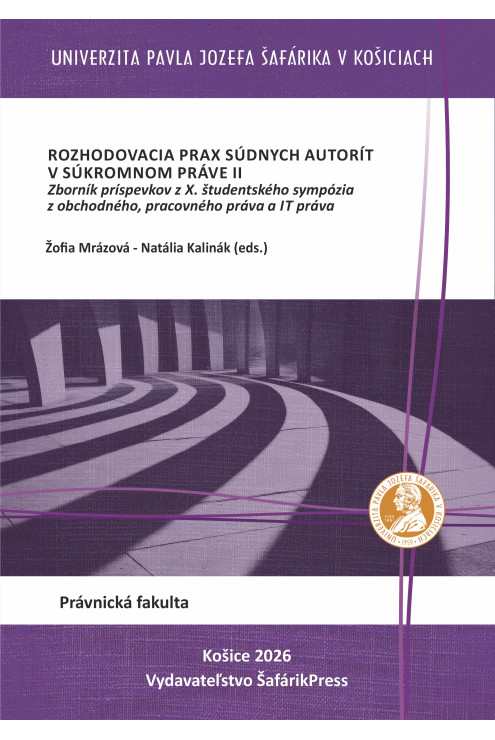
On November 28, 2025, the Department of Commercial Law and Economic Law, in cooperation with the Department of Labor Law and Social Security Law of the Faculty of Law at UPJŠ in Košice, organized the 10th anniversary student symposium focused on commercial law, labor law, and IT law. The symposium, entitled "Decision-making practice of judicial authorities in private law II," built on the success of the previous year and once again provided students with an opportunity to showcase their analytical skills and legal creativity. The symposium was prepared as part of the APVV-23-0331 scientific project "Integration of the Capital Markets Union: Changes in Corporate Financing and the Rescue of Commercial Companies in Financial Difficulties."
This year, participants again had the opportunity to focus in detail on specific decisions of the Supreme Court of the Slovak Republic, the Supreme Administrative Court of the Slovak Republic, and the Constitutional Court of the Slovak Republic and to prepare a gloss – an expert explanation or commentary on a selected decision. In their contributions, the students briefly outlined the facts of the case, identified the legal issues that the judicial authorities sought to address, discussed the legal solution to the problem, and concluded by assessing the significance of the decision for practical application.
The subject of the examination was current issues of commercial law, such as the liability of an executive for the obligations of a commercial company, determining the usual remuneration of a member of a statutory body, invitation to a substitute members' meeting of a cooperative, or the inclusion of a contractual penalty in general terms and conditions. In the labor law section, judicial practice was analyzed in matters such as the employer's obligation to offer employment and the definition of the term "work-related accident." Decisions in the areas of bankruptcy law and procedural law were also discussed, giving students insight into the complexity of judicial practice.
Preparing their contributions enabled students to improve their analytical thinking, practice writing legal texts, and develop their ability to argue and clearly formulate their own opinions on the decisions of judicial authorities. The discussion following the presentations was lively and inspiring, with teachers, researchers, and students themselves participating, asking numerous additional questions and providing ideas for further research. Each participant received a certificate for their active participation in the symposium, symbolizing their effort, creativity, and determination.
This collection contains the written outputs of the students from this year's event. We are pleased to note that, once again, the students approached the task with great commitment, responsibility, and creativity. In conclusion, we would like to express our sincere thanks to all those who contributed to the success of the symposium and supported future lawyers on their path to professional growth.
Data sheet
Jozef Olej a kol.
Preložená vysokoškolská učebnica je venovaná problematike trestného práva procesného, ktorú autori v rovnakom zložení spracovali v roku 2006, bezprostredne po účinnosti nového rekodifikovaného Tr. por. – zák. č. 301/2005 Z.z. Obdobie, ktoré uplynulo od účinnosti tejto právnej normy nepochybne prispelo k potvrdeniu či ustáleniu názorov na niektoré nové inštitúty a súčasne si vyžiadalo potrebu reagovať na početné novelizácie tohto zákona.
Štruktúra predloženej publikácie, členenie do jednotlivých kapitol, v podstate korešponduje s úpravou jednotlivých inštitútov obsiahnutých v Tr. poriadku, a to od úpravy základných pojmov, prameňov, zásad trestného konania, cez postavenie jednotlivých subjektov trestného konania, procesné úkony, inštitúty zaisťovacej povahy a dôkaznej povahy, jednotlivé štádia trestného konania až po úpravu právneho styku s cudzinou, resp. trov trestného konania. Ako už bolo uvedené, autori reagujú na pomerne časté a v mnohých prípadoch aj výrazné zmeny úpravy rekodofikovaného Tr. poriadku, vrátane súvisiacich právnych predpisov, prezentujú svoje názory i názory mnohých iných odborníkov na spracovanú problematiku a tieto konfrontujú s poznatkami z praxe, vrátane uvádzania aktuálnej iudikatúry.
Ambíciou autorov tak bolo a naďalej zostáva, ponúknuť predovšetkým študentom právnických fakúlt základnú učebnú pomôcku pre štúdium trestného práva procesného.
Autori
E-book
Milena Barinková (ed.)
The researchers of the grant task ‘Creation and implementation of labour law with regard to regional aspects of the labour market’ deal in their work with the analysis of employers' attempts for legislative changes in the level of social rights of employees justified by regional differences, the analysis of possible impacts in their implementation, as well as the assessment of their compliance with the protective function of Slovak labour law and the value character of fundamental human rights inherent in the European and legal culture.
E-book
Jana Žuľová - Milena Barinková
Legal norms regulate everyday life. We learn about the rights and obligations that arise for us from these norms through language. It is therefore very important that they are created in such a way that all levels of society understand them, not only recipients with legal education.
The Labour Code is a norm of everyday use, and so far there is no publication that approximates or clarifies the understanding of the provisions of this law through the prism of its language. The main goal of the publication is to apply the acquired linguistic knowledge about the pitfalls of the comprehensibility of legal language for the general public to the Labour Code and thus enable its more adequate understanding. Our ambition is not a comprehensive interpretation of the provisions of the Labour Code, which give the impression of incomprehensibility for the average addressee.
We focused on selected problematic phenomena observed and identified during the solution of the VEGA grant project no. 1/0526/17 Linguistic and Sanctioning Mechanisms in the Creation and Operation of Labor Law Norms and strived for a conceptual approach to their examination enriched by empirical research.
E-book
Jana Žuľová (ed.)
Collection of Scientific Works
Article 35 of the Constitution of the Slovak Republic guarantees everyone the right to freely choose their profession and receive training for it, as well as the right to engage in entrepreneurial or other gainful activity. Everyone has the right to freely decide whether to secure their livelihood through self-employment—with all the associated consequences and risks—or through employment within labor-law relationships by performing dependent work.
The framework and rules for exercising these rights are primarily regulated by labor, commercial, and tax legislation, each with its own set of rights and obligations applicable specifically to entrepreneurs and employees. Constant competitive pressure, along with the effects of economic crises, pushes employers to seek ways to extract the most from workers while optimizing for the lowest possible insurance, administrative, and tax costs. As a result, employment contracts are being terminated, and under the pressure of losing their income, individuals are "voluntarily" shifting to commercial-law relationships.
This situation, along with other distortions in the labor market, confronts those entitled to work with unfair practices by employers, thereby undermining their ability to freely exercise this fundamental right.
E-book
Erik Štenpien - Ivan Svatuška (eds.)
The Collection of scientific Contributions of the International scientific conference: 100 Years of Treaty of Trianon – Diplomacy, State and Law on the Turn of the Century.
The presented publication is the first of a series of proceedings published within the solution of the grant APVV-19-0419. The conference took place from 14 to 15 October 2021 with the participation of experts from Slovakia, Hungary and Poland. The ambition of the research team, composed of legal historians and positive lawyers from three countries, is to provide a comprehensive, unbiased view of the peace negotiations that resulted in the Treaty of Trianon with Hungary. The conference, the result of which is the presented collection, was devoted to the causes of possible disputes in Europe - focusing on diplomacy and constitutional development of Central European countries at the turn of the 19th and 20th centuries, ie in the period immediately preceding the outbreak of World War I.
Regina Hučková - Diana Treščáková - Laura Rózenfeldová
Vysokoškolská učebnica Právo informačných a komunikačných technológií je určená študentom vysokých škôl vo všeobecnosti, najmä však študentom Právnickej fakulty, ktorí majú záujem o štúdium práva v spojení s informačnými a komunikačnými technológiami. Učebnica predstavuje zdroj informácií potrebných nielen pre štúdium tejto problematiky, ale aj pre rozšírenie celkového obzoru v danej problematike.
E-book
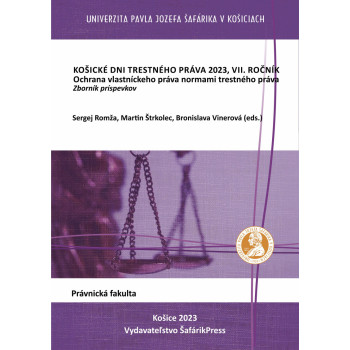
Sergej Romža - Martin Štrkolec - Bronislava Vinerová
Proceedings of Scientific Papers from the Nationwide Interdisciplinary Scientific Conference with International Participation held on June 21–22, 2023, organized by the Department of Criminal Law, Faculty of Law, Pavol Jozef Šafárik University in Košice.
Download e-book for free (pdf)
E-book
Ľudmila Elbert - Ľubica Gregová Širicová (eds.)
In addition to acquiring theoretical knowledge, it is necessary to study and analyze the decisions of international judicial and arbitration bodies in order to fully understand the subject of the Public International Law or disciplines closely related to it.
Since the Slovak literature in the field of Public International Law does not contain any electronic textbook of selected decisions of international judicial and arbitration bodies, the authors of the submitted publication aim to eliminate this gap by elaborating the “Public International Law Casebook”, which will primarily be intended for undergraduate students of the law faculties in the Slovak republic and the Czech republic.
The proposed publication seeks to make the study of international law more attractive through a publication that will make students familiar with the decisions translated into the Slovak language in a popular electronic form.
E-book
Laura Gazdagová (ed.)
The topic that the students focused on in The proceedings of the XVIIIth edition of the Student Symposium on International and European Law held on November 15, 2024 was centered around the legacy of the 105th anniversary of the Paris Peace Conference. The proceedings, which contain the students' contributions, reflect the pivotal role of this conference in shaping post-war geopolitical stability and redefining relations between states. The expert analyses included in the proceedings focus on the conditions that were intended to ensure lasting peace, yet also created controversial aspects that led to disputes and laid the foundation for future tensions. The students also addressed the impact of the conference's decisions on political and social structures that significantly influenced global development in the 20th century. In addition to the declared outcomes, the students also expressed, in written form within the proceedings, the need to strengthen international cooperation and establish institutions for the prevention of military conflicts, a need that remains relevant today, as these decisions continue to shape the dynamics of contemporary international relations.
E-book
Ladislav Hrabčák et al.
The comprehensive work represents the final output from solving Project VVGS-2019-1068 titled 'Blockchain technology as a factor influencing the current form of law' and was created simultaneously as one of the partial outputs from Project APVV-19-0124 titled 'Tax Law and New Phenomena in Economy (Digital Services, Shared Economy, Virtual Currencies)'. The partial overlap in research topics between these projects allowed for such research, especially regarding digital (virtual) currencies.
Download e-book for free (pdf)
E-book
Ľuboš Dobrovič - Vladimír Vrana
The world of diplomacy, whether ancient or modern, is naturally prone to problems associated with cultural clashes and often serves as an “unarmed battlefield” of cultural concepts. International diplomacy, however, stands on the assumption of war, as misunderstandings and cultural discrepancies lead to confusion. Cultural encounters also provide many opportunities for the choice of misunderstanding: the choice to perceive an act as an insult, even if unintended, or the choice to ignore the most blatant intentional insult, all according to momentary expediency.
The Roman historian Livy recounts an anecdote about the gates of the Temple of Janus, which, when open, signified that Rome was at war. However, the doors of the ancient Temple of Janus were closed only twice from the beginning of the 7th century BC to the end of the 1st century BC. One might ask, how many times and for how long after the signing of the Treaty of Trianon were the metaphorical gates of the European (or global) Temple of Janus closed?
The publication that the reader holds in their hands does not attempt to exhaustively answer all questions of ancient and modern international diplomacy. That is neither possible nor the goal of this scientific monograph. Authors seeking intersections between diplomacy of antiquity, the Middle Ages, and the early 20th century encountered some thought-provoking ideas and controversial debates. Indeed, what other conclusions can the topic of the Treaty of Trianon and the perpetual clash of cultures in the Mediterranean antiquity and medieval Europe bring?
We believe that the topic of ancient and modern diplomacy will inspire the reader and stimulate the professional public to new ideas, reflections, and scholarly activity.
The scientific monograph was prepared as an output of the project of the Agency for the Support of Research and Development No. APVV-19-0419: "100 years of the Treaty of Trianon."
E-publication
Diana Treščáková - Regina Hučková (eds.)
Publication Law Business Economy XIV. is collection of international scientific works which contains scientific contributions of wide variety of branches of law, as well as related fields of scientific expertise. Among areas of issues which were discussed in this publication are questions of civil, commercial, competition, intellectual property, arbitration and corporate law, as well as other partial areas, including scientific works dealing with business and IT law. Entire publication is significant with richness of scientific contributions from various jurisdictions, because of renowed authors from various countries. Apart from theoretical contribution and expansion of current state of the art in submitted interdisciplinary area, solutions to legal problems were formulated at de lege ferenda level.
Download the e-book for free
E-book
Sergej Romža - Veronika Tóthová - Bronislava Vinnerová (eds.)
The Collection of scientific contributions nationwide interdisciplinary scientific conference with international participation
The text book of scientific contributions The value direction of criminal law is the output of a nationwide interdisciplinary scientific conference with international participation organized by the Department of Criminal Law of the Faculty of Law of the UPJŠ in Košice. The proceedings contain contributions focused on issues of the value direction of criminal law, both in the field of substantive and procedural law.
This is a highly topical issue, as the values of law as such are reflected in each of its areas. In view of social events, the constant amendment of the criminal codes and, in particular, the forthcoming amendment of both the Criminal Code and the Code of Criminal Procedure, we consider the topic of the conference and the title of the text book to be highly topical, without significant limits in scientific research.
In their contributions, the participants of the national interdisciplinary scientific conference with international participation also devoted themselves to reflections de lege ferenda and offer insights into the above-mentioned amendments to the criminal codes into practice as well as their upcoming amendments.
The aim of the published proceedings is to continue to improve and develop new knowledge in the field of criminal law in the light of the new rules, while adhering to all established values, on the basis of the previous professional knowledge.
E-book
Martina Jánošíková - Dominika Marčoková Becková (eds.)
The peer-reviewed Proceeding of Scientific Papers is dedicated to the issue of the European Public Prosecutor's Office and is the result of a scientific project APVV-18-0421 European Public Prosecutor's Office in Connections of the Constitutional Order of the Slovak Republic as Strengthening of the European Integration through Law.
In their works, the authors of scientific papers, dealt with the issue of the European Public Prosecutor's Office in the context of European Union law and criminal law, as well as the relation of the European Public Prosecutor's Office with the national prosecutor's office and law enforcement authorities. The scientific works published in the proceeding dealt with the topics of the reasons for the establishment of the European Public Prosecutor's Office, the position of the European Public Prosecutor's Office in the institutional system of the EU and the Slovak Republic, relations of cooperation and coordination between the European Public Prosecutor's Office and the Public Prosecutor's Office of the Slovak Republic, the protection of the constitutionality and legality of the procedures and decisions of the European Public Prosecutor's Office, with special attention to the protection of fundamental rights, as well as the first result and evaluation of the operation of the European Public Prosecutor's Office in the Slovak Republic.
Thanks to the content of scientific papers, the reader can get a more comprehensive idea of this new body of the European Union, which operates in an area traditionally associated with state sovereignty and represents another step forward in the integration processes represented by the European Union.
E-book
Miroslav Štrkolec Anna Vartašová Tímea Jančiová
This proceedings of scientific papers presents papers from the international scientific conference of the same name, which took place from 24 to 26 September 2025 at the UPJŠ in Košice and was supported by the projects APVV-23-0158 "Reform of the Customs Union in the Era of Electronic Commerce in the Slovak Republic" and VEGA 1/0698/25 "Development Fee as a Tool for the Development of Municipalities and Cities in the Slovak Republic". Individual papers are aimed at addressing current issues of tax law, budgetary law and financial market law in the context of the challenges of the ongoing multi-crisis (starting with the COVID-19 pandemic, the war in Ukraine, the extreme increase in energy and other supplies costs or inflation, and the subsequent need for consolidation of public finances). The papers are divided into two parts, where in the first part, indivídua! authors focus on national reports - a comprehensive assessment of the impacts of the aforementioned multi-crisis in individual V4 countries - in the areas of taxes, budgets and financial markets, and in the second part, individua! Authors focus on more specific issues in the aforementioned three thematic areas.
E-book
Milan Sudzina, Renata Świrgoń-Skok, Wojciech J. Kosior
Given the importance of the ownership right, the aim of this monograph is to provide an analysis, a clear systematic interpretation and an evaluation of the above issue, not only from the theoretical point of view, but also from the point of view of legal practice. The protection of ownership relations is ensured in various ways. It is judicial protection, protection provided by local self-government authorities, self-help, public registration of real property and other instruments of administrative and criminal law. In connection with the transformation of legislation in Slovakia and Poland after the fall of the socialist regime, there have been many changes in the legislation of both countries concerning the protection of ownership rights. A number of private law institutions related to the ownership of real property, the use of which was impossible or limited during the socialist period, have been restored. Legislation has also been adopted to alleviate the consequences of certain property and other injustices caused by the deprivation of ownership of real property during the socialist period. The adoption of restitution legislation was the basis for restoring the ownership rights of the original owners, who were allowed to get back their real property that had been used by socialist organisations. After the end of the socialist regime, the various forms of ownership, which until then had favoured the state ownership, were abolished. Changes were made to ensure that the ownership rights of all owners had the same content and enjoyed the same legal protection. The monograph is structured in such a way as to enable a comparison of individual institutions of rights in rem under Polish and Slovak law. The monograph also analyses the relevant decision-making practice of the supreme judicial authorities. The scientific methods applied enabled the authors not only to analyse and evaluate the historical context and the current legal regulation of ownership rights in Poland and Slovakia, but also to point out possible gaps and shortcomings and to elaborate de lege ferenda proposals that can be used in future legislative activity.
Download e-book for free (pdf)
This website uses cookies to ensure you get the best experience on our website