- New

Zavolajte nám:
+421 55 234 1635E-book
Miroslav Štrkolec Anna Vartašová Tímea Jančiová
This proceedings of scientific papers presents papers from the international scientific conference of the same name, which took place from 24 to 26 September 2025 at the UPJŠ in Košice and was supported by the projects APVV-23-0158 "Reform of the Customs Union in the Era of Electronic Commerce in the Slovak Republic" and VEGA 1/0698/25 "Development Fee as a Tool for the Development of Municipalities and Cities in the Slovak Republic". Individual papers are aimed at addressing current issues of tax law, budgetary law and financial market law in the context of the challenges of the ongoing multi-crisis (starting with the COVID-19 pandemic, the war in Ukraine, the extreme increase in energy and other supplies costs or inflation, and the subsequent need for consolidation of public finances). The papers are divided into two parts, where in the first part, indivídua! authors focus on national reports - a comprehensive assessment of the impacts of the aforementioned multi-crisis in individual V4 countries - in the areas of taxes, budgets and financial markets, and in the second part, individua! Authors focus on more specific issues in the aforementioned three thematic areas.
Data sheet
E-book
Adam Giertl - Ľubica Gregová Širicová (eds.)
Proceedings from the 5th Student Symposium held on April 21-22, 2013
The French delegate to the Commission on Human Rights, while discussing the inclusion of the term "media" in the article on freedom of expression in the draft of the International Covenant on Civil and Political Rights, wisely urged other members of the commission to be forward-looking regarding the information media of the future.
The discussion took place in 1950, when delegates could not yet foresee the impact of the internet on social relations. Given that it is now clear that information technologies significantly influence law, including international law, the organizers of the student symposium decided to dedicate its sixth edition to the theme "Information Society and International Law."
Students of the Faculty of Law, after registering for the symposium, first focused on preparing their contributions, with each participant having access to a consultant if needed. This year, the list of consultants, in addition to members of the Institute of European Law and the Department of International Law, was expanded to include an expert in intellectual property law, Mgr. Martin Husovec, a graduate of our Faculty of Law and currently an IMPRS-CI doctoral student at the Max Planck Institute for Intellectual Property and Competition Law. We also take this opportunity to thank him for dedicating his time to the students and providing them with valuable advice in preparing their contributions. After the preparatory phase, the symposium itself took place, with the aim of presenting the prepared contributions and discussing them.
The presented contributions reflected a wide range of intersections between international law and the information society.
E-book
Ivan Svatuška - Lucia Pištejová (eds.)
Collection of Scientific Contributions from the International Scientific Conference of PhD Students and Young Researchers held on April 22, 2022, organized by the Department of State and Law History of the Faculty of Law, Pavol Jozef Šafárik University in Košice.
We recommend this collection to the attention not only of PhD students and young researchers but also to all experts working in the fields of general history and legal science. At the same time, we bring it to the attention of all lay enthusiasts interested in the issues of legal development after the First World War. After all, as one of the world-renowned foreign legal historians likes to say: "Law is the most beautiful science in the world, because everyone can find an area that interests them in it."
E-book
Žofia Mrázová - Natália Kalinák (eds.)
The Department of Commercial Law and Economic Law in cooperation with the Department of Labour Law and Social Security Law and the Department of International Law and European Law of the Faculty of Law of the University of Applied Sciences in Košice organized the IXth annual student symposium, this time on commercial, labour and private international law. The student symposium under the title Decision-making practice of judicial authorities in private law took place on 29 November 2024 at the premises of the Faculty of Law of UPJŠ in Košice. The symposium was prepared within the framework of the scientific projects APVV-23-0331 “Integration of the Capital Markets Union: change of corporate financing and rescue of companies in financial difficulties” and APVV-21-0336 “Analysis of judicial decisions by artificial intelligence methods.”
This year was exceptional in that the organizers of the event decided to change the usual concept of preparing and presenting a professional article on a chosen topic. This time the students chose interesting decisions of the Supreme Court, the Constitutional Court or the Court of Justice of the European Union. They concentrated on working with one particular decision, which they analysed in detail and drafted a gloss - an expert explanation or commentary on the chosen decision. Their task consisted of a brief presentation of the facts, identification of the legal questions that the judicial authorities sought to answer, a legal analysis of the problem addressed, and an assessment of the significance of the decision for the practice of application. In their analyses, the students dealt with topical issues such as the joint action of a proxy and a member of the body, the consequences of a breach of the pre-emptive right, or the repugnancy of an agreement on the division of the community of property of the spouses. In employment law, decisions were presented concerning the right of the father of a child to a breastfeeding break or the wearing of symbols at work. In the section on private international law, the case law on cross-border relocation of the seat as well as on the choice of international jurisdiction of the courts was analysed.
The present proceedings consist of written outputs of students from this event. We are delighted that the students again this year approached their task with enthusiasm and conscientiousness. Finally, our sincere thanks go to all those who contributed to the success of the symposium.
E-book
Ladislav Orosz, Martina Makaturová
This scientific volume has been published as an output of the VEGA grant project No. 1/0474/24 Audit of Slovak Electoral and Referendum Legislation. Thematically, it focuses on the issue of the legal regulation of election campaigns and a critical analysis of the experience of its application in electoral practice. On this basis, the authors also formulate proposals for improving the current legal framework of election campaigns.
The proceedings include contributions presented at the scientific conference of the same name held in May 2025. The volume contains papers not only from domestic but also from foreign authors, who present the legal regulation of election campaigns in their respective home countries. Contributions from academics are complemented and enriched by those of representatives of non-governmental organizations engaged in election and campaign monitoring, as well as by contributions from authors working in public authorities responsible for the administration of elections and for overseeing the constitutionality and legality of elections.
E-book
Collection of Papers from the 8th Student Symposium held on April 20–21, 2015 in Danišovce
The capture of the historic Syrian city of Palmyra by fighters of the radical Islamic State caused shock among the global public. The main reason is the barbarism with which this organization proceeds, not only in relation to the treasures of the world’s cultural heritage. The situation in the Middle East, where cultural treasures of inestimable value are under direct threat, demonstrates how fragile the world’s cultural heritage is. The reaction of the international public and world leaders shows how sensitively the destruction of cultural heritage is perceived.
The quoted statement chosen by the editors relates to the threat posed by the Islamic State—however, the spirit of this statement can be applied to any cultural wealth that forms part of the world’s cultural heritage. The destruction or damage of these values primarily represents a loss for humanity as such. Each destroyed artifact of world cultural heritage signifies the disappearance of a unique legacy left by previous generations for the future. At the same time, cultural heritage must be understood as a broad spectrum of assets—both tangible and intangible. Their legal protection was the topic of this year’s symposium. As with any social interest, the protection of cultural heritage can be ensured through various mechanisms and under different forms of social organization.
These diverse approaches are unified by law as a normative system. The question for the 8th year of the symposium on international law was what role international law plays in the protection of cultural heritage. In the context of the European region, the role of the European Union as a regional organization was examined.
E-book
Adam Giertl (ed.)
Proceedings of the Student Symposium on International Law and European Law held on April 28, 2017, at the Faculty of Law of Pavol Jozef Šafárik University in Košice
The Student Symposium is regularly organized by the Institute of International Law and European Law, and in 2017, it marked the jubilee tenth edition of the symposium, which over time expanded its focus to include European law.
The tradition of holding student symposia is also associated with the good practice of preparing proceedings from each event. Understandably, the tenth edition is no exception, and thus, the tenth edition of the symposium proceedings is now available to readers. In previous years, the symposium has always focused on specific areas of international and European law. Thus, the subjects of study for symposium participants have included migration issues (2016), the protection of cultural values (2015), and the challenges of cyberspace (2013).
This year, given that it is the jubilee tenth edition, the symposium organizers have chosen to approach the symposium's focus thematically and recall some significant milestones in the development of international law that occurred in years ending with the number seven.
E-publication
Diana Treščáková - Regina Hučková (eds.)
Publication Law Business Economy XIV. is collection of international scientific works which contains scientific contributions of wide variety of branches of law, as well as related fields of scientific expertise. Among areas of issues which were discussed in this publication are questions of civil, commercial, competition, intellectual property, arbitration and corporate law, as well as other partial areas, including scientific works dealing with business and IT law. Entire publication is significant with richness of scientific contributions from various jurisdictions, because of renowed authors from various countries. Apart from theoretical contribution and expansion of current state of the art in submitted interdisciplinary area, solutions to legal problems were formulated at de lege ferenda level.
Download the e-book for free
E-book
Ľuboš Dobrovič - Vladimír Vrana
The world of diplomacy, whether ancient or modern, is naturally prone to problems associated with cultural clashes and often serves as an “unarmed battlefield” of cultural concepts. International diplomacy, however, stands on the assumption of war, as misunderstandings and cultural discrepancies lead to confusion. Cultural encounters also provide many opportunities for the choice of misunderstanding: the choice to perceive an act as an insult, even if unintended, or the choice to ignore the most blatant intentional insult, all according to momentary expediency.
The Roman historian Livy recounts an anecdote about the gates of the Temple of Janus, which, when open, signified that Rome was at war. However, the doors of the ancient Temple of Janus were closed only twice from the beginning of the 7th century BC to the end of the 1st century BC. One might ask, how many times and for how long after the signing of the Treaty of Trianon were the metaphorical gates of the European (or global) Temple of Janus closed?
The publication that the reader holds in their hands does not attempt to exhaustively answer all questions of ancient and modern international diplomacy. That is neither possible nor the goal of this scientific monograph. Authors seeking intersections between diplomacy of antiquity, the Middle Ages, and the early 20th century encountered some thought-provoking ideas and controversial debates. Indeed, what other conclusions can the topic of the Treaty of Trianon and the perpetual clash of cultures in the Mediterranean antiquity and medieval Europe bring?
We believe that the topic of ancient and modern diplomacy will inspire the reader and stimulate the professional public to new ideas, reflections, and scholarly activity.
The scientific monograph was prepared as an output of the project of the Agency for the Support of Research and Development No. APVV-19-0419: "100 years of the Treaty of Trianon."
E-book
The monograph deals with two fundamental aspects concerning evaluation of evidence in the law. In the first part, the monograph addresses the question: „How it is possible to apply law in individual case, if human knowledge about past is objectively limited and flawed?“ (e.g. what is the nature of truth in the law?). The second part of the monograph identifies certain models of reasoning concerning factual questions which occur across different individual legal cases (especially tax cases and criminal cases). In that regard, the monograph draws from Anglo-American legal scholarship and deals with three main concepts concerning evaluation of evidence: argumentation, probability and narratives and their role in evaluation of evidence.
The monograph is the output of the grant project APVV no. 16-0160 which deals with the issue of tax evasion and tax avoidance (especially their motivating factors, emergence, and elimination). The author believes that better understanding of evaluation of evidence may contribute to the improvement in effectiveness of tax administration.
E-book
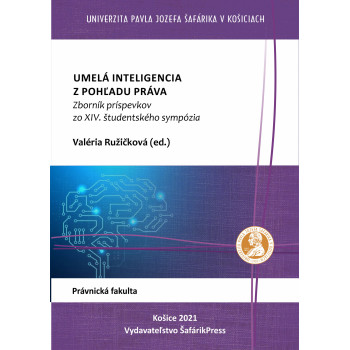
Valéria Ružičková (ed.)
Proceedings of the XIVth Student Symposium on International Law and European Law.
For the XIV Year of Student Symposium on International Law and European Law under the topic „Artificial Intelligence from the Perspective of Law“, students of the Faculty of Law and the Faculty of Science prepared several papers regarding current questions related to the ongoing development of the artificial intelligence. From the legal point of view, the papers regard the importance of the artificial intelligence in human activities in space, its impact on fundamental rights, development of new human rights in relation to its application in healthcare and nursing care as well as personal data protection while making use of the artificial intelligence.
Apart from the papers concerning the artificial intelligence from the legal perspective, two of the papers regard the artificial intelligence from the scientific perspective, explaining the importance of the artificial intelligence in localization in indoor environment as well as its importance in prediction of healthcare costs.
E-publication
Laura Gazdagová-Bartolomej Mižák-Vladyslava Kryvoshei
Technological development is increasingly reshaping the environment in which international law operates. Rapid digitalization, global interconnectedness, and the emergence of new technologies raise questions that traditional legal norms are not always prepared to address. New forms of cross-border interactions, security challenges, and ethical dilemmas influence the functioning of states, international organizations, and other actors. Against this backdrop, discussions are evolving on how international law can maintain its relevance in an era of rapid innovation and how it may adapt to a dynamic technological landscape.
Download the e-book for free
E-book
Milan Sudzina, Renata Świrgoń-Skok, Wojciech J. Kosior
Given the importance of the ownership right, the aim of this monograph is to provide an analysis, a clear systematic interpretation and an evaluation of the above issue, not only from the theoretical point of view, but also from the point of view of legal practice. The protection of ownership relations is ensured in various ways. It is judicial protection, protection provided by local self-government authorities, self-help, public registration of real property and other instruments of administrative and criminal law. In connection with the transformation of legislation in Slovakia and Poland after the fall of the socialist regime, there have been many changes in the legislation of both countries concerning the protection of ownership rights. A number of private law institutions related to the ownership of real property, the use of which was impossible or limited during the socialist period, have been restored. Legislation has also been adopted to alleviate the consequences of certain property and other injustices caused by the deprivation of ownership of real property during the socialist period. The adoption of restitution legislation was the basis for restoring the ownership rights of the original owners, who were allowed to get back their real property that had been used by socialist organisations. After the end of the socialist regime, the various forms of ownership, which until then had favoured the state ownership, were abolished. Changes were made to ensure that the ownership rights of all owners had the same content and enjoyed the same legal protection. The monograph is structured in such a way as to enable a comparison of individual institutions of rights in rem under Polish and Slovak law. The monograph also analyses the relevant decision-making practice of the supreme judicial authorities. The scientific methods applied enabled the authors not only to analyse and evaluate the historical context and the current legal regulation of ownership rights in Poland and Slovakia, but also to point out possible gaps and shortcomings and to elaborate de lege ferenda proposals that can be used in future legislative activity.
Download e-book for free (pdf)
E-book
Miroslav Štrkolec - Filip Baláži - Natália Priateľová - Anna Vartašová
Tax Law and New Phenomena in the Economy. This collection of scientific papers presents contributions from the international scientific conference “V. SLOVAK-CZECH DAYS OF TAX LAW: Tax Law and New Phenomena in the Economy,” which took place on June 5 and 6, 2023, at the Faculty of Law of Pavol Jozef Šafárik University in Košice and was supported by the Scientific and Grant Agency within the project APVV-19-0124 “Tax Law and New Phenomena in the Economy (digital services, shared economy, virtual currencies).”
The individual contributions focus on addressing current issues of tax law in the context of new phenomena in the economy. The authors in their contributions mainly deal with digitalization and the resulting challenges for tax law, especially specific problems related to crypto-assets, digital tax, and technologies, as well as the shared economy and its tax impacts.
Attention is also given to selected extraordinary measures adopted in the financial sector in response to the COVID-19 pandemic and application problems that have arisen or may arise in their implementation in practice.
Download e-book for free (pdf)
E-book
Dominika Kováčová- Lucia Pištejová- Ivan Vaňa
The present monograph deals with the post-war settlement of relations and peace negotiations related to the settlement of the borders of the newly established Czechoslovak Republic. The work discusses in detail the negotiation processes related to the preparation and signing of the Versailles and Saint-Germain Peace Treaties. Similarly, it then discusses in detail the peripeties related to the drafting of the Treaty of Trianon dealing with the border with Hungary and its subsequent delineation in the field. Last but not least, the thesis captures the settling of Czechoslovakia's international relations with Poland and their common border, with a particular focus on the arbitration settlement on the territory of Orava and Spiš.
Download e-book for free (pdf)
E-book
Dominika Zavadová(ed.)
Proceedings from the 3rd Student Symposium on Commercial Law
In November 2015, the third annual Student Symposium on Commercial Law took place at the university facility in Danišovce.
After two years of symposia focused on company law, the main topic of the third edition was the general part of commercial obligations law. This year as well, the goal of the student symposium remained to provide more space for students to formulate their own perspectives on current legal issues and to present the results of their own work.
The overarching topic made it possible to assign several current issues, allowing students to tackle problems they are likely to encounter in their future practice. The selected topics are not among those unanimously accepted by legal doctrine or established case law. On the contrary, the topics were deliberately chosen for the lack of sufficient domestic literary sources. As a result, processing the individual topics required more than just standard textbook or commentary knowledge.
The participating members of the department, both teachers and doctoral candidates, acted this year primarily as contact persons, rather than as consultants or supervisors of the students’ work. The primary purpose of the symposium at the faculty is to enable students interested in commercial law to develop their analytical and argumentative skills, as well as to express their personalities. We aim for students to develop not only professional knowledge but also personal skills-so-called soft skills-the art of presenting their own opinions and arguing persuasively.
E-book
Jozef Suchoža - Ján Husár - Regina Hučková
The Proceedings of the International Scientific Symposium "LA W-BUSINESS-ECONOMICS XII" is a collection of scientific works by authors participating in the symposium of the same name. The publication focuses primarily on the area of representation in private law, related pai1ies in corporate and bankruptcy law, and current issues of legal regulation of artificial intelligence.
The authors of indivídua! contributions are erudite experts from various branches of law. The collection of scientific papers is a complete work in the form of a collection, with an overlap into private and public law sectors.
Readers are presented with scientific outputs from authors from the Slovak legal environment, as well as from foreign authors. Several authors' paper provide a European legal perspective or an international comparative perspective.
Download e-book for free (pdf)
This website uses cookies to ensure you get the best experience on our website