Slovenčina


E-book
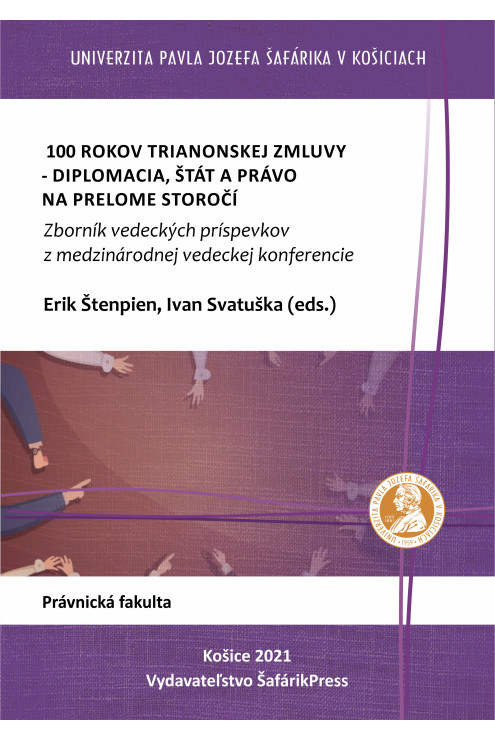
Erik Štenpien - Ivan Svatuška (eds.)
The Collection of scientific Contributions of the International scientific conference: 100 Years of Treaty of Trianon – Diplomacy, State and Law on the Turn of the Century.
The presented publication is the first of a series of proceedings published within the solution of the grant APVV-19-0419. The conference took place from 14 to 15 October 2021 with the participation of experts from Slovakia, Hungary and Poland. The ambition of the research team, composed of legal historians and positive lawyers from three countries, is to provide a comprehensive, unbiased view of the peace negotiations that resulted in the Treaty of Trianon with Hungary. The conference, the result of which is the presented collection, was devoted to the causes of possible disputes in Europe - focusing on diplomacy and constitutional development of Central European countries at the turn of the 19th and 20th centuries, ie in the period immediately preceding the outbreak of World War I.

Data sheet
E-book
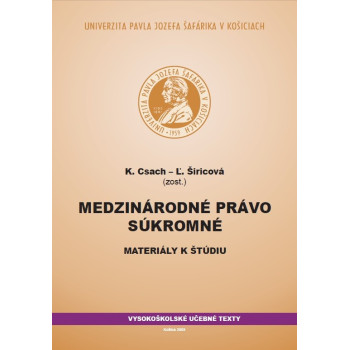
Kristián Csach - Ľubica Širicová
Private international law has undergone dramatic changes in recent periods. The fully operational process of communitarization of this legal field has not yet – and perhaps could not have been – effectively reflected by domestic legislators. Under the current legal status, it is not uncommon for legal issues to intertwine regulations of community origin and domestic legislation (embodied primarily by Act No. 97/1963 Coll. on Private International Law and Procedure).
Questions about the obsolescence of some provisions of this, until recently, universal codified regulation of private international law arise mainly (but not exclusively) from the conflict rules contained in the so-called "Rome I" Regulation on the law applicable to contractual obligations, the "Rome II" Regulation on the law applicable to non-contractual obligations, and most recently in Council Regulation (EC) No. 4/2009 of 18 December 2008 on jurisdiction, applicable law, recognition, and enforcement of decisions and cooperation in matters relating to maintenance obligations.
Respecting the principle of the primacy of generally binding acts of the Community over domestic law, the correct application of normative texts cannot be achieved without the ability to quickly navigate through the norms and subsequently compare them.
Students and anyone else are therefore confronted with a multitude of legal regulations of substantial scope and detailed regulation. Currently, apart from systematically arranged references on the websites of the Ministry of Justice, we do not find a comprehensive material that would offer an overview of legal regulations in the field of private international law and procedure.
E-book
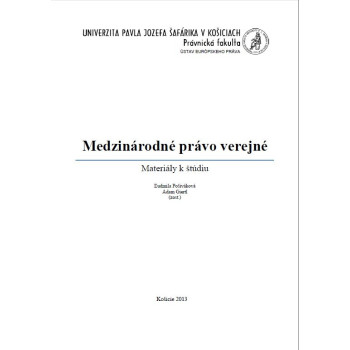
Ľudmila Pošiváková - Adam Giertl
The presented selection of public international law documents aims to map international law from both historical and sectoral perspectives. The reader will find several historical documents in this collection, but the focus is primarily on currently valid legal sources.
The selection is guided by the publication Public International Law – General and Special Part by Prof. Ján Klučko, which is reflected in the division into general and special parts. The general part addresses the historical development of international law but primarily focuses on the protection of individuals and responsibility relationships in international law. The special part then examines the international regulation of various institutions of international law.
We acknowledge that this selection offers room for expansion, but we believe it meets basic requirements and fills a certain gap in the study of international law.
We trust that this collection of public international law materials will be beneficial for students, and not only for them, in the study of public international law and will contribute to raising awareness in this field.
E-book
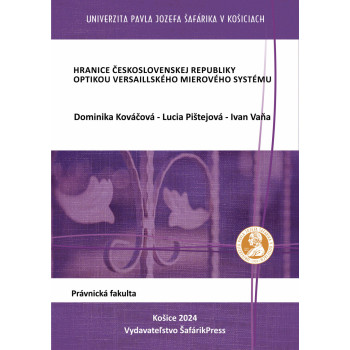
Dominika Kováčová- Lucia Pištejová- Ivan Vaňa
The present monograph deals with the post-war settlement of relations and peace negotiations related to the settlement of the borders of the newly established Czechoslovak Republic. The work discusses in detail the negotiation processes related to the preparation and signing of the Versailles and Saint-Germain Peace Treaties. Similarly, it then discusses in detail the peripeties related to the drafting of the Treaty of Trianon dealing with the border with Hungary and its subsequent delineation in the field. Last but not least, the thesis captures the settling of Czechoslovakia's international relations with Poland and their common border, with a particular focus on the arbitration settlement on the territory of Orava and Spiš.
Download e-book for free (pdf)
E-book
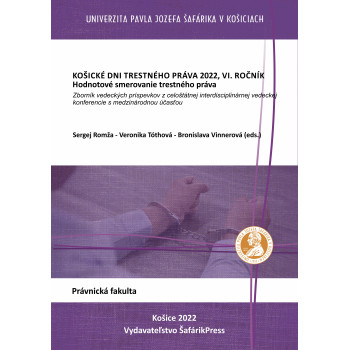
Sergej Romža - Veronika Tóthová - Bronislava Vinnerová (eds.)
The Collection of scientific contributions nationwide interdisciplinary scientific conference with international participation
The text book of scientific contributions The value direction of criminal law is the output of a nationwide interdisciplinary scientific conference with international participation organized by the Department of Criminal Law of the Faculty of Law of the UPJŠ in Košice. The proceedings contain contributions focused on issues of the value direction of criminal law, both in the field of substantive and procedural law.
This is a highly topical issue, as the values of law as such are reflected in each of its areas. In view of social events, the constant amendment of the criminal codes and, in particular, the forthcoming amendment of both the Criminal Code and the Code of Criminal Procedure, we consider the topic of the conference and the title of the text book to be highly topical, without significant limits in scientific research.
In their contributions, the participants of the national interdisciplinary scientific conference with international participation also devoted themselves to reflections de lege ferenda and offer insights into the above-mentioned amendments to the criminal codes into practice as well as their upcoming amendments.
The aim of the published proceedings is to continue to improve and develop new knowledge in the field of criminal law in the light of the new rules, while adhering to all established values, on the basis of the previous professional knowledge.