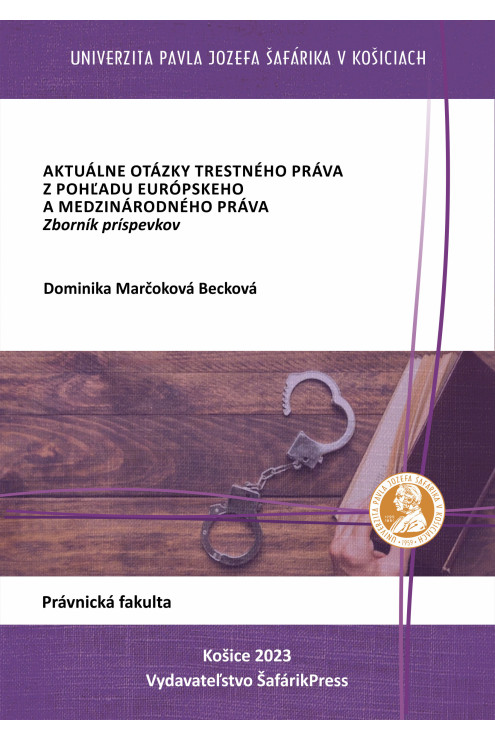
Aktuálne otázky trestného práva z pohľadu európskeho a medzinárodného práva

E-book

Dominika Marčoková Becková (ed.)

Proceedings of Papers of XVIth year of the student symposium of the Institute of International Law and European Law

Proceedings of Papers of XVIth year of the student symposium of the Institute of International Law and European Law is devoted to selected aspects of the place and role of criminal law from the point of view of contemporary EU law and international law. In their contributions, students deal with current topics of criminal law in the law of the European Union and international law. In the EU law, the most actual issue is the European Public Prosecutor's Office, a body of the EU responsible for investigateing and prosecuting criminal offenses affecting the Union's financial interests.

The first part of papers dealt with the reasons for the establishment of the European Public Prosecutor's Office, its structure and tasks, the issue of conducting the investigation of the European Public Prosecutor's Office in the conditions of the Slovak Republic, as well as with the relations of the European Public Prosecutor's Office with its closest partner, the European Anti-Fraud Office.

The second part of the contributions reflects current issues and challenges of criminal law in international law. Authors in their papers focused on the issue of the International Criminal Tribunal for Ukraine, the legal problems and challenges associated with its creation, on the issue of the crime of aggression before the International Criminal Court, as well as on issues of immunity of state representatives before national courts.

Download the e-book for free  (pdf)

Quantity

978-80-574-0219-0

Data sheet

Method of publication:
E-book (pdf)
Editor:
Dominika Marčoková Becková
Document type:
Proceedings
Number of pages:
78
Available from:
28.06.2023
Year of publication:
2023
Edition:
1st edition
Publication language:
German
Faculty:
Faculty of Law
Note:
Publikácia je čiastkovým výstupom z riešenia projektu APVV-18-0421 Európska prokuratúra v súradniciach ústavného poriadku Slovenskej republiky ako posilnenie európskej integrácie prostredníctvom práva.
License:
Creative Commons BY NC (Uveďte autora - Nepoužívajte komerčne)
DOI:
https://doi.org/10.33542/AOTP-0219-0
- Free for download

16 other products in the same category:

STAV A PERSPEKTÍVY VEREJNÝCH FINANCIÍ V EÚ

E-book

E-book

Elena LazoríkováAdrián PopovičAnna Románová

Reviewed proceedings of scientific papers

The Proceedings presents papers from international scientific conference “The Condition of Public Finances in the EU and their Future Perspectives” held on June 2 – 3, 2022 in Košice, Slovakia and is published as a partial outcome of the implementation of the VEGA project No. 1/0485/21: "Simultaneity and possibilities of reforming the system of own resources of the EU budget (legal and economic aspects also in the context of the consequences of the COVID-19 pandemic)" and VEGA project No. 1/0214/21: "Real Property Tax - Legal Status and Potential".

The proceedings consist of contributions from conference participants divided into two thematic sections: “The EU Budget” and “Real Estate in Taxation.” While the first section addresses both the revenue side of the EU budget (particularly in the context of the own resources system), as well as its expenditure side and its relationship to other budgets, the second section focuses on real estate as the subject of specific regulations under various taxes, including those that directly tax real estate through a tax of the same name.

Download e-book for free (pdf)

Impact of the European Union on Criminal Law of...

E-book

E-book

Dominika Marčoková Becková (ed.)

Reviewed collection of papers of the international scientific conference is the output of the international scientific conference held on 7th October 2022 within the framework of the project APVV-18-0421 „European Public Prosecutor's Office in Connections of the Constitutional Order of the Slovak Republic as Strengthening of the European Integration through Law“.

Unlike other areas of activities of the European Union, the European Union did not begin to enter the area of criminal law and criminal policy until much later. The reason is that the sphere of criminal law has traditionally been associated with the sovereignty of the state, which is why the Member States of the European Union are very slow to allow the European Union into it. The issue of the European Union's influence on the criminal law of its Member States is therefore becoming actual and raises many questions and application problems. In their papers, the authors address the various problems posed by the European Union's influence in the area of criminal law. Among the scientific problems and issues that the authors paid attention to in their works are the following: reasons for competence of the European Union within the field of criminal law; Impact of the EU legislation on criminal law of EU Member States; proposals to improve existing legislation, whether at European Union or national level, cooperation of the Court of Justice of the European Union and national judges via preliminary proceedings within the field of criminal law; as well as the issue of the European Public Prosecutor's Office.

Download the e-book for free  (pdf)

Ochrana zamestnanca perspektívou priemyselnej...

E-book

E-book

Milena Barinková (ed.)

Proceedings from the IV Annual Student Symposium on Labor Law held on April 5–6, 2019, in Danišovce

The term "Industrial Revolution 4.0" is currently widely used, yet remains mysterious and its content unfamiliar to many. While we do not claim omniscience, through the educational process at the Faculty of Law of Pavol Jozef Šafárik University in Košice and the scientific research of the Department of Labor Law and Social Security Law, we have delved into examining the accompanying features and anticipated phenomena of this modern industrial revolution.

It can be stated with great certainty that this revolution already affects—and will continue to affect—production processes, including radical changes in their structure, the emergence of groundbreaking technological and communication tools, and, undoubtedly, labor relations. The rise of new forms and methods of work based on automation and digitalization, applied within new models of labor relations, is beginning to threaten jobs in certain sectors of the economy. There is an increasing demand for specialized qualifications and skills, particularly in information technology, with an emphasis on process digitalization, data processing, and the creation of communication networks connecting objects and people. This intelligent industry inevitably disqualifies many existing jobs from their current structures, leading to job losses for numerous employees. Analysts openly predict that by 2030, robots will replace up to 20 million industrial jobs worldwide.

The vision of which occupations or working conditions will be impacted is becoming increasingly concrete. Radical changes will require radical solutions as well as previously unknown movements and new elements or measures in the labor market.

Download the e-book for free  (pdf)

Tvorba a realizácia pracovného práva so...

E-book

E-book

Milena Barinková (ed.)

The researchers of the grant task ‘Creation and implementation of labour law with regard to regional aspects of the labour market’ deal in their work with the analysis of employers' attempts for legislative changes in the level of social rights of employees justified by regional differences, the analysis of possible impacts in their implementation, as well as the assessment of their compliance with the protective function of Slovak labour law and the value character of fundamental human rights inherent in the European and legal culture.

Download the e-book for free (pdf)

Základy zdaňovania (v interakcii ekonómie a práva)

E-book

E-book

Karolína ČervenáAnna Vartašová

The scientific textbook in the form of an electronic interactive publication is intended for university students who are interested in an interdisciplinary view of taxation in the context of linking the basic theoretical knowledge in the field of law and economics related to taxation with an emphasis on application practice. The content of the textbook primarily covers general theoretical knowledge in the field of taxation in terms of their historical creation and characteristics in the scope of the legal and economic framework of tax system in general, as well as that currently applied in the Slovak Republic.

The textbook also includes pictures and graphs (listed in the appendix), which interactively complement the text part, as well as a set of questions in (in the context of the scope of particular chapters), whose task is to contribute to the fulfilment of didactic goals of the textbook.

Download the e-book for free  (pdf)

Medzinárodné právo súkromné

E-book

E-book

Kristián Csach - Ľubica Širicová

Private international law has undergone dramatic changes in recent periods. The fully operational process of communitarization of this legal field has not yet – and perhaps could not have been – effectively reflected by domestic legislators. Under the current legal status, it is not uncommon for legal issues to intertwine regulations of community origin and domestic legislation (embodied primarily by Act No. 97/1963 Coll. on Private International Law and Procedure).

Questions about the obsolescence of some provisions of this, until recently, universal codified regulation of private international law arise mainly (but not exclusively) from the conflict rules contained in the so-called "Rome I" Regulation on the law applicable to contractual obligations, the "Rome II" Regulation on the law applicable to non-contractual obligations, and most recently in Council Regulation (EC) No. 4/2009 of 18 December 2008 on jurisdiction, applicable law, recognition, and enforcement of decisions and cooperation in matters relating to maintenance obligations.

Respecting the principle of the primacy of generally binding acts of the Community over domestic law, the correct application of normative texts cannot be achieved without the ability to quickly navigate through the norms and subsequently compare them.

Students and anyone else are therefore confronted with a multitude of legal regulations of substantial scope and detailed regulation. Currently, apart from systematically arranged references on the websites of the Ministry of Justice, we do not find a comprehensive material that would offer an overview of legal regulations in the field of private international law and procedure.

Download the e-book for free (pdf)

Diverzné a inkluzívne pracoviská - legislatívne...

E-book

E-book

Jana ŽuľováDenisa Rudžiková

In the environment of Slovak employers, an active approach to diversity and inclusion in the workplace is coming to the fore. Targeted diversity and inclusion programs help make employers more attractive on the labor market and attract more job seekers. Proactively, better working conditions are created for employees with responsibilities to the family (in most cases still in relation to mothers), groups of people who have been on the fringes of interest until now are also employed (elderly, disabled, LGBT groups, minorities, graduates of secondary and higher education schools).

The presented collection of abstracts responds to the outlined facts, which is a grouping of the starting motives and conclusions of the contributions presented at the scientific conference Diverse and inclusive workplaces - legislative starting points organized by the department of labor law and social security law of the Faculty of Law of the P. J. Šafárik University in Košice, which took place on September 29, 2023 in a hybrid form.

With their abstracts, the authors point to a range of problematic areas that are not only a reflection of academic considerations, but also those legal questions that have to be dealt with in ordinary legal practice. The goal is to use analysis and explanation to define the existing labor law measures/tools applicable to the implementation of diversity and inclusion in the workplace according to the current Slovak legal framework and the EU legal framework and thus emphasize the starting point of any effort to build diversity and the implementation of inclusion in the workplace.

Download e-book for free (pdf)

Zákon o národnostiach a Rada vlády Slovenskej...

E-book

E-book

Jana Šutajová

From January 1, 1969, the Constitutional Act on the Status of Nationalities in the Czechoslovak Socialist Republic (ČSSR) and the Constitutional Act on the Federation came into effect. The Constitutional Act on the Status of Nationalities represented at least a formal significant step forward in the legal regulation of minority rights. However, this law was intended to serve as a foundation for further legal adjustments. It was declared that additional steps and negotiations for the adoption of implementing regulations would follow and that further laws would be enacted at both the federal and national levels. Nevertheless, no additional law or government regulation related to the constitutional act on the status of nationalities in the ČSSR was ever issued.

During the normalization period, issues concerning further legislation related to national minorities were not addressed. However, in the brief period following the adoption of the constitutional act in 1968 until the end of 1969, some institutions attempted to prepare and promote such legal norms. One of these institutions was the Government Council of the Slovak Socialist Republic (SSR) for Nationalities (hereafter referred to as the Council or the Government Council for Nationalities). The monograph provides an insight into the development of additional legal norms arising from the constitutional act on the status of nationalities in the Slovak Socialist Republic, prepared by the Government Council of SSR for Nationalities. This council was one of the institutions established in Slovakia after the formation of the Czechoslovak federation and dealt with nationality issues.

In addressing further legal norms stemming from the constitutional act on nationalities in ČSSR, it was necessary to consider prior developments. Therefore, the first part of the monograph examines the status of minorities in Czechoslovakia before adopting the constitutional act, activities of nationalities preceding its adoption, and its enactment itself. Subsequent sections focus on institutional changes in SSR following federalization, the establishment of the Government Council of SSR for Nationalities, and specific actions taken by this Council and its expert bodies in drafting proposals for laws concerning nationalities in the Slovak Socialist Republic.

The motivation for writing this monograph stemmed from the fact that this topic has so far received attention only in a few studies in Slovakia, which primarily focused on the Hungarian minority during either the Prague Spring or normalization periods.

Download the e-book for free (pdf)

Ochrana práv veriteľov v obchodných záväzkových...

E-book

E-book

Žofia Mrázová (ed.)

Proceedings of Contributions from the V. Student Symposium on Commercial Law

The proceedings are the result of student works presented at the fifth annual student symposium organized by the Department of Commercial Law and Economic Law, Faculty of Law, UPJŠ in Košice, which took place on November 30 – December 1, 2017, at the UPJŠ educational and training facility in Danišovce.

This year’s symposium focused on problematic issues related to creditor rights protection in commercial contractual relationships.

The purpose of these annually organized symposia is to provide students with a platform to present their own opinions and improve their analytical and argumentation skills.

Download the e-book for free (pdf)

Aktuálne výzvy daňového práva

E-book

E-book

Adrián Popovič  - Jozef Sábo

Reviewed proceedings from the student symposium organized on the occasion of IV. Slovak-Czech days of tax law.

The International Scientific Conference IV. Slovak-Czech days of tax law was held 16th - 18th June 2021 in Košice (Faculty of Law of Pavol Jozef Šafárik University in Košice). On this occasion, a student symposium on the topic: "Current Challenges of Tax Law" was organized for students of the Pavol Jozef Šafárik University Faculty of Law in Košice on 15th June 2021. The focus of the symposium was chosen due to the content of the grant project APVV-19-0124 entitled "Tax law and new phenomena in the economy (digital services, shared economy, virtual currencies)", which is currently being addressed at the Department of Financial Law, Tax Law and Economy, Faculty of Law, Pavol Jozef Šafárik University in Košice. The output of this symposium is a reviewed proceeding of papers, in which students focus on examining the current challenges of tax law. In this context, students examine not only the current challenges in the field of real estate tax and the introduction of taxation based on their market value of real estate, the decision-making of the Court of Justice of the European Union in the field of direct taxation and indirect taxation, but also new and extremely current taxation issues of cryptoactive (virtual currency) taxation, not only in the Slovak Republic but also in the world. The authors also assess in detail the current situation in the research area, and they also present de lege ferenda proposals that could contribute to the development and improvement of several aspects of taxation, which is a benefit not only for legal science but also for application practice.

Download e-book for free (pdf)

Právo informačných a komunikačných technológií

€19.50
Availability: 5 In Stock

Regina Hučková - Diana Treščáková - Laura Rózenfeldová

Vysokoškolská učebnica Právo informačných a komunikačných technológií je určená študentom vysokých škôl vo všeobecnosti, najmä však študentom Právnickej fakulty, ktorí majú záujem o štúdium práva v spojení s informačnými a komunikačnými technológiami. Učebnica predstavuje zdroj informácií potrebných nielen pre štúdium tejto problematiky, ale aj pre rozšírenie celkového obzoru v danej problematike.

The Impact of industrial and technological...

E-book

E-book

bolya Katalin Koncz

The exploration of the interplay between innovation and society elucidates fundamental connections between human advancement and societal transformation. Technological development and its dissemination profoundly influence both the economy and social structures, often restructuring them while presenting new challenges and opportunities. This monograph delves into the theme of "Innovation and Society", focusing specifically on how technological advancements impact various facets of society ‒ from the realm of work to social policies and the evolution of gender roles. These areas are approached through a novel lens, examining them from the perspective of legislative reforms enacted and endorsed by the state. The monograph examines the characteristics and legal framework of 20th-century Hungarian society using diverse laws, regulations, and statistical data. Through analyses and documented evidence, it offers a comprehensive understanding of societal structure and operations, encompassing aspects such as the labor market, female employment, the status of industry and commerce, and shifts in legal frameworks. Detailed statistical insights into population dynamics, labor market trends, and economic sectors further deepen our comprehension of social processes. The documents scrutinize the employment distribution and conditions across different sectors, including food processing and milling, while also providing specific details on the roles, distribution, and wages of women in the workforce, with particular emphasis on occupations where women are prominently engaged. The analysis of legislative provisions delineates the historical backdrop and measures enacted for fostering social and economic transformations, covering issues such as patent legislation, guardianship laws, and family law. This compilation offers an exhaustive overview of 20th-century Hungarian society and its legal underpinnings, enriching scholarly inquiries into historical and sociological dimensions within this domain.

Download e-book for free (pdf)

Zborník príspevkov z X. ročníka študentského...

E-book

E-book

Adam Giertl (ed.)

Proceedings of the Student Symposium on International Law and European Law held on April 28, 2017, at the Faculty of Law of Pavol Jozef Šafárik University in Košice

The Student Symposium is regularly organized by the Institute of International Law and European Law, and in 2017, it marked the jubilee tenth edition of the symposium, which over time expanded its focus to include European law.

The tradition of holding student symposia is also associated with the good practice of preparing proceedings from each event. Understandably, the tenth edition is no exception, and thus, the tenth edition of the symposium proceedings is now available to readers. In previous years, the symposium has always focused on specific areas of international and European law. Thus, the subjects of study for symposium participants have included migration issues (2016), the protection of cultural values (2015), and the challenges of cyberspace (2013).

This year, given that it is the jubilee tenth edition, the symposium organizers have chosen to approach the symposium's focus thematically and recall some significant milestones in the development of international law that occurred in years ending with the number seven.

Download the e-book for free (pdf)

Transteritoriálne správne akty v podmienkach...

E-book

E-book

Radomír JakabTibor SemanLukáš Jančát

The concept of a transterritorial administrative act is relatively new in administrative law, especially in the conditions of the Slovak Republic. It has practical applicability to the application of European Union law (including international law). Its essence lies in the fact that the effects of such an administrative act issued within one Member State exceed the territory of that Member State, have effects in other Member States, in all Member States of the European Union without being subject to the recognition process.

The purpose of the monograph is to present outputs of the scientific examination of this type of administrative acts, the definition of its characteristics and its effects, the examination of the possibilities of procedural defense against its effects by the State concerned, and possibly the possibility of unifying the action of the Member States of the European Union in case of procedural defense against the effects of transterritorial administrative acts. The monograph also contains analysis of certain types of transterrritorial administrative acts that are commonly used in the conditions of the European union and Slovak republic; they are also categorized under specific criteria.,

Download the e-book for free  (pdf)

Mierové rokovania po roku 1918 a ich vplyv na...

E-book

E-book

Erik Štenpien - Lucia Pištejová  - Ivan Svatuška (eds.)

Proceedings of the international scientific conference held on April 13-14, 2023, organized by the Department of History of State and Law, Faculty of Law, University of Pavel Jozef Šafárik in Košice.

The presented collection provides a summary of scientific works from the last international conference dealing with the issue of the Trianon Peace Treaty and the negotiations during the peace conference after 1918. The collection contains scientific contributions from members of the research team of the APVV 19-0419 project, as well as other experts from the field of legal history. Through their contributions, they offer an insight into the complex processes of the formation of Europe after the First World War. They approximate the essential and relatively complicated processes of negotiations on important issues of the post-war arrangement and the further direction of individual countries. Contributions of foreign legal historians, which bring an alternative view of the examined issue, are a stimulating contribution to the collection.

The anthology includes scientific studies related to the investigated issue, often with an overlap with the present. The collection also includes scientific contributions with positive legal topics. The collection in the presented form is thus primarily intended for readers from the professional public.

Last but not least, it can interest the lay public interested in the issue of the post-war arrangement and Slovak-Hungarian relations.

Download the e-book for free (pdf)

Blockchain technológia ako činiteľ (faktor)...

E-book

E-book

Ladislav Hrabčák et al.

The comprehensive work represents the final output from solving Project VVGS-2019-1068 titled 'Blockchain technology as a factor influencing the current form of law' and was created simultaneously as one of the partial outputs from Project APVV-19-0124 titled 'Tax Law and New Phenomena in Economy (Digital Services, Shared Economy, Virtual Currencies)'. The partial overlap in research topics between these projects allowed for such research, especially regarding digital (virtual) currencies.

Download e-book for free (pdf)

This website uses cookies to ensure you get the best experience on our website