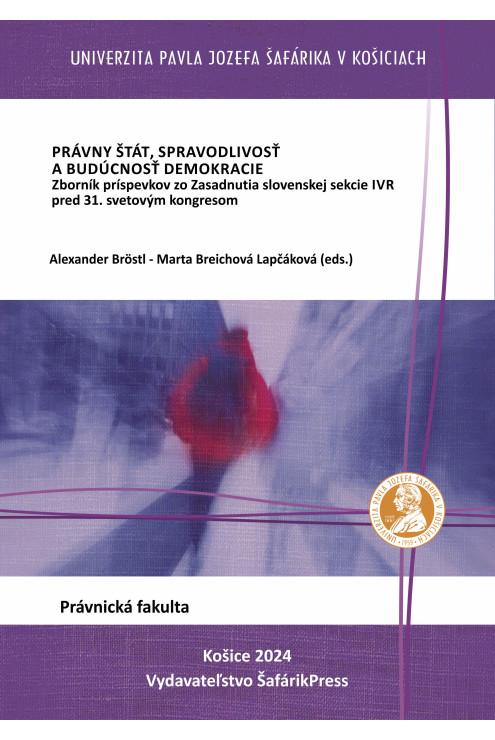
Právny štát, spravodlivosť a budúcnosť demokracie

E-book

Alexander Bröstl - Marta Breichová Lapčáková (eds.)

Collection of papers from session of the slovak section of the IVR

In accordance with its name, the collection is devoted to three framework areas consisting of the rule of law, justice and the future of democracy, reflecting the focus of the 31st World Congress of the International Association for the Philosophy of Law and Social Philosophy (IVR). Published contributions of the slovak section of the IVR are devoted to the present questions of the rule of law in relation to the democratic legal state. Principles of the rule of law and present questions connected to the democratic character of the Slovak republic, including the democratic procedures on the local level, are juxtaposed with shifts on the international and global scene. Individual contributions are thus devoted to the technical and biotechnological challenges of contemporary democracy, the manifestation of game theory in the search for consensus in collegial judicial bodies, or to the concept of loyal opposition in the ongoing judicial dialogue surrounding the application of law in the european legal space. Space is also devoted to the universal questions of the nature of legal science, and to the present and future of the rule of law. The collection thus goes beyond the borders of the slovak legal space and aims to understand current trends in a broader context.

Download the e-book for free (pdf)

Quantity

978-80-574-0376-0

Data sheet

Method of publication:
E-book (pdf)
Editors:
Alexander Bröstl - Marta Breichová Lapčáková
Document type:
Proceedings
Number of pages:
177
Available from:
23.12.2024
Edition:
1st edition
Publication language:
Slovak
Faculty:
Faculty of Law
Note:
Zborník vedeckých prác vznikol v rámci riešenia projektu APVV-21-0336 – „Analýza súdnych rozhodnutí metódami umelej inteligencie“
License:
CC BY NC ND (Uveďte autora - Nepoužívajte komerčne - Nespracovávajte)
DOI:
https://doi.org/10.33542/PSB-0376-0
- Free for download

16 other products in the same category:

Extrateritoriálne účinky cudzích správnych...

E-book

E-book

Radomír Jakab - Diana Repiščáková (eds.)

The collection of scientific papers was created as part of a scientific seminar entitled “Extraterritorial Effects of Foreign Administrative Decisions in the Conditions of the European Union – Starting Points and Current State,” held from November 23 to 25, 2022, at the training and educational facility in Danišovce, in connection with the implementation of a scientific project entitled “Extraterritorial Effects of Foreign Administrative Decisions in the Conditions of the European Union,” supported by a grant from the Scientific Grant Agency under No. 01/187/2022.

The aim of the mentioned project is the scientific examination of extraterritoriality, i.e., the extraterritorial effects of administrative decisions of the Member States of the European Union on the territory of other Member States, in order to assess the need for, possibilities of, and desirable scope of harmonization of the legal regulation of the Member States of the European Union, with the goal of increasing the level of free movement of administrative decisions within the European Union. As part of the research project, an initial scientific seminar was held under the title “Extraterritorial Effects of Foreign Administrative Decisions in the Conditions of the European Union – Starting Points and Current State.”

Members of the research team, who are also members of the Department of Constitutional Law and Administrative Law at the Faculty of Law of Pavol Jozef Šafárik University in Košice, participated in this scientific seminar. At the seminar, contributions were presented that primarily summarized the current state of knowledge in the area of extraterritorial effects of foreign administrative decisions in the context of the European Union. This summary will serve as a basis for the further scientific examination of this issue by the members of the research team. These contributions subsequently formed the scientific papers included in this collection.

Download the e-book for free (pdf)

Členovia orgánov obchodnej spoločnosti....

E-book

E-book

Jaroslav DolnýMonika Seilerová (eds.)

The collection of contributions from the VII. Student Symposium on Commercial Law and Labor Law held on December 5, 2019, at the Faculty of Law of Pavol Jozef Šafárik University in Košice

The theme of this year's symposium provided students with the opportunity to choose between addressing issues related to commercial law or focusing on labor law aspects concerning the position of members of the governing bodies of commercial companies, based on an analysis of legal regulations and case law.

The creative exploration of commercial law questions particularly related to areas such as the manner of acting on behalf of a commercial company, the liability of the de facto statutory body of a commercial company, information obligations of the statutory body towards its shareholders, and the remuneration for serving as a member of the board of directors of a joint-stock company. It also addressed the liability of the statutory body for the insolvency of the company and the enforcement of non-competition clauses concerning managing directors of limited liability companies.

The connection between commercial law and labor law was directed towards a legal analysis of personal data protection related to health and its misuse by members of the governing bodies of commercial companies, as well as the legitimacy of concurrently holding a position (as a member) in a statutory body with an employment relationship, and the legal status of senior employees, particularly concerning their duties and responsibilities for ensuring employee health through creating healthy working conditions.

Download the e-book for free (pdf)

Právne postavenie spoločníka v obchodnej...

E-book

E-book

Žofia Šuleková (ed.)

Proceedings of the Contributions from the IV. Student Symposium on Corporate Law held on November 24-25, 2016, at the Training Facility of Pavol Jozef Šafárik University in Danišovce.

The Department of Commercial Law and Economic Law at the Faculty of Law of Pavol Jozef Šafárik University in Košice organized the fourth edition of the student symposium, this time focusing on corporate law.

The event took place on November 24-25, 2016, at the training facility of Pavol Jozef Šafárik University in Danišovce. The aim of the annually organized symposiums is to create a discussion platform for students with the participation of mentors from the department, including teachers, researchers, and doctoral students. This year’s symposium focused on problematic issues related to the legal status of a partner in a commercial company. The topics were assigned to allow students to demonstrate and develop their analytical and argumentative skills while improving their ability to present and formulate their own views and perspectives.

The presented proceedings are the outcome of the students' work from this event.

Download the e-book for free (pdf)

Správne právo hmotné - Všeobecná časť

€20.00
Availability: 25 In Stock

Tibor Seman - Radomír Jakab - Jozef Tekeli

The presented textbook on the general part of substantive administrative law offers a comprehensive collection of knowledge, principles, doctrines, institutions, and legal norms that form the foundation for the existence and functioning of public administration. It serves as a prerequisite for mastering the special part of substantive administrative law and administrative procedural law. This updated version of the first edition of the textbook reflects the current development of public administration, the state of administrative law, and educational needs. The textbook introduces key institutions of the general part of administrative law, which are essential for understanding how public administration operates in Slovakia. It includes the characteristics and internal structure of administrative law, its sources, and its relationships with other branches of law. Covered topics include subjects of administrative law, the organization of public administration, methods and forms of its activities, guarantees of legality in public administration, administrative liability, civil service, and work performed in the public interest. It will be useful not only to students but also to anyone interested in the theory and practice of such a dynamic branch of law as administrative law undoubtedly is.

Míľniky právneho vývoja v Európe po prvej...

E-book

E-book

Ivan SvatuškaLucia Pištejová (eds.)

Collection of Scientific Contributions from the International Scientific Conference of PhD Students and Young Researchers held on April 22, 2022, organized by the Department of State and Law History of the Faculty of Law, Pavol Jozef Šafárik University in Košice.

We recommend this collection to the attention not only of PhD students and young researchers but also to all experts working in the fields of general history and legal science. At the same time, we bring it to the attention of all lay enthusiasts interested in the issues of legal development after the First World War. After all, as one of the world-renowned foreign legal historians likes to say: "Law is the most beautiful science in the world, because everyone can find an area that interests them in it."

Download the e-book for free (pdf)

Regionalizmus: Stav, východiská, perspektívy

E-book

E-book

Adam Giertl (ed.)

Proceedings of Scientific Works

International law does not represent a monolithic entity of uniform legal norms. It is a legal system that is fundamentally created by the consensus of states. It reflects the collective will of multiple entities regarding what should be binding and enforceable as law among them.

From this understanding arises the fact that the needs for legal regulation will differ in various parts of the world. The consequence of this situation is the formation of regional groupings where, to some extent, specific legal rules apply. As Professor Klučka points out in his study published in this proceedings, regionalization can occur both on a contractual basis and on an institutional basis. Regionalism in law thus raises many interesting questions that legal science addresses.

This proceedings of scientific papers also aims to contribute to the knowledge in this field.

Download the e-book for free (pdf)

Diverzné a inkluzívne pracoviská - legislatívne...

E-book

E-book

Jana ŽuľováDenisa Rudžiková

In the environment of Slovak employers, an active approach to diversity and inclusion in the workplace is coming to the fore. Targeted diversity and inclusion programs help make employers more attractive on the labor market and attract more job seekers. Proactively, better working conditions are created for employees with responsibilities to the family (in most cases still in relation to mothers), groups of people who have been on the fringes of interest until now are also employed (elderly, disabled, LGBT groups, minorities, graduates of secondary and higher education schools).

The presented collection of abstracts responds to the outlined facts, which is a grouping of the starting motives and conclusions of the contributions presented at the scientific conference Diverse and inclusive workplaces - legislative starting points organized by the department of labor law and social security law of the Faculty of Law of the P. J. Šafárik University in Košice, which took place on September 29, 2023 in a hybrid form.

With their abstracts, the authors point to a range of problematic areas that are not only a reflection of academic considerations, but also those legal questions that have to be dealt with in ordinary legal practice. The goal is to use analysis and explanation to define the existing labor law measures/tools applicable to the implementation of diversity and inclusion in the workplace according to the current Slovak legal framework and the EU legal framework and thus emphasize the starting point of any effort to build diversity and the implementation of inclusion in the workplace.

Download e-book for free (pdf)

Ownership rights protection in Polish and...

E-book

E-book

Milan Sudzina, Renata Świrgoń-Skok, Wojciech J. Kosior

Given the importance of the ownership right, the aim of this monograph is to provide an analysis, a clear systematic interpretation and an evaluation of the above issue, not only from the theoretical point of view, but also from the point of view of legal practice. The protection of ownership relations is ensured in various ways. It is judicial protection, protection provided by local self-government authorities, self-help, public registration of real property and other instruments of administrative and criminal law. In connection with the transformation of legislation in Slovakia and Poland after the fall of the socialist regime, there have been many changes in the legislation of both countries concerning the protection of ownership rights. A number of private law institutions related to the ownership of real property, the use of which was impossible or limited during the socialist period, have been restored. Legislation has also been adopted to alleviate the consequences of certain property and other injustices caused by the deprivation of ownership of real property during the socialist period. The adoption of restitution legislation was the basis for restoring the ownership rights of the original owners, who were allowed to get back their real property that had been used by socialist organisations. After the end of the socialist regime, the various forms of ownership, which until then had favoured the state ownership, were abolished. Changes were made to ensure that the ownership rights of all owners had the same content and enjoyed the same legal protection. The monograph is structured in such a way as to enable a comparison of individual institutions of rights in rem under Polish and Slovak law. The monograph also analyses the relevant decision-making practice of the supreme judicial authorities. The scientific methods applied enabled the authors not only to analyse and evaluate the historical context and the current legal regulation of ownership rights in Poland and Slovakia, but also to point out possible gaps and shortcomings and to elaborate de lege ferenda proposals that can be used in future legislative activity.

Download e-book for free (pdf)

Transteritoriálne správne akty v podmienkach...

E-book

E-book

Radomír JakabTibor SemanLukáš Jančát

The concept of a transterritorial administrative act is relatively new in administrative law, especially in the conditions of the Slovak Republic. It has practical applicability to the application of European Union law (including international law). Its essence lies in the fact that the effects of such an administrative act issued within one Member State exceed the territory of that Member State, have effects in other Member States, in all Member States of the European Union without being subject to the recognition process.

The purpose of the monograph is to present outputs of the scientific examination of this type of administrative acts, the definition of its characteristics and its effects, the examination of the possibilities of procedural defense against its effects by the State concerned, and possibly the possibility of unifying the action of the Member States of the European Union in case of procedural defense against the effects of transterritorial administrative acts. The monograph also contains analysis of certain types of transterrritorial administrative acts that are commonly used in the conditions of the European union and Slovak republic; they are also categorized under specific criteria.,

Download the e-book for free  (pdf)

Obchodné a pracovné právo: Na spoločnej vlne

E-book

E-book

Natália Kalinák-Andrej Oriňak

The Department of Commercial Law and Economic Law together with the Department of Labour Law and Social Security Law of the Faculty of Law of UPJŠ in Košice organized the 8th annual student symposium, this time on commercial, labour and private international law, which took place at the Faculty of Law of UPJŠ in Košice on 1 December 2023. The student symposium under the title Commercial and Labour Law on a Common Wave was carried out as part of the research projects VEGA 1/0259/22 and VEGA č. 1/0291/23. The aim of the annual symposia is to create a discussion platform for students under the supervision of mentors from among the members of the department, namely teachers, researchers and PhD students. The theme of this year's symposium brought about discussion of interesting theoretical and practical legal issues thematically focused on the synergy of business law and labour law. The students addressed topical issues related to the status of entrepreneurs, the conduct of companies in labour law relations as well as the duties and responsibilities of employees. The topics of the sharing economy, gender quotas in corporate bodies and unfair bribery were not forgotten. While working on individual topics, students had the opportunity to improve their analytical thinking and argumentation skills, while they could practice writing a legal professional text, which in practice often increases the success of every lawyer. Students had the opportunity to develop their critical thinking and learn how to clearly formulate their own opinions on current legal issues. After the presentation of the papers, not only the team of lecturers and researchers, but also the students themselves engaged in a fruitful discussion, asking a number of original questions. Each student participant was awarded a certificate for their active participation in the symposium. The present proceedings are the outcome of the students' work from this event.

Download e-book for free (pdf)

Iniciatívy EÚ pri predchádzaní daňovým únikom a...

E-book

E-book

Adrián Popovič a kol.

The possibility of solving the grant project VVGS-2016-284 has provided a unique opportunity for members of the author´s team in the interdisciplinary composition to examine the issue not only from a tax-law point of view, but also from a political point of viewIn the presented monograph, the authors focused on the characterization of different aspects of the EU in order to allow the reader correctly understand its position in relation to the outside world and to its inward relations within its Member States in the context of the creation and implementation of the EU tax policy.

Particular attention is paid to the definition of the relationship between national tax legislation and EU law, the impact of the EU's tax policy on the national laws of its Member States, with reference to the identification of the harmonized areas with the approximation of their current stage of development and the final objective. This definition can be seen as a prerequisite for a correct and comprehensive understanding of the application and implementation of EU institutions' initiatives to prevent tax evasion and tax fraud and their implementation into the national legal order of the Slovak Republic. In the last part of the monograph, the authors focused on defining individual EU initiatives to combat tax evasion and tax fraud as a means of implementing its tax policy, in the area of ​​indirect taxation, in particular in the field of value added tax and in the field of direct taxation, especially with regard to corporate taxation, and to evaluate their projection into the national tax legislation of the Slovak Republic. At the same time, in these chapters, they assessed the real impact and effect of the measures admitted on the basis of the initiatives in practice.

The presented work is intended for a university student studying in the field of Tax Law and European Law, as well as the broader legal and economic community. However, in view of the scope and recency of the subject under consideration, the authors believe that the publication will find its application not only in the theoretical field but also in the practical field.

 JUDr. Adrián Popovič

Download the e-book for free (pdf)

10 rokov v EÚ: Vzťahy, otázky, problémy

E-book

E-book

Ján Klučka(ed.)

Collection of Papers from the International Scientific Conference Held on May 29–30, 2014 at the Faculty of Law, Pavol Jozef Šafárik University in Košice.

In the first half of this year, a scientific conference entitled “10 Years in the EU: Relations, Questions, Issues” was held in Košice, and the contributions from this event constitute the content of the present collection bearing the same name.

The aim of the organizers—namely, the Slovak Association of European Law, the Representation of the European Commission in the Slovak Republic, and the Institute of European Law together with the Department of International Law of the Faculty of Law at Pavol Jozef Šafárik University—was not only (even if loosely) to follow up on the previous 2009 conference “Community Law in Slovakia – Five Years ‘After’”, but, after another five years, to continue its main objective: to provide participants from both the academic and non-academic community with a space for further analysis and exchange of views on legal issues related to the membership of the Slovak Republic in the European Union and various current issues of the Union’s legal order.

From this perspective, a shift in the overall focus of the conference contributions in 2009 and 2014 can be observed. While the contributions from the first conference focused primarily on various aspects of the application of Union law in the Slovak legal system and related application problems, especially before courts and other authorities, the basic orientation of the contributions from the second conference is already different. The present collection also confirms that the contributions focus primarily on current issues of the European legal order and on certain aspects of the Union’s external policy, while the relationship of Union law to the Slovak legal system is no longer given primary attention.

Several contributions focus on areas characterized by a certain overlap or “cohabitation” of Union law with public international law, private international law, or, more broadly, international relations.

Download the e-book for free (pdf)

Vybrané otázky sociálneho práva Európskej únie

€21.80 €10.90 -50%
Availability: 38 In Stock

 Marcel Dolobáč a kol. 

Učebnica s názvom Vybrané otázky sociálneho práva Európskej únie prierezovo spracúva najzásadnejšie otázky pracovného práva a práva sociálneho zabezpečenia v Európskej únii. V úvodných statiach učebnice sa autori zamerali na objasnenie základnej terminológie a stručne poukazujú na vývoj sociálneho práva v Únii. Ďalšie kapitoly práce postupne vysvetľujú vybranú problematiku ktorá celkovo dotvára sociálne právo Európskej únie, konkrétne – voľný pohyb zamestnancov, zákaz diskriminácie, flexibilitu pracovných vzťahov prostredníctvom atypických pracovných pomerov, dočasné pridelenie zamestnancov, ochranu osobitných kategórií zamestnancov, ochranu osobných údajov, oblasť bezpečnosti a ochrany zdravia pri práci, ochranu práv zamestnancov pri prevode, prechode zamestnávateľa a jeho platobnej neschopnosti, kolektívnu ochranu práv zamestnancov a napokon uplatňovanie systémov sociálneho zabezpečenia. Učebnica analyzuje predovšetkým úniovú úpravu s akcentom na rozhodnú judikatúru Súdneho dvora Európskej únie, vnútroštátny právny poriadok objasňuje iba vo vybraných problematických oblastiach. 

Autori

Ochrana (duševného) zdravia zamestnanca

E-book

E-book

Milena Barinková (ed.)

The complex of legal norms protecting work, ensuring safety and health protection at work, is very broad in scope, extending beyond the Labour Code to include other specific legal regulations, collective agreements, executive legal regulations, and internal corporate normative acts.

Health protection of employees from hazardous workplace influences is a central requirement stemming from fundamental human rights guaranteed by the Constitution of the Slovak Republic. To ensure its universal enforcement across all employers in both private and public sectors, strict regulation through cogent norms is fully justified. The European Commission’s Communication to the European Parliament, Council, European Economic and Social Committee, and Committee of the Regions on the EU Strategic Framework on Health and Safety at Work 2014–2020 (COM(2014) 332 final) addresses the need to account for labor market changes arising from demographic shifts, aging populations, and technological advancements.

Work pace demands are intensifying, and all age categories of employees must adapt to new technologies, organizational changes, and evolving job structures. This increases requirements for maintaining health fitness throughout entire professional careers. Mental health fitness, which receives insufficient specific attention, is an inherent part of health fitness requirements. Prevention plays a critical role in mental health protection.

Download the e-book for free (pdf)

The loan or usury? Compulsory enforcement of...

E-book

E-book

Terézia HišemováDarina Kmecová (eds.)

Reviewed proceedings of scientific papers of Conference of Slovak and Czech law romanists, which take place at May, 10.-11.5.2018, at Faculty of Law, UPJŠ in Košice.

The submitted reviewed proceeding of scientific papers on „The loan or usury? Compulsory enforcement of roman - law basics and problems of application practice.”  is prepared within the solution of the grant project VEGA on: „The loan or usury? Compulsory enforcement of historical - law basics and problems of application practice.”, no. p. 1/0198/17.

The authors of papers are important personalities of Roman law working in the Slovak and Czech Republic, as well as PhD students and young scientists from Slovak and foreign universities who are active in the academic environment as well as in legal practice. The main goal of the editors is to help improve the current legal situation, which is assessed as unsatisfactory, and through a historical excursion of the development of the loan institute and then the forced execution of the decision, to create de lege ferenda proposals considering all areas of research.

The Proceedings trace the interrelationships between the substantive law institute in terms of the Roman law of contractus unilaterales - mutuum in its various types, often realized by the attachment of high interest rates, which bordered on the insurrection and the procedural law of individual lawsuits enforced in the legislative, formular and cognitive process. If there was no possibility to impose certain behaviour on the obligated person (the debtor, the sentenced person), then the declared general obligation to enforce the legal norms was only a legal term. It has always been the case that every internally well-organized state, whether antique or present, has to use power tools - often with the use of gross violence - but within the limits of the law, to promote what it has declared valid law. It must protect creditors on the one hand, but it must also prevent self-help and the use of illegal, unjustified and disproportionate violence.

The loan contract as a real contract has often become an integral part and relatively the most frequent reason leading to the compulsory enforcement, especially when contracting parties often agree on the connection of interest - sometimes within the legal limit, sometimes exceeding the legal framework - and in this way the potential future creditor (the plaintiff) significantly increased the insolvency risk of the debtor (the defendant, the sentenced) and of the subsequent execution. The pronounced and deepening social stratification of the Roman population and the secondary depreciation effort, the cancellation of the debts of the poor part of the population logically culminated in social unrest and revolt against the enforcement of the enforcement law.

The proceedings capture not only the rich scientific discussion of Slovak and Czech legal Romanists, but also the opinions, experience and knowledge of experts on contemporary law dealing with this type of issues. As a result, it provides a unique interdisciplinary view of the subject and raises many stimulus points for future research. This work proves that the problems encountered by the various representatives of the Roman jurisprudence and their legal and theoretical bases and solutions are undoubtedly useful and serve as a guideline also for solving legal issues in the field of modern enforcement proceedings.

Download the e-book for free (pdf)

This website uses cookies to ensure you get the best experience on our website