Slovenčina


E-book
Magdaléna Hovanová - Dušan Šlosár
The monograph addresses the issues surrounding functional families, dysfunctional families, and those affected by crises. It analyzes various determinants that lead to family dysfunction and identifies factors contributing to family crises and the destabilization of family relationships. Special attention is given to working with dysfunctional families, particularly through family rehabilitation, methods, forms, and procedures employed mainly by helping professionals.
Additionally, the monograph explores contemporary forms of couple cohabitation and the factors that have caused changes in this area. Families are examined from the perspective of helping professions, including psychology, sociology, adult education, health care, law, and economics. These various perspectives create a comprehensive view of the examined issues and establish a multidisciplinary space for addressing problems within the family system. A functional family is seen as the foundation of society; therefore, society must create tools to assist families that are unable to resolve issues affecting their functionality.

Data sheet
E-book
Lukáš Šutor (ed.)
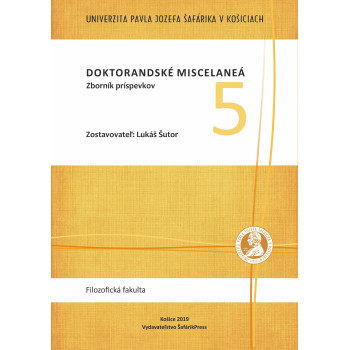
The fifth volume of Doctoral Miscellanea was created as a conference proceedings, returning to the original idea of the entire project: to establish a publication space for contributions from emerging scientists.
The first two issues of Doctoral Miscellanea consisted of outputs from departmental seminars, which involved internal discussions. Compared to direct publication, it proved more beneficial for doctoral students to verify their initial research results in multiple stages and present them in diverse ways (reaching more listeners and readers). The length of the texts in the first two issues was adapted to the duration of the presentations, but this practice was slightly disrupted by the omission of seminars in previous issues. In the current issue, the scope of the studies is somewhat more uniform.
An added value of the fifth volume was the meeting of all contributors at a joint conference, the Autumn School for Doctoral Students of the Faculty of Arts at UPJŠ in Košice, which took place on October 17, 2018, and October 18, 2018, in Danišovce.
We believe that this unique experience—often the first for many—of actively presenting at a scientific event could contribute to a better final version of the submitted contributions. At the same time, it allowed doctoral students to broaden their horizons within the humanities and social sciences, at least within the scope of the currently addressed dissertation research.
Lukáš Šutor
E-book
Zuzana Buráková - Petra Filipová
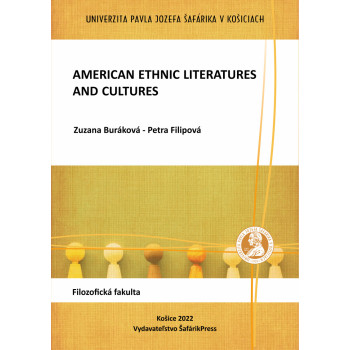
The canon of American literature has undergone constant revision with many authors who were long excluded from wider recognition now being accepted as significant figures. With the emergence of postcolonial and ethnic studies after the 1960s, the diversity of the literary canon has become greater than ever, and we can now see American literature as remarkably distinctive in this respect.
The question of how to define ethnicity and how far an immigrant should go to preserve their ethnic heritage have always been addressed by writers, together with larger issues such as the definition of national identity and national literature, and where we should draw the lines between local and global identities. We understand that a single course in American ethnic literature cannot hope to answer all these complex questions, but we firmly believe that discussing these questions in classes can help us to be more understanding and tolerant of ethnic diversity.
For this reason, the main aim of this textbook is to provide an interdisciplinary introduction to American ethnic literatures with an emphasis on their historical and cultural background, to expand students’ knowledge of American literatures and cultures at the master’s level and familiarize them with specific features of ethnic literatures in the contemporary USA. The textbook contains information on Native American, African American, Asian American, Jewish American, and Hispanic American literature, history and culture.
Download e-book for free (pdf)
E-kniha
Renáta Orosová Michal Novocký Zuzana Vagaská
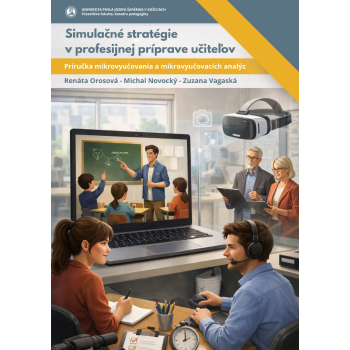
This publication provides a summary of knowledge about microteaching as a simulation strategy in the context of university teacher education. Readers will find theoretical foundations of simulation techniques, definitions and objectives of microteaching, the role of analysis as a tool for reflection, possibilities for implementation in both face-to-face and distance learning formats, and numerous examples of best practices. We believe that this text contributes to a deeper understanding of the importance of microteaching, a simulation strategy that systematically develops pedagogical skills and helps shape the professional competencies of future teachers.
E-book
Jana Šutajová Alexander Onufrák
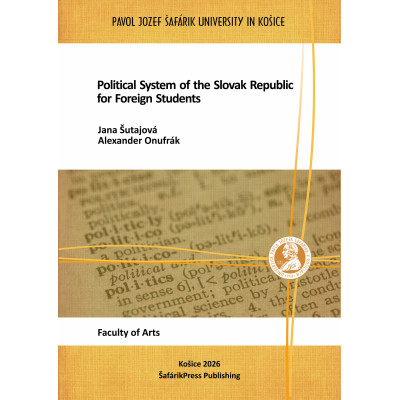
This university textbook, „Political System of the Slovak Republic for Foreign Students“, is designed to introduce Erasmus students and other international students to basic information regarding the historical and political development of Slovakia and the political system of the Slovak Republic. It focuses on political developments since 1918.
It introduces foreign students to pivotal historical events that influenced political developments in Slovakia (the establishment of the First Czechoslovak Republic, the Munich Agreement and the Vienna Arbitration, the Slovak State, postwar developments and the Košice Government Program, the 1946 elections, February 1948, the Prague Spring of 1968, normalization, the Velvet Revolution of 1989, the dissolution of the Czechoslovak Federal Republic, the establishment of the Slovak Republic, and its integration into the European Union and the North Atlantic Treaty Organization) and with the political system of the Slovak Republic (constitutional institutions, the party system, the electoral system).