Slovenčina


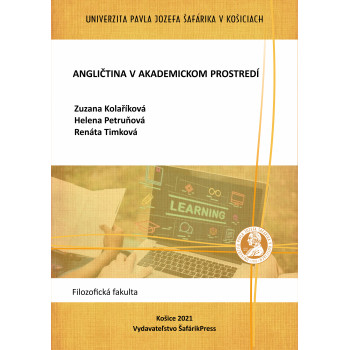
E-book
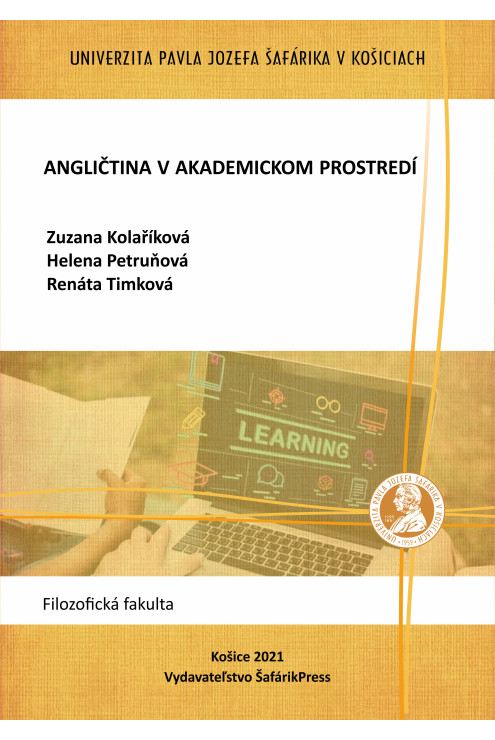
Zuzana Kolaříková - Helena Petruňová - Renáta Timková
English in the Academic Environment is intended primarily for those interested in improving their academic English and is primarily designed to fulfill the needs of university students and teachers who use English in their studies, in their work activities, and in their communication with foreign colleagues and professionals.
The publication offers selected phrases and sentence structures from the field of academic English, gives practical examples of the use of nominal, verbal and prepositional phrases, free and established collocations, idiomatic expressions, including translations of some selected phrases. It also highlights some common mistakes in the use of English in an academic environment, which are a manifestation of incorrect or insufficiently acquired linguistic resources and, last but not least, a consequence of the linguistic influence of Slovak.

Data sheet
E-book
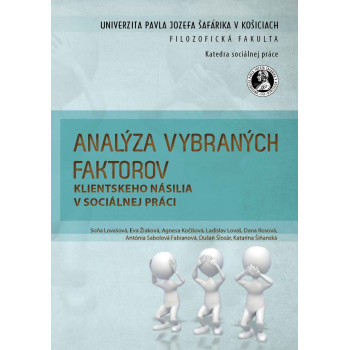
Soňa Lovašová a kol.
Violence in the workplace has been a problem that has received attention for fifty years. Client violence is one of its forms. These are cases where the aggressor is a person coming to an institution to use its services. Client violence affects all helping professions. This monograph deals with the specifics of client violence in social work.
In addition to theoretical outputs, it also offers research results conducted on a sample of 1170 respondents, frontline workers in selected entities providing services in the social field in Slovakia. The monograph represents a summary of three years of work by eight experts. Each author contributed within their area of expertise and brought a different perspective to the issue. The main aim was to bring a variety of views on the issue and attempt to combine them into a cohesive whole. Thus, a monograph was created that contains interesting theoretical foundations included in six theoretical chapters, starting with the introductory chapter on the position of client violence in the area of workplace violence.
The following chapters address the risk and riskiness of social work, ethical aspects, the personality of the social worker, and risk areas of social work. The research chapter presents the research project to the reader and three subchapters of findings processed in tables and described in detail.
The final part of the monograph deals with prevention and group work. An important part is also the appendices, which include a questionnaire battery, a program implemented for social work students, and a proposed program for workers in the social field.
E-book
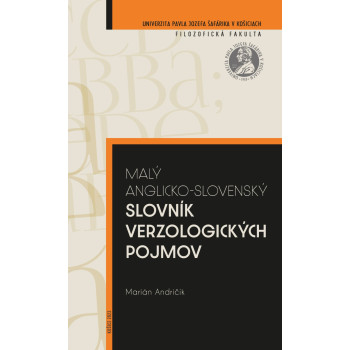
The basis for the creation of this publication was both our many years of translation activities in the field of Anglophone poetry and a consistent interest in theoretical questions in the area of versology. Years of collecting and compiling material ultimately culminated in this dictionary, which we present to the professional public with the awareness of its incompleteness and occasional terminological uncertainty in finding equivalents, since a more comprehensive comparative study in this field has not yet been published.
For this reason, alongside established terminological equivalents, we decided to offer our own proposals for those terms that so far have had no Slovak equivalents – these are graphically marked in italics. Given the narrowly defined target group of users, we have dispensed with the grammatical classification of individual headwords and, except for a few exceptions, also with their phonetic transcription, phenomena common in general dictionaries. In addition to individual headwords, the dictionary also contains established collocations used in versological literature. Since we expect the dictionary to serve as study material for students of English and Slovak philology, we have added a closer characterization or explanation of many equivalents in parentheses.
We believe that this dictionary, the first of its kind in our literary-scientific context, will become a solid foundation for further, more extensive, and more comprehensive handbooks.
Download e-book for free (pdf)
E-book
The book is primary designed for the first-year students of the study programme “English Language for European Institutions and Economy” and its subject “Comparative Phonetics and Phonology”. Following the structure of this subject, the textbook is divided into eleven chapters whose content provides the reader with the essential theoretical information about the given issue from the sound subsystems of the English and the Slovak languages. The structure of each chapter is as follows: (1) theoretical explanation of the topic, (2) Suggestions for further reading recommending additional sources that develop the topic, (3) exercises whose aim is to evaluate students’ theoretical knowledge of the theme presented in the particular chapter, as well as its practical application in the process of communication. Considering the content of the book, it can be also used a study material for the students of all philological study programmes whose content encompasses the sound system of the English and/or the Slovak language.
E-journal
Juraj Schenk et al.
The scientific journal Sociálne a politické analýzy (Social and Political Analyses) serves as an interactive electronic platform for communication and the presentation (publication) of experts and their work in the fields of basic and applied research and analyses within sociological, psychological, political, and methodological contexts. It is a medium focused on intensively supporting research activities and analyses within an interdisciplinary framework, facilitating the exchange of experiences, fostering collaboration, and revitalizing the production of scientific work in this area.
The publication section of the journal offers space for works such as:
- Original sociological, psychological, and political studies and analyses in any areas of social life
- Methodological studies
- Research reports
- Studies from qualification theses Research and analysis projects
- Reviews