Slovenčina


E-journal
Renáta Orosová (výkonný redaktor)
The scientific-professional journal Edukácia focuses on issues of education and upbringing in the fields of primary, secondary, and higher education.
It emphasizes the current state and perspectives of educational practice, contemporary aspects of pre-service teacher training, social pedagogy, special pedagogy, as well as pedagogical and psychological aspects of upbringing in basic educational institutions from the perspective of the broader educational community.
It is intended for researchers, young university lecturers, doctoral students, and professional and pedagogical staff, with the aim of presenting trends in education and stimulating discussion on current issues in the presented areas of upbringing and education.

Data sheet
E-book
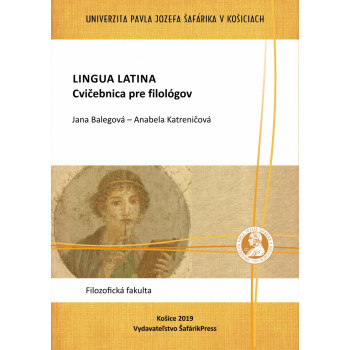
Jana Balegová - Anabela Katreničová
The university textbook Lingua Latina – a workbook for philologists is a parallel study material to the textbook Lingua Latina – cursus communis. It is designed for practicing grammatical material at home. The content of the exercises corresponds to the focus of individual lessons in the mentioned textbook, both in terms of the covered grammatical phenomena and vocabulary. For this reason, only vocabulary that was not part of the lessons covered in the textbook is included in the exercises.
A Latin-Slovak dictionary at the end of the workbook contains the entire vocabulary from both the workbook and the textbook. A Slovak-Latin dictionary includes the vocabulary from exercises that require translation into Latin. The vocabulary of this workbook is oriented towards the needs of students specializing in philology and, with regard to the selection of source materials, also includes non-classical lexicon or non-classical meanings of classical words (this lexicon is marked with an asterisk). The workbook includes a key that allows students to directly verify the correctness of their work.
The textbook Lingua Latina – a workbook for philologists is available electronically in PDF format. As part of the educational program, online tests available on the KKF FF UPJŠ website (https://www.upjs.sk/filozoficka-fakulta/katedra-klasickejfilologie/katedra/) also serve to practice the covered material.
E-book
It is impossible to be in contact with a person-centered approach and not be influenced by it. Carl Random Rogers was and is still perceived as one of the most influential psychologists of the 20th century (Cook, et al., 2009).
He was the first psychologist to be awarded twice by the American Psychological Association during his lifetime; in 1957 for his contributions to psychotherapy research and in 1973 for distinguished professional contributions. He developed his own psychotherapeutic approach, client-centered therapy, where unlike existing psychotherapeutic approaches, the healing power lies in the relationship between the client and the therapist, not in the applied method.
Rogers and his colleagues were the first to record, transcribe, and publish complete cases of therapeutic conversations and initiated systematic research in the field of psychotherapy. By using the term client instead of patient and seeking sources of change within the person, he created a non-medical model of help as part of the helping professions (Capuzzi, Gross, 2001). The self-theory created by Rogers is a theory that is included in many contemporary psychology texts (Cloninger, 2003; Feist, Feist, 2001; Ryckman, 2004).
Soňa Lovašová - Katarína Šiňanská - Magdaléna Halachová - Vladimír Lichner (eds.)
The central theme of the conference is violence in social work. Violence in social work appears in various forms, whether it involves working with clients who are victims of different types of violence or dealing with aggressive clients where the social worker themselves becomes the victim. Violence in society is rapidly increasing, and social work is a science that must necessarily adapt to society; this is its essence. Therefore, managing aggressive situations in any form is an important part of a social worker's personal skill set.
Unfortunately, protecting social workers from violence will gradually become a necessity, and in the future, we may not avoid training in self-defense and reducing aggression as part of professional preparation or lifelong education.
The aim of this collection is to present the issue of violence in social work from various perspectives to both the professional and lay public. We hope that this serious problem will receive increasing attention and that the individual contributions will help readers understand the extent of the problem of violence in social work.
E-book
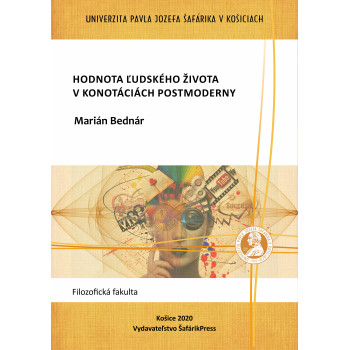
The scientific monograph The Value of Human Life in the Connotations of Postmodernism presents a current issue of reflections on the value of human life. It sees in the broader connotations of postmodern society, where the approaches of applied ethics (bioethics), philosophy and Christian theology intersect. This issue is embedded in the historical, philosophical, sociological and cultural-social Postmodernism.
The monograph analyses the postmodern value system, the dominant postmodern anthropological concept, secular bioethics and civil law in relation to human life and its value. The key is the confrontation of the postmodern anti-life mentality and life in the most discussed bioethical issues: contraception, artificial insemination techniques, genetic manipulation, abortion, sterilization, (bio) technology, euthanasia. An alternative approach is offered by the theological vision of human and life presented in the Judeo-Christian context. In the light of modern theological disciplines, the personnel concept is enriched by theological anthropology culminating in an eschatological vision.
In this sense, the issue of the value of human life culminates, which is also inspired by one of the most important encyclicals of Pope John Paul II. Evangelium vitae (25th anniversary of its writing). It is she who calls for the acceptance and respect of every human life and for the practical development of a new culture of life.