Slovenčina


E-book
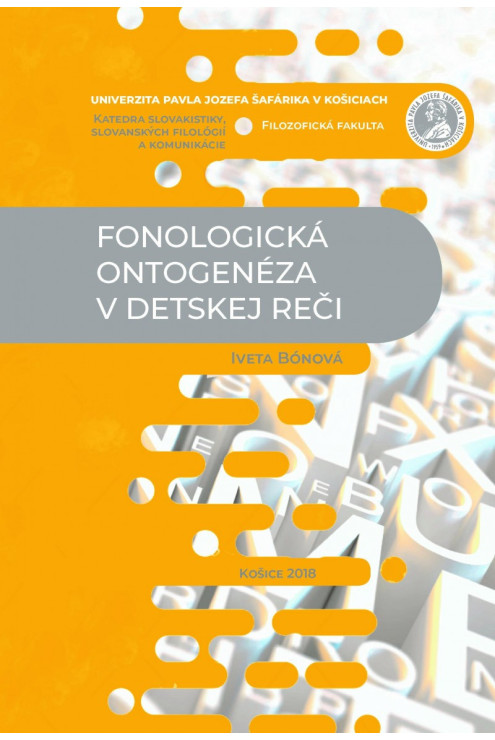
The foundations of the presented work were developed alongside the emerging research on child language in Slovakia. An enthusiastic team of individuals from several scientific fields—psychology (Marína Mikulajová), speech therapy (Svetlana Kapalková), and linguistics (Daniela Slančová, Jana Kesselová, Zuzana Ondráčková, Stanislava Zajacová, Iveta Bónová)—met regularly, discussed, and sought ways to mobilize efforts to achieve their set goals: conducting research on the language of intact (healthily developing) children based on actual longitudinal observation.
I am very pleased and grateful to have been part of the team at the beginning of systematic research in the field of child language acquisition in Slovakia. As a member of this team and a co-researcher on several projects in this area, I had the opportunity to participate in research on child language, which is no longer "on the fringes" of scientific interest. It has become a serious, exact study supported by quantitative and qualitative data, conducted systematically "at an excellent scientific level" (Průcha, 2011, p. 14).
The research itself was naturally preceded by data collection. The technologies of the late 20th century enabled the replacement of the outdated diary recording method with what is now the most commonly applied approach to material collection—audio-visual recordings. The synthesis of analyzed data collected over time, its explanation, generalization, and integration into a broader interdisciplinary research context is all the more interesting and beneficial as it contributes to speech therapy practice. Thanks to the results of the latest research, intervention possibilities in speech therapy are expanding, and methods for (early) diagnosis and stimulation are being developed and refined.

Data sheet
E-book
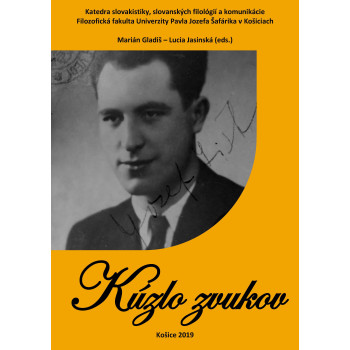
Marián Gladiš - Lucia Jasinská (eds.)
This peer-reviewed collection of papers is a publication output of the scientific colloquium named The Magic of Sounds, which was organized by the Department of Slovak Studies, Slavonic Philologies and Communication at the Faculty of Arts of the Pavol Jozef Šafárik University in Košice, and by the Košice Branch of the Slovak Linguistic Society at the Ľudovít Štúr Linguistic Institute of the Slovak Academy of Sciences in Bratislava, on the occasion of the 100th anniversary of birth of Associate Professor PhDr. Jozef Liška, PhD., the founder of the Slovak logopaedics.
Participants focused their papers on the analysis of the linguistic and speech therapy work of J. Liška, his contribution to Slovak dialectology and orthoepy, presented him as an Anglicist, and they also dealt with the audio aspect of children's speech, exact methods of disturbances and low voice quality measuring, or machine speech processing.
An interpretative paper of the documentary They Will Speak Well, a socially important piece of film work, which was made in 1958 under the supervision of J. Liška, is also included in the proceedings.
E-book
Renáta Orosová - Lucia Diheneščíková - Katarína Petríková - Lívia Nemcová
Proceedings of Abstracts from the International Scientific Conference: Education and Training 2018: The 21st Century Educator and Their Perspectives in Educational Practice
The international scientific conference focuses on issues related to education and training in primary, secondary, and higher education institutions from the perspective of educators.
It emphasizes the current state and future perspectives of 21st-century educators in educational practice, addressing pedagogical and sociological aspects of education within foundational educational institutions. Additionally, it explores contemporary aspects of pre-service teacher preparation.
The conference is aimed at researchers, young university lecturers, doctoral students, as well as professional and educational practitioners. Its goal is to present the educator—whether a teacher, social pedagogue, or special educator—in a modern perspective, highlighting their essential collaboration in the context of education. Furthermore, it seeks to stimulate discussions on pressing issues within the fields of education and training in light of the current situation in the education sector.
E-book
Silvia Kontírová a kol.
Pedagogical practice is an organizational form of higher education training for prospective teachers, implemented through mandatory pedagogical practice subjects.
These subjects have an integrative and practical-training character, building upon the theoretical and practical instruction provided to students at the faculty. They are conducted within the scope defined by curricula in the conditions of specialized workplaces (training schools) and under the supervision of qualified professionals (training teachers). Unlike other higher education subjects, pedagogical practice primarily provides students with opportunities for independent creative teaching in real school environments.
The practical activities of students in training schools are characterized as supervised, monitored, and evaluated by designated entities.
E-book
Mária Bačíková - Anna Janovská
The textbook "Foundations of Methodology in Pedagogical-Psychological Research" is primarily intended for students of teaching academic subjects, but it will enrich anyone who needs to familiarize themselves with research methodology focusing on psychological and pedagogical sciences. In the textbook, students become acquainted with the basic principles of conducting research, the process of research implementation, and the basic methods of quantitative or qualitative approaches. The examples used in the textbook are mostly focused on research conducted in a school environment.
By mastering the basic knowledge presented in the textbook, the reader will be able to conduct simple research in school conditions. At the same time, understanding the principles of research methodology helps with the critical evaluation of information from various sources. In preparing the textbook, we utilized our long-term experience with teaching the subject of research methodology, as well as with implementing many research projects. We believe that the simple language of the textbook and the abundance of practical examples will help students understand the basics of such complex issues as research methodology.
We would like to take this opportunity to thank the students of the Faculty of Arts and Natural Sciences at P. J. Šafárik University in Košice who attended the course "Foundations of Methodology in Pedagogical-Psychological Research" in the previous academic year for their inspiration, constructive comments on previous versions of the text, and ideas (or mistakes) that we drew upon in the textbook. We also thank other students who allowed us to use examples from their final theses in the textbook. The conclusion of the work is open because, as it turns out, we do not have a common denominator for both concepts that could decide on the correctness of one or the other concept. It is precisely in this that the Socratic question remains a serious philosophical problem today.