Slovenčina


E-book
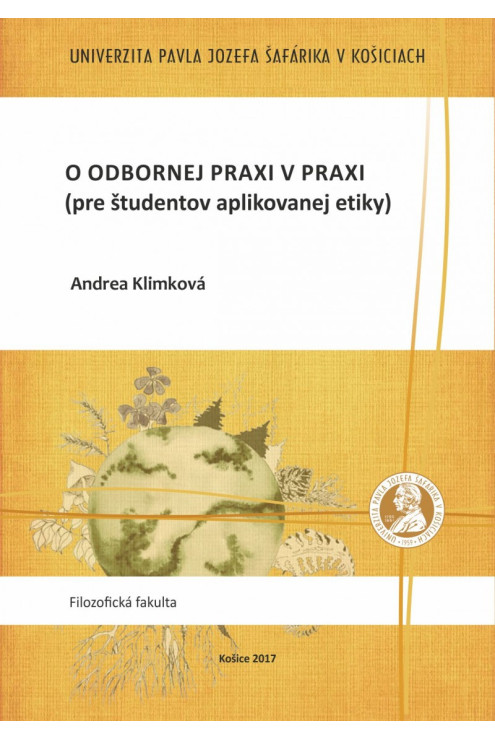
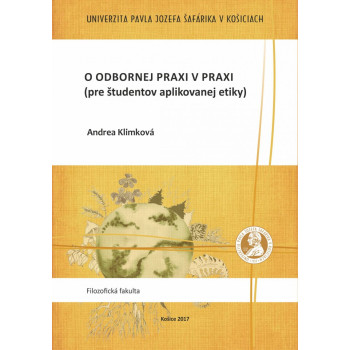
The current development of applied ethics globally suggests that applied ethics is entering a new, qualitatively distinct era of innovative application approaches, methodologies, and methods, as well as novel educational formats. The application levels in applied ethics (in bioethics, business ethics, technology ethics, professional ethics, etc.) are tied to critical reflection on previous strategies and methodologies in their teaching.
Combining ethical rationality with practical variability and implementing ethical policies and tools in concrete practice truly demands new competencies, new skills, and the ability to work in novel ways with empirical and normative frameworks. This requires working with ethical theory and moral practice inventively, heuristically, innovatively, and propedeutically.
The creation of useful and professionally constructed procedures and formats is part of the professional and academic preparation of applied ethicists at modern departments of applied ethics.

Data sheet
E-book
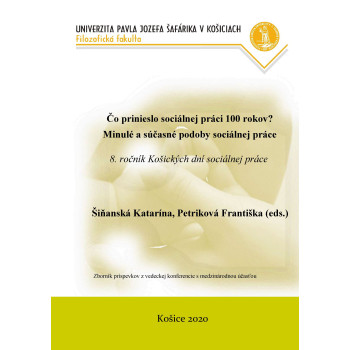
Katarína Šiňanská - Františka Petriková (eds.)
The present proceedings is devoted to different perspectives on the problems addressed by the field of social work and also the changes in the orientation of social work with respect to the current requirements of society. Proceeding is made up of a wide range of contributions from various spheres belonging to the sphere of social work. Contributions are devoted to the cyber world of social work, supervision, self-care, risk behavior, but also social work in the past.
The cyberspace in social work is elaborated in several contributions, suggesting a new dimension of social work. In the contributions about cybe world, the authors consider “cyberspace” as a new form of counseling and assistance to clients, as the present time is more online-oriented. Proceedings of international conference "What has brought social work 100 years?"
The past and present forms of social work are therefore devoted to various themes, incentives and insights into the benefits of the contribution of social work over 100 years, examining and evaluating past, present but also future forms of social work as a science.
E-book
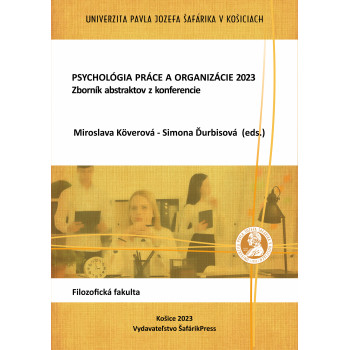
Miroslava Köverová - Simona Ďurbisová (eds.)
Proceedings present abstracts of contributions registered for the scientific conference Work and Organizational Psychology 2023. Conference date and venue: 8-9 June 2023, Department of Psychology, Faculty od Arts, Pavol Jozef Šafárik University in Košice.
E-book
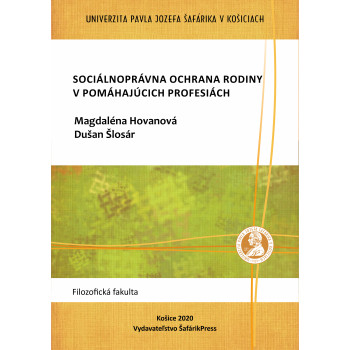
Magdaléna Hovanová - Dušan Šlosár
The monograph deals with the issue of social protection of the family, where the basis is a view of the family as a natural part of human and social life. The starting point is provided by the institutes that create and structure it, influence its value orientation, the development of social relations within the family, but also relations to the social environment.
In broader contexts, the monographic treatment of social protection provides the results of transdisciplinary knowledge. It deals with the work of helping professionals with functional and non-functional families and families with special needs. It offers problem solving through tailored methods, techniques, procedures and measures used by various helping professions in the field of social protection and social guardianship.
E-book
The scientific monograph "Spirituality in Slovak Realist and Modernist Literature" reevaluates interpretative approaches to the spiritual dimension in prose texts of Slovak literature from the realist and modernist periods. The author transcends stereotypical views on spirituality, often confined to religious themes, and advocates for an interdisciplinary approach and new methodological approaches in literary-critical research. The monograph focuses on literary characters and their spiritual dimension in connection with other compositional and semantic elements of literary texts. It does not offer a definitive view on the topic but aims to open discussion and highlight the need for a reassessment of the literary canon and the openness of artistic literature to multiple interpretations. The analysis of texts from Slovak realism and literary modernism demonstrated a differentiated spirituality and its artistic portrayal. The phenomenon of spirituality is present in the texts along the axis of explicitness - implicitness - latency and has its specific manifestation in shaping literary characters through psychologization, introspection, and spiritual depth.
Download e-book for free (pdf)