Slovenčina


E-book
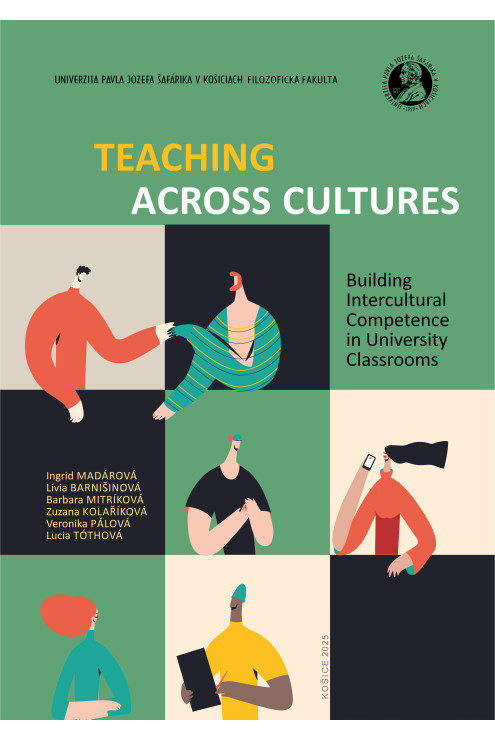
Ingrid Madárová - Lívia Barnišinová - Barbara Mitríková - Zuzana Kolaříková - Veronika Pálová - Lucia Tóthová
This handbook is primarily intended for university teachers who regularly come into contact with international students. It focuses on supporting effective intercultural communication in the academic environment. Through examples of specific situations from everyday academic life, it offers recommendations on how to prevent potential misunderstandings arising from intercultural differences. It also includes practical advice aimed at building open, culturally sensitive, and respectful communication that enhances mutual understanding and fosters an inclusive educational environment.

Data sheet
E-book
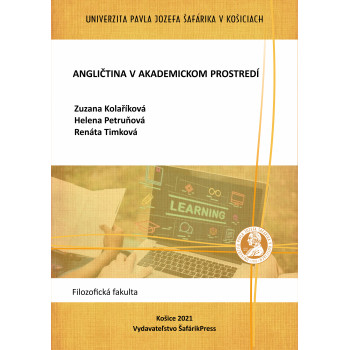
Zuzana Kolaříková - Helena Petruňová - Renáta Timková
English in the Academic Environment is intended primarily for those interested in improving their academic English and is primarily designed to fulfill the needs of university students and teachers who use English in their studies, in their work activities, and in their communication with foreign colleagues and professionals.
The publication offers selected phrases and sentence structures from the field of academic English, gives practical examples of the use of nominal, verbal and prepositional phrases, free and established collocations, idiomatic expressions, including translations of some selected phrases. It also highlights some common mistakes in the use of English in an academic environment, which are a manifestation of incorrect or insufficiently acquired linguistic resources and, last but not least, a consequence of the linguistic influence of Slovak.
E-book
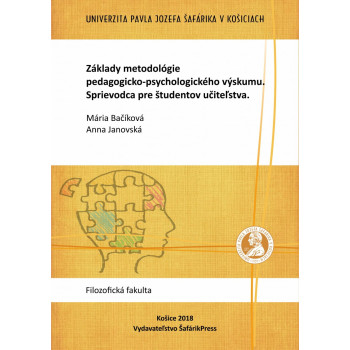
Mária Bačíková - Anna Janovská
The textbook "Foundations of Methodology in Pedagogical-Psychological Research" is primarily intended for students of teaching academic subjects, but it will enrich anyone who needs to familiarize themselves with research methodology focusing on psychological and pedagogical sciences. In the textbook, students become acquainted with the basic principles of conducting research, the process of research implementation, and the basic methods of quantitative or qualitative approaches. The examples used in the textbook are mostly focused on research conducted in a school environment.
By mastering the basic knowledge presented in the textbook, the reader will be able to conduct simple research in school conditions. At the same time, understanding the principles of research methodology helps with the critical evaluation of information from various sources. In preparing the textbook, we utilized our long-term experience with teaching the subject of research methodology, as well as with implementing many research projects. We believe that the simple language of the textbook and the abundance of practical examples will help students understand the basics of such complex issues as research methodology.
We would like to take this opportunity to thank the students of the Faculty of Arts and Natural Sciences at P. J. Šafárik University in Košice who attended the course "Foundations of Methodology in Pedagogical-Psychological Research" in the previous academic year for their inspiration, constructive comments on previous versions of the text, and ideas (or mistakes) that we drew upon in the textbook. We also thank other students who allowed us to use examples from their final theses in the textbook. The conclusion of the work is open because, as it turns out, we do not have a common denominator for both concepts that could decide on the correctness of one or the other concept. It is precisely in this that the Socratic question remains a serious philosophical problem today.
E-book
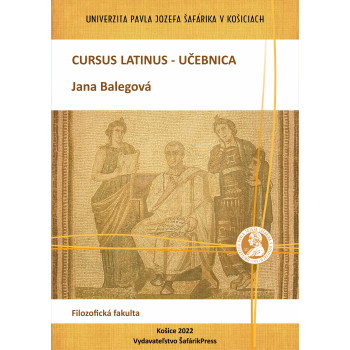
University textbook „Cursus Latinus - textbook“ is intended for students of the study program Latin language and literature. It is divided into „Introduction“ and 37 lessons. The content of lessons is morphology, sentence syntax and selected phenomena of case syntax of the Latin language. Each of the lessons contains a grammatical explanation, followed by sentences designed to demonstrate the forms of grammatical phenomena and the required vocabulary (Dictionary). Using these examples, students learn the basic principles of translation from Latin into Slovak and from Slovak into Latin. The textbook also includes a Latin-Slovak dictionary containing the entire vocabulary used in the textbook. The „Cursus Latinus - textbook“ is intended for the interpretation of grammar and the acquisition of grammatical phenomena of the Latin language under the guidance of the teacher. A parallel exercise book (Cursus Latinus – exercise book) is used to practice Latin grammar at home. The exercise book includes a key to the exercises and a Latin-Slovak dictionary containing vocabulary from the textbook and the exercise book. University textbook „Cursus Latinus - textbook“ is available electronically in PDF format.
E-book
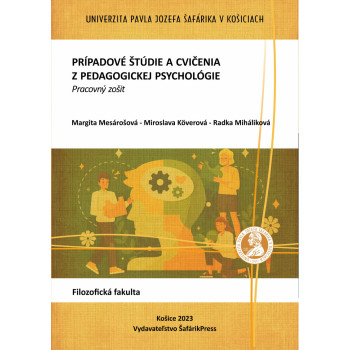
Margita Mesárošová - Miroslava Köverová - Radka Miháliková
The publication is a follow-up to the university textbook Progress in Educational Psychology. It is intended for both bachelor and master degree students.
It contains questions, tasks, practical exercises, case studies and topics for discussion in the field of educational psychology.
The aim of the publication is to support the active involvement of students in teaching, consolidation and deepening of their theoretical knowledge in educational psychology, as well as practicing and improving practical skills.
Download e-book for free (pdf)