Slovenčina


E-book
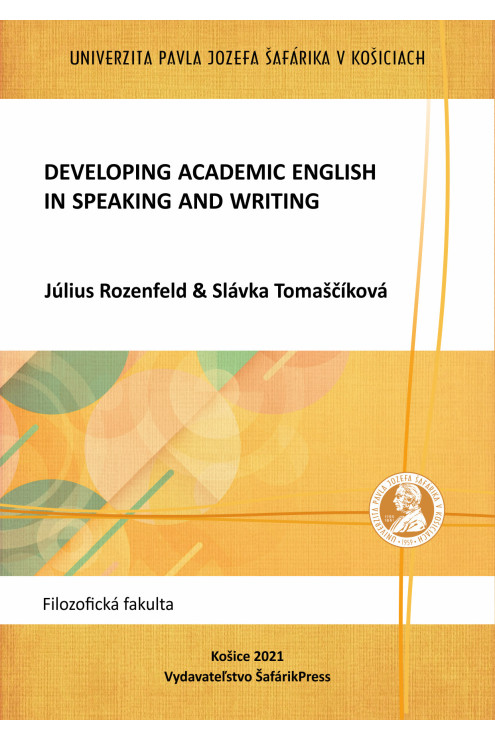
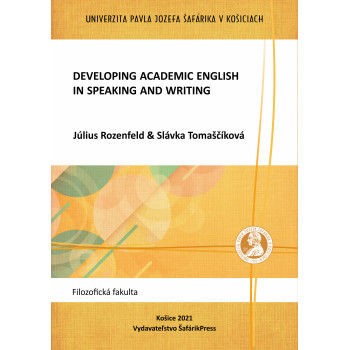
Július Rozenfeld - Slávka Tomaščíková
The academic textbook entitled “Developing Academic English in Speaking and Writing” responds to the need identified by the authors in their own teaching practice to integrate the enhancement of the academic skills of speaking and writing into a single coherent approach. Using complex methodologies of academic speaking and academic writing, the authors offer practical guidelines on how to broaden students’ knowledge of the discourse of Academic English and how to improve their academic competencies and productive language skills in speaking and writing in English.
The textbook is designed for university students of English philology, students of literary and cultural studies focusing on Anglophone areas, students of English translation and interpretation study programmes, but also for students who study in English and who are expected to engage in scientific inquiry, document their research in Bachelor and Master theses or in doctoral dissertations written in English, and to present their work to their academic community.

Data sheet
E-book
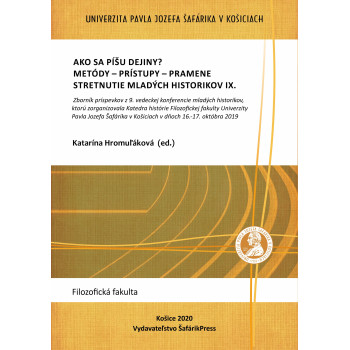
Katarína Hromuľáková (ed.)
Proceedings of the Scientific Conference. Košice, October 16-17, 2019
The proceedings titled "Ako sa píšu dejiny? Metódy – prístupy – pramene" present the contributions from the conference "Meeting of Young Historians IX," annually organized by the Department of History, Faculty of Arts, UPJŠ.
In the individual contributions, which span from the Middle Ages to the most recent history, the authors propose various theoretical and methodological research approaches to history, which currently represent fundamental prerequisites for historical research.
The ambition of the authors, as the next generation of historians, is not only to open up current questions of theoretical reflection in historiography but also to offer concrete examples supported by their own research.
Mgr. Katarína Hromuľáková
E-book
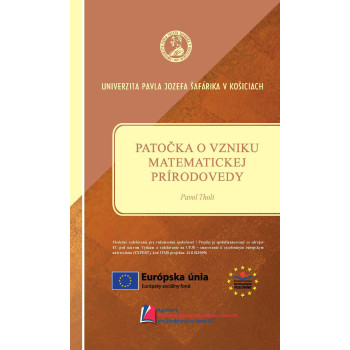
The work presented in the following text is an attempt to analyze Patočka's perspective on the emergence and essence of mathematical natural science in the 17th century. During this period, Patočka's attention was particularly drawn to Descartes' philosophy and Cartesianism, as well as the philosophies of Galileo, Bacon, and Leibniz.
Patočka himself devoted continuous and exceptional attention to these questions, as evidenced by several monographic works and numerous articles and studies he wrote on the subject.
E-book
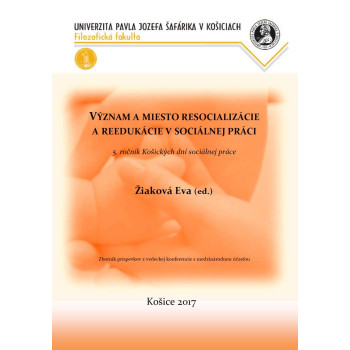
Eva Žiaková (ed.)
The 5th edition of the Košice Days of Social Work
Proceedings of the scientific conference with international participation held on November 25, 2016, in Košice
The issue of re-education and resocialization is not new, but it is an increasingly urgent problem as various types of dependencies grow in both scope and content. It can be said that this issue represents one of the central themes of social work in its theoretical foundations as well as practical contexts.
This was the main reason for selecting this topic as the central theme of the 5th edition of the Košice Days of Social Work, which was the sixth continuation of the professional community’s gatherings to address social problems currently troubling our society. The presented proceedings include nearly three dozen contributions from more than twenty authors from Slovakia, as well as Poland and the Czech Republic. The content of the contributions deals not only with theoretical foundations and perspectives on the issue of resocialization and re-education but also with the consequences of these processes in various client social risk groups—whether it involves the addicted, aggressive, chronically ill, convicted, divorced, bullied, cyberbullied, etc.
I believe that such a wide range of contributions will enrich all those who work and study in the theoretical, research, and practical fields of social work.