Slovenčina


E-book
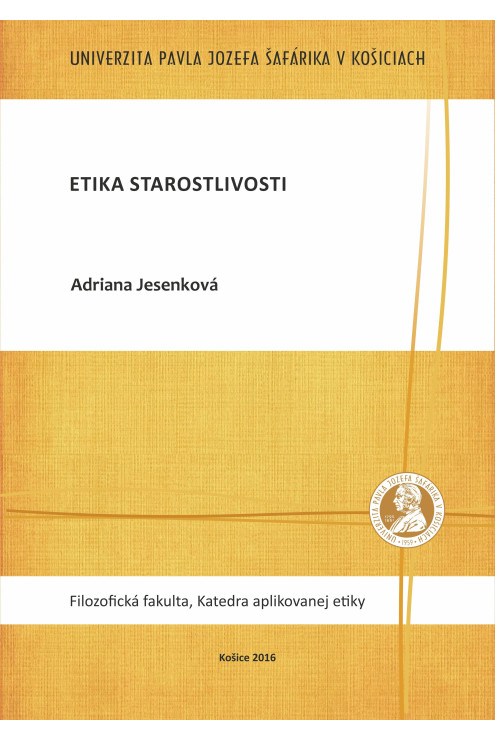
The ethics of care offers inspiring ways to think about the relationships and connections we are part of. It provides a new and unconventional reading and understanding of human relationships, thereby enabling us to respond in new and appropriate ways to certain empirical challenges (Pettersen 2011, p. 51).
Just twenty-five years ago, thinking about care was associated with women’s decisions in the private sphere concerning their personal dilemmas and problems. Over the last two decades, advocates of the ethics of care have demonstrated that the ideal of care has the potential to regulate not only private behavior but also human interactions in general.
Today, ideas about care have the power to change how we evaluate personal relationships, professional conduct, public policy, international relations, and global issues. The relevance of the ethics of care in such a wide range of areas of life, many of which are characterized by mutual incompatibilities and conflicting interests, is conditioned by several factors. However, one of the most significant is the creativity and fruitfulness of the thinking of the representatives of the ethics of care, who develop ethical concepts, models, and methods capable of grasping and analyzing human relationships in all their diversity (Pettersen 2011, p. 52).
Compared to traditional ethical concepts and theories in moral philosophy, the ethics of care introduces radically different sets of models and normative concepts. Today, it is precisely feminist ethics of care that offers a critical reflection on care within the realm of moral philosophy, ethics, and social philosophy. The aim of this publication is to identify the concept, subject, approach, philosophical foundations and starting points, as well as the possibilities for applying the ethics of care as a specific moral approach and, at the same time, as a specific moral theory in the field of social science and humanities research.
Data sheet
E-journal
Renáta Orosová (výkonný redaktor)
Vedecký recenzovaný časopis Edukácia je zameraný na problematiku vzdelávania a výchovy v oblasti základného, stredného a vysokého školstva. Zreteľ kladie na súčasný stav a perspektívy edukačnej praxe, aktuálne aspekty pregraduálnej prípravy učiteľov, sociálnej pedagogiky, špeciálnej pedagogiky, ako aj pedagogické a psychologické aspekty výchovy v základných výchovných inštitúciách z pohľadu širokej pedagogickej verejnosti. Je určený vedeckým pracovníkom, mladým vysokoškolským učiteľom, doktorandom, ako aj odborným a pedagogickým pracovníkom s cieľom prezentovať trendy v edukácii a vyvolať diskusiu k aktuálnym otázkam prezentovaných oblastí výchovy a vzdelávania.
Ciele vedeckého časopisu Edukácia:
E-book
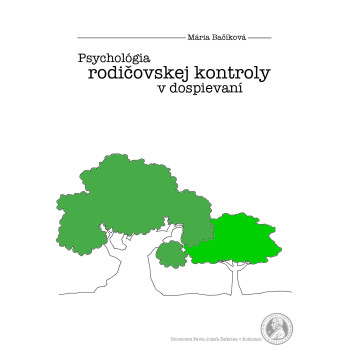
The primary aim of the presented monograph is to introduce Slovak readers to the current state of knowledge in the field of parental control psychology and its consequences for various aspects of adolescent development. Additionally, it seeks to present research findings obtained from a representative sample of Slovak adolescents in early adolescence. The topic of parental control has been marginally addressed in the Slovak context, primarily as part of studies on parenting styles, but a detailed analysis of its forms and consequences within the Slovak environment is lacking.
The monograph is divided into nine chapters, with the first seven being theoretical in nature: Chapter 1 focuses on specific aspects of the parent-adolescent relationship and describes changes that occur during adolescence. Chapter 2 introduces the construct of parental control, situating it within several social-personality theories and general parenting styles. Chapter 3 examines two fundamental forms of control: behavioral and psychological, as well as their interplay. Chapter 4 defines the concept of structure as one form of parental control. Chapter 5 summarizes current knowledge about gender differences in the application of parental control. Chapter 6 presents factors related to the application of control, including child-related, parent-related, and contextual factors. Chapter 7, concluding the theoretical section, discusses discrepancies in perceptions of control between adolescents and their parents.
E-book
Iveta Bónová - Marián Gladiš (eds.)
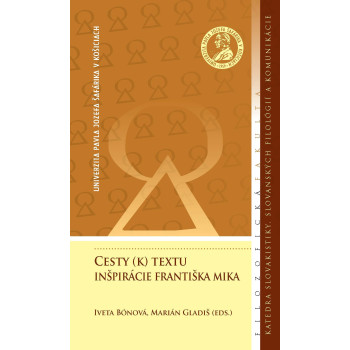
About the personality of university professor František Miko, DrSc., much has rightly been written, especially after 1989. Indeed, anyone involved in language and literature, at least within the geographical scope of the West Slavic region, is familiar with his work, particularly his brilliant expressive conception of style.
Our ambition in the introduction of this presented collection is not to substitute a dictionary of linguists, nor to provide a comprehensive view of his life and professional career. Rather, it is to remind ourselves of an exceptional individual—a scientist whose attitude, contributions, and results have influenced and continue to influence not only entire generations of researchers but also scientific thinking as a whole.
In the presented collection, we supplement the characterization contained in the inventively and convincingly formulated title of the obituary The Quiet Revolutionary of Our Science, František Miko, with a set of thematically diverse contributions (from the fields of style, sound, translation studies, phraseology, didactics...) dedicated to this significant figure of Slovak science on the occasion of what would have been his ninety-fifth birthday.
E- journal
Renáta Orosová (výkonný redaktor)
Vedecký recenzovaný časopis Edukácia je zameraný na problematiku vzdelávania a výchovy v oblasti základného, stredného a vysokého školstva. Zreteľ kladie na súčasný stav a perspektívy edukačnej praxe, aktuálne aspekty pregraduálnej prípravy učiteľov, sociálnej pedagogiky, špeciálnej pedagogiky, ako aj pedagogické a psychologické aspekty výchovy v základných výchovných inštitúciách z pohľadu širokej pedagogickej verejnosti. Je určený vedeckým pracovníkom, mladým vysokoškolským učiteľom, doktorandom, ako aj odborným a pedagogickým pracovníkom s cieľom prezentovať trendy v edukácii a vyvolať diskusiu k aktuálnym otázkam prezentovaných oblastí výchovy a vzdelávania.
Ciele vedeckého časopisu Edukácia:
• prezentovať súčasné postavenie a funkciu pedagóga v edukačnej praxi a jeho perspektívy,
• prezentovať aktuálne otázky vzdelávania a výchovy z pohľadu učiteľov, sociálnych pedagógov, špeciálnych pedagógov a psychológov,
• prezentovať inovácie v edukačnej praxi; analyzovať stav a problémy prepájania teórie a praxe výchovy a vzdelávania vo vzťahu k moderným vyučovacím koncepciám,
• prezentovať aktuálne trendy v pregraduálnej príprave pedagógov,
• prezentovať výsledky empirických výskumov z oblasti pedagogiky, sociálnej pedagogiky, špeciálnej pedagogiky a psychológie v prostredí rodiny, školy a mimoškolských výchovných inštitúcií.