Filter By

Categories

Categories

Selections

Selections

Year of publication:

Year of publication:

Publication language:

Publication language:

Faculty:

Faculty:

Active filters

  • Year of publication:: 2009
  • Year of publication:: 2014
  • Year of publication:: 2016
  • Year of publication:: 2017
  • Year of publication:: 2026
  • Year of publication:: 2026
  • Year of publication:: 2026
  • Faculty:: Faculty of Law
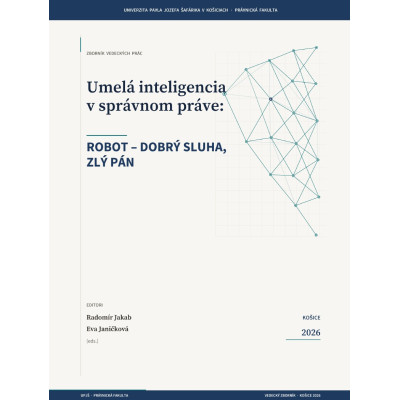
Umelá inteligencia v správnom práve: ROBOT - DOBRÝ SLUHA, ZLÝ PÁN
  • New

Umelá inteligencia v správnom práve: ROBOT -...

E-book

E-book

Radomír Jakab     Eva Janičková  (eds.)

This collection of scientific papers is a direct output of the 2nd Czechoslovak Symposium titled "AI in Administrative Law: ROBOT – GOOD SERVANT, BAD MASTER," held on October 2nd and 3rd, 2025, in the Tokaj region. The symposium was organized as part of the research project VEGA no. 1/0062/25, entitled "Automation of Decision-Making Processes in Public Administration".This proceeding provide a comprehensive presentation and professional confrontation of knowledge regarding the use of artificial intelligence within decision-making processes in public administration, at both the national and European levels.

Individual contributions examine the theoretical limits of national regulations, as well as practical impacts in sectoral areas, such as the digitalization of the labor market, alternative resolution of administrative disputes, prevention of illegal content, and the specific issue of liability for null and void decisions issued by artificial intelligence systems. The ultimate goal of these contributions is formulation of legislative recommendations aimed at streamlining administrative proceedings in the Slovak Republic, while simultaneously respecting the principles of the rule of law and the protection of fundamental human rights and freedoms.
Download the e-book for free (pdf)

Košice Days of Private Law VI.

Košice Days of Private Law VI.

E-book

E-book

Peter Molnár Miroslava Kušníriková  Michal Bartko Júlia Krajčírová Marek Kohút

The peer‑reviewed proceedings of the international scientific conference Košice Days of Private Law VI, held on 22–24 April 2026, represent a partial output of research projects approved by the Scientific Grant Agency of the Ministry of Education, Science, Research and Sport of the Slovak Republic and the Slovak Academy of Sciences (VEGA). The publication results from the projects VEGA No. 1/0492/26, entitled “The Concept of Civil Litigation and Individual Types of Actions under the Civil Dispute Procedure Code – Findings, Challenges, Perspectives”, and VEGA No. 1/0501/26, entitled “Trustworthy Online Space: Protection of the Minor Consumer in the European Digital Market”.

Download the e-book for free (pdf)

Rozhodovacia prax súdnych autorít v súkromnom práve II

Rozhodovacia prax súdnych autorít v súkromnom...

E-book

E-book

Žofia Mrázová Natália Kalinák

On November 28, 2025, the Department of Commercial Law and Economic Law, in cooperation with the Department of Labor Law and Social Security Law of the Faculty of Law at UPJŠ in Košice, organized the 10th anniversary student symposium focused on commercial law, labor law, and IT law. The symposium, entitled "Decision-making practice of judicial authorities in private law II," built on the success of the previous year and once again provided students with an opportunity to showcase their analytical skills and legal creativity. The symposium was prepared as part of the APVV-23-0331 scientific project "Integration of the Capital Markets Union: Changes in Corporate Financing and the Rescue of Commercial Companies in Financial Difficulties."

Download the e-book for free (pdf)

Hranice zmluvnej slobody v pracovnom práve

Hranice zmluvnej slobody v pracovnom práve

E-book

E-book

Marcel Dolobáč

The author's ambition is to build on the current and at the same time to stimulate further discussion of the anchoring of labour law in the system of private law sectors and to contribute to the variation of views in relation to freedom of contract and its limits in labour law. The broad contractual freedom of civil law does not apply to the field of labour law, and thus the penetration of standard civil law institutes into labour law relations is not always self-evident.

The above constitutes the main theses of the present monograph. The issue of freedom of contract in labour law can be grasped in several ways. The author has chosen a content structure that is built on three basic pillars. In the first part, the author assesses the position of labour law in the system of law, which is determined primarily by the actual subject of legal regulation - dependent labour and the specific method of legal regulation through cogent and relatively cogent norms. In this context, the author would like to note at the outset that the much-discussed dispositive nature of labour law norms appears to be merely presumptive. Labour law is built on minima and maxima, with relative mandatory norms being the building blocks of fixed boundaries, a fact that distinguishes labour law from other branches of private law. These considerations are followed by the author's view of autonomy of will in labour law. The limits of contractual freedom (not only) in the theoretical sense form the second pillar of the author's ideas.

Finally, the third part of the thesis is to be the one that translates the theoretical-legal considerations of the interconnection of civil law and labour law into the interpretation of selected civil law institutes and the possibility of their application and implementation in labour law relations.

Download he e-book for free (pdf)

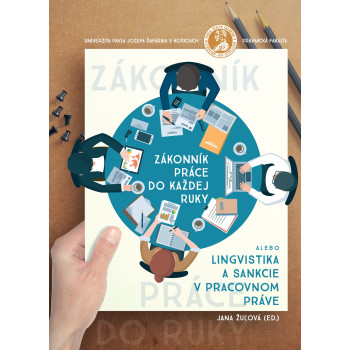
Zákonník práce do každej ruky alebo lingvistika a sankcie v pracovnom práve

Zákonník práce do každej ruky alebo lingvistika...

E-book

E-book

Jana Žuľová

Proceedings of the Second Annual Student Symposium on Labor Law held on May 12–13, 2017 in Danišovce

The presented proceedings are the result of scientific works by students of the Faculty of Law at Pavol Jozef Šafárik University in Košice and are systematically divided into two parts.

The first part presents interdisciplinary intersections of linguistics and labor law in its creation, interpretation, and application. The second part addresses the issue of targeting the addressees of labor law norms through various sanction mechanisms. The proceedings include a questionnaire compiled by the researchers of a grant project, aimed at determining whether and in which aspects the Labor Code diverges from its addressees in terms of linguistic and stylistic processing. Indeed, there is no other legal norm that is closer to the participants of labor relations, and whose understanding at the highest possible level is justified by its everyday use.

The presented proceedings thus serve as a means of expanding the horizons of our students beyond their regular studies and as a tool for popularizing scientific research. In case of interest, the completed questionnaire can be sent to: jana.zulova (@) upjs.sk.

Download the e-book for free (pdf)

Zborník príspevkov z X. ročníka študentského sympózia z medzinárodného a európskeho práva

Zborník príspevkov z X. ročníka študentského...

E-book

E-book

Adam Giertl (ed.)

Proceedings of the Student Symposium on International Law and European Law held on April 28, 2017, at the Faculty of Law of Pavol Jozef Šafárik University in Košice

The Student Symposium is regularly organized by the Institute of International Law and European Law, and in 2017, it marked the jubilee tenth edition of the symposium, which over time expanded its focus to include European law.

The tradition of holding student symposia is also associated with the good practice of preparing proceedings from each event. Understandably, the tenth edition is no exception, and thus, the tenth edition of the symposium proceedings is now available to readers. In previous years, the symposium has always focused on specific areas of international and European law. Thus, the subjects of study for symposium participants have included migration issues (2016), the protection of cultural values (2015), and the challenges of cyberspace (2013).

This year, given that it is the jubilee tenth edition, the symposium organizers have chosen to approach the symposium's focus thematically and recall some significant milestones in the development of international law that occurred in years ending with the number seven.

Download the e-book for free (pdf)

Právne postavenie spoločníka v obchodnej spoločnosti

Právne postavenie spoločníka v obchodnej...

E-book

E-book

Žofia Šuleková (ed.)

Proceedings of the Contributions from the IV. Student Symposium on Corporate Law held on November 24-25, 2016, at the Training Facility of Pavol Jozef Šafárik University in Danišovce.

The Department of Commercial Law and Economic Law at the Faculty of Law of Pavol Jozef Šafárik University in Košice organized the fourth edition of the student symposium, this time focusing on corporate law.

The event took place on November 24-25, 2016, at the training facility of Pavol Jozef Šafárik University in Danišovce. The aim of the annually organized symposiums is to create a discussion platform for students with the participation of mentors from the department, including teachers, researchers, and doctoral students. This year’s symposium focused on problematic issues related to the legal status of a partner in a commercial company. The topics were assigned to allow students to demonstrate and develop their analytical and argumentative skills while improving their ability to present and formulate their own views and perspectives.

The presented proceedings are the outcome of the students' work from this event.

Download the e-book for free (pdf)

Medzinárodné právo súkromné

Medzinárodné právo súkromné

E-book

E-book

Kristián Csach - Ľubica Širicová

Private international law has undergone dramatic changes in recent periods. The fully operational process of communitarization of this legal field has not yet – and perhaps could not have been – effectively reflected by domestic legislators. Under the current legal status, it is not uncommon for legal issues to intertwine regulations of community origin and domestic legislation (embodied primarily by Act No. 97/1963 Coll. on Private International Law and Procedure).

Questions about the obsolescence of some provisions of this, until recently, universal codified regulation of private international law arise mainly (but not exclusively) from the conflict rules contained in the so-called "Rome I" Regulation on the law applicable to contractual obligations, the "Rome II" Regulation on the law applicable to non-contractual obligations, and most recently in Council Regulation (EC) No. 4/2009 of 18 December 2008 on jurisdiction, applicable law, recognition, and enforcement of decisions and cooperation in matters relating to maintenance obligations.

Respecting the principle of the primacy of generally binding acts of the Community over domestic law, the correct application of normative texts cannot be achieved without the ability to quickly navigate through the norms and subsequently compare them.

Students and anyone else are therefore confronted with a multitude of legal regulations of substantial scope and detailed regulation. Currently, apart from systematically arranged references on the websites of the Ministry of Justice, we do not find a comprehensive material that would offer an overview of legal regulations in the field of private international law and procedure.

Download the e-book for free (pdf)

Kúpna zmluva – história a súčasnosť II.

Kúpna zmluva – história a súčasnosť II.

E-book

E-book

Erik Štenpien (ed.)

Proceedings from the international scientific conference held on September 26-27, 2014 at the Faculty of Law, UPJŠ in Košice

Nowadays, in the modern 21st century, we have a much more complex society than the ancient one. It requires legal regulation of various types of purchase contracts, where although the basic feature remains, it needs to be specified further, and the simple sentence 'I sell, you buy' needs to be supplemented with conditions 'how, where, when, under what conditions?' This is the task of modern civil law. The current recodification of civil law has already taken place in some European countries, and it is currently underway in our country. Therefore, it is important to meet at conferences with colleagues from these countries and exchange knowledge, to discuss their experiences, avoid the bad, and accept or adjust the good according to our conditions.

This proceedings is the output publication from the conference held on September 26-27, 2014 in Košice. It was the second conference with the participation of the most prominent legal Romanists, legal historians, and civilists from home and abroad. The proceedings is the result of unique cooperation among experts from various fields of legal science. I believe that the published outputs will help to understand the institute of purchase contracts from all its aspects and will become an inspiration for both experts and laypeople.

Download the e-book for free (pdf)

Základné zásady v rozhodovacej činnosti súdnej moci

Základné zásady v rozhodovacej činnosti súdnej...

E-book

E-book

Alexander Bröstl - Marta Breichová Lapčáková - Martin Štrkolec (eds.)

Collection of scientific papers by doctoral students.

Thematically, the contributions are diverse: they feature fundamental principles in public law (basic principles of criminal proceedings, the principle of contradiction, basic principles of constitutional court proceedings, basic principles in private law and procedural law (superficies solo cedit), the principle of civil court proceedings in deciding labor disputes, equality of participants and the duty to instruct, objection of bias in light of the right to an impartial court, the principle of speed and the principle of economy in the decision-making activities of general courts, basic principles in legal theory and international law (general legal principles recognized by civilized nations), coexistence of the principle of equality and the principle of non-discrimination in the legal order of the European Union, argumentation through the principle of rule of law in the decision-making activities of courts, the impact of fundamental principles on the interpretation of legal norms.

It is important that the authors, i.e., doctoral students from law faculties in the Czech Republic and the Slovak Republic, almost unanimously examine these principles in the process of application (interpretation) of law, from the perspective of how legal (primarily judicial) practice deals with them. This should be fundamentally welcomed and appreciated.

Download the e-book for free (pdf)

Obchodná spoločnosť ako právnická osoba

Obchodná spoločnosť ako právnická osoba

E-book

E-book

Ján Husár - Kristián Csach (eds.)

The collection contains contributions presented at the international conference held on April 1st - 3rd 2014 in Smolenice, organized by Pavol Jozef Šafárik University in Košice in cooperation with the Institute of State and Law of the Slovak Academy of Sciences and the Institute of State and Law of the Czech Academy of Sciences. Authors are high-profile Slovak and Czech scholars in the field of private law and company law, as well as representatives of new generation of young researchers. Contributions focus on contemporary issues in the field of company law, in particular theoretical basis of corporations, groups of companies, doctrine of abuse of rights, reflective loss and new tendencies in corporate law in foreign legal orders. The first part of the contributions presented at the conference have been already published in the special issue of the theoretical magazine Právny Obzor n. 4/2014. 

Download the e-book for free (pdf)

Aktuálne problémy medzinárodného leteckého a kozmického práva

Aktuálne problémy medzinárodného leteckého a...

E-book

E-book

Adam Giertl (ed.)

Proceedings from the VII. annual student symposium on international law held on April 11-12, 2014 at the UPJŠ training facility in Danišovce

Despite this, flying and space travel are now a common part of human civilization. What is the role of law in this process? This is the question posed by the organizers of the VII. annual student symposium on international law, aiming to evaluate the contribution of international law in the field of aviation and space flights, especially in light of current developments.

The individual topics were tackled by second, third, and higher-year students of the Faculty of Law at UPJŠ in Košice. The result of their work on the assigned topics, which the authors could consult with members of the Institute of European Law and the Department of International Law, is the presented work.

The proceedings are thematically divided into two parts. The first part acquaints the reader with selected topics related to aviation law, and the second part is dedicated to international space law.

With its focus, the proceedings also have a broader impact, as in some aspects it fits into the broader context of research conducted at the Institute of European Law and the Department of International Law, which focuses on examining the influence of regionalism on general international law and vice versa. This issue is also reflected in the topics of the individual contributions.

Download the e-book for free (pdf)

10 rokov v EÚ: Vzťahy, otázky, problémy

10 rokov v EÚ: Vzťahy, otázky, problémy

E-book

E-book

Ján Klučka(ed.)

Collection of Papers from the International Scientific Conference Held on May 29–30, 2014 at the Faculty of Law, Pavol Jozef Šafárik University in Košice.

In the first half of this year, a scientific conference entitled “10 Years in the EU: Relations, Questions, Issues” was held in Košice, and the contributions from this event constitute the content of the present collection bearing the same name.

The aim of the organizers—namely, the Slovak Association of European Law, the Representation of the European Commission in the Slovak Republic, and the Institute of European Law together with the Department of International Law of the Faculty of Law at Pavol Jozef Šafárik University—was not only (even if loosely) to follow up on the previous 2009 conference “Community Law in Slovakia – Five Years ‘After’”, but, after another five years, to continue its main objective: to provide participants from both the academic and non-academic community with a space for further analysis and exchange of views on legal issues related to the membership of the Slovak Republic in the European Union and various current issues of the Union’s legal order.

From this perspective, a shift in the overall focus of the conference contributions in 2009 and 2014 can be observed. While the contributions from the first conference focused primarily on various aspects of the application of Union law in the Slovak legal system and related application problems, especially before courts and other authorities, the basic orientation of the contributions from the second conference is already different. The present collection also confirms that the contributions focus primarily on current issues of the European legal order and on certain aspects of the Union’s external policy, while the relationship of Union law to the Slovak legal system is no longer given primary attention.

Several contributions focus on areas characterized by a certain overlap or “cohabitation” of Union law with public international law, private international law, or, more broadly, international relations.

Download the e-book for free (pdf)

Aktuálne otázky migrácie z pohľadu medzinárodného práva s osobitným zreteľom na Chartu práv Európskej únie

Aktuálne otázky migrácie z pohľadu...

E-book

E-book

Adam Giertl (ed.)

Collection of Papers from the 9th Annual Student Symposium on International and European Law held on April 22, 2016 at the Faculty of Law, Pavol Jozef Šafárik University in Košice

As indicated by the very title of the 9th Annual Student Symposium on International and European Law, “Current Issues of Migration from the Perspective of International Law with Special Regard to the Charter of Fundamental Rights of the European Union,” the participants focused on the highly topical subject of European migration, which they examined from various aspects of both international and Union law (a total of 9 contributions).

In assessing the role of individual actors primarily involved in addressing the problems arising from migration to Europe, particular emphasis was placed on the role of international specialized organizations, which often provide direct assistance to migrants “in the field” through humanitarian or medical aid. However, this is not the only response of the international community, as it is complemented by the activities of the concerned states as well as various non-governmental organizations and volunteers. Regarding the evaluation of the European Union’s activities, the symposium participants agreed that the mass migration wave caught the EU relatively unprepared—institutionally, legislatively, and technically—accompanied by a lack of clarity in adopting a fundamental approach to this reality.

It was also emphasized that these shortcomings occurred despite the fact that developments in the preceding period clearly signaled the possibility of gradual migration to the European Union escalating into a mass phenomenon. According to the participants, additional ex post and sometimes delayed measures adopted in response to the ongoing migration process contributed to an overall increase in political tension within the EU and divided its member states into opposing camps.

Download the e-book for free (pdf)

Európska únia a jej vplyv na organizáciu a fungovanie verejnej správy v Slovenskej republike

Európska únia a jej vplyv na organizáciu a...

E-book

E-book

Alena Krunková (ed.)

Proceedings of the Scientific Conference Held on June 28, 2016 at the Faculty of Law of Pavol Jozef Šafárik University in Košice in connection with the implementation of the project “The European Union and Its Impact on the Organization and Functioning of Public Administration in the Slovak Republic” – approved under number MVZP – SK PRES/2016/134

The Slovak Republic, as a member state of the European Union, is undertaking a historic role associated with the Presidency of the Council of the European Union within the presidency trio. At the beginning of 2016, the Ministry of Foreign and European Affairs of the Slovak Republic announced a call for applications for grants for 2016 in the field of international relations and foreign policy, specifically focused on the Slovak Republic’s Presidency of the Council of the European Union. The Faculty of Law of Pavol Jozef Šafárik University in Košice responded to this call and obtained a project aimed at carrying out research activities through a series of events focused on regional self-government in the Slovak Republic in the context of its role within the European Union. The Faculty has long been engaged with issues of European Union law both in its teaching and in the scientific research activities of its individual faculty members. The project aims to enrich this portfolio with special activities targeting not only professionals, but also students and the general public.

The first activity of the project was a conference entitled “The European Union and Its Impact on the Organization and Functioning of Public Administration in the Slovak Republic – Development So Far, Current State, and Perspectives.” The conference was attended by invited public officials, representatives of academia, and representatives of local government, as one of the main goals of the project is to connect the academic community with the practical sphere and thus involve practitioners in the planned activities within the project.

Download the e-book for free (pdf)

Ochrana súkromia zamestnanca

Ochrana súkromia zamestnanca

E-book

E-book

Jana Žuľová(ed.)

Proceedings from the 1st Annual Student Symposium on Labor Law held on April 8–9, 2016 in Danišovce

Discussions on the topic of privacy are currently very topical and interesting. The advancement and progress of technology have added a new dimension to individual privacy. With the use of modern electronic devices, terms such as precious commodity, chimera, or illusion are increasingly associated with privacy. Workplaces have not remained immune to modernization either. Machines are replacing human labor, programming and planning the production process, but also controlling, monitoring, and recording the fulfillment of assigned work tasks.

The availability of technology and its implementation in employers’ operations intrude upon the personal and private sphere of employees, which is an inherent part of every person’s life and does not remain left behind the doors of the workplace. Proper and correct use of monitoring mechanisms by employers means not only mastering their technical installation at the workplace and covering the associated financial costs, but also respecting the privacy of employees.

It cannot be overlooked that the right to privacy is among the fundamental human rights and freedoms, enjoying the corresponding characteristics (inalienability, non-transferability, irrevocability, etc.) and appropriate legal protection. And even though it is not absolute and may be suspended in favor of another right (especially the employer’s right to protect their property), every intervention—such as comprehensive camera surveillance, monitoring of phone calls, email correspondence, blocking certain websites, etc.—always has adverse consequences for the privacy of the employee.

Download the e-book for free (pdf)

Obchodné záväzky: Všeobecná časť

Obchodné záväzky: Všeobecná časť

E-book

E-book

Dominika Zavadová(ed.)

Proceedings from the 3rd Student Symposium on Commercial Law

In November 2015, the third annual Student Symposium on Commercial Law took place at the university facility in Danišovce.

After two years of symposia focused on company law, the main topic of the third edition was the general part of commercial obligations law. This year as well, the goal of the student symposium remained to provide more space for students to formulate their own perspectives on current legal issues and to present the results of their own work.

The overarching topic made it possible to assign several current issues, allowing students to tackle problems they are likely to encounter in their future practice. The selected topics are not among those unanimously accepted by legal doctrine or established case law. On the contrary, the topics were deliberately chosen for the lack of sufficient domestic literary sources. As a result, processing the individual topics required more than just standard textbook or commentary knowledge.

The participating members of the department, both teachers and doctoral candidates, acted this year primarily as contact persons, rather than as consultants or supervisors of the students’ work. The primary purpose of the symposium at the faculty is to enable students interested in commercial law to develop their analytical and argumentative skills, as well as to express their personalities. We aim for students to develop not only professional knowledge but also personal skills-so-called soft skills-the art of presenting their own opinions and arguing persuasively.

Download the e-book for free (pdf)

Medzinárodné daňové úniky a metódy ich predchádzania

Medzinárodné daňové úniky a metódy ich...

E-book

E-book

Peter Huba - Jozef Sábo - Martin Štrkolec

The presented monograph aims to provide an in-depth overview of the issue of international tax evasion, both in terms of its conceptual foundations and with regard to specific methods and schemes used to carry out tax evasion.

The members of the authorial team have also addressed questions of tax evasion in their previous works: "International Tax Evasion and Tax Havens" (JUDr. Jozef Sábo) and "Legal Aspects of the Elimination of Double Taxation and Prevention of Tax Evasion" (JUDr. Peter Huba).

This monograph represents a synthesis of the relevant research activities of the authorial team, enriched by the interdisciplinary dimension of the tax evasion problem. At the same time, it highlights those shortcomings that appear to be the most serious from the perspective of the risk of international tax evasion and base erosion in Slovakia. In this respect, a comparative perspective on the issue is presented, drawing extensively from American sources, mainly due to the high quality and long-standing research on international tax evasion in the United States.

The authorial team believes that this monograph will help to bring the issue of corporate income tax evasion closer to the professional public, and that it will receive attention equal to that given to VAT fraud and other pressing issues of current tax legislation.

Download the e-book for free (pdf)

This website uses cookies to ensure you get the best experience on our website