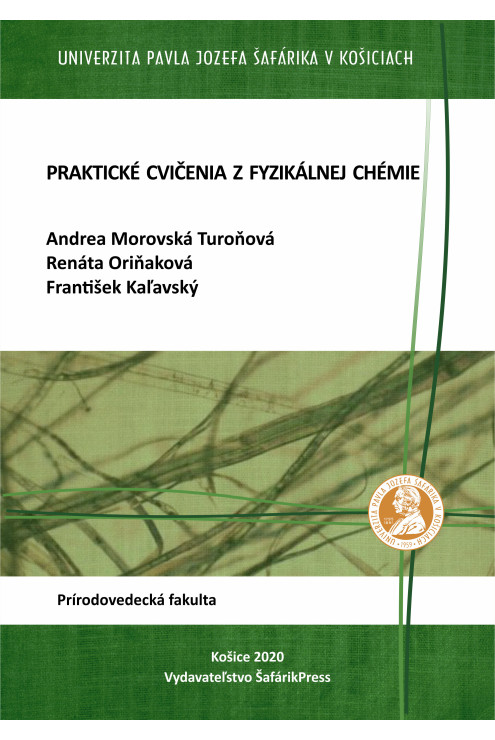
Praktické cvičenia z fyzikálnej chémie

E-book

Andrea Morovská TuroňováRenáta OriňakováFrantišek Kaľavský 

The university textbooks "Practical Exercises in Physical Chemistry" are intended as teaching literature for students of the 2nd year of the Chemistry study program and the 3rd year of the interdisciplinary study program at the Faculty of Science of the Pavel Jozef Šafárik University in Košice.

The three chapters summarize the basic knowledge of thermodynamics, electrochemistry and kinetics, the next chapter deals with the measurement of some other physico-chemical quantities. The tasks developed on the basis of cooperation with the Criminalistics and Expertise Institute of the Police in Košice, which also participates in the innovation of practical teaching, are also very attractive and interesting for students. Thematic units are updated and supplemented by new knowledge, principles as well as detailed working procedures using new instrumentation.

The aim of laboratory exercises in physical chemistry is to illustrate and confirm the physicochemical laws and correlations that apply to the quantitative description of chemical phenomena. Students will learn to use instruments and equipment that occur in physico-chemical laboratories, they will learn the principles of accurate and correct quantitative measurement of physical quantities, important from a chemical point of view. They can also develop professional and scientific communication skills, and we want to support their creative approach to making measurement protocols.

Download the e-book for free  (pdf)

Quantity

978-80-8152-935-1

Data sheet

Method of publication:
E-book (pdf)
Authors:
Andrea Morovská Turoňová - Renáta Oriňaková - František Kaľavský
Document type:
Course Notes
Number of pages:
122
Available from:
20.11.2020
Year of publication:
2020
Edition:
1st edition
Publication language:
Slovak
Faculty:
Prírodovedecká fakulta
Note:
Projekt KEGA č. 008UPJŠ-4/2018
License:
Creative Commons BY NC - SA (Uveďte autora - Nepoužívajte komerčne - Zachovajte licenciu )
- Free for download

16 other products in the same category:

Základy organickej chémie.  Vysokoškolský učebný text k predmetu Základy chémie

Základy organickej chémie. Vysokoškolský...

E-book

E-book

Mária Vilková - Zuzana Kudličková - Ján Elečko

Organic chemistry is the chemistry of carbon. Organic compounds in the form of large molecules (macromolecules), such as nucleic acids, proteins, carbohydrates, and lipids are the basic elements of living organisms. This study material is created for non-chemistry students, especially students of biology. Most of these students have little or no knowledge of organic chemistry. Therefore, we proceed from the basic principles of organic chemistry to biochemistry.

The basic principles of organic chemistry and biochemistry are briefly summarized in individual chapters, but the main content consists of tasks for practising basic knowledge. To check the correctness of solving the tasks, the correct solutions are also given. The importance of this study material lies in the fact that students will get additional study material that they will use in studying the subject Basics of Chemistry.

Download the e-book for free (pdf)

Výpočtová a kognitívna neuroveda II (Návody na cvičenia)

Výpočtová a kognitívna neuroveda II (Návody na...

E-book

E-book

Norbert Kopčo

Neuroscience is an interdisciplinary field of science at the interface of biological, psychological and computer sciences, which aims to describe the functioning of the brain and mind. Computational and cognitive neuroscience are subfields of neuroscience focused on the study of information processing in the human and animal nervous systems, and on the theoretical description of the brain and mind. This university textbook contains several assignments that provide an overview of the methods used in computational and cognitive neuroscience, with an emphasis on mathematical modeling and on the behavioral study of cognitive processes. The textbook builds on the author's previous works.

Download e-book for free (pdf)

Praktikum z nukleárnej magnetickej rezonancie. Časť 1: Kvantitatívna NMR

Praktikum z nukleárnej magnetickej rezonancie....

E-book

E-book

Mária Vilková - Zuzana Kudličková - Aneta Salayová - Tomáš Ján Liška

The Nuclear Magnetic Resonance Practicum – Part 1: Quantitative NMR is designed for students taking the NMR Practicals course, which focuses on the practical aspects of quantitative nuclear magnetic resonance (qNMR). This publication builds on previous NMR courses and assumes basic theoretical knowledge of the method, emphasizing experimental procedures, data processing, and result interpretation. qNMR is a precise analytical technique with broad applications in analytical chemistry, pharmaceutical research, biomedicine, and quality control. The script provides a detailed guide to conducting experiments, as well as procedures for analyzing and evaluating acquired data. This publication offers students methodological guidance and support in mastering qNMR analysis and serves as a valuable resource not only during their studies but also for further research in NMR spectroscopy.

Download the e-book for free (pdf)

UNINFOS 2014 • Univerzitné informačné systémy (Zborník abstraktov)

UNINFOS 2014 • Univerzitné informačné systémy...

E-book

E-book

Gabriel Semanišin - Emil Hutňan - Jana Oleničová

The proceedings contain abstracts of contributions from participants of the UNIFOS 2014 conference, University Information Systems in Košice, which took place from October 27 to 29, 2014.

ICT centers are important element that provide functioning and development hardware and software infrastructure at Slovak Universities. There are more differences between them in real position, management, personal sources and financing. ICT centers provide a wide range of services to large number of university users and they implement the policy of information security recently.

Download the e-book for free (pdf)

Tvorba úloh pre programátorské súťaže

Tvorba úloh pre programátorské súťaže

E-book

E-book

Ľubomír ŠnajderJán Guniš

The publication lists interim results of qualitative educational research focused on the development and evaluation of programming tasks being carried out by authors since 2005 in the frame of programming competition PALMA junior.

The publication consists of three chapters: Computer science competitions in Slovakia, Tasks in computer science education, Selected problems of PALMA junior competition. The first chapter provides an overview of computer science competitions for a primary and secondary schools in Slovakia. The second chapter described the issue of learning tasks - their components, focus, formulation types, and development system of tasks. The third chapter contains the assignments and commented author solutions of selected problems represented focus of PALMA junior competition – programming, algorithms and mathematics.

For each problem is mentioned analysis of pupils’ solutions aimed to ways of thinking, typical misconceptions, sets of preparatory and extended problems. The publication is addressed to computer science teacher trainers, authors of programming competitions problems, and computer science teachers.  

Download the e-book for free (pdf)

Určitý integrál

Určitý integrál

E-book

E-book

Ondrej Hutník

The concept of the integral is one of the most significant concepts in mathematics as a whole. In its most primitive form, it was already used by the ancient Greeks in the creation of Euclidean geometry. However, it was only after Descartes' work on analytical geometry in 1637 that mathematicians could begin to consider the integral as a subject of analysis. Descartes' work laid the groundwork for the discovery of infinitesimal calculus by Leibniz and Newton around 1665. At that time, a great dispute arose over the priority of this discovery, dividing scholars of Germany and England into two opposing camps, each favoring their own champion. Today, we know that Newton's work on fluxions and fluents was somewhat earlier, but Leibniz's notation and approach have gained more acceptance in the mathematical world, and the symbols ∫ ∫ and d d are still used today. A brief overview of the history of the integral will be presented in Chapter 1.

Today, there is a plethora of scripts, textbooks, and books dedicated to explaining the concept of the integral. Therefore, every potential author faces the initial question of whether to write another text on this topic. Our affirmative answer to this question was driven by the students' request to find the subject matter of a part of the winter semester of the second year presented in a coherent form. The second motivation is a slightly different approach to the topic. If we consider the methods typically used in solving problems and gaining routine with a certain integral, it mainly involves the Newton-Leibniz formula, and often there is little time left to compute the definite (Riemann) integral using its definition. Therefore, we included a discussion of the Newton integral in Chapter 2, which reflects this fact and is directly related to the indefinite integral, whose various calculation methods receive relatively much attention in the previous semester. Only after that, in Chapter 3, do we build the theory of the Riemann integral, present criteria for its existence, classes of integrable functions, basic properties, and finally its relationship with the Newton integral. Questions primarily concerning geometric applications are addressed in Chapter 4, and in the final chapter, we focus on extending the Riemann integral to unbounded functions and unbounded intervals.

Download the e-book for free (pdf)

Vybrané kapitoly z koloidnej chémie

Vybrané kapitoly z koloidnej chémie

E-book

E-book

Daniela Kladeková

Working with this study text requires adequate knowledge of physical chemistry, physics, and biology, as navigating the presented material becomes challenging without this foundation. A solid grasp of mathematics is essential and aids in understanding colloidal chemistry problems. The textbook, structured into individual chapters, first addresses optical and molecular-kinetic properties after classifying and characterizing disperse systems.

This university-level textbook is primarily intended for students in chemical and ecological disciplines at the Faculty of Science, Pavol Jozef Šafárik University in Košice. It does not aim to exhaustively cover every detail of the subject, as comprehensive treatments are already available in specialized monographs on colloid and macromolecular chemistry, as well as in foundational physical chemistry textbooks.
Download the e-book for free (pdf)

Pravdepodobnosť v príkladoch
  • On sale!
  • -€9.39

Pravdepodobnosť v príkladoch

€9.90 €0.51 -€9.39
Availability: 87 In Stock

Valéria Skřivánková 

Predložený učebný text sa pokúša ilustrovať možné aplikácie Teórie pravdepodobnosti na príkladoch z oblastí (vo fyzike, chémii,  biológii, ekonomike, finančníctve, atď.), ktoré sú spestrené o úlohy na hľadanie optimálnej stratégie.

Text je určený predovšetkým poslucháčom Prírodovedeckej fakulty UPJŠ, budúcim učiteľom matematiky, študentom odboru matematika a informatika prípadne iným záujemcom, ktorí budú aplikovať pravdepodobnostné metódy pri riešení reálnych problémov. Obsahom pokrýva prvú časť predmetu "Pravdepodobnosť a štatistika".

Autorka

Book of Abstracts: International Meeting on Advanced Materials

Book of Abstracts: International Meeting on...

E-book

E-book

Soňa Király (ed.)

The book of abstracts from International Meeting on Advanced Materials, IMAM 2025, is composed of contributions from participants of this conference. The conference consisted of 16 lectures by mentioned conference participants. The conference is focused on advanced materials and its application in various research areas. All contributions are professionally processed and inspiring.

Download the e-book for free (pdf)

Kvantová teória poľa 1

Kvantová teória poľa 1

E-book

E-book

Michal Hnatič - Tomáš Lučivjanský

This textbook is primarily intended for first-year master's degree students at Pavol Jozef Šafárik University in Košice, especially those in the nuclear physics, subnuclear physics, and theoretical physics programs. For many years, these lectures were taught by one of the authors at this university, and naturally, over time, there arose an effort to provide these lectures to students in printed form.

In this textbook, we will focus mainly on classical field theory, its quantization based on the operator approach, and the introduction of interactions. Descriptions based on functional integration, Feynman diagram techniques, and more advanced parts will be covered in a subsequent volume of the textbook. In this context, we want to emphasize that in many modern quantum field theory textbooks, the operator approach is used to a lesser extent and is replaced by the approach using (functional) path integrals.

This is probably due to time considerations, as the functional approach leads much faster to practical calculations. On the other hand, we believe that the operator approach is better from a pedagogical point of view. It is much closer to the traditional quantum mechanics course, which is often based on the Schrödinger or Heisenberg formalism. Therefore, students can much more easily follow the flow of ideas that led to the construction of quantum field theory and its fundamental concepts.

Download e-book for free (pdf)

EFFUSE príručka pre učiteľov

EFFUSE príručka pre učiteľov

E-book

E-publication

Beáta Valkayed.
Ivana Slepáková-Lenka Maliničová a kol.

The EFFUSE Teacher's Guide is a practical educational material for primary and secondary school teachers who want to develop environmental awareness with their pupils through field-based learning. It is based on the concept of the EFFUSE project (‘Environment for the future by science education’), which aims to link science, research and education with environmental protection. The manual provides teachers with methodological support for planning and implementing outdoor activities aimed at observing and documenting organisms around the Laborec River and the Uh River. It contains instructions for working with real samples, basic biomonitoring procedures and offers the opportunity to participate in the creation of a virtual laboratory that mirrors the state of the local aquatic ecosystem. Through these activities, pupils will learn to understand the links between human activity and the state of the environment, while learning the basics of how scientists work in the fields of biology and ecology. The guide also motivates teachers to become agents of positive change, inspire the younger generation to be active and engage the community in conservation. It is a challenge and an opportunity to create a space for meaningful learning in line with current trends in environmental and digital education.

Download the e-book for free (pdf)

Digitálna forenzná analýza I.

Digitálna forenzná analýza I.

E-book

E-book

Pavol Sokol - Ladislav Bačo - Tomáš Bajtoš

In the university textbook, we present the theoretical foundations and technical details of the activities of a forensic investigator. We describe the identification and provision of digital tracks, file system analysis. analysis of various artifacts of the Windows operating system, analysis of the operating memory. The textbook is also supplemented by a chapter devoted to the analysis of malicious code (malware). University textbooks are intended for students of bachelor's, master's, engineering and doctoral study programs in computer science, but also in non-informatics fields.

Download the e-book for free  (pdf)

Cvičenia z imunológie

Cvičenia z imunológie

E-book

E-book

Vlasta DemečkováPetra HradickáPetra Adamková

The learning material for the course Practice in Immunology is based on several years of experience with teaching this subject, but mainly to provide students from the Biology Department at the Faculty of Natural Sciences, UPJŠ in Košice with sufficient theoretical background for practical exercises. It also serves as a scientific diary for detailed recording of all experimental data necessary for preparing laboratory protocols from individual exercises.

In studying biology, it is essential that students thoroughly understand not only the basics of each discipline but also acquire practical skills, including designing scientific experiments, selecting appropriate analytical/investigative techniques up to interpreting and presenting experimental data. The goal of this new publication is therefore to provide master's students with a practical study guide that supports and expands their knowledge about basic immunology principles.

Download e-book for free (pdf)

Magnetic Cooling and Frustrated Magnetism. Book of Abstracts

Magnetic Cooling and Frustrated Magnetism. Book...

E-book

E-publication

Jozef Strečka-Katarína Karľová

The proceedings include the programme and abstracts of the workshop Magnetic Cooling and Frustrated Magnetism, held in Košice on October 27–29, 2025. The event is organized with the support of the French National Research Agency (ANR), the Faculty of Science of Pavol Jozef Šafárik University in Košice, and the Slovak Research and Development Agency. The workshop focuses on current challenges in quantum physics, particularly frustrated magnetism and magnetic cooling. Participants will present original research results that may significantly contribute to the development of future quantum technologies.

Download the e-book for free (pdf)

Študentská vedecká konferencia PF UPJŠ 2019

Študentská vedecká konferencia PF UPJŠ 2019

E-book

E-book

Katarína Cechlárová (ed.)

This year, the Student Scientific Conference was held on April 24, 2019, across 17 sections in disciplines such as biology and ecology, chemistry, physics, geography, mathematics, informatics, and their didactics. Bachelor’s and master’s students presented a total of 124 contributions. The most successful participants advanced to national or traditional Czech-Slovak student scientific showcases in fields like physics, chemistry, mathematics, informatics, and mathematics didactics.

In addition to faculty students, 10 high school students participated outside the competition. They were invited based on their achievements in subject-specific Olympiads or because they were already engaged with the faculty under the guidance of dedicated teachers in laboratory work as part of their preparation for future studies. The day also featured a programming competition with 23 participants, an IHRA contest involving 16 teams of high school students and 15 teams from elementary schools, and a new Puzzle section where 72 high school students from the region competed.

The abstracts from the Student Scientific Conference demonstrate that our faculty's students not only absorb theoretical knowledge delivered in lectures but also actively engage in solving partial scientific problems that align with research objectives at the institutes of PF UPJŠ. This collection serves as both a record of scientific activity at the faculty and a dignified presentation for the broader public.

Prof. RNDr. Katarína Cechlárová, DrSc.

Vice-Dean for Education

Doc. RNDr. Gabriel Semanišin, PhD.

Dean of the Faculty

Download the e-book for free  (pdf)

This website uses cookies to ensure you get the best experience on our website