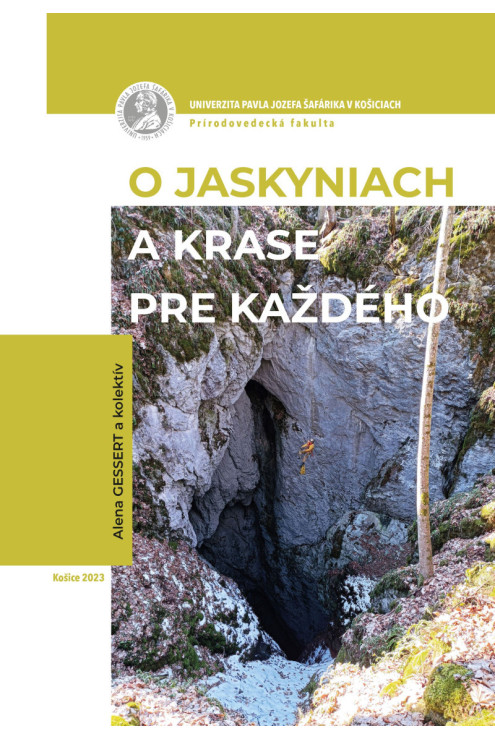
Caves have always been very specific places throughout history. In some cultures, they served as sites for sacrifices or remembrance, while in others, they were seen as places where one could cross to the "other side of life." People used caves for shelter, as places to leave messages, to wait out bad weather, and in some cases, even lived in them. During wars in our region, entire families or villages would hide from enemies in caves, or they would use them to conceal weapons.
Today, in most countries, caves are destinations for tourists who want to experience something new and unknown: darkness, high humidity, and the fascinating beauty of underground formations. They are also sought after by cavers who long to explore caves, enter worlds where no human has set foot before, find evidence of previous habitation, or conduct research that continually advances our knowledge.
In the publication you are holding, we present both traditional and less conventional topics about the formation of karst and caves, selected ecological aspects, maps and their creation, significant caves of the world, and the life of people in such areas. We also offer an overview of important karst locations that are definitely worth learning more about or visiting in person. This publication is intended for readers among pupils, students, teachers, and the general public, and we believe it will draw you into this mysterious world.
Táto publikácia vyšla s podporou MŠŠVV SR, Agentúry KEGA, projekt č. 016UPJŠ-4/2021 – Rok 2021 - Medzinárodný rok jaskýň a krasu - vzdelávajme sa, skúmajme a chráňme.
License:
CC BY NC ND (Uveďte autora - Nepoužívajte komerčne - Nespracovávajte)
Učebný text je určený poslucháčom medziodborového štúdia v kombinácii s matematikou, jednoodborového štúdia matematiky ako aj rozširujúceho štúdia matematiky. Je zameraný na základné poznatky o deliteľnosti celých čísel, kongruenciách a aritmetických funkciách.
The aim of these study texts is to provide students in the second and third levels of higher education with specific guidance on processing 2D diffraction data, performing phase analysis from X-ray diffraction data, and refining microstructural parameters of identified phases using the Rietveld refinement method.
This guide is designed in the form of real-world tasks from materials research and leads the reader step by step through the processes of processing, evaluating, and interpreting the measured data. For this purpose, freely accessible programs such as Fit2D, QualX, POV-Ray, and GSAS II will be used, as well as a freely downloadable commercial program (Diamond) that allows for task execution in demonstration mode. Phase analysis will be conducted exclusively using the freely distributable crystallographic database Crystallography Open Database (COD).
Abstracts of the 4th International Conference Nanomaterials: Fundamentals and Applications (NFA) 2020 is the contributions summary of the conference participants. The conference will feature three invited lectures and eight registered lectures. This conference is a tool for creating a dialogue between experts in the field of nanomaterials, their use and overall application in various fields. Papers in the proceedings are thematically divided into 6 areas. All contributions are highly professional and interesting and can contribute to further creative scientific work.
The text summarizes the basic knowledge about the functioning of the soil ecosystem with a focus on soil protists and dominant groups of soil animals. Characteristics of each soil animal group include basic morphology, ecology, distribution, population dynamics and their importance in the soil ecosystem. The aim of the text is to gain a basic understanding of the diversity and interactions of soil fauna with the soil environment. It deals with the ecological classification of soil fauna on the basis of body size, presence in the soil during the life cycle, food preference and by locomotion. It highlights important morphological and ecophysiological adaptations of soil fauna to physical and chemical environmental factors. The text also gives an overview of the basic methods in the field collection of soil fauna and their extraction from soil samples under laboratory conditions. It further informs on the method of taxonomic identification and ecological evaluation of soil fauna communities. Discusses the soil fauna of different types of ecosystems. It highlights the differences in soil fauna communities that inhabit grassland and forest habitats, and agricultural soils. This teaching material is intended for students in biology degree programmes.
Zbierka úloh z matematickej analýzy III. je pokračovaním predchádzajúcich dvoch vydaných zbierok autorov Kulcsár a Kulcsárová. Táto časť obsahuje príklady na zopakovanie a precvičenie učiva stredných škôl, ako aj časti prvého semestra kurzu matematická analýza určeného pre študentov matematiky, fyziky, informatiky a učiteľského štúdia v kombinácii s matematikou. Zbierka môže tiež pomôcť všetkým učiteľom, ktorí chcú použiť rôzne úlohy vo svojom vyučovaní. Zbierka zahŕňa oblasť postupností reálnych čísel: aritmetické a geometrické postupnosti, všeobecne a rekurentne zadané postupnosti, nachádzajú sa tu úlohy na vyšetrovanie vlastností postupností (monotónnosť, ohraničenosť, konvergencia) a výpočet rôznych typov limít. Všetky zadané úlohy sú vyriešené na konci každej kapitoly s podrobným komentárom.
For computer scientists, the constant challenge is to seek efficient algorithms and various technical and implementation possibilities to improve the computational complexity of currently known algorithms. Partial solutions are offered by approaches such as grid-based methods and parallelization of computation. Quantum computers represent a significant but still unfulfilled promise. From a theoretical perspective, probabilistic and approximation approaches provide very effective solutions, and these are the methods we aim to explore in detail.
These electronic university textbooks serve as supplementary materials for the course Approximation and Probabilistic Algorithms. They were developed from the authors' materials and contributions by Prof. RNDr. Viliam Geffert, DrSc., whom the authors thank for providing the manuscript. Acknowledgments also extend to RNDr. Ján Katrenič, PhD., who prepared the first set of exercises for the course, and Žaneta Semanišinová, who reviewed large portions of the text and contributed suggestions for its improvement.
Selected tasks and problems from biochemistry – metabolism follow biochemistry lectures on metabolism and individual metabolic pathways for students of the second and third year of the bachelor’s degree in the fields of chemistry, biology and their combinations with other fields. Scripts provide an opportunity to better understand the lectured subject matter of metabolism through the solution of tasks and problems as serve as a basis for one-hour exercises. The scripts are divided thematically into eleven chapters, and each chapter contains 10 tasks and 7 problems. At the beginning of the chapters there is a short description and explanation of the given metabolic pathway. However, when solving the tasks, the student must focus mainly on the curriculum that was presented on the given topic in the lecture. Subsequently, at the end of chapter, answers to problems are also presented. These scripts are intentionally accessible only in electronic form. The reason is the effort to continuously update and modernize individual tasks.
Over the past fifteen years, the course on ’Exactly Solvable Models in Statistical Physics’ has become an indispensable ground of the study programme ’Theoretical Physics’ at Faculty of Science of Pavol Jozef Šafarik University in Košice. At first, the course based on the first edition of this textbook was intended for undergraduate students only, however, I have later prepared follow-up course taught at a postgraduate level on demand of several ambitious students who wished to continue in studying this exciting research field.
It is already more than decade when our students enrolled in the study programme ’Theoretical Physics’ graduate from ’Introduction to Exactly Solvable Models in Statistical Physics’ at a master level and ’Exactly Solvable Models in Statistical Physics’ at a postgraduate level. Of course, it was necessary somehow to rearrange topics for the courses of undergraduate and postgraduate students.
More specifically, a few more challenging topics concerned with exact solutions of 2D Ising model (chapter 3) were moved to a more advanced course intended for the postgraduate students, while an introductory course intended for the undergraduate students was contrarily supplemented with a few new topics requiring the second edition of this textbook.
The second edition of this textbook thus contains a completely new chapter 4 devoted to the exact solution of the Ising model on the Bethe lattice using the method of exact recursion relations, while the chapter 5 was supplemented by exact results for ground state of a few frustrated Heisenberg spin models using the variational method. It is my hope that the next edition of this textbook will come soon and it will involve all topics specifically taught within the postgraduate course as well.
The structure of the animal body is extremely varied. Each species has its distinctive morphological features, which bears as a testimony to long-term development and belonging to the developmental lineage. At the same time, the body has been tested for a long time by natural conditions, resulting in unique adaptations to the environment and life strategy. Despite this admirable variety - which includes both recent and fossil animals and which we have far from mapped – a comparison of body parts brings knowledge we can generalize: the main building principles, and boundaries within which phenotypic diversity is realized.
Comparative animal morphology today uses the latest methodological material and knowledge from other disciplines, from genetics, molecular biology and experimental embryology, through progressive imaging methods (e.g. electron microscopy, computer micro-tomography) and the possibilities of subsequent software processing of image material (measurement, staining, etc.) to the view of physics, chemistry, statics and geometry on the structures (to nanostructures) of the living body. Detailed knowledge of historical and contemporary conditions on Earth is an important interpretative context in the study of animal morphology. Surprisingly, the knowledge accumulated after centuries of research is now rapidly supplemented by new knowledge, and often the traditional knowledge is subsequently reinterpreted. Finally, and no less important, in studying animal (and human) morphology, we learn surprising knowledge about ourselves.
The author of the presented textbook had the ambition in a simplified form to introduce the reader, especially the student of biological studies, into a dynamic and fascinating scientific discipline, as the current comparative animal morphology is.
The scientific book of abstracts is a summary of the contributions of teachers, scientists and other conference participants, which contain the original results of their scientific and research activities. Their work will be the subject of the next domestic conference „New Trends in Chemistry, Research and Education at Faculty of Science of P. J. Šafárik University in Košice 2020“. The conference is a space for dialogue between scientific academics on the one hand and professional staff and students on the other.
The contributions published in this volume can be divided according to content into the field of analytical, inorganic, physical, organic chemistry, biochemistry and didactics of chemistry. All contributions are interesting and can be used in further creative scientific and research work, in the process of education and in practical work.
In these university-level textbooks, we present the fundamental concepts of networks and graph theory. We explore breadth-first and depth-first graph searching. We present static and dynamic network models. We describe the issue of detecting overlapping and non-overlapping communities in directed and undirected networks. Various approaches to anomaly detection in networks also form an important part of this textbook. The final chapter is dedicated to spectral clustering, which plays a significant role in data mining in network graphs for various application domains.
These textbooks are suitable for first and second-year university students in computer science programs. The study materials are also suitable for students in non-computer science fields, with the aim of improving their knowledge and practical experience in computer science-related areas, and provide an opportunity for students to find employment in IT companies to solve practical tasks.
Auxiliary teaching material for the course General Physics III – Oscillations, Waves, and Optics is intended for students of single-subject and interdisciplinary studies of physics.
The content provides a basic outline of the material covered, without detailed explanations, with an emphasis on the physical method of thinking using the simplest elements of higher mathematics. The presented text does not aim to replace the recommended textbooks, but rather to help students navigate the subject matter. Recommended literature can be found at the end of the text.
The teaching material contains the basic framework of the lectures and is supplemented and revised each year, with lectures enriched by supporting demonstration experiments.
The textbook is intended for university students who are preparing for the profession of biology teacher. The structure of the book is similar to an encyclopedia, with one page devoted to each content item, but the topics of the chapters and subchapters follow each other.
The explanatory text on the page illustrates the diagram and there are notes and links to other sources of information. For better orientation, the content of the textbook is divided into 8 sections, which cover several chapters. It follows the general didactics, which it connects with the teaching of biological content. The book provides a basic orientation in the approaches to learning this subject, and also explains the relationship between biology as a science and the didactics of biology. It deals with teaching standards and curricula, advises on how to master biological concepts and understanding, how to communicate with students in biology classes, when and why are effective visual and practical methods. It acquaints the reader with the issue of setting goals for biological education in the cognitive, psychomotor and affective areas in relation to formative and summative assessment.
Hopeful as well as experienced teachers will find in this publication not only a look into the history of teaching biology, but also a look into the future. Current trends in biology teaching, the connection of teaching with digital technologies, the virtual learning environment and interactive simulations and models belong to science lessons today.
In the university textbook, we present the theoretical foundations and technical details of the activities of a forensic investigator. We describe the identification and provision of digital tracks, file system analysis. analysis of various artifacts of the Windows operating system, analysis of the operating memory. The textbook is also supplemented by a chapter devoted to the analysis of malicious code (malware). University textbooks are intended for students of bachelor's, master's, engineering and doctoral study programs in computer science, but also in non-informatics fields.
The publication contains abstracts of contributions presented at the Student Scientific Conference of the Faculty of Natural Sciences at UPJŠ in Košice, held on April 25, 2013. The event was marked by the celebration of the 50th anniversary of the Faculty of Natural Sciences at UPJŠ and was part of a series of events called ScienceFest.
This university textbook is intended for students of the Faculty of Science of the University of Applied Sciences in Košice who have enrolled in practical exercises in Biotechnology, but also for all other students who are interested in learning about the practical applications of biotechnology.
The aim of the practical course is to familiarize students with basic biotechnological methods and their applications. The students will verify in practice the theoretical knowledge acquired in the Biotechnology lectures such as the course of fermentation processes, wine production, preparation of fermented milk products and cheese, preparation of culture media, inoculation and cultivation of microorganisms, etc. The practical exercises also include the use of analytical and spectral methods, which are an integral part of biochemistry.
The scripts are published only in electronic form and are available on the University's website: http://kosice.upjs.sk/~kbch/sk, for the reason that it will always be possible to update and modernize the content of the laboratory exercises.