Slovenčina


E-book
The aim of writing the university textbook "Selected Heterocyclic Compounds" was to create a study aid for students of the Organic Chemistry program, which provides essential information in a clear format for the subject of Heterocyclic Compounds. In selecting the content of the textbook, the goal was to present basic information about the chemistry of the most significant heterocycles. Given that the summary of chemical knowledge about heterocycles is vast, it was not possible to include all heterocyclic compounds in the content.
The intention was for readers to orient themselves in the field of heterocyclic compounds. Separate chapters included in the content address the nomenclature of heterocycles, basic chemical properties of individual heterocycles, their synthesis and reactions, the occurrence of heterocycles in nature, and their practical applications (medications, dyes, pesticides, detergents, etc.).
Download e-book for free (pdf)

Data sheet
E-book
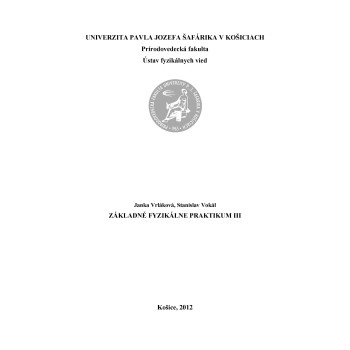
Janka Vrláková - Stanislav Vokál
Atomic and nuclear physics are relatively young scientific disciplines forming the final part of the general physics course at the Faculty of Physics of the Jagiellonian University. Their aim is to explain the nature of the basic physical properties of atoms, atomic nucleus and elementary particles.
This is also the content of the lectures and exercises ‘General Physics IV’ in the 2nd year of the Bachelor's degree in Physics at the Faculty of Natural Sciences (PF) of the P.J. Šafárik University (UPJŠ) in Košice. They are followed by optional lectures ‘Nuclear Radiation in the Environment’, ‘Introduction to the Physics of the Microworld’ in the 3rd year of the Bachelor's degree of single-discipline study of physics, or teacher study of physics in combination with another subject, and ‘Subnuclear Physics’ in the 1st year of the Master's degree of teacher study of physics in combination with another subject.
In the aforementioned lectures, the latest experimental findings on the structure and behaviour of the microworld are presented by means of physical theories and their subsequent experimental verification in experiments.
E-book
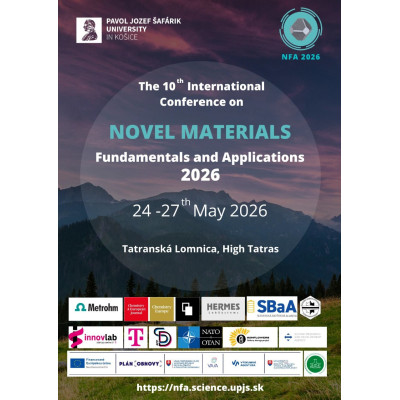
Soňa Király(ed.)
The proceedings of the international conference titled "The 10th International Conference on Novel Materials Fundamentals and Applications, NFA 2025" consist of 44 papers submitted by conference participants. This conference focuses primarily on new materials, from theory to practical application, with the aim of demonstrating how fundamental discoveries can lead to innovative applications. All contributions are inspiring and professionally prepared.
Download the e-book for free
E-book
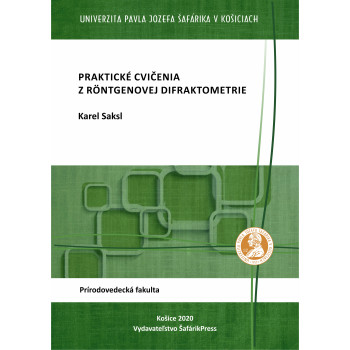
The aim of these study texts is to provide students in the second and third levels of higher education with specific guidance on processing 2D diffraction data, performing phase analysis from X-ray diffraction data, and refining microstructural parameters of identified phases using the Rietveld refinement method.
This guide is designed in the form of real-world tasks from materials research and leads the reader step by step through the processes of processing, evaluating, and interpreting the measured data. For this purpose, freely accessible programs such as Fit2D, QualX, POV-Ray, and GSAS II will be used, as well as a freely downloadable commercial program (Diamond) that allows for task execution in demonstration mode. Phase analysis will be conducted exclusively using the freely distributable crystallographic database Crystallography Open Database (COD).
E-book
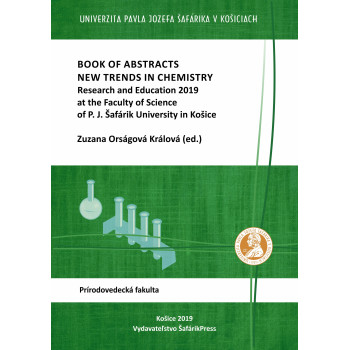
Zuzana Orságová Králová (ed.)
The scientific book of abstracts is a summary of the contributions of teachers, scientists and other conference participants, which contain the original results of their scientific and research activities. Their work will be the subject of the next domestic conference "New trends in chemistry, research and education 2019". The conference is a space for dialogue between scientific academics on the one hand and professional staff and students on the other.
The contributions published in this volume can be divided according to content into the field of analytical, inorganic, physical, organic chemistry, biochemistry and didactics of chemistry. All contributions are interesting and can be used in further creative scientific and research work, in the process of education and in practical work.