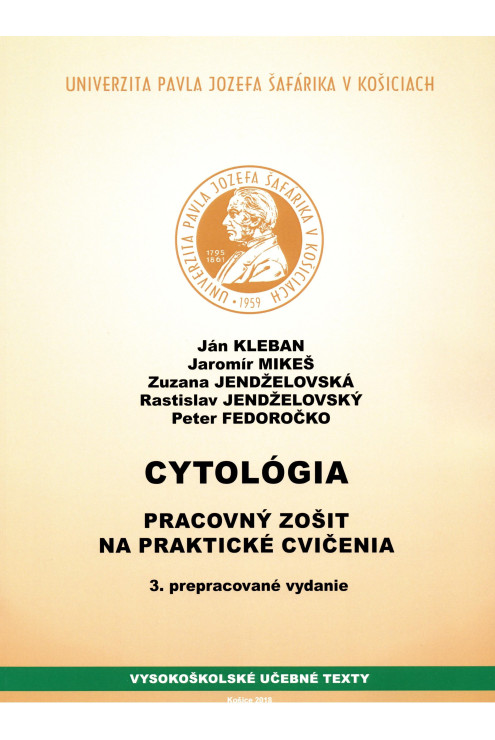
Cytológia pracovný zošit na praktické cvičenia

€10.50
Tax included

Ján Kleban a kolektív

Predkladaný pracovný zošit na praktické cvičenia z cytológie je určený poslucháčom 1. ročníka bakalárskeho štúdia biológie a 1. ročníka bakalárskeho medziodborového štúdia v kombinácii s biológiou na Prírodovedeckej fakulte Univerzity Pavla Jozefa Šafárika v Košiciach. Slúži ako návod, ktorý má študentom uľahčiť prácu a umožniť rýchlejšiu orientáciu v zadanej úlohe. Úprava pracovného zošita do formy protokolov umožňuje študentom zakresliť vlastné pozorovanie a tým stimuluje študentov k presnejšiemu a trvalejšiemu zapamätaniu si precvičovanej úlohy a zároveň umožňuje spätnú kontrolu pedagógom. Počas cvičení sa študenti postupne oboznámia so základnými pojmami optiky, s aplikáciami využívajúcimi mikroskopickú techniku, ale aj so základnými rozdielmi medzi štruktúrou rastlinnej a živočíšnej bunky a ich organelami.

Quantity

978-80-8152-630-5

Data sheet

Method of publication:
Printed publication
Authors:
Ján Kleban - Jaromír Mikeš - Zuzana Jendželovská - Rastislav Jendželovský - Peter Fedoročko
Document type:
Course Notes
Number of pages:
82
Year of publication:
2018
Edition:
3. doplnené
Publication language:
Slovak
Faculty:
Prírodovedecká fakulta
UPJŠ Unit
Ústav biologických a ekologických vied
License:
Copyright

Specific References

MPN
302067

16 other products in the same category:

Zbierka úloh z matematiky pre nematematické odbory
  • On sale!
  • -€7.79

Zbierka úloh z matematiky pre nematematické odbory

€8.79 €1.00 -€7.79
Availability: 46 In Stock

Danica Studenovská a kol. 

Táto zbierka úloh je určená poslucháčom Prírodovedeckej fakulty UPJŠ, ktorí sa v rámci predmetu Matematika I. zoznamujú s pojmami funkcie, limity, derivácie, integrálu a ich aplikáciami. Ide najmä o študentov nematematických odborov a učiteľských kombinácií, avšak táto zbierka je vhodná aj pre iných študentov a záujemcov o základy matematickej analýzy.

Autori

Určitý integrál

E-book

E-book

Ondrej Hutník

The concept of the integral is one of the most significant concepts in mathematics as a whole. In its most primitive form, it was already used by the ancient Greeks in the creation of Euclidean geometry. However, it was only after Descartes' work on analytical geometry in 1637 that mathematicians could begin to consider the integral as a subject of analysis. Descartes' work laid the groundwork for the discovery of infinitesimal calculus by Leibniz and Newton around 1665. At that time, a great dispute arose over the priority of this discovery, dividing scholars of Germany and England into two opposing camps, each favoring their own champion. Today, we know that Newton's work on fluxions and fluents was somewhat earlier, but Leibniz's notation and approach have gained more acceptance in the mathematical world, and the symbols ∫ ∫ and d d are still used today. A brief overview of the history of the integral will be presented in Chapter 1.

Today, there is a plethora of scripts, textbooks, and books dedicated to explaining the concept of the integral. Therefore, every potential author faces the initial question of whether to write another text on this topic. Our affirmative answer to this question was driven by the students' request to find the subject matter of a part of the winter semester of the second year presented in a coherent form. The second motivation is a slightly different approach to the topic. If we consider the methods typically used in solving problems and gaining routine with a certain integral, it mainly involves the Newton-Leibniz formula, and often there is little time left to compute the definite (Riemann) integral using its definition. Therefore, we included a discussion of the Newton integral in Chapter 2, which reflects this fact and is directly related to the indefinite integral, whose various calculation methods receive relatively much attention in the previous semester. Only after that, in Chapter 3, do we build the theory of the Riemann integral, present criteria for its existence, classes of integrable functions, basic properties, and finally its relationship with the Newton integral. Questions primarily concerning geometric applications are addressed in Chapter 4, and in the final chapter, we focus on extending the Riemann integral to unbounded functions and unbounded intervals.

Download the e-book for free (pdf)

Názvoslovie organických zlúčenín

E-book

E-book

Miroslava Martinková

This electronic material provides the basic principles of creating a systematic nomenclature of organic compounds, from the simplest hydrocarbons to the more complicated nomenclature of carbohydrates. For some groups of derivatives, alternative ways of generating system names are also mentioned, as well as the most common trivial names that are still in use in the literature and in practice, in some cases being the characteristic (dominant) ones. In the introductory section, the basic rules to be respected when writing names of organic compounds are discussed. This document is intended primarily for interdisciplinary undergraduate and graduate students as support material for the courses Organic Chemistry and Selected Chapters in Organic Chemistry and Biochemistry. In the final section of this document, solved examples are given so that the student can check how the rules for forming the names of organic compounds have been understood.

Download e-book for free (pdf)

Študentská vedecká konferencia PF UPJŠ 2017

E-book

E-book

Katarína CechlárováEva Pitoňáková (eds.)

Proceedings of Abstracts from Contributions by Participants of the Student Scientific Conference at the Faculty of Science, UPJŠ in Košice, Held on April 26, 2017

This is the fifth edition of the proceedings from the Student Scientific Conference (ŠVK) at the Faculty of Science, Pavol Jozef Šafárik University in Košice. We are pleased that ŠVK has become an integral part of faculty life and a showcase for the quality of education provided. In 2017, ŠVK took place as part of the traditional Science Days on April 26, 2017. 105 students from the Faculty of Science presented their work. Contributions were organized into 15 sections, supplemented by an open programming competition involving 17 students and the final round of the IHRA competition, which included 27 teams from across Slovakia.

The abstracts in this proceedings demonstrate that students at the Faculty of Science, UPJŠ, acquire knowledge and skills in their field not only through theoretical study of disciplines but also through active engagement in solving partial scientific problems aligned with research goals at the faculty’s institutes. These abstracts also provide an overview of the faculty’s scientific activity, which we believe will be of interest to the broader public.

doc. RNDr. Gabriel Semanišin, PhD.

Dean of the Faculty

Download the e-book for free (pdf)

Počítačová fyzika II

E-book

E-book

Milan Žukovič

This textbook is intended for master's degree students and is a follow-up to the Computational Physics I course studied at the bachelor's level. The content of the textbook Computational Physics II focuses on stochastic methods of solving physical problems, mainly on Monte Carlo (MC) simulation of many-particle systems.

The focus on this computationally intensive approach is motivated by the gradual increase in the computing capacities of ordinary computers as well as the introduction of high-performance computing clusters. This has led to significant progress in the development of new simulation techniques, thanks to which MC simulations have found application in various areas of research and application practice. Considering the main research focus of the department, this text is particularly devoted to the presentation of basic and more advanced MC simulation techniques applied to a simple Ising spin model in order to investigate its magnetic, thermodynamic and critical properties.

The next part is devoted to MC simulations of random processes. It focuses on the simplest but also the most basic random walk process and demonstrates its applications in financial analysis and the solution of a quantum system described by the time-dependent Schrödinger equation. The last part is dedicated to the basics of molecular dynamics, applied to simulating the classical movement of atoms in a given force field. By mastering the problems addressed in this course, students will obtain a potential tool for working out of their diploma theses, or a methodology useful for their further scientific and research practice in the field of investigating of complex systems.

The lectured topic is subsequently exercised in the form of preparing projects implemented in the freely distributable software Octave, which is easy on the user's programming skills and which students have the opportunity to familiarize themselves with in the previous study.

Download e-book for free (pdf)

Štúdium fyzikálnych vlastností tuhých látok

E-book

E-book

Róbert Tarasenko - Vladimír Tkáč

The presented university textbook is intended for all students engaged in the field of condensed matter physics who, while working on their final theses, come into contact with the experimental device known as the Physical Properties Measurement System (PPMS). The main purpose of this textbook is to facilitate, in a certain way, the students' work with the complex manuals provided with this experimental device. At the same time, through this textbook and its clear instructions, students acquire the necessary experimental skills essential in the field of condensed matter physics.

Download the e-book for free (pdf)

48th Conference of the Middle European...

E-book

E-book

Jozef Strečka,Katarína Karľová

The 48th Conference of the Middle European Cooperation in Statistical Physics (MECO48) will be held on May 22nd-26th, 2023, in Stará Lesná, High Tatras, Slovakia. The MECO48 conference continues a long tradition of regular international meetings in the domain of statistical physics established in the early 1970s with the aim of bridging the gap between the communities of scientists from the Eastern and Western parts of Europe separated by the iron curtain.

In the modern era the MECO conferences attract attention of the community of scientists who are active in the field of statistical physics including various interdisciplinary applications to biology, medicine, geography, finance, quantum information theory, and machine learning.

The MECO48 conference is organized jointly by Faculty of Science of Pavol Jozef Šafárik University in Košice, Institute of Experimental Physics of Slovak Academy of Sciences in Košice, Institute of Physics, Slovak Academy of Sciences in Bratislava and Faculty of Humanities and Natural Sciences, University of Prešov under the financial support of Slovak Research and Development Agency (grant No. APVV-20-0150) and other sponsors.

Download e-book for free (pdf)

Základy experimentálnych metód vo fyzike...

E-book

E-book

Martin Orendáč

The textbook is designed to prepare students who will engage in the experimental study of the properties of condensed matter. It demonstrates that a contemporary experimental physicist must not only possess sufficiently detailed knowledge of the physical processes occurring within the object under study but also understand the methods for creating the experimental conditions in which the experiment is conducted. Active knowledge of the functioning of the entire experimental setup can be of fundamental importance in the implementation or potential modification of the measurement methodology used.

Download the e-book for free (pdf)

Matematická analýza 3. Nekonečné číselné a...

E-book

E-book

Božena MihalíkováOndrej HutníkJozef Kiseľák

The textbook is devoted to the mathematical analysis of infinite series of numbers and functions. It is intended for students of mathematics, physics and computer science, as well as interdisciplinary study of combination with mathematics. It contains a theoretical background for investigating the convergence of infinite series, expanding functions into power and Taylor series, as well as the use of these results in various problems of mathematics, physics, and computer science. Using the historical background the textbook clarifies the motivations and the need to introduce some key concepts and their further development. Basic concepts and statements are demonstrated on a large number of solved exercises, but it contains a number of exercises for independent practice. Several results are supplemented by dynamic animations executable in the electronic version of the textbook.

Download the e-book for free (pdf)

Kvantová teória poľa 1

E-book

E-book

Michal Hnatič - Tomáš Lučivjanský

This textbook is primarily intended for first-year master's degree students at Pavol Jozef Šafárik University in Košice, especially those in the nuclear physics, subnuclear physics, and theoretical physics programs. For many years, these lectures were taught by one of the authors at this university, and naturally, over time, there arose an effort to provide these lectures to students in printed form.

In this textbook, we will focus mainly on classical field theory, its quantization based on the operator approach, and the introduction of interactions. Descriptions based on functional integration, Feynman diagram techniques, and more advanced parts will be covered in a subsequent volume of the textbook. In this context, we want to emphasize that in many modern quantum field theory textbooks, the operator approach is used to a lesser extent and is replaced by the approach using (functional) path integrals.

This is probably due to time considerations, as the functional approach leads much faster to practical calculations. On the other hand, we believe that the operator approach is better from a pedagogical point of view. It is much closer to the traditional quantum mechanics course, which is often based on the Schrödinger or Heisenberg formalism. Therefore, students can much more easily follow the flow of ideas that led to the construction of quantum field theory and its fundamental concepts.

Download e-book for free (pdf)

Geografické poznatky bez hraníc - výber z...

E-book

E-book

Dušan Barabas a kol.

The presented text is the final product of work within the project "Tanuljunk egymástól!/Let’s Learn from Each Other!" The project emerged from long-standing contacts between the staff of the Centre for Regional Studies of the Hungarian Academy of Sciences and the Institute of Geography at the Faculty of Science, Pavol Jozef Šafárik University in Košice, as a natural effort to expand mutual cooperation. The first step was collaboration within Interreg II projects, involving a broad range of institutions from both academic and non-academic environments. This initial attempt was unsuccessful due to administrative errors. Consequently, a project titled HUSK/0801/1.6.1/0003 "Tanuljunk egymástól!/Let’s Learn from Each Other!" was prepared and developed in agreement with the Hungarian side. It was approved and co-financed by the European Regional Development Fund under the Hungary-Slovakia Cross-Border Cooperation Program 2007–2013.

Download the e-book for free (pdf)

UNINFOS 2014 • Univerzitné informačné systémy...

E-book

E-book

Gabriel Semanišin - Emil HutňanJana Oleničová

The proceedings contain contributions from participants of the UNIFOS 2014 conference, University Information Systems in Košice, which took place from October 27 to 29, 2014.

ICT centers are important element that provide functioning and development hardware and software infrastructure at Slovak Universities. There are more differences between them in real position, management, personal sources and financing. ICT centers provide a wide range of services to large number of university users and they implement the policy of information security recently.

Download the e-book for free (pdf)

Ecology I (General Ecology)
  • On sale!
  • -€10.35

Ecology I (General Ecology)

€11.35 €1.00 -€10.35
Availability: 72 In Stock

Igor HudecĽubomír Kováč 

The study course provides the basic knowledge on the fundamental parameters, relationships and processes in ecological sciences. Brief content: ecological factors and relations to environment (air, water, soil); influence of ecological factors upon organisms (morphological adaptations, behavioural responses); populations and communities (external and internal parameters of populations, population dynamics); ecosystems (impact assessment) and biomes (basic features and human impact); cycles (hydrologic, gaseous, sedimentation) of basic elements on Earth.  

Authors

Jarná škola doktorandov 2022

E-book

E-book

Peter Fedoročko (eds.)

From June 14 to June 17, 2022, the 8th annual Spring School for Doctoral Students at Pavol Jozef Šafárik University in Košice will take place in Liptovský Ján. The scientific program of the spring school will comprise 3 plenary lectures by leading scientific experts and 1 workshop. Doctoral students will present their research papers in two sections: 22 doctoral students of Faculty of Public Administration, Faculty of Law and Faculty of Arts, and 26 doctoral students of Faculty of Medicine and Faculty of Science. The scientific programme of the spring school will also include a panel discussion with the management of Pavol Jozef Šafárik University in Košice.

Download the e-book for free (pdf)

The 6th International Conference on...

E-book

E-book

Jana Shepa (ed.)

The book of abstracts from 6th International Conference on Nanomaterials: Fundamentals and Applications, NFA 2022 is composed of contributions from the participants of this international conference. The conference consisted of 4 invited lecture and 52 abstracts of participants. The conference is focused on nanotechnology and its application in various research areas. All contributions are professionally processed and inspiring.

Download the e-book for free (pdf)

This website uses cookies to ensure you get the best experience on our website