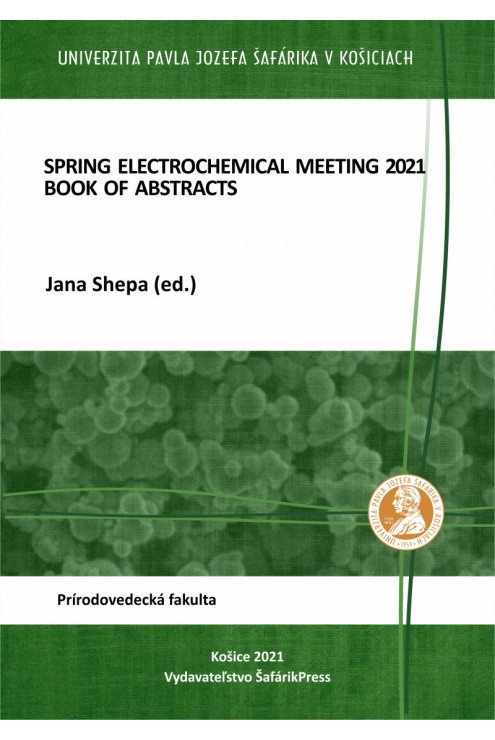
Spring Electrochemical Meeting. Book of Abstracts.

E-book

Jana Shepa (ed.)

The book of abstracts from the second year of the international conference Spring electrochemical meeting is composed of contributions from the participants of this student conference.

The conference consisted of one invited lecture and ten competing student lectures. The message of this meeting is to create a dialogue between students of electrochemistry and the mutual exchange of knowledge. All contributions are professionally processed and inspiring.

Download the e-book for free (pdf)

Quantity

978-80-574-0000-4

Data sheet

Method of publication:
E-book (pdf)
Editor:
Jana Shepa
Document type:
Book of abstracts
Number of pages:
36
Available from:
31.05.2021
Year of publication:
2021
Edition:
1st edition
Publication language:
English
Faculty:
Prírodovedecká fakulta
- Free for download

16 other products in the same category:

Nanotechnology

Nanotechnology

€16.84
Availability: 58 In Stock

 Andrej Oriňak - Renáta Oriňaková - Andrea Fedorková

Nanotechnology represent the fastest developing science in the present. They are based on the technologies that enable the matter manipulation at atomic level. Nanotechnology offer prepartion of the new materials with unknown and very specific properties and functions.Recent nanotechnology still stay in formative phase of their development. But more and more they are visible with nano-specific phenomenons in the fundamental control of the properties as well mater behaviour. This is quite possible that without nanotechnology will not work any science to the future, moreover that science will not exist anymore. Nanotechnolgy will give a chance and force to transform world to more environmental and comfortable. Expected is expansion of the nanotechnolgy to molecular nanosystems – heterogenous nets, in which molecules and supramolecules work as the nanodevices. The computers and robots will be reduced to the small and ultrasmall dimensions. In medicine will foremost the application of nanotechnology in genetic therapy and elimination of ageing. Nanosurgery will work at molecular level, cancer cells will be identified early and filtered , then substituted with healthy and unchanged. It is necessary to inform university or high school students  about principles of nanotechnolgy, preparation of the nanostructures, functionality of them and to offer full representation about molecular systems and nanodevices; the methods of nanostructures characterization and about application in miniaturized systems. 

Authors

Stresová fyziológia rastlín - Návody na cvičenia

Stresová fyziológia rastlín - Návody na cvičenia

E-book

E-book

Jozef Kováčik

These "Exercise Manuals" present a concise overview of commonly used methodologies as well as progressive techniques, such as the use of liquid chromatography and fluorescence microscopy. Individual tasks were selected based on the research focus of the Department of Botany at the Faculty of Science, Pavol Jozef Šafárik University in Košice, particularly in the context of "stress physiology."

Some tasks can also be utilized within the subject "Plant Ecology." Chamomile (Matricaria chamomilla) is typically used as a model plant for individual tasks due to its long-standing history of research at the Department of Botany and its ease of cultivation under laboratory conditions. The chapters also briefly discuss the significance of monitored parameters, principles of their determination, and metabolism (formation or degradation), aiming to indicate their mutual context.

This approach highlights that determining an individual parameter cannot provide a general explanation for the overall causes and impacts of observed changes; however, it can serve as a basis for testing hypotheses at the level of other parameters.

For deeper study of specific issues, there is an abundance of high-quality international monographs and review articles available.

Download the e-book for free (pdf)

Digitálna forenzná analýza I.

Digitálna forenzná analýza I.

E-book

E-book

Pavol Sokol - Ladislav Bačo - Tomáš Bajtoš

In the university textbook, we present the theoretical foundations and technical details of the activities of a forensic investigator. We describe the identification and provision of digital tracks, file system analysis. analysis of various artifacts of the Windows operating system, analysis of the operating memory. The textbook is also supplemented by a chapter devoted to the analysis of malicious code (malware). University textbooks are intended for students of bachelor's, master's, engineering and doctoral study programs in computer science, but also in non-informatics fields.

Download the e-book for free  (pdf)

The 9th International Conference on Novel Materials Fundamentals and Applications 2025

The 9th International Conference on Novel...

E-book

E-publication

Soňa Király

The Book of Abstracts of The 9th International Conference on Novel Materials Fundamentals and Applications, NFA 2025, contains 46 contributions from the participants of this conference. This congress is primarily focused on novel materials, ranging from theory to practical applications, with the aim of demonstrating how fundamental discoveries can lead to innovative implementations. All contributions are inspiring and professionally prepared.

Download the e-book for free (pdf)

Teória vypočítateľnosti

Teória vypočítateľnosti

E-book

E-book

Ľubomír Antoni-Stanislav Krajči

An important part of theoretical computer science is the problem of Turing machines. This computational model has two basic properties: like any other computational program, the software of a Turing machine is composed of instructions, but in its case they are all of a single type. Every other (so far known) computer program can be transformed into a Turing machine program without loss of information. While the second feature reduces the question of what a calculator cannot do to the question of what a Turing machine cannot do, the first feature allows a much simpler investigation of such a question. Using this computational model, we can thus find concrete problems that no automaton can ever deal with (perhaps the most famous is the problem of the Turing machine stopping). Their existence demonstrates the fundamental limitations of (not only ideal) computational means, and thus encourages both criticality and humility in our thinking.

Download e-book for free (pdf)

Návody na praktické cvičenia z biotechnológie

Návody na praktické cvičenia z biotechnológie

E-book

E-book

Danica Sabolová

This university textbook is intended for students of the Faculty of Science of the University of Applied Sciences in Košice who have enrolled in practical exercises in Biotechnology, but also for all other students who are interested in learning about the practical applications of biotechnology.

The aim of the practical course is to familiarize students with basic biotechnological methods and their applications. The students will verify in practice the theoretical knowledge acquired in the Biotechnology lectures such as the course of fermentation processes, wine production, preparation of fermented milk products and cheese, preparation of culture media, inoculation and cultivation of microorganisms, etc. The practical exercises also include the use of analytical and spectral methods, which are an integral part of biochemistry.

The scripts are published only in electronic form and are available on the University's website: http://kosice.upjs.sk/~kbch/sk, for the reason that it will always be possible to update and modernize the content of the laboratory exercises.

Download the e-book for free (pdf)

Zbierka úloh z matematickej analýzy III.
  • On sale!
  • -€12.62

Zbierka úloh z matematickej analýzy III.

€12.97 €0.35 -€12.62
Availability: 9 In Stock

Ondrej Hutník a kol. 

Zbierka úloh z matematickej analýzy III. je pokračovaním predchádzajúcich dvoch vydaných zbierok autorov Kulcsár a Kulcsárová. Táto časť obsahuje príklady na zopakovanie a precvičenie učiva stredných škôl, ako aj časti prvého semestra kurzu matematická analýza určeného pre študentov matematiky, fyziky, informatiky a učiteľského štúdia v kombinácii s matematikou. Zbierka môže tiež pomôcť všetkým učiteľom, ktorí chcú použiť rôzne úlohy vo svojom vyučovaní. Zbierka zahŕňa oblasť postupností reálnych čísel: aritmetické a geometrické postupnosti, všeobecne a rekurentne zadané postupnosti, nachádzajú sa tu úlohy na vyšetrovanie vlastností postupností (monotónnosť, ohraničenosť, konvergencia) a výpočet rôznych typov limít. Všetky zadané úlohy sú vyriešené na konci každej kapitoly s podrobným komentárom.

Autori

Jarná škola doktorandov 2022

Jarná škola doktorandov 2022

E-book

E-book

Peter Fedoročko (eds.)

From June 14 to June 17, 2022, the 8th annual Spring School for Doctoral Students at Pavol Jozef Šafárik University in Košice will take place in Liptovský Ján. The scientific program of the spring school will comprise 3 plenary lectures by leading scientific experts and 1 workshop. Doctoral students will present their research papers in two sections: 22 doctoral students of Faculty of Public Administration, Faculty of Law and Faculty of Arts, and 26 doctoral students of Faculty of Medicine and Faculty of Science. The scientific programme of the spring school will also include a panel discussion with the management of Pavol Jozef Šafárik University in Košice.

Download the e-book for free (pdf)

Prehľad dejín biológie, lekárstva a farmácie

Prehľad dejín biológie, lekárstva a farmácie

E-book

E-book

Martin BačkorMiriam Bačkorová

The proposed text focuses on the history of studying biology, medicine, and pharmacy as scientific disciplines from prehistoric times through antiquity, the Middle Ages, and the modern era. The text chronologically organizes the most significant figures in the history of biological scientific disciplines, outlines key characteristics of major historical discoveries, and reevaluates their significance from the perspective of 21st-century science.

The educational text is chronologically divided into the most significant periods of civilization development. The last two completed centuries—the 19th and 20th—are subdivided into major life science fields due to the unprecedented growth of biological disciplines and the resulting volume of acquired information.

Since it can sometimes be challenging in science to define what constitutes the past versus the present of a particular discipline, we have excluded significant biological discoveries from the early 21st century, which are typically regarded as the “present” of biology.

Download the e-book for free (pdf)

Študentská vedecká konferencia PF UPJŠ 2019

Študentská vedecká konferencia PF UPJŠ 2019

E-book

E-book

Katarína Cechlárová (ed.)

This year, the Student Scientific Conference was held on April 24, 2019, across 17 sections in disciplines such as biology and ecology, chemistry, physics, geography, mathematics, informatics, and their didactics. Bachelor’s and master’s students presented a total of 124 contributions. The most successful participants advanced to national or traditional Czech-Slovak student scientific showcases in fields like physics, chemistry, mathematics, informatics, and mathematics didactics.

In addition to faculty students, 10 high school students participated outside the competition. They were invited based on their achievements in subject-specific Olympiads or because they were already engaged with the faculty under the guidance of dedicated teachers in laboratory work as part of their preparation for future studies. The day also featured a programming competition with 23 participants, an IHRA contest involving 16 teams of high school students and 15 teams from elementary schools, and a new Puzzle section where 72 high school students from the region competed.

The abstracts from the Student Scientific Conference demonstrate that our faculty's students not only absorb theoretical knowledge delivered in lectures but also actively engage in solving partial scientific problems that align with research objectives at the institutes of PF UPJŠ. This collection serves as both a record of scientific activity at the faculty and a dignified presentation for the broader public.

Prof. RNDr. Katarína Cechlárová, DrSc.

Vice-Dean for Education

Doc. RNDr. Gabriel Semanišin, PhD.

Dean of the Faculty

Download the e-book for free  (pdf)

Geopriestorové technológie v bádateľsky orientovanom vyučovaní geografie

Geopriestorové technológie v bádateľsky...

E-book

E-book

Stela Csachová - Ján Kaňuk - Alena GessertLadislav NovotnýŠtefan GáborJozef Šupinský

This book addressed the inquiry-based learning and teaching with the support of geospatial technologies. Today, geospatial technologies are influencing geography teaching learning, particularly in secondary education. Theoretical framework gives the reader the insight to inquiry-based learning, with special focus on inquiry in geography. The one-by-one step of inquiry is analysed in detail. The major part of the book presents the eleven models of geography lessons, representing the subject content of physical, human and regional geographies, various levels of inquiry and use of different geospatial technologies. The readers are acquainted with the use of geographic information system (particularly Google Earth and ArcGIS online), web portals, webGIS, open data, mobile applications and new forms of 3D cartographic visualisation (virtual reality, 3D print, dynamic 3D map) in teaching geography. The lesson models were tested with the students to be geography teachers in school year 2021/2022. This books serves as resource mainly for undergraduate teacher students and in-service geography teachers.

Download e-book for free (pdf)

The 6th International Conference on Nanomaterials: Fundamentals and Applications

The 6th International Conference on...

E-book

E-book

Jana Shepa (ed.)

The book of abstracts from 6th International Conference on Nanomaterials: Fundamentals and Applications, NFA 2022 is composed of contributions from the participants of this international conference. The conference consisted of 4 invited lecture and 52 abstracts of participants. The conference is focused on nanotechnology and its application in various research areas. All contributions are professionally processed and inspiring.

Download the e-book for free (pdf)

Počítačová fyzika II

Počítačová fyzika II

E-book

E-book

Milan Žukovič

This textbook is intended for master's degree students and is a follow-up to the Computational Physics I course studied at the bachelor's level. The content of the textbook Computational Physics II focuses on stochastic methods of solving physical problems, mainly on Monte Carlo (MC) simulation of many-particle systems.

The focus on this computationally intensive approach is motivated by the gradual increase in the computing capacities of ordinary computers as well as the introduction of high-performance computing clusters. This has led to significant progress in the development of new simulation techniques, thanks to which MC simulations have found application in various areas of research and application practice. Considering the main research focus of the department, this text is particularly devoted to the presentation of basic and more advanced MC simulation techniques applied to a simple Ising spin model in order to investigate its magnetic, thermodynamic and critical properties.

The next part is devoted to MC simulations of random processes. It focuses on the simplest but also the most basic random walk process and demonstrates its applications in financial analysis and the solution of a quantum system described by the time-dependent Schrödinger equation. The last part is dedicated to the basics of molecular dynamics, applied to simulating the classical movement of atoms in a given force field. By mastering the problems addressed in this course, students will obtain a potential tool for working out of their diploma theses, or a methodology useful for their further scientific and research practice in the field of investigating of complex systems.

The lectured topic is subsequently exercised in the form of preparing projects implemented in the freely distributable software Octave, which is easy on the user's programming skills and which students have the opportunity to familiarize themselves with in the previous study.

Download e-book for free (pdf)

Exactly Solvable Models in Statistical Physics

Exactly Solvable Models in Statistical Physics

E-book

E-book

Jozef Strečka

Over the past fifteen years, the course on ’Exactly Solvable Models in Statistical Physics’ has become an indispensable ground of the study programme ’Theoretical Physics’ at Faculty of Science of Pavol Jozef Šafarik University in Košice. At first, the course based on the first edition of this textbook was intended for undergraduate students only, however, I have later prepared follow-up course taught at a postgraduate level on demand of several ambitious students who wished to continue in studying this exciting research field.

It is already more than decade when our students enrolled in the study programme ’Theoretical Physics’ graduate from ’Introduction to Exactly Solvable Models in Statistical Physics’ at a master level and ’Exactly Solvable Models in Statistical Physics’ at a postgraduate level. Of course, it was necessary somehow to rearrange topics for the courses of undergraduate and postgraduate students.

More specifically, a few more challenging topics concerned with exact solutions of 2D Ising model (chapter 3) were moved to a more advanced course intended for the postgraduate students, while an introductory course intended for the undergraduate students was contrarily supplemented with a few new topics requiring the second edition of this textbook.

The second edition of this textbook thus contains a completely new chapter 4 devoted to the exact solution of the Ising model on the Bethe lattice using the method of exact recursion relations, while the chapter 5 was supplemented by exact results for ground state of a few frustrated Heisenberg spin models using the variational method. It is my hope that the next edition of this textbook will come soon and it will involve all topics specifically taught within the postgraduate course as well. 

Download the e-book for free  (pdf)

Digitálna knižnica nástrojov formatívneho hodnotenia Digilib

Digitálna knižnica nástrojov formatívneho...

E-book

E-publication

Denisa Maceková-Monika Václavková-Marek Kvet-Ivana Sotáková
The Digilib Digital Library of Formative Assessment Tools – User Guide, Part A introduces the Digilib application as the key component of the library, designed to support the implementation of formative assessment in teaching at all levels of education. It explains the structure of the system, its modules, the principles of user roles, and the possibilities for working with the digital formative assessment tools. Particular attention is paid to the possibilities for creating, editing, and assigning the tools to students, as well as to providing personalised real-time feedback. The User Guide also explains how the Digilib application is interconnected with the affiliated applications Digiform and Digilib Images, which expand the possibilities for creating and visualising assessment tools. The guide is intended for teachers at all levels of education, student teachers, school administrators, and digital coordinators who are interested in the systematic use of the Digilib digital library to support the implementation of formative assessment, enhance the quality of the educational process, and foster the development of students’ self-assessment and reflective competences.
Download the e-book for free(pdf)

This website uses cookies to ensure you get the best experience on our website