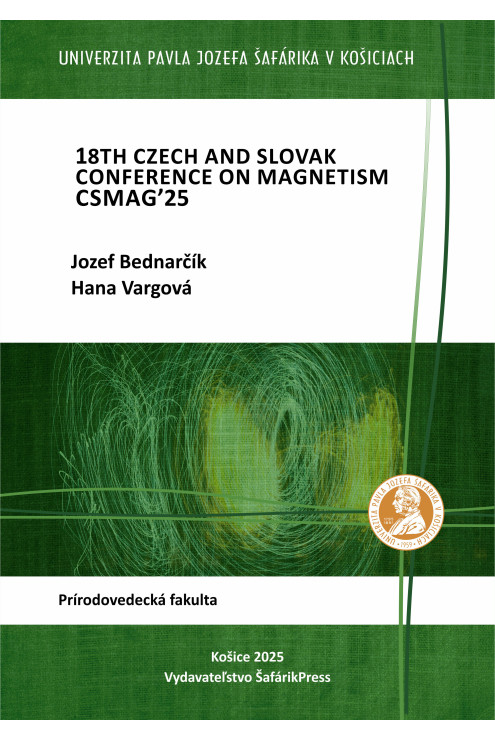
18th Czech and Slovak Conference on Magnetism – CSMAG’25

E-book

Jozef Bednarčík - Hana Vargová (eds.)

The Czech and Slovak Conference on Magnetism (CSMAG) is a scientific meeting that honors a longstanding tradition initiated in Košice in 1960. Evolving from a regional gathering of the Czechoslovak magnetic community into a prominent international forum, CSMAG brings together researchers from diverse fields of magnetism. The conference covers a wide range of topics including theoretical and experimental magnetism, magnetic materials for energy and spintronics applications, low-dimensional and molecular magnets, rare-earth and actinide systems, and multifunctional materials. With contributions from over 20 countries, CSMAG’25 fosters cross-disciplinary collaboration and showcases the latest advances in both fundamental studies and practical applications of magnetic phenomena.

Download the e-book for free (pdf)

Quantity

978-80-574-0423-1

Data sheet

Method of publication:
E-book (pdf)
Editors:
Jozef Bednarčík - Hana Vargová
Document type:
Book of abstracts
Number of pages:
220
Available from:
20.06.2025
Year of publication:
2025
Edition:
1st edition
Publication language:
English
Faculty:
Prírodovedecká fakulta
License:
CC BY NC ND (Uveďte autora - Nepoužívajte komerčne - Nespracovávajte)
DOI:
https://doi.org/10.33542/CSM-0423-1
- Free for download

16 other products in the same category:

Praktické cvičenia z röntgenovej difraktometrie II

E-book

E-book

Karel Saksl

Solving crystal structures is the royal discipline of X-ray crystallography. Its primary task, with the exception of defects, is to describe the atomic structure of the motif that, by its repetition, fills the volume of the entire crystal or crystalline phase. This task is nowadays more or less routine for single-crystal X-ray diffraction, which can locate hundreds to thousands of non-hydrogen atoms in large unit cells. However, in real practice, we often have material available only in powder form instead of single crystals. Solving the atomic structure from its X-ray diffraction data is non-trivial, mainly because the three-dimensional diffraction space of a single crystal is reduced to one dimension by measuring a large number of randomly oriented microcrystals (crystallites). Therefore, the solution itself requires, in addition to proper measurement methodology, the selection of suitable tools, procedures, and strategies that, through optimization, will lead to the solution and refinement of the given crystalline phase. The current limit of this method is approximately 100 non-hydrogen atoms in the asymmetric part of the unit cell, which, however, is sufficient for most inorganic materials.

The goal of these educational texts is to provide students in the second and third levels of university studies with specific guidance on solving crystal structures from powder X-ray diffraction data. These scripts build upon my first monograph and require practical knowledge of its content. Similar to my previous monograph, I offer solved examples without a deep theoretical introduction, demonstrating procedures and strategies leading to the correct solution of crystalline phases using the freely available GSAS-II program. The examples are arranged from simpler to more complex, and the reader will find many useful pieces of information in the literature references as well as in the comments below the line. Part of these scripts are data intended for your individual practice of the described procedures. 

Karel Sakls

Download the e-book for free  (pdf)

Matematika pre nematematické odbory
  • On sale!
  • -€7.96

Matematika pre nematematické odbory

€8.96 €1.00 -€7.96
Availability: 135 In Stock

Danica StudenovskáTomáš Madaras 

Táto publikácia je určená pre študentov nematematických odborov na Prírodovedeckej fakulte UPJŠ v Košiciach. Jej obsahom je látka preberaná v prvom semestri v rámci predmetu Matematika I..

Publikácia nadväzuje na učivo stredných škôl a nevyžaduje žiadne predbežné špeciálne znalosti. Môže slúžiť ako základ na ďalšie samostatné štúdium a môže byť užitočná aj pre iných záujemcov o matematiku a jej aplikácie.

Vyriešené príklady v jednotlivých kapitolách majú pomôcť čitateľovi pri zvládnutí štúdia. Tomu napomáhajú aj ilustratívne obrázky.

Autori

Praktické cvičenia z biochémie

E-book

E-book

Erik Sedlák - Rastislav Varhač -  Patrik Danko - Helena Paulíková - Dušan Podhradský

The presented scripts were created in an effort to update and especially clarify the tasks that are solved in the basic practical exercises in biochemistry students of the 2nd and 3rd year of the bachelor's degree in chemistry, biology and their combinations with other disciplines. Most of the tasks come from the original scripts "Podhradský, Mihalovová: Praktické cvičenia z biochémie, Košice 1989".

Some of them have been modified to a greater or lesser extent and adapted to current conditions in the laboratory. New tasks were also added, such as those dedicated to nucleic acids. The scripts are thematically divided into six separate units, each of which consists of several tasks. The names of the units correspond to the nature of the biomacromolecules, which form their central theme. Theoretical introductions at the beginning of the unit are newly constructed and their main goal is to provide a brief overview of the basic biochemical methods used in the study of biomacromolecules.

These scripts are intentionally only available in electronic form. The reason is the effort to continuously update and modernize individual tasks according to the changing possibilities of our laboratory. We hope that the scripts will fulfill their role and that students will have sufficient theoretical knowledge and practical skills in the field of basic biochemical methods after completing these laboratory exercises.

Download e-book for free (pdf)

EFFUSE – River Landscape, Volume 2: Guidelines...

E-book

E-publication

Beáta Valkay ed.
Ivana Slepáková-Andrej Mock a kol.

The publication EFFUSE – River Landscape, Volume 2: Guidelines for Experts, developed within the EFFUSE project, is intended for professionals in the field of environmental sciences. It provides recommendations for research in river landscapes and highlights their importance for understanding ecological processes. The text presents bioindicators as a key tool for assessing landscape health and biodiversity conservation. A dedicated section explains why studying river landscapes as natural laboratories is essential. The publication also includes a practical manual for the Olympus DSX-1000 High End Model microscope, expanding opportunities in scientific education and research. In this way, it combines theoretical guidelines with modern technologies that enhance environmental knowledge.

Download the e-book for free (pdf)

1st Workshop on Perspective Electron Spin...

E-book

E-book

Jozef Strečka- Katarína Karl’ová (eds.)

Zborník obsahuje program a abstrakty workshopu s názvom: 1st Workshop on Perspective Electron Spin Systems for Future Quantum Technologies, ktorý sa bude konať 28.-29. júna 2022 v Košiciach. Workshop je organizovaný Prírodovedeckou fakultou Pavla Jozefa Šafárika v Košiciach a Ústavom experimentálnej fyziky Slovenskej akadémie vied v Košiciach s finančnou podporou Agentúry na podporu výskumu a vývoja. Ústrednými témami konferencie budú súčasné problémy kvantovej fyziky - kvantovej teórie magnetizmu spinových a elektrónových štruktúr, exotických kvantových spinových stavov, kvantového previazania, kvantových fázových prechodov, topologického kvantového počítania a kvantového spracovania informácie. Účastníci workshopu budú prezentovať originálne pôvodné výsledky svojho výskumu, ktoré môžu zásadným spôsobom ovplyvniť vývoj budúcich kvantových technológií.   

Download the e-book for free (pdf)

Úvod do porovnávacej morfológie živočíchov

E-book

E-book

Andrej Mock

The structure of the animal body is extremely varied. Each species has its distinctive morphological features, which bears as a testimony to long-term development and belonging to the developmental lineage. At the same time, the body has been tested for a long time by natural conditions, resulting in unique adaptations to the environment and life strategy. Despite this admirable variety - which includes both recent and fossil animals and which we have far from mapped – a comparison of body parts brings knowledge we can generalize: the main building principles, and boundaries within which phenotypic diversity is realized.

Comparative animal morphology today uses the latest methodological material and knowledge from other disciplines, from genetics, molecular biology and experimental embryology, through progressive imaging methods (e.g. electron microscopy, computer micro-tomography) and the possibilities of subsequent software processing of image material (measurement, staining, etc.) to the view of physics, chemistry, statics and geometry on the structures (to nanostructures) of the living body. Detailed knowledge of historical and contemporary conditions on Earth is an important interpretative context in the study of animal morphology. Surprisingly, the knowledge accumulated after centuries of research is now rapidly supplemented by new knowledge, and often the traditional knowledge is subsequently reinterpreted. Finally, and no less important, in studying animal (and human) morphology, we learn surprising knowledge about ourselves.

The author of the presented textbook had the ambition in a simplified form to introduce the reader, especially the student of biological studies, into a dynamic and fascinating scientific discipline, as the current comparative animal morphology is.

Stiahnite si e-knihu zadarmo (pdf)

Študentská vedecká konferencia PF UPJŠ 2017

E-book

E-book

Katarína CechlárováEva Pitoňáková (eds.)

Proceedings of Abstracts from Contributions by Participants of the Student Scientific Conference at the Faculty of Science, UPJŠ in Košice, Held on April 26, 2017

This is the fifth edition of the proceedings from the Student Scientific Conference (ŠVK) at the Faculty of Science, Pavol Jozef Šafárik University in Košice. We are pleased that ŠVK has become an integral part of faculty life and a showcase for the quality of education provided. In 2017, ŠVK took place as part of the traditional Science Days on April 26, 2017. 105 students from the Faculty of Science presented their work. Contributions were organized into 15 sections, supplemented by an open programming competition involving 17 students and the final round of the IHRA competition, which included 27 teams from across Slovakia.

The abstracts in this proceedings demonstrate that students at the Faculty of Science, UPJŠ, acquire knowledge and skills in their field not only through theoretical study of disciplines but also through active engagement in solving partial scientific problems aligned with research goals at the faculty’s institutes. These abstracts also provide an overview of the faculty’s scientific activity, which we believe will be of interest to the broader public.

doc. RNDr. Gabriel Semanišin, PhD.

Dean of the Faculty

Download the e-book for free (pdf)

Kmity, vlny a optika

E-book

E-book

Ján Füzer

Auxiliary teaching material for the course General Physics III – Oscillations, Waves, and Optics is intended for students of single-subject and interdisciplinary studies of physics.

The content provides a basic outline of the material covered, without detailed explanations, with an emphasis on the physical method of thinking using the simplest elements of higher mathematics. The presented text does not aim to replace the recommended textbooks, but rather to help students navigate the subject matter. Recommended literature can be found at the end of the text.

The teaching material contains the basic framework of the lectures and is supplemented and revised each year, with lectures enriched by supporting demonstration experiments.

Download e-book for free (pdf)

NOVEL TRENDS IN CHEMISTRY, RESEARCH AND...

E-book

Jana Šandrejová - Andrea Gajdošová (eds.)

The scientific book of abstracts from the conference „Novel Trends in Chemistry, Research and Education 2024“ is a summary of the contributions of conference participants, which contain the original results of their scientific and research activities. The contributions published in this volume are divided according to content into the fields of analytical, inorganic, organic, physical chemistry, biochemistry and didactics of chemistry.

Download the e-book for free (pdf)

Náhodné procesy a ich aplikácie

E-book

E-book

Valéria SkřivánkováMartina Hančová

The publication is focused on discrete random processes, primarily on Markov chains, which have wide application in the field of economics and finance.

The textbook is divided into five chapters, the first of which serves as an introduction to random processes and provides definition, properties and classification of random processes in general. The second chapter discusses Markov chains with discrete time, including valuation of transitions between states and their optimal management. The third chapter focuses on special Markov chains with continuous time and emphasizes construction and solution to the system of Kolmogorov differential equations, which describe the dynamics of the process development. The last two chapters illustrate applications of Markov chains using examples of queuing system modeling and renewal theory.

Besides the explanation of basic terms, definitions and theorems with proofs, this textbook also provides number of solved examples to illustrate the discussed theory. Problem assignments are placed at the end of each chapter, so that readers can test their understanding of the content as they progress through the book. Solutions to all the problems and the list of references are provided at the end of the publication.

This textbook is primarily intented for students majoring in Economics and Financial Mathematics at the Faculty of Science of Pavol Jozef Šafárik University in Košice, and it covers content of the course “Random Proceses 1“ thought there. It might however serve also students from other schools in similar progams or professionals interested in this topic.

Download the e-book for free (pdf)

Návody na praktické cvičenia z biotechnológie

E-book

E-book

Danica Sabolová

This university textbook is intended for students of the Faculty of Science of the University of Applied Sciences in Košice who have enrolled in practical exercises in Biotechnology, but also for all other students who are interested in learning about the practical applications of biotechnology.

The aim of the practical course is to familiarize students with basic biotechnological methods and their applications. The students will verify in practice the theoretical knowledge acquired in the Biotechnology lectures such as the course of fermentation processes, wine production, preparation of fermented milk products and cheese, preparation of culture media, inoculation and cultivation of microorganisms, etc. The practical exercises also include the use of analytical and spectral methods, which are an integral part of biochemistry.

The scripts are published only in electronic form and are available on the University's website: http://kosice.upjs.sk/~kbch/sk, for the reason that it will always be possible to update and modernize the content of the laboratory exercises.

Download the e-book for free (pdf)

MAGNETICKÉ NANOČASTICE: NANOMAGNETIZMUS,...

E-book

Adriana Zeleňáková

Magnetic nanoparticles are extremely interesting magnetic objects that still hide much that is undiscovered, both because of their physical properties and because of their diverse applications. Iron nanoparticles, or iron oxides, are used in medical diagnostics for magnetic resonance imaging, in the treatment of hyperthermia, and an important application is the use of magnetic particles for targeted drug delivery.

The textbook "Magnetic Nanoparticles: Nanomagnetism, Preparation and Advanced Applications" is intended primarily for students of the Master's programme in Physics and students of related disciplines at universities and faculties with a physical, chemical, metallurgical and biophysical focus. The motivation for writing this textbook was to develop study material that would contribute to improving the quality of teaching in the profile subject Nanomaterials and Nanotechnology at the Institute of Physical, Faculty of Sciences, UPJŠ, in the Master's programme Condensed Matter Physics, as well as in the profile subject in the PhD programme Advanced Materials.

The university textbook is divided into eight chapters. The first and second chapters are devoted to basic information about magnetism, the origin of nanomagnetism in nanoparticles and surface phenomena. The third and fourth chapters are devoted to nanomagnetism in nanoparticle systems. The fifth chapter describes in detail individual protocols for investigating the phenomenon of superparamagnetism and the phenomenon of superspin glass using the SQUID device. The sixth chapter describes individual procedures for the preparation of magnetic nanoparticles and the seventh chapter describes individual experimental techniques for the study of magnetic nanoparticles. The final eighth chapter describes the applications of nanoparticles in biomedicine.

During the writing of this textbook, the chapters were prepared using the foreign-language specialist literature listed in the recommended reading list.

Download the e-book for free

Prípadové štúdie v dolovaní údajov

E-book

E-book

Erik BruothJuraj ŠebejĽubomír Antoni

In these university-level textbooks, we present the fundamental concepts of networks and graph theory. We explore breadth-first and depth-first graph searching. We present static and dynamic network models. We describe the issue of detecting overlapping and non-overlapping communities in directed and undirected networks. Various approaches to anomaly detection in networks also form an important part of this textbook. The final chapter is dedicated to spectral clustering, which plays a significant role in data mining in network graphs for various application domains.

These textbooks are suitable for first and second-year university students in computer science programs. The study materials are also suitable for students in non-computer science fields, with the aim of improving their knowledge and practical experience in computer science-related areas, and provide an opportunity for students to find employment in IT companies to solve practical tasks.

Download e-book for free (pdf)

Magnetic Cooling and Frustrated Magnetism. Book...

E-book

E-publication

Jozef Strečka-Katarína Karľová

The proceedings include the programme and abstracts of the workshop Magnetic Cooling and Frustrated Magnetism, held in Košice on October 27–29, 2025. The event is organized with the support of the French National Research Agency (ANR), the Faculty of Science of Pavol Jozef Šafárik University in Košice, and the Slovak Research and Development Agency. The workshop focuses on current challenges in quantum physics, particularly frustrated magnetism and magnetic cooling. Participants will present original research results that may significantly contribute to the development of future quantum technologies.

Download the e-book for free (pdf)

Študentská vedecká konferencia PF UPJŠ 2023

E-book

E-book

Marián Kireš  (ed.)

Proceedings of Abstracts from the Student Scientific Conference of the Faculty of Science, Pavol Jozef Šafárik University in Košice

The Student Scientific Conference (SSC) represents the culmination of long-term and intensive work on a selected topic, collaboration with a supervisor, or a broader team at the workplace. In practice, however, it often marks the beginning of scientific research, focusing on a chosen subject, field, or close cooperation with a future supervisor of a bachelor's, master's, or doctoral thesis.

This year, the Student Scientific Conference took place on April 19, 2023, featuring 14 sections, a programming competition, and the IHRA contest. Bachelor’s and master’s students presented 101 contributions. Additionally, 8 high school students participated non-competitively, presenting their SOČ projects; 14 students took part in the programming competition, and 3 students competed in the IHRA contest.

We believe that the proceedings of abstracts and related documents serve not only as an archive but also as a dignified presentation of scientific activities at our faculty for the wider public.

Download the e-book for free  (pdf)

This website uses cookies to ensure you get the best experience on our website