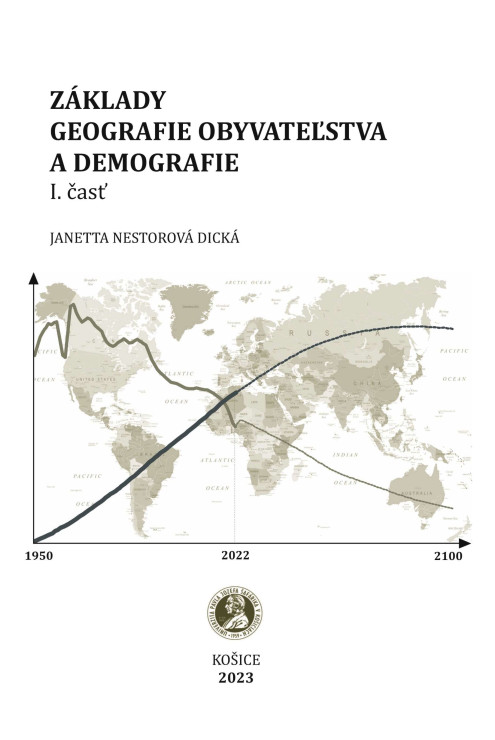
Základy geografie obyvateľstva a demografie I. časť

E-book

Janetta Nestorová Dická

The university handbook Elementals of Population Geography and Demography - Part I, as an introduction to population studies, is primary study material for students of the geography study program, as well as for students of the Information Systems in Public Administration study program at the Pavel Jozef Šafárik University in Košice, but also for the wider public interested in about population phenomena and their spatiality. Among other things, the handbook offers the latest population reports in the world and its regions.

The aim of the handbook is to introduce young geographers to the basics of population research, which includes the most frequently used tools and methods in geographic analysis. The first part of the handbook contains an introduction to the scientific disciplines of population geography and demography with an overview of basic sources of demographic data.

The next part discusses the issue of anthropogenesis, i.e. the development of humans from our ancestors and the spatial spread of humans across our Earth. Part of this part is the recent development of the world population and changes in the size and distribution of the global population over time. The last part analyses how the population is distributed in the world and in relation to the geographical components of the space.

Download the e-book for free  (pdf)

Quantity

978-80-574-0222-0

Data sheet

Method of publication:
E-book (pdf)
Author:
Janetta Nestorová Dická
Document type:
University Textbook
Number of pages:
117
Available from:
21.06.2023
Year of publication:
2023
Edition:
1st edition
Publication language:
Slovak
Faculty:
Prírodovedecká fakulta
Note:
Vysokoškolská učebnica je výstupom projektu VEGA 1/0514/21
License:
Creative Commons BY NC ND (Uveďte autora - Nepoužívajte komerčne - Nespracovávajte)
DOI:
https://doi.org/10.33542/ZGO-0222-0
- Free for download

16 other products in the same category:

Návody na cvičenia z fyziológie rastlín

Návody na cvičenia z fyziológie rastlín

E-book

E-book

Miroslav Repčák - Martin Bačkor - Peter Paľove-Balang - Silvia Gajdošová

The establishment of the Plant Physiology Laboratory at the Department of Botany, Faculty of Arts, Pavol Jozef Šafárik University in Košice in 1969 was associated with the name of Ing. Štefan Kocúrik, CSc. (1923–2006), who also prepared the first "Instructions for Exercises in Plant Physiology" (Košice 1972, 1976).

Since 1980, the manual by Associate Professor RNDr. Karol Erdelský, CSc., and Ing. Fridrich Frič, DrSc., titled "Practicum and Analytical Methods in Plant Physiology" (Bratislava 1980) has been used. With the increase in the number of students, it became relevant in 1991 to publish the "Instructions for Exercises in Plant Physiology" again to improve preparation and the efficient organization of practical work. Associate Professor RNDr. A. Košturiak, CSc., contributed significantly to the expansion of the introductory part of the instructions with his valuable advice, for which the authors are grateful. For the fourth edition, some tasks were updated and modernized, taking into account the possibilities of the renovated laboratory. The selection of tasks was adapted to the current scope of exercises for individual plant physiology subjects within the bachelor's and master's study programs in biology and ecology. These subjects include: Plant Physiology, Plant Metabolism, Mineral Nutrition of Plants, Plant Growth and Development, and Plant Ecology. Some tasks are also suitable for high school experiments.

The choice of topics was influenced by the research focus of our workplace on secondary metabolism, ecophysiology, and medicinal plants. The instructions generally adhere to the SI unit system, occasionally including other commonly used units.

Download the e-book for free (pdf)

Digiform - podporná aplikácia k Digilib

Digiform - podporná aplikácia k Digilib

E-book

E-publication

Denisa Maceková-Monika Václavková-Marek Kvet-Ivana Sotáková

The publication Digiform: A Supporting Application to Digilib – User Guide, Part B presents the Digiform web application as a tool that extends the functionality of the Digilib digital library of formative assessment tools. The application enables the creation and editing of formative assessment tool templates, which can be adapted to the specificities of individual subjects and levels of education and subsequently imported into the Digilib environment for use in the teaching process. The guide provides a detailed description of how to work with the Digiform application, from creating new templates, editing and personalising them, through to their export and implementation in the main Digilib application. Attention is also given to the interconnection with the Digilib Images application, which enables the integration of visual elements into the assessment tools, thereby enhancing their didactic effectiveness and visual appeal. The guide is intended for teachers at all levels of education, student teachers, school administrators, and digital coordinators who are interested in the systematic use of the Digilib digital library to support the implementation of formative assessment, enhance the quality of the educational process, and foster the development of students’ self-assessment and reflective competences.

Download the e-book for free (pdf)

Praktikum z nukleárnej magnetickej rezonancie. Časť 2: Kvantitatívna analýza a fyzikálno-chemické štúdie

Praktikum z nukleárnej magnetickej rezonancie....

E-book

E-publication
Mária Vilková-Zuzana Kudličková-Ján Elečko
This study material is intended for students of chemistry and related disciplines interested in applied nuclear magnetic resonance (NMR) and physical chemistry. It offers practice-oriented tasks designed to develop skills in NMR spectroscopy, quantitative analysis, and data interpretation. Students learn modern approaches to determining physicochemical parameters (e.g., partition coefficients, pKa values, keto–enol equilibria, or enantiomeric excess) and gain experience with software tools for spectrum processing.
Download the e-book for free (pdf)

Základy organickej chémie.  Vysokoškolský učebný text k predmetu Základy chémie

Základy organickej chémie. Vysokoškolský...

E-book

E-book

Mária Vilková - Zuzana Kudličková - Ján Elečko

Organic chemistry is the chemistry of carbon. Organic compounds in the form of large molecules (macromolecules), such as nucleic acids, proteins, carbohydrates, and lipids are the basic elements of living organisms. This study material is created for non-chemistry students, especially students of biology. Most of these students have little or no knowledge of organic chemistry. Therefore, we proceed from the basic principles of organic chemistry to biochemistry.

The basic principles of organic chemistry and biochemistry are briefly summarized in individual chapters, but the main content consists of tasks for practising basic knowledge. To check the correctness of solving the tasks, the correct solutions are also given. The importance of this study material lies in the fact that students will get additional study material that they will use in studying the subject Basics of Chemistry.

Download the e-book for free (pdf)

Základné fyzikálne praktikum II.
  • On sale!
  • -€9.55

Základné fyzikálne praktikum II.

€10.55 €1.00 -€9.55
Availability: 21 In Stock

Peter Kollár a kol. 

Skriptá Základné fyzikálne praktikum II. sú určené pre študentov Prírodovedeckej fakulty UPJŠ v Košiciach študujúcich na študijných programoch fyzika a medziodborových programoch v kombinácii s fyzikou. Obsahom skrípt sú úlohy z elektriny, magnetizmu a optiky. Podľa študijných programov sú zaradené do 3.semestra bakalárskeho štúdia, v ktorom by už študenti mali mať absolvovaný predmet všeobecná fyzika II. (elektrina a magnetizmus). Súčasťou každej úlohy sú základné poznatky venované javom, ktoré sú obsahom samotnej úlohy.

Autori

Tvorba úloh pre programátorské súťaže

Tvorba úloh pre programátorské súťaže

E-book

E-book

Ľubomír ŠnajderJán Guniš

The publication lists interim results of qualitative educational research focused on the development and evaluation of programming tasks being carried out by authors since 2005 in the frame of programming competition PALMA junior.

The publication consists of three chapters: Computer science competitions in Slovakia, Tasks in computer science education, Selected problems of PALMA junior competition. The first chapter provides an overview of computer science competitions for a primary and secondary schools in Slovakia. The second chapter described the issue of learning tasks - their components, focus, formulation types, and development system of tasks. The third chapter contains the assignments and commented author solutions of selected problems represented focus of PALMA junior competition – programming, algorithms and mathematics.

For each problem is mentioned analysis of pupils’ solutions aimed to ways of thinking, typical misconceptions, sets of preparatory and extended problems. The publication is addressed to computer science teacher trainers, authors of programming competitions problems, and computer science teachers.  

Download the e-book for free (pdf)

Štruktúra a reaktivita – riešené príklady a úlohy. 1. časť

Štruktúra a reaktivita – riešené príklady a...

E-book

E-book

Slávka Hamuľaková

The textbook "Structure and reactivity - solved examples and tasks, part 1" is the basis for teaching the subject "Structure and reactivity" for students of the 1st year of master's studies at the Faculty of Science, UPJŠ, department of Organic Chemistry. The textbook is divided into individual chapters, each chapter offering students examples of chemical reactions, where their course is explained on the basis of appropriate reaction mechanisms. A substantial part of the textbook consists of unresolved tasks, the main goal of which is the development of students' knowledge and skills. Due to the fact that the textbook is focused on only one semester of study, it cannot cover all reactions, rather it is only representative examples of different types of reactions, such as: addition reactions, elimination reactions, aromatic substitution, addition-elimination reactions, radical reactions and pericyclic reactions.

Download the e-book for free (pdf)

Systematika cievnatých rastlín, 5. vydanie

Systematika cievnatých rastlín, 5. vydanie

E-book

E-book

Pavol Mártonfi

The university textbook deals with the latest knowledge from the systematics of vascular plants in a clear manner. Vascular plants arose in the Silurian period in the Paleozoic, when the first primitive plants moved from water to dry land, which required evolutionary progress in the morphological and anatomical structure of these plants. During about 420 million years of the existence of vascular plants, several of their main groups have evolved: the spore vascular plants, including the lycopods (branch Lycopodiophyta) and group of ferns and related plants (branch Monilophyta), and the seed plants, including gymnosperms (branch Gymnospermae) and angiosperms ( Angiospermae), which currently dominate among plants. The textbook provides a brief but comprehensive overview of the main groups, orders and families of plants with their description, distribution, main representatives, while also addressing the useful properties of selected species. The work is complemented by an overview of the system of plants by Cronquist, Tachtadžjan, APG and an overview of the families of the Slovak flora, as well as a taxonomic index.

Download e-book for free (pdf)

Vybrané kapitoly z elektrochémie

Vybrané kapitoly z elektrochémie

E-book

E-book

Kveta Markušová - Daniela Kladeková

Electrochemistry is the science that studies ionic systems and the processes or phenomena that occur at the interface between ionic systems and metals or semiconductors. At the current stage of development, electrochemistry can be divided into two main areas based on its focus. The first one - ionics - deals with the properties of ionic systems (solutions, melts, solid electrolytes). The second area - electrodeics - focuses on phenomena at the electrode/ionic system interface.

Both ionics and electrodeics investigate equilibrium and non-equilibrium phenomena and processes. Research into the properties of ionic systems under equilibrium conditions provides information and insights into the structure and composition of electrolyte solutions, melts, and solid electrolytes, while measurements under non-equilibrium conditions provide data on the electrical conductivity of ionic systems. In the field of electrodeics, the study of equilibria at the electrode/solution (or melt) interface is the domain of electrochemical thermodynamics. Measuring the rates of processes occurring at this phase interface and explaining the principles governing these processes fall under the scope of electrode process kinetics or electrochemical kinetics.

Download the e-book for free (pdf)

The XIV. European Magnetic Sensors and Actuators Conference – EMSA2024 - Book of Abstracts

The XIV. European Magnetic Sensors and...

E-book

E-book

Jozef Bednarčík (ed.)

The European Magnetic Sensors and Actuators Conference (EMSA) is a consolidated European forum that serves to assess the status, recent progress, and development in the field of magnetic sensor technology and magnetic actuators. It was first held in 1996 in Iasi (Romania) and since then has continued every two-three years in different European cities. The aim of the conference is to generate an overview of research in magnetic sensors and actuators, to recognize their relevance in modern industry and to identify potential future collaborations. EMSA 2024 will provide an excellent opportunity to bring together scientists and engineers from universities, research institutes and industry to present and discuss their most recent results covering both fundamental and applied aspects of magnetic sensors and actuators.

Download e-book for free (pdf)

MAGNETICKÉ NANOČASTICE: NANOMAGNETIZMUS, PRÍPRAVA A POKROKOVÉ APLIKÁCIE

MAGNETICKÉ NANOČASTICE: NANOMAGNETIZMUS,...

E-book

Adriana Zeleňáková

Magnetic nanoparticles are extremely interesting magnetic objects that still hide much that is undiscovered, both because of their physical properties and because of their diverse applications. Iron nanoparticles, or iron oxides, are used in medical diagnostics for magnetic resonance imaging, in the treatment of hyperthermia, and an important application is the use of magnetic particles for targeted drug delivery.

The textbook "Magnetic Nanoparticles: Nanomagnetism, Preparation and Advanced Applications" is intended primarily for students of the Master's programme in Physics and students of related disciplines at universities and faculties with a physical, chemical, metallurgical and biophysical focus. The motivation for writing this textbook was to develop study material that would contribute to improving the quality of teaching in the profile subject Nanomaterials and Nanotechnology at the Institute of Physical, Faculty of Sciences, UPJŠ, in the Master's programme Condensed Matter Physics, as well as in the profile subject in the PhD programme Advanced Materials.

The university textbook is divided into eight chapters. The first and second chapters are devoted to basic information about magnetism, the origin of nanomagnetism in nanoparticles and surface phenomena. The third and fourth chapters are devoted to nanomagnetism in nanoparticle systems. The fifth chapter describes in detail individual protocols for investigating the phenomenon of superparamagnetism and the phenomenon of superspin glass using the SQUID device. The sixth chapter describes individual procedures for the preparation of magnetic nanoparticles and the seventh chapter describes individual experimental techniques for the study of magnetic nanoparticles. The final eighth chapter describes the applications of nanoparticles in biomedicine.

During the writing of this textbook, the chapters were prepared using the foreign-language specialist literature listed in the recommended reading list.

Download the e-book for free

Vybrané heterocyklické zlúčeniny

Vybrané heterocyklické zlúčeniny

E-book

E-book

Mariana Budovská

The aim of writing the university textbook "Selected Heterocyclic Compounds" was to create a study aid for students of the Organic Chemistry program, which provides essential information in a clear format for the subject of Heterocyclic Compounds. In selecting the content of the textbook, the goal was to present basic information about the chemistry of the most significant heterocycles. Given that the summary of chemical knowledge about heterocycles is vast, it was not possible to include all heterocyclic compounds in the content.

The intention was for readers to orient themselves in the field of heterocyclic compounds. Separate chapters included in the content address the nomenclature of heterocycles, basic chemical properties of individual heterocycles, their synthesis and reactions, the occurrence of heterocycles in nature, and their practical applications (medications, dyes, pesticides, detergents, etc.).

Download e-book for free (pdf)

Globálne navigačné satelitné systémy

Globálne navigačné satelitné systémy

E-book

E-book

Vladimír Sedlák

In the presented university textbooks, so-called satellite-based augmentation systems (SBAS, from the English Satellite Based Augmentation Systems, in Slovak Systémy rozširujúce základné satelitné systémy) are also discussed. These systems enhance, expand, or refine the basic satellite navigation systems. They are supportive satellite systems for GNSS (Global Navigation Satellite Systems). Currently, the long-operational American GPS and Russian GLONASS systems, as well as the partially operational European Galileo system (since December 2016), have and will continue to have broad applications in various fields of human activity, both professional and personal.

The university textbook Globálne navigačné satelitné systémy (Global Navigation Satellite Systems) reflects the current progressive development in the technological and instrumental principles and components of such satellite navigation systems. It presents the state of these satellite technologies from their historical origins and development to the present. The rapid advancements, particularly in the instrumental base of satellite navigation systems, will require updates on their current state in future editions of these university textbooks.

Download the e-book for free (pdf)

EFFUSE príručka pre žiakov: Základy biomonitoringu vodných tokov

EFFUSE príručka pre žiakov: Základy...

E-book

E-publication

Beáta Valkay ed.
Ivana Slepáková-Lenka Maliničová a kol.

EFFUSE - A Guide for Students is an interactive educational resource for primary and secondary school students to help them better understand how their daily activities affect the environment. The handbook was developed within the EFFUSE project (‘Environment for the future by science education’) and motivates young people to take a greater interest in the nature around them. It focuses on practical field activities during which they will explore the ecosystem of the Laborec and Uh rivers, observe and document organisms and work with real samples from nature. At the same time, they will learn about the work of scientists - botanists, zoologists and microbiologists - and learn basic biomonitoring methods. The manual will also guide them through the process of creating a virtual laboratory to display the results of their investigations of an aquatic ecosystem. It will help them understand the importance of sustainable development and encourage them to behave responsibly towards nature. It is their opportunity to learn about their surroundings in a new way, to learn to think scientifically and to become active creators of positive change for their community and future generations.

Download the e-book for free(pdf)

Anatomické termíny pre štúdium anatómie človeka a neuroanatómie (2. vydanie)

Anatomické termíny pre štúdium anatómie človeka...

E-book

E-book

Juraj Ševc - Anna Alexovič Matiašová

Among students of single-discipline and interdisciplinary biology studies at faculties with a natural science focus, there often arises a problem in defining the scope of the curriculum when studying the subject of Human Anatomy. The presented study material aims to help students of non-medical scientific fields navigate the extensive anatomical terminology and to limit the amount of required anatomical terms to an optimum, so that alongside mastering Latin nomenclature, students still have sufficient capacity to memorize additional knowledge in the areas of systemic, comparative, developmental, and functional anatomy.

Emphasis on organizing individual anatomical terms into logical units simultaneously supports a hierarchical view of the architecture of the human body. Despite its seemingly self-serving nature, anatomical terminology thus becomes the framework upon which students build knowledge from more or less related scientific disciplines studying the human body and the processes occurring within it throughout their further studies. At the same time, alongside this ambition that goes beyond the scope of the anatomy discipline, the Anatomical Terms follow a long tradition of anatomical handbooks while respecting the valid Latin and Slovak anatomical nomenclature.

This script represents a practical supplement to university textbooks of Anatomy or Neuroanatomy and especially to anatomical atlases, but it certainly does not aim to replace them. Here you will find all the necessary terms gathered in one place, which you can always have at hand on your phone, e-reader, or laptop. The emphasis on organizing individual anatomical terms into logical units supports a hierarchical view of the architecture of the human body, and the inclusion of a brief introduction to each system is intended to encourage you to seek further, more detailed information about the structure and function of the given organ system.

Download the e-book for free (pdf)

A guide to the didactics of biology

A guide to the didactics of biology

E-book

E-book

Katarína Kimáková

The textbook is intended for university students who are preparing for the profession of biology teacher. The structure of the book is similar to an encyclopedia, with one page devoted to each content item, but the topics of the chapters and subchapters follow each other.

The explanatory text on the page illustrates the diagram and there are notes and links to other sources of information. For better orientation, the content of the textbook is divided into 8 sections, which cover several chapters. It follows the general didactics, which it connects with the teaching of biological content. The book provides a basic orientation in the approaches to learning this subject, and also explains the relationship between biology as a science and the didactics of biology. It deals with teaching standards and curricula, advises on how to master biological concepts and understanding, how to communicate with students in biology classes, when and why are effective visual and practical methods. It acquaints the reader with the issue of setting goals for biological education in the cognitive, psychomotor and affective areas in relation to formative and summative assessment.

Hopeful as well as experienced teachers will find in this publication not only a look into the history of teaching biology, but also a look into the future. Current trends in biology teaching, the connection of teaching with digital technologies, the virtual learning environment and interactive simulations and models belong to science lessons today.

Download the e-book for free (pdf)

This website uses cookies to ensure you get the best experience on our website