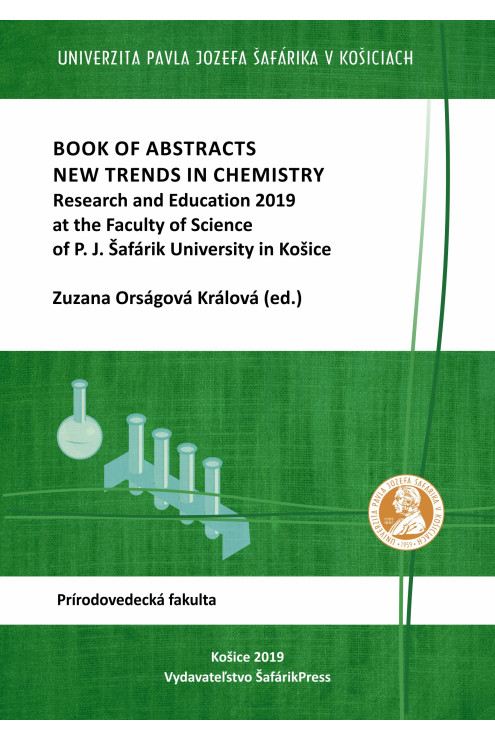
Book of abstracts - New trends in chemistry, research and education 2019

E-book

Zuzana Orságová Králová (ed.)

The scientific book of abstracts is a summary of the contributions of teachers, scientists and other conference participants, which contain the original results of their scientific and research activities. Their work will be the subject of the next domestic conference "New trends in chemistry, research and education 2019". The conference is a space for dialogue between scientific academics on the one hand and professional staff and students on the other.

The contributions published in this volume can be divided according to content into the field of analytical, inorganic, physical, organic chemistry, biochemistry and didactics of chemistry. All contributions are interesting and can be used in further creative scientific and research work, in the process of education and in practical work.

Download the e-book for free  (pdf)

Quantity

978-80-8152-784-5

Data sheet

Method of publication:
E-book (pdf)
Editor:
Zuzana Orságová Králová
Document type:
Book of abstracts
Number of pages:
68
Available from:
08.11.2019
Year of publication:
2019
Edition:
1st edition
Publication language:
English
Faculty:
Prírodovedecká fakulta
Note:
APVV 16-0029
- Free for download

16 other products in the same category:

Geografické poznatky bez hraníc - výber z...

E-book

E-book

Dušan Barabas a kol.

The presented text is the final product of work within the project "Tanuljunk egymástól!/Let’s Learn from Each Other!" The project emerged from long-standing contacts between the staff of the Centre for Regional Studies of the Hungarian Academy of Sciences and the Institute of Geography at the Faculty of Science, Pavol Jozef Šafárik University in Košice, as a natural effort to expand mutual cooperation. The first step was collaboration within Interreg II projects, involving a broad range of institutions from both academic and non-academic environments. This initial attempt was unsuccessful due to administrative errors. Consequently, a project titled HUSK/0801/1.6.1/0003 "Tanuljunk egymástól!/Let’s Learn from Each Other!" was prepared and developed in agreement with the Hungarian side. It was approved and co-financed by the European Regional Development Fund under the Hungary-Slovakia Cross-Border Cooperation Program 2007–2013.

Download the e-book for free (pdf)

Základy geografie obyvateľstva a demografie I....

E-book

E-book

Janetta Nestorová Dická

The university handbook Elementals of Population Geography and Demography - Part I, as an introduction to population studies, is primary study material for students of the geography study program, as well as for students of the Information Systems in Public Administration study program at the Pavel Jozef Šafárik University in Košice, but also for the wider public interested in about population phenomena and their spatiality. Among other things, the handbook offers the latest population reports in the world and its regions.

The aim of the handbook is to introduce young geographers to the basics of population research, which includes the most frequently used tools and methods in geographic analysis. The first part of the handbook contains an introduction to the scientific disciplines of population geography and demography with an overview of basic sources of demographic data.

The next part discusses the issue of anthropogenesis, i.e. the development of humans from our ancestors and the spatial spread of humans across our Earth. Part of this part is the recent development of the world population and changes in the size and distribution of the global population over time. The last part analyses how the population is distributed in the world and in relation to the geographical components of the space.

Download the e-book for free  (pdf)

Automation of Laboratory Experiments in LabVIEW...

E-book

E-book

Erik Čižmár

Textbook Automation of Laboratory Experiments in LabVIEW environment is devoted to the basics of graphical programming and shows the way how to communicate with measuring equipment and Arduino development boards in LabVIEW. The basic concepts of creating a virtual instrument and its interactive user environment are introduced. Three physical tasks are presented, the practical implementation of which takes place with the use appropriate instrumentation and LabVIEW. Practical tasks are dedicated to measuring the transmission characteristics of a low-pass RC filter, measuring the natural resonant frequency of a quartz tuning fork using the heterodyne pulse method, and mapping the magnetic field of a permanent magnet using Arduino.

Download the e-book for free (pdf)

Pravdepodobnosť v príkladoch
  • On sale!
  • -€9.39

Pravdepodobnosť v príkladoch

€9.90 €0.51 -€9.39
Availability: 88 In Stock

Valéria Skřivánková 

Predložený učebný text sa pokúša ilustrovať možné aplikácie Teórie pravdepodobnosti na príkladoch z oblastí (vo fyzike, chémii,  biológii, ekonomike, finančníctve, atď.), ktoré sú spestrené o úlohy na hľadanie optimálnej stratégie.

Text je určený predovšetkým poslucháčom Prírodovedeckej fakulty UPJŠ, budúcim učiteľom matematiky, študentom odboru matematika a informatika prípadne iným záujemcom, ktorí budú aplikovať pravdepodobnostné metódy pri riešení reálnych problémov. Obsahom pokrýva prvú časť predmetu "Pravdepodobnosť a štatistika".

Autorka

Študentská vedecká konferencia PF UPJŠ 2017

E-book

E-book

Katarína CechlárováEva Pitoňáková (eds.)

Proceedings of Abstracts from Contributions by Participants of the Student Scientific Conference at the Faculty of Science, UPJŠ in Košice, Held on April 26, 2017

This is the fifth edition of the proceedings from the Student Scientific Conference (ŠVK) at the Faculty of Science, Pavol Jozef Šafárik University in Košice. We are pleased that ŠVK has become an integral part of faculty life and a showcase for the quality of education provided. In 2017, ŠVK took place as part of the traditional Science Days on April 26, 2017. 105 students from the Faculty of Science presented their work. Contributions were organized into 15 sections, supplemented by an open programming competition involving 17 students and the final round of the IHRA competition, which included 27 teams from across Slovakia.

The abstracts in this proceedings demonstrate that students at the Faculty of Science, UPJŠ, acquire knowledge and skills in their field not only through theoretical study of disciplines but also through active engagement in solving partial scientific problems aligned with research goals at the faculty’s institutes. These abstracts also provide an overview of the faculty’s scientific activity, which we believe will be of interest to the broader public.

doc. RNDr. Gabriel Semanišin, PhD.

Dean of the Faculty

Download the e-book for free (pdf)

Praktické cvičenia z fyzikálnej chémie

E-book

E-book

Andrea Morovská TuroňováRenáta OriňakováFrantišek Kaľavský 

The university textbooks "Practical Exercises in Physical Chemistry" are intended as teaching literature for students of the 2nd year of the Chemistry study program and the 3rd year of the interdisciplinary study program at the Faculty of Science of the Pavel Jozef Šafárik University in Košice.

The three chapters summarize the basic knowledge of thermodynamics, electrochemistry and kinetics, the next chapter deals with the measurement of some other physico-chemical quantities. The tasks developed on the basis of cooperation with the Criminalistics and Expertise Institute of the Police in Košice, which also participates in the innovation of practical teaching, are also very attractive and interesting for students. Thematic units are updated and supplemented by new knowledge, principles as well as detailed working procedures using new instrumentation.

The aim of laboratory exercises in physical chemistry is to illustrate and confirm the physicochemical laws and correlations that apply to the quantitative description of chemical phenomena. Students will learn to use instruments and equipment that occur in physico-chemical laboratories, they will learn the principles of accurate and correct quantitative measurement of physical quantities, important from a chemical point of view. They can also develop professional and scientific communication skills, and we want to support their creative approach to making measurement protocols.

Download the e-book for free  (pdf)

Biochemická terminológia

€11.05
Availability: 44 In Stock

 Mária KožurkováMartin Putala 

Cieľom tejto knihy je spracovať názvoslovné zásady a pravidlá, podľa ktorých sa tvoria slovenské názvy biochemických zlúčenín. Táto monografia je po dlhšom čase prvým pokusom o spracovanie tohto problému, a preto dúfame, že bude pomôckou a prínosom nielen pre študentov a učiteľov ale aj vedeckých pracovníkov. Poslúži aj študentom stredných škôl, ktorí majú záujem o biochémiu a molekulovú biológiu. Kniha obsahuje najnovšie názvoslovie, zásady a pravidlá pri tvorbe názvov biochemických zlúčenín. Kniha plne aplikuje odporúčania spoločnej komisie Medzinárodnej únie pre teoretickú a aplikovanú chémiu (IUPAC) a Medzinárodnej únie pre biochémiu a molekulárnu biológiu (IUBMB) so zahrnutím aktuálnych úprav názvoslovia, stereochémie a grafického znázornenia štruktúr podľa IUPAC. 

Autori

A guide to the didactics of biology

E-book

E-book

Katarína Kimáková

The textbook is intended for university students who are preparing for the profession of biology teacher. The structure of the book is similar to an encyclopedia, with one page devoted to each content item, but the topics of the chapters and subchapters follow each other.

The explanatory text on the page illustrates the diagram and there are notes and links to other sources of information. For better orientation, the content of the textbook is divided into 8 sections, which cover several chapters. It follows the general didactics, which it connects with the teaching of biological content. The book provides a basic orientation in the approaches to learning this subject, and also explains the relationship between biology as a science and the didactics of biology. It deals with teaching standards and curricula, advises on how to master biological concepts and understanding, how to communicate with students in biology classes, when and why are effective visual and practical methods. It acquaints the reader with the issue of setting goals for biological education in the cognitive, psychomotor and affective areas in relation to formative and summative assessment.

Hopeful as well as experienced teachers will find in this publication not only a look into the history of teaching biology, but also a look into the future. Current trends in biology teaching, the connection of teaching with digital technologies, the virtual learning environment and interactive simulations and models belong to science lessons today.

Download the e-book for free (pdf)

Tvorba úloh pre programátorské súťaže

E-book

E-book

Ľubomír ŠnajderJán Guniš

The publication lists interim results of qualitative educational research focused on the development and evaluation of programming tasks being carried out by authors since 2005 in the frame of programming competition PALMA junior.

The publication consists of three chapters: Computer science competitions in Slovakia, Tasks in computer science education, Selected problems of PALMA junior competition. The first chapter provides an overview of computer science competitions for a primary and secondary schools in Slovakia. The second chapter described the issue of learning tasks - their components, focus, formulation types, and development system of tasks. The third chapter contains the assignments and commented author solutions of selected problems represented focus of PALMA junior competition – programming, algorithms and mathematics.

For each problem is mentioned analysis of pupils’ solutions aimed to ways of thinking, typical misconceptions, sets of preparatory and extended problems. The publication is addressed to computer science teacher trainers, authors of programming competitions problems, and computer science teachers.  

Download the e-book for free (pdf)

Cytológia pracovný zošit na praktické cvičenia

€10.00
Availability: 35 In Stock

Ján Kleban a kolektív

Predkladaný pracovný zošit na praktické cvičenia z cytológie je určený poslucháčom 1. ročníka bakalárskeho štúdia biológie a 1. ročníka bakalárskeho medziodborového štúdia v kombinácii s biológiou na Prírodovedeckej fakulte Univerzity Pavla Jozefa Šafárika v Košiciach. Slúži ako návod, ktorý má študentom uľahčiť prácu a umožniť rýchlejšiu orientáciu v zadanej úlohe. Úprava pracovného zošita do formy protokolov umožňuje študentom zakresliť vlastné pozorovanie a tým stimuluje študentov k presnejšiemu a trvalejšiemu zapamätaniu si precvičovanej úlohy a zároveň umožňuje spätnú kontrolu pedagógom. Počas cvičení sa študenti postupne oboznámia so základnými pojmami optiky, s aplikáciami využívajúcimi mikroskopickú techniku, ale aj so základnými rozdielmi medzi štruktúrou rastlinnej a živočíšnej bunky a ich organelami.

Laboratórna technika a výpočty

E-book

E-book

Zuzana Jurašeková

Úvod k praktikám k experimentálnym metódam biofyziky

The university textbook titled Laboratory Techniques and Calculations is designed for the first-year students of the bachelor's degree in Biophysics at the Institute of Physics, Faculty of Sciences, P. J. Šafárik University in Košice. The objective is to equip students with fundamental knowledge and practical skills for the work in a chemical laboratory. It is essential for addressing different biophysical issues and experiments that students will have to solve later. The textbook comprises three principal sections: a theoretical part focused on the calculations, a section dedicated to laboratory work, and the last part offers a brief introduction to spectroscopy. The theoretical part summarizes the basic definitions and equations related to the characterization and preparation of solutions and mixtures. The second, most comprehensive part provides guidance and suggestions for safe and efficient practices in a chemical laboratory. The primary focus is on the manipulation of chemical substances and the use of specific small laboratory instruments and equipment. The fundamental laboratory procedure guides for the selected laboratory works are also provided. As part of a short introduction to spectroscopy, students can become familiar with fundamental spectroscopic concepts and principles. UV-VIS absorption spectrophotometry receives special attention, along with a brief introduction to fluorescence. The textbook is supplemented by various practical and theoretical tasks, as well as numerous web links to further explanatory texts and videos.

Download the e-book for free (pdf)

EFFUSE príručka pre učiteľov

E-book

E-publication

Beáta Valkayed.
Ivana Slepáková-Lenka Maliničová a kol.

The EFFUSE Teacher's Guide is a practical educational material for primary and secondary school teachers who want to develop environmental awareness with their pupils through field-based learning. It is based on the concept of the EFFUSE project (‘Environment for the future by science education’), which aims to link science, research and education with environmental protection. The manual provides teachers with methodological support for planning and implementing outdoor activities aimed at observing and documenting organisms around the Laborec River and the Uh River. It contains instructions for working with real samples, basic biomonitoring procedures and offers the opportunity to participate in the creation of a virtual laboratory that mirrors the state of the local aquatic ecosystem. Through these activities, pupils will learn to understand the links between human activity and the state of the environment, while learning the basics of how scientists work in the fields of biology and ecology. The guide also motivates teachers to become agents of positive change, inspire the younger generation to be active and engage the community in conservation. It is a challenge and an opportunity to create a space for meaningful learning in line with current trends in environmental and digital education.

Download the e-book for free (pdf)

Teória efektívneho poľa pre lokalizované...

E-book

E-book

Michal Jaščur

This monograph is devoted to the discussion of effective field theory based on the differential operator method, originally introduced by Honmura and Kaneyoshi in 1979, which remains actively used for theoretical studies of localized spin models of magnetism—particularly variants of the Ising model. To date, this methodology has been applied by numerous authors to investigate a wide range of systems, including crystalline systems, diluted magnetic systems, systems with random exchange interactions, amorphous magnetic materials, systems under random magnetic and crystalline fields, thin magnetic layers, magnetic systems with free surfaces, binary and ternary magnetic alloys, among others.

During my scientific career, I have collaborated with several leading experts in this field—including Prof. Kaneyoshi, with whom I completed two long-term research stays—to advance the development of the differential operator method (and consequently effective field theory). Within this research area, I have published over 40 scientific papers in prominent international physics journals. These works include both methodological advancements and significant applications that predict intriguing physical phenomena, such as multicompensation phenomena in ferrimagnets.

Download the e-book for free

NANOVIR – Nanočastice pre riešenie...

E-book

E-book

Adriana Zeleňáková - Jozef Bednarčík

Peer-reviewed Proceedings of the Scientific Conference NANOVIR

The main objective of the scientific conference NANOVIR was the presentation of scientific results obtained during the implementation of the NANOVIR project – Nanoparticles for solving diagnostic and therapeutic problems with COVID-19, co-financed by the European Regional Development Fund within the Operational Programme Integrated Infrastructure 2014 – 2020, ITMS: 313011AUW7.

The project was carried out from January 1, 2021, to June 30, 2023, and was supported with a sum of EUR 1,916,004.79. Three co-investigating organizations participated in the project: Pavol Jozef Šafárik University in Košice as the main investigator, the University of Veterinary Medicine and Pharmacy in Košice as partner no. 1, and the Institute of Experimental Physics of the Slovak Academy of Sciences as partner no. 2.

Download the e-book for free (pdf)

School of XFEL and Synchrotron Radiation Users...

E-book

E-book

Jozef Bednarčík (ed.)

Pavol Jozef Šafárik University in Košice under the auspices of Ministry of Education, Research, Development and Youth of the Slovak Republic, Ministry of Economy of the Slovak Republic and European X-Ray Free-Electron Laser Facility GmbH in Hamburg organizes School of XFEL and Synchrotron Radiation Users 2024 (SFEL 2024). The school is continuation of the Winter Schools of Synchrotron radiation held in 2011, 2013, 2014 and SFEL 2017, 2018, 2019 and 2022. The aim of the SFEL2024 school is to facilitate the growth of new Slovak research community of high expertise in high-efficiency RTG laser and synchrotron and neutron sources. The SFEL school is designed for efficient transfer of the rapidly developing know-how in these areas to young generation – researchers and university students. The next aim of the SFEL2024 is strengthening of personal connections between the local Slovak research community and forming scientific teams of XFEL users. Slovak research community thus can take advantage of the fact that Slovakia is a shareholder of European XFEL GmbH Company in Hamburg, but also makes more efficient use of other closely related scientific facilities, including ILL and ESRF in Grenoble and DESY in Hamburg.

Download the e-book for free (pdf)

This website uses cookies to ensure you get the best experience on our website