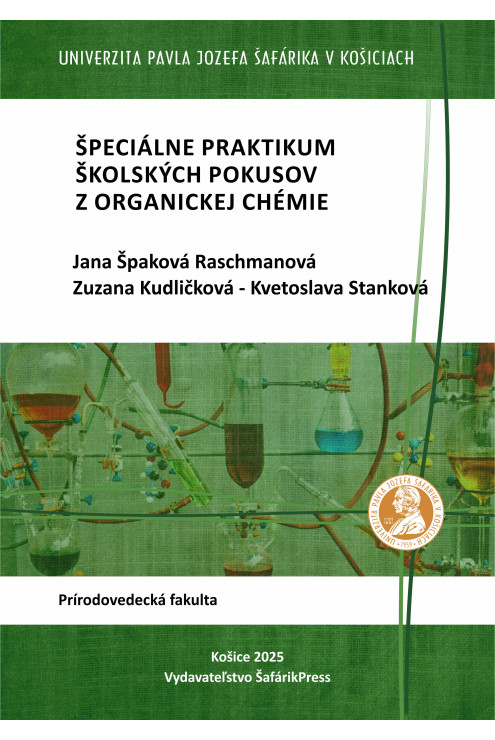
Špeciálne praktikum školských pokusov z organickej chémie

E-book

Jana Špaková Raschmanová - Zuzana Kudličková - Kvetoslava Stanková

Organic chemistry plays a key role in our lives, from the pharmaceutical industry to the production of plastics and food additives. Additionally, it is essential in biochemistry, as it deals with the basic building blocks of living organisms, such as carbohydrates, lipids, proteins, and nucleic acids. One of the best ways to teach organic chemistry and increase students' interest in the subject is through conducting school experiments. This study material presents a collection of visually striking practical experiments in organic chemistry that will help students better understand the chemical processes and techniques used in the field. This electronic study material is supplemented with visual material, allowing students to verify the results of experiments and better understand the individual procedures. At the end of each section, there are questions to help assess the acquired knowledge and encourage deeper understanding of the experiments conducted.

Download the e-book for free (pdf)

Quantity

978-80-574-0394-4

Data sheet

Method of publication:
E-book (pdf)
Authors:
Jana Špaková Raschmanová - Zuzana Kudličková - Kvetoslava Stanková
Document type:
Course Notes
Number of pages:
109
Available from:
25.03.2025
Year of publication:
2025
Edition:
1st edition
Publication language:
Slovak
Faculty:
Prírodovedecká fakulta
Note:
Vysokoškolský učebný text Špeciálne praktikum školských pokusov z organickej chémie vznikol vďaka finančnej podpore Vnútorného vedeckého grantového systému UPJŠ VVGS UPJS – IPEL č. VVGS-2022-2409.
License:
CC BY NC ND (Uveďte autora - Nepoužívajte komerčne - Nespracovávajte)
- Free for download

16 other products in the same category:

EFFUSE – River Landscape, Volume 2: Guidelines...

E-book

E-publication

Beáta Valkay ed.
Ivana Slepáková-Andrej Mock a kol.

The publication EFFUSE – River Landscape, Volume 2: Guidelines for Experts, developed within the EFFUSE project, is intended for professionals in the field of environmental sciences. It provides recommendations for research in river landscapes and highlights their importance for understanding ecological processes. The text presents bioindicators as a key tool for assessing landscape health and biodiversity conservation. A dedicated section explains why studying river landscapes as natural laboratories is essential. The publication also includes a practical manual for the Olympus DSX-1000 High End Model microscope, expanding opportunities in scientific education and research. In this way, it combines theoretical guidelines with modern technologies that enhance environmental knowledge.

Download the e-book for free (pdf)

EFFUSE Scientific education for advanced

E-book

E-publication

Beáta Valkay ed.
Ivana Slepáková-Monika Balogová a kol.

EFFUSE - Scientific Education for Advanced is an educational material designed for university students interested in ecological sciences, biology and environmental protection. The publication was developed as part of the EFFUSE project and focuses on the scientific investigation of living organisms in the river ecosystem, with an emphasis on their ecological role and importance as bioindicators. The river ecosystem is a dynamic environment where a wide range of organisms can be studied, from algae and phytoplankton to aquatic invertebrates, fish, amphibians and reptiles. This publication presents a detailed study of their adaptations, life cycles, reproductive strategies and their importance for ecological balance. Particular attention is paid to fish and amphibians, whose environmental demands and sensitivity to pollution make them important indicators of water quality and environmental status. The publication also provides guidance on how to integrate their study into university education in the form of practical research. It also includes a chapter on science education in the context of sustainable development, which is often absent from university curricula in Slovakia and Ukraine. This material promotes the link between theory and practice and develops students' scientific thinking in order to prepare them to meet the environmental challenges of the future.

Download the e-book for free (pdf)

Praktikum z nukleárnej magnetickej rezonancie....

E-book

E-publication
Mária Vilková-Zuzana Kudličková-Ján Elečko
This study material is intended for students of chemistry and related disciplines interested in applied nuclear magnetic resonance (NMR) and physical chemistry. It offers practice-oriented tasks designed to develop skills in NMR spectroscopy, quantitative analysis, and data interpretation. Students learn modern approaches to determining physicochemical parameters (e.g., partition coefficients, pKa values, keto–enol equilibria, or enantiomeric excess) and gain experience with software tools for spectrum processing.
Download the e-book for free (pdf)

Kmity, vlny a optika

E-book

E-book

Ján Füzer

Auxiliary teaching material for the course General Physics III – Oscillations, Waves, and Optics is intended for students of single-subject and interdisciplinary studies of physics.

The content provides a basic outline of the material covered, without detailed explanations, with an emphasis on the physical method of thinking using the simplest elements of higher mathematics. The presented text does not aim to replace the recommended textbooks, but rather to help students navigate the subject matter. Recommended literature can be found at the end of the text.

The teaching material contains the basic framework of the lectures and is supplemented and revised each year, with lectures enriched by supporting demonstration experiments.

Download e-book for free (pdf)

Názvoslovie organických zlúčenín

E-book

E-book

Miroslava Martinková

This electronic material provides the basic principles of creating a systematic nomenclature of organic compounds, from the simplest hydrocarbons to the more complicated nomenclature of carbohydrates. For some groups of derivatives, alternative ways of generating system names are also mentioned, as well as the most common trivial names that are still in use in the literature and in practice, in some cases being the characteristic (dominant) ones. In the introductory section, the basic rules to be respected when writing names of organic compounds are discussed. This document is intended primarily for interdisciplinary undergraduate and graduate students as support material for the courses Organic Chemistry and Selected Chapters in Organic Chemistry and Biochemistry. In the final section of this document, solved examples are given so that the student can check how the rules for forming the names of organic compounds have been understood.

Download e-book for free (pdf)

New Trends in Chemistry, Research and Education...

E-book

E-book

Zuzana Orságová Králová (ed.)

The scientific book of abstracts is a summary of the contributions of teachers, scientists and other conference participants, which contain the original results of their scientific and research activities. Their work will be the subject of the next domestic conference „New Trends in Chemistry, Research and Education at Faculty of Science of P. J. Šafárik University in Košice 2020“. The conference is a space for dialogue between scientific academics on the one hand and professional staff and students on the other.

The contributions published in this volume can be divided according to content into the field of analytical, inorganic, physical, organic chemistry, biochemistry and didactics of chemistry. All contributions are interesting and can be used in further creative scientific and research work, in the process of education and in practical work.

Download the e-book for free  (pdf)

Profesori Prírodovedeckej fakulty UPJŠ v...

E-book

E-book

Renáta Oriňaková

We have prepared a publication that focuses on the personalities of professors. These personalities represent entire scientific teams, participated in the creation of new study programs, and had a significant impact on the formation of the faculty. Factually, we tried to capture the basic data in a uniform structure. We are building on a similar publication from ten years ago, which greatly helped us, especially with professors who worked at the faculty many years ago and whose memories are gradually fading. The ambition of the publication is to contribute to the preservation of basic information that is closely related to the history of the faculty.

doc. RNDr. Roman Soták, PhD. Dean of the Faculty of Science, UPJŠ in Košice

Download e-book for free (pdf)

Metódy prípravy nanoštruktúr I

E-book

E-book

Vladimír Komanický

The aim of this textbook is to acquaint students in physics, chemistry and material science on both undergraduate and graduate level, with the techniques used to prepare micro-electromechanical devices, nanoobjects and nanostructures using the so called top down methodologies. The is no requirement for this course to pass any prior courses. The introduction part of the text defines the forces that affect nanoobjects and the interactions between them. Reader can understand in detail why properties of nanomaterials and nanostructures are so different when comprared to their macroscopic counterparts. Text gives also an overview of thin film preparation technologies as precursors for the preparation of nanostructures. The main emphasis in Volume I is on conventional lithographic technologies for the preparation and shaping of nanostructures, methods for characterization of thin films, nanoparticles and nanomaterials. Unconventional lithographic methods will also be discussed in the prepared upcoming Volume II. Student will also get acquainted with the applications of nanostructures in research focused on nanophysics, nanocatalysis and nanoelectronics. The textbook is used as a study material for the course ÚFV / MPN / 14 - Methods of preparation and characterization of nanostructures. Part of the course is also a laboratory exercise in which the student gets acquainted with the techiques used for the preparation and characterization of thin films and top-down technologies used for the preparation of nanostructures.

Download the e-book for free (pdf)

O jaskyniach a krase pre každého – vybrané...

E-book

E-book

Alena Gessert

Caves have always been very specific places throughout history. In some cultures, they served as sites for sacrifices or remembrance, while in others, they were seen as places where one could cross to the "other side of life." People used caves for shelter, as places to leave messages, to wait out bad weather, and in some cases, even lived in them. During wars in our region, entire families or villages would hide from enemies in caves, or they would use them to conceal weapons.

Today, in most countries, caves are destinations for tourists who want to experience something new and unknown: darkness, high humidity, and the fascinating beauty of underground formations. They are also sought after by cavers who long to explore caves, enter worlds where no human has set foot before, find evidence of previous habitation, or conduct research that continually advances our knowledge.

In the publication you are holding, we present both traditional and less conventional topics about the formation of karst and caves, selected ecological aspects, maps and their creation, significant caves of the world, and the life of people in such areas. We also offer an overview of important karst locations that are definitely worth learning more about or visiting in person. This publication is intended for readers among pupils, students, teachers, and the general public, and we believe it will draw you into this mysterious world.

Download e-book for free (pdf)

Určitý integrál

E-book

E-book

Ondrej Hutník

The concept of the integral is one of the most significant concepts in mathematics as a whole. In its most primitive form, it was already used by the ancient Greeks in the creation of Euclidean geometry. However, it was only after Descartes' work on analytical geometry in 1637 that mathematicians could begin to consider the integral as a subject of analysis. Descartes' work laid the groundwork for the discovery of infinitesimal calculus by Leibniz and Newton around 1665. At that time, a great dispute arose over the priority of this discovery, dividing scholars of Germany and England into two opposing camps, each favoring their own champion. Today, we know that Newton's work on fluxions and fluents was somewhat earlier, but Leibniz's notation and approach have gained more acceptance in the mathematical world, and the symbols ∫ ∫ and d d are still used today. A brief overview of the history of the integral will be presented in Chapter 1.

Today, there is a plethora of scripts, textbooks, and books dedicated to explaining the concept of the integral. Therefore, every potential author faces the initial question of whether to write another text on this topic. Our affirmative answer to this question was driven by the students' request to find the subject matter of a part of the winter semester of the second year presented in a coherent form. The second motivation is a slightly different approach to the topic. If we consider the methods typically used in solving problems and gaining routine with a certain integral, it mainly involves the Newton-Leibniz formula, and often there is little time left to compute the definite (Riemann) integral using its definition. Therefore, we included a discussion of the Newton integral in Chapter 2, which reflects this fact and is directly related to the indefinite integral, whose various calculation methods receive relatively much attention in the previous semester. Only after that, in Chapter 3, do we build the theory of the Riemann integral, present criteria for its existence, classes of integrable functions, basic properties, and finally its relationship with the Newton integral. Questions primarily concerning geometric applications are addressed in Chapter 4, and in the final chapter, we focus on extending the Riemann integral to unbounded functions and unbounded intervals.

Download the e-book for free (pdf)

ANATOMICKÉ TERMÍNY PRE JEDNOODBOROVÉ A...

E-book

E-book

Juraj ŠevcFilip Mochnacký

Students studying biology as the single-subject or as a part of two-subject programs on various faculties of sciences are often encountered with the problem, how to limit the topics in the subject Human anatomy. This List of anatomical terms is aiming to help the non-medical students to get acquainted with the extensive anatomical nomenclature and to optimize the number of anatomical terms, which should be memorized, to preserve the sufficient capacity of the students for another knowledge of the field of systemic, comparative, developmental and functional anatomy. The emphasis on the arrangement of individual anatomical terms into the logical units supports the hierarchical view on the architecture of the human body.

Despite the common opinion, anatomical nomenclature represents a framework, which is during the further study gradually enveloped with the knowledge of more or less related disciplines concerning with the human body and its biological processes. Moreover, besides this ambition, which exceeds the area of the human anatomy, this List of anatomical terms continues the long tradition with respect to the valid Latin and Slovak anatomical terminology.

Download the e-book for free  (pdf)

Matematika pre nematematické odbory
  • On sale!
  • -€7.96

Matematika pre nematematické odbory

€8.96 €1.00 -€7.96
Availability: 135 In Stock

Danica StudenovskáTomáš Madaras 

Táto publikácia je určená pre študentov nematematických odborov na Prírodovedeckej fakulte UPJŠ v Košiciach. Jej obsahom je látka preberaná v prvom semestri v rámci predmetu Matematika I..

Publikácia nadväzuje na učivo stredných škôl a nevyžaduje žiadne predbežné špeciálne znalosti. Môže slúžiť ako základ na ďalšie samostatné štúdium a môže byť užitočná aj pre iných záujemcov o matematiku a jej aplikácie.

Vyriešené príklady v jednotlivých kapitolách majú pomôcť čitateľovi pri zvládnutí štúdia. Tomu napomáhajú aj ilustratívne obrázky.

Autori

FORMATÍVNE 2025. Spoločne pri implementácii...

E-book

E-publication

Mária Ganajová-Ivana Sotáková-Petra Letošníková

The conference proceedings FORMATIVE 2025 – Implementing Formative Assessment in Schools Together constitute the output of an online conference organised by the Institute of Chemical Sciences, Faculty of Science, Pavol Jozef Šafárik University in Košice, in cooperation with the National Institute of Education and Youth in Bratislava, within the framework of the KEGA project No. 001UPJŠ-4/2023. These proceedings present current knowledge, experience, and examples of good practice in implementing formative assessment in primary, secondary, and university teaching, with an emphasis on the use of digital tools. The papers address the foundations of formative assessment in the context of curricular changes and the ongoing educational reform, as well as specific didactic procedures for its implementation in the teaching of science and social science subjects, including mathematics, Slovak language, and foreign languages. Particular attention is paid to the development of professional teaching competences, formative assessment strategies, providing targeted feedback, and promoting students’ active participation in the assessment process. These proceedings also present the Digilib digital library, a tool developed to support the creation and management of formative assessment processes within the school environment. This publication is intended for experts in pedagogy and didactics, teachers at all levels of education, student teachers, digital coordinators, and all those interested in educational innovation and in improving the quality of teaching through formative assessment.

Download the e-book for free

Exactly Solvable Models in Statistical Physics

E-book

E-book

Jozef Strečka

Over the past fifteen years, the course on ’Exactly Solvable Models in Statistical Physics’ has become an indispensable ground of the study programme ’Theoretical Physics’ at Faculty of Science of Pavol Jozef Šafarik University in Košice. At first, the course based on the first edition of this textbook was intended for undergraduate students only, however, I have later prepared follow-up course taught at a postgraduate level on demand of several ambitious students who wished to continue in studying this exciting research field.

It is already more than decade when our students enrolled in the study programme ’Theoretical Physics’ graduate from ’Introduction to Exactly Solvable Models in Statistical Physics’ at a master level and ’Exactly Solvable Models in Statistical Physics’ at a postgraduate level. Of course, it was necessary somehow to rearrange topics for the courses of undergraduate and postgraduate students.

More specifically, a few more challenging topics concerned with exact solutions of 2D Ising model (chapter 3) were moved to a more advanced course intended for the postgraduate students, while an introductory course intended for the undergraduate students was contrarily supplemented with a few new topics requiring the second edition of this textbook.

The second edition of this textbook thus contains a completely new chapter 4 devoted to the exact solution of the Ising model on the Bethe lattice using the method of exact recursion relations, while the chapter 5 was supplemented by exact results for ground state of a few frustrated Heisenberg spin models using the variational method. It is my hope that the next edition of this textbook will come soon and it will involve all topics specifically taught within the postgraduate course as well. 

Download the e-book for free  (pdf)

Počítačová fyzika II

E-book

E-book

Milan Žukovič

This textbook is intended for master's degree students and is a follow-up to the Computational Physics I course studied at the bachelor's level. The content of the textbook Computational Physics II focuses on stochastic methods of solving physical problems, mainly on Monte Carlo (MC) simulation of many-particle systems.

The focus on this computationally intensive approach is motivated by the gradual increase in the computing capacities of ordinary computers as well as the introduction of high-performance computing clusters. This has led to significant progress in the development of new simulation techniques, thanks to which MC simulations have found application in various areas of research and application practice. Considering the main research focus of the department, this text is particularly devoted to the presentation of basic and more advanced MC simulation techniques applied to a simple Ising spin model in order to investigate its magnetic, thermodynamic and critical properties.

The next part is devoted to MC simulations of random processes. It focuses on the simplest but also the most basic random walk process and demonstrates its applications in financial analysis and the solution of a quantum system described by the time-dependent Schrödinger equation. The last part is dedicated to the basics of molecular dynamics, applied to simulating the classical movement of atoms in a given force field. By mastering the problems addressed in this course, students will obtain a potential tool for working out of their diploma theses, or a methodology useful for their further scientific and research practice in the field of investigating of complex systems.

The lectured topic is subsequently exercised in the form of preparing projects implemented in the freely distributable software Octave, which is easy on the user's programming skills and which students have the opportunity to familiarize themselves with in the previous study.

Download e-book for free (pdf)

This website uses cookies to ensure you get the best experience on our website