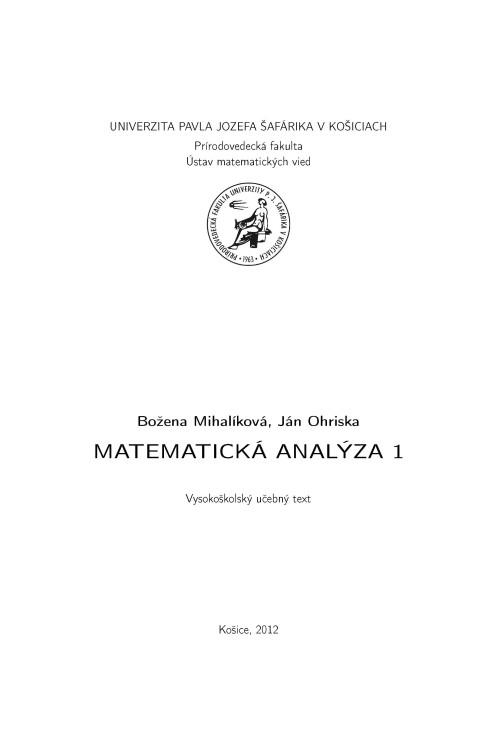
Matematická analýza 1

E-book

Božena Mihalíková - Ján Ohriska

This text is intended for first-year students in 76-12-8 ‘General Education Teaching’ in combinations with mathematics. It is based on the authors' lectures and their more than ten years of experience in teaching this subject at the Faculty of Education of the University of Applied Sciences. When writing it, the authors tried to take into account the specificity of mathematics teaching studies.

The present teaching text was not written due to the lack of textbooks on mathematical analysis. The reason for writing it was the authors' findings that the students do not have sufficient experience in working with specialized literature from secondary school, the difficulties for many of them (especially in the first semesters) are caused by even a slightly different interpretation, not rarely also by a change in labeling, which makes them miss the essence of the studied problem. The authors of the text did not set out to be original. Their aim was to make such a selection of topics as is necessary for a future teacher of mathematics and to choose such a method of interpretation which, in their opinion, is suitable for first-year students.

A good mastery of the curriculum (expansion of the mathematical apparatus and the related possibilities of applying other methods of proof as well as the acquisition of the necessary numerical skills) presupposes the use of other literary sources (textbooks, collections of problems) according to the teacher's recommendation.

Download the e-book for free (pdf)

Quantity

978-80-7097-963-1

Data sheet

Method of publication:
E-book (pdf)
Authors:
Božena Mihalíková - Ján Ohriska
Document type:
Course Notes
Number of pages:
220
Available from:
01.08.2012
Year of publication:
2012
Edition:
1st edition
Publication language:
Slovak
Faculty:
Prírodovedecká fakulta
- Free for download

16 other products in the same category:

The 4th International Conference on...

E-book

E-book

Jana ShepaIvana Šišoláková (eds.)

Abstracts of the 4th International Conference Nanomaterials: Fundamentals and Applications (NFA) 2020 is the contributions summary of the conference participants. The conference will feature three invited lectures and eight registered lectures. This conference is a tool for creating a dialogue between experts in the field of nanomaterials, their use and overall application in various fields. Papers in the proceedings are thematically divided into 6 areas. All contributions are highly professional and interesting and can contribute to further creative scientific work.

Download the e-book for free  (pdf)

NOVEL TRENDS IN CHEMISTRY, RESEARCH AND...

E-book

Jana Šandrejová - Andrea Gajdošová (eds.)

The scientific book of abstracts from the conference „Novel Trends in Chemistry, Research and Education 2024“ is a summary of the contributions of conference participants, which contain the original results of their scientific and research activities. The contributions published in this volume are divided according to content into the fields of analytical, inorganic, organic, physical chemistry, biochemistry and didactics of chemistry.

Download the e-book for free (pdf)

Tvorba úloh pre programátorské súťaže

E-book

E-book

Ľubomír ŠnajderJán Guniš

The publication lists interim results of qualitative educational research focused on the development and evaluation of programming tasks being carried out by authors since 2005 in the frame of programming competition PALMA junior.

The publication consists of three chapters: Computer science competitions in Slovakia, Tasks in computer science education, Selected problems of PALMA junior competition. The first chapter provides an overview of computer science competitions for a primary and secondary schools in Slovakia. The second chapter described the issue of learning tasks - their components, focus, formulation types, and development system of tasks. The third chapter contains the assignments and commented author solutions of selected problems represented focus of PALMA junior competition – programming, algorithms and mathematics.

For each problem is mentioned analysis of pupils’ solutions aimed to ways of thinking, typical misconceptions, sets of preparatory and extended problems. The publication is addressed to computer science teacher trainers, authors of programming competitions problems, and computer science teachers.  

Download the e-book for free (pdf)

Ropucha zelená v meste Košice

E-book

E-book

Monika Balogová - Viktória Vargová - Kristián Gulyás - Natália Pipová - Dalibor Uhrovič -Marcel Uhrin

A peer-reviewed publication dealing with the biology and ecology of the European green toad, bringing new findings through scientific research on the roosting ecology, spatial activity and dispersal of this protected species in urban environments. The subject matter of this publication is highly topical, as amphibians represent the most threatened vertebrate group in the world. This work is suitable not only for university students interested in batrachology, amphibian ecology, and vertebrate zoology, but also for conservation workers, municipalities, and specialists directly involved in the reconstruction of urban areas with green toads. Last but not least, this publication is suitable for enthusiasts with an interest in nature and its conservation.

Download the e-book for free (pdf)

Počítačová fyzika II

E-book

E-book

Milan Žukovič

This textbook is intended for master's degree students and is a follow-up to the Computational Physics I course studied at the bachelor's level. The content of the textbook Computational Physics II focuses on stochastic methods of solving physical problems, mainly on Monte Carlo (MC) simulation of many-particle systems.

The focus on this computationally intensive approach is motivated by the gradual increase in the computing capacities of ordinary computers as well as the introduction of high-performance computing clusters. This has led to significant progress in the development of new simulation techniques, thanks to which MC simulations have found application in various areas of research and application practice. Considering the main research focus of the department, this text is particularly devoted to the presentation of basic and more advanced MC simulation techniques applied to a simple Ising spin model in order to investigate its magnetic, thermodynamic and critical properties.

The next part is devoted to MC simulations of random processes. It focuses on the simplest but also the most basic random walk process and demonstrates its applications in financial analysis and the solution of a quantum system described by the time-dependent Schrödinger equation. The last part is dedicated to the basics of molecular dynamics, applied to simulating the classical movement of atoms in a given force field. By mastering the problems addressed in this course, students will obtain a potential tool for working out of their diploma theses, or a methodology useful for their further scientific and research practice in the field of investigating of complex systems.

The lectured topic is subsequently exercised in the form of preparing projects implemented in the freely distributable software Octave, which is easy on the user's programming skills and which students have the opportunity to familiarize themselves with in the previous study.

Download e-book for free (pdf)

The 8th International Conference on Novel...

E-book

E-book

Jana Shepa  (ed.)

The book of abstracts from 8th International Conference on Novel Materials: Fundamentals and Applications, NFA 2023 is composed of contributions from the participants of this international conference. The conference consisted of 6 invited lecture and 38 abstracts of participants. The conference is focused on novel materials and its application in various research areas. All contributions are professionally processed and inspiring.

Download the e-book for free(pdf)

Book of Abstracts: International Meeting on...

E-book

E-book

Soňa Király (ed.)

The book of abstracts from International Meeting on Advanced Materials, IMAM 2025, is composed of contributions from participants of this conference. The conference consisted of 16 lectures by mentioned conference participants. The conference is focused on advanced materials and its application in various research areas. All contributions are professionally processed and inspiring.

Download the e-book for free (pdf)

Vybrané kapitoly z elektrochémie

E-book

E-book

Kveta Markušová - Daniela Kladeková

Electrochemistry is the science that studies ionic systems and the processes or phenomena that occur at the interface between ionic systems and metals or semiconductors. At the current stage of development, electrochemistry can be divided into two main areas based on its focus. The first one - ionics - deals with the properties of ionic systems (solutions, melts, solid electrolytes). The second area - electrodeics - focuses on phenomena at the electrode/ionic system interface.

Both ionics and electrodeics investigate equilibrium and non-equilibrium phenomena and processes. Research into the properties of ionic systems under equilibrium conditions provides information and insights into the structure and composition of electrolyte solutions, melts, and solid electrolytes, while measurements under non-equilibrium conditions provide data on the electrical conductivity of ionic systems. In the field of electrodeics, the study of equilibria at the electrode/solution (or melt) interface is the domain of electrochemical thermodynamics. Measuring the rates of processes occurring at this phase interface and explaining the principles governing these processes fall under the scope of electrode process kinetics or electrochemical kinetics.

Download the e-book for free (pdf)

Skenovacia tunelová mikroskopia

E-book

E-book

Tomáš Samuely

Today, scanning probe microscopes are standard tools in materials science, physics, chemistry, biology, and engineering. Thousands of these microscopes are in operation worldwide and are at least as common and popular as scanning electron microscopes.

Despite the vast number of newer scanning probe microscopy techniques, classical STM remains a significant and irreplaceable method, widely used, for example, in solid-state research. In this text, we will focus on both traditional and innovative STM techniques that are available and utilized in the laboratories of the Center for Low Temperature Physics in Košice.

Download e-book for free (pdf)

Študentská vedecká konferencia PF UPJŠ 2017

E-book

E-book

Katarína CechlárováEva Pitoňáková (eds.)

Proceedings of Abstracts from Contributions by Participants of the Student Scientific Conference at the Faculty of Science, UPJŠ in Košice, Held on April 26, 2017

This is the fifth edition of the proceedings from the Student Scientific Conference (ŠVK) at the Faculty of Science, Pavol Jozef Šafárik University in Košice. We are pleased that ŠVK has become an integral part of faculty life and a showcase for the quality of education provided. In 2017, ŠVK took place as part of the traditional Science Days on April 26, 2017. 105 students from the Faculty of Science presented their work. Contributions were organized into 15 sections, supplemented by an open programming competition involving 17 students and the final round of the IHRA competition, which included 27 teams from across Slovakia.

The abstracts in this proceedings demonstrate that students at the Faculty of Science, UPJŠ, acquire knowledge and skills in their field not only through theoretical study of disciplines but also through active engagement in solving partial scientific problems aligned with research goals at the faculty’s institutes. These abstracts also provide an overview of the faculty’s scientific activity, which we believe will be of interest to the broader public.

doc. RNDr. Gabriel Semanišin, PhD.

Dean of the Faculty

Download the e-book for free (pdf)

Základné fyzikálne praktikum III.

E-book

E-book

Janka Vrláková - Stanislav Vokál

Atomic and nuclear physics are relatively young scientific disciplines forming the final part of the general physics course at the Faculty of Physics of the Jagiellonian University. Their aim is to explain the nature of the basic physical properties of atoms, atomic nucleus and elementary particles.

This is also the content of the lectures and exercises ‘General Physics IV’ in the 2nd year of the Bachelor's degree in Physics at the Faculty of Natural Sciences (PF) of the P.J. Šafárik University (UPJŠ) in Košice. They are followed by optional lectures ‘Nuclear Radiation in the Environment’, ‘Introduction to the Physics of the Microworld’ in the 3rd year of the Bachelor's degree of single-discipline study of physics, or teacher study of physics in combination with another subject, and ‘Subnuclear Physics’ in the 1st year of the Master's degree of teacher study of physics in combination with another subject.

In the aforementioned lectures, the latest experimental findings on the structure and behaviour of the microworld are presented by means of physical theories and their subsequent experimental verification in experiments.

Download the e-book for free (pdf)

Exactly Solvable Models in Statistical Physics

E-book

E-book

Jozef Strečka

Over the past fifteen years, the course on ’Exactly Solvable Models in Statistical Physics’ has become an indispensable ground of the study programme ’Theoretical Physics’ at Faculty of Science of Pavol Jozef Šafarik University in Košice. At first, the course based on the first edition of this textbook was intended for undergraduate students only, however, I have later prepared follow-up course taught at a postgraduate level on demand of several ambitious students who wished to continue in studying this exciting research field.

It is already more than decade when our students enrolled in the study programme ’Theoretical Physics’ graduate from ’Introduction to Exactly Solvable Models in Statistical Physics’ at a master level and ’Exactly Solvable Models in Statistical Physics’ at a postgraduate level. Of course, it was necessary somehow to rearrange topics for the courses of undergraduate and postgraduate students.

More specifically, a few more challenging topics concerned with exact solutions of 2D Ising model (chapter 3) were moved to a more advanced course intended for the postgraduate students, while an introductory course intended for the undergraduate students was contrarily supplemented with a few new topics requiring the second edition of this textbook.

The second edition of this textbook thus contains a completely new chapter 4 devoted to the exact solution of the Ising model on the Bethe lattice using the method of exact recursion relations, while the chapter 5 was supplemented by exact results for ground state of a few frustrated Heisenberg spin models using the variational method. It is my hope that the next edition of this textbook will come soon and it will involve all topics specifically taught within the postgraduate course as well. 

Download the e-book for free  (pdf)

The 5th International Conference on...

E-book

E-book

Veronika NiščákováIvana Šišoláková (eds.)

Abstracts of the 5th Intemational Conference Nanomaterials: Fundamentals and Applications (NF A) 2021 is the contributions summary of the conference participants. The conference will feature four invited lectures and ten registered lectures. This conference is a tool for creating a dialogue between experts in the field of nanomaterials, their use and overall application in various fields.

Papers in the proceedings are thematically divided into 6 areas. All contributions are highly professional and interesting and can contribute to further creative scientific work.

Download the e-book for free  (pdf)

Pokročilé elektrochemické metódy

E-book

E-book

Ivana Šišoláková - Radka Gorejová - Jana Shepa - Renáta Oriňaková

The university textbook "Advanced Electrochemical Methods" is a teaching aid intended for master's or doctoral students studying electrochemical subjects at the Department of Physical Chemistry, Faculty of Science, Pavol Jozef Šafárik University in Košice.

These textbooks follow and further develop textbooks focused on the basic electrochemical methods currently used in modern research. The presented teaching texts are processed in sixteen clear chapters, where they provide a theoretical principle and derivation of electrochemical processes and mechanisms in individual methods. Teaching texts also consist of practical laboratory exercises, in which students can try out the real application of the studied electrochemical methods.

The practical tasks are focused primarily on the demonstration of research that is carried out at our workplace. Students will be able to try, for example, electrochemical modification of the electrode surface, preparation of electrochemical sensors for the determination of analytes, preparation and characterization of a dye-sensitized solar cell or electrochemical evolution of hydrogen.

Download the e-book for free (pdf)

Fotonika

E-book

E-book

Gregor Bánó

Photonics is an application-oriented discipline at the interface of optics, opto-electronics and quantum optics. It includes classical optics extended by the description of physical phenomena and optical devices that rely on quantum (photon) nature of light.
The main objective of the Photonics course is to provide a comprehensive overview of essential optical and photonic phenomena routinely applied in experimental scientific research while working with various light sources (e.g. in the field of biophotonics). The first chapters are devoted to the description of light at different levels. The logical order of subsections in this part corresponds to the structure of the textbook: B. E. A. Saleh, M. C. Teich, Fundamentals of Photonics. The following chapters contain a description of laser operation and an overview of selected optical instruments and their applications.
The body text is complemented by practical notes on the use of theoretical knowledge during daily work in the laboratory. The course of Photonics requires a basic knowledge of mathematics, electromagnetism and optics, and thus it is recommended to students who previously passed through the courses of the Bachelor's program in Physics.

Download the e-book for free (pdf)

This website uses cookies to ensure you get the best experience on our website