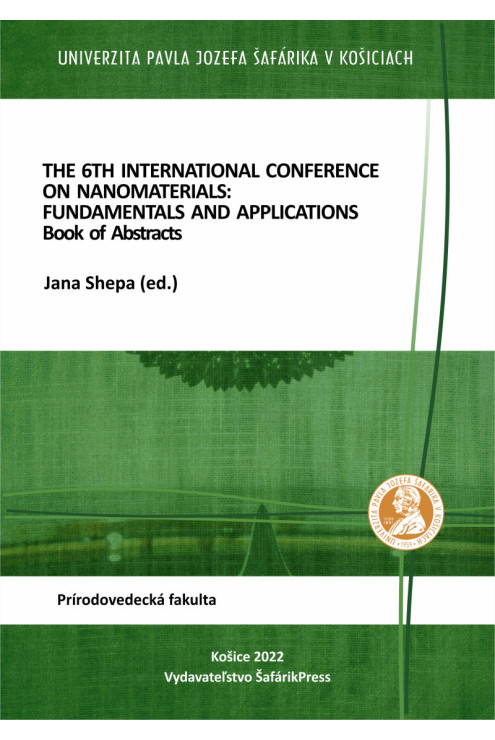
The 6th International Conference on Nanomaterials: Fundamentals and Applications

E-book

Jana Shepa (ed.)

The book of abstracts from 6th International Conference on Nanomaterials: Fundamentals and Applications, NFA 2022 is composed of contributions from the participants of this international conference. The conference consisted of 4 invited lecture and 52 abstracts of participants. The conference is focused on nanotechnology and its application in various research areas. All contributions are professionally processed and inspiring.

Download the e-book for free (pdf)

Quantity

978-80-574-0127-8

Data sheet

Method of publication:
E-book (pdf)
Editor:
Jana Shepa
Document type:
Book of abstracts
Number of pages:
147
Available from:
12.10.2022
Year of publication:
2022
Edition:
1st edition
Publication language:
English
Faculty:
Prírodovedecká fakulta
- Free for download

16 other products in the same category:

Vybrané experimentálne úlohy z koloidiky

E-book

E-book

Daniela Kladeková

This university text is intended for students of chemical and ecological sciences at the Faculty of Natural Sciences of the P. J. Šafárik University in Košice and is intended to serve as a tool for experimental exercises in colloid chemistry. Colloid chemistry is an important part of the theoretical basis of the chemical sciences and belongs to the newer interdisciplinary fields of natural sciences.

It combines knowledge from physical chemistry, physics and biology, while also drawing on a solid knowledge of mathematics and other scientific disciplines. Experiments are often essential in understanding the problems of colloid chemistry, modelling ideas about the phenomena and laws involved in the discipline. This is why active participation in experimental exercises is so important and essential to mastering the material in colloid chemistry.

In selecting the tasks for these scripts, it was also necessary to respect the considerable limitations imposed by the possibilities of the laboratory instrumentation and material equipment of our department. Despite this limitation, however, they can illustrate to students the basic theoretical physicochemical principles of colloid dispersion systems and, importantly, their understanding can contribute to the understanding of some of the more important peculiarities of colloidal phenomena.

Download the e-book for free (pdf)

MAGNETICKÉ NANOČASTICE: NANOMAGNETIZMUS,...

E-book

Adriana Zeleňáková

Magnetic nanoparticles are extremely interesting magnetic objects that still hide much that is undiscovered, both because of their physical properties and because of their diverse applications. Iron nanoparticles, or iron oxides, are used in medical diagnostics for magnetic resonance imaging, in the treatment of hyperthermia, and an important application is the use of magnetic particles for targeted drug delivery.

The textbook "Magnetic Nanoparticles: Nanomagnetism, Preparation and Advanced Applications" is intended primarily for students of the Master's programme in Physics and students of related disciplines at universities and faculties with a physical, chemical, metallurgical and biophysical focus. The motivation for writing this textbook was to develop study material that would contribute to improving the quality of teaching in the profile subject Nanomaterials and Nanotechnology at the Institute of Physical, Faculty of Sciences, UPJŠ, in the Master's programme Condensed Matter Physics, as well as in the profile subject in the PhD programme Advanced Materials.

The university textbook is divided into eight chapters. The first and second chapters are devoted to basic information about magnetism, the origin of nanomagnetism in nanoparticles and surface phenomena. The third and fourth chapters are devoted to nanomagnetism in nanoparticle systems. The fifth chapter describes in detail individual protocols for investigating the phenomenon of superparamagnetism and the phenomenon of superspin glass using the SQUID device. The sixth chapter describes individual procedures for the preparation of magnetic nanoparticles and the seventh chapter describes individual experimental techniques for the study of magnetic nanoparticles. The final eighth chapter describes the applications of nanoparticles in biomedicine.

During the writing of this textbook, the chapters were prepared using the foreign-language specialist literature listed in the recommended reading list.

Download the e-book for free

Linear programming via problem solving

E-book

E-book

Katarína Cechlárová

Linear programming belongs to parts of mathematics with the greatest number of real applications. This Slovak-English problem collection provides an overview of basic knowledge in the area, application problems as well as problems to acquire routine in calculations. It is complemented by questions motivating the student to look for further theoretical principles, construct conterexamples  and formulate arguments to explain the studied phenomena.

Download the e-book for free (pdf)

NOVEL TRENDS IN CHEMISTRY, RESEARCH AND...

E-book

Jana Šandrejová - Andrea Gajdošová (eds.)

The scientific book of abstracts from the conference „Novel Trends in Chemistry, Research and Education 2024“ is a summary of the contributions of conference participants, which contain the original results of their scientific and research activities. The contributions published in this volume are divided according to content into the fields of analytical, inorganic, organic, physical chemistry, biochemistry and didactics of chemistry.

Download the e-book for free (pdf)

1st Workshop on Perspective Electron Spin...

E-book

E-book

Jozef Strečka- Katarína Karl’ová (eds.)

Zborník obsahuje program a abstrakty workshopu s názvom: 1st Workshop on Perspective Electron Spin Systems for Future Quantum Technologies, ktorý sa bude konať 28.-29. júna 2022 v Košiciach. Workshop je organizovaný Prírodovedeckou fakultou Pavla Jozefa Šafárika v Košiciach a Ústavom experimentálnej fyziky Slovenskej akadémie vied v Košiciach s finančnou podporou Agentúry na podporu výskumu a vývoja. Ústrednými témami konferencie budú súčasné problémy kvantovej fyziky - kvantovej teórie magnetizmu spinových a elektrónových štruktúr, exotických kvantových spinových stavov, kvantového previazania, kvantových fázových prechodov, topologického kvantového počítania a kvantového spracovania informácie. Účastníci workshopu budú prezentovať originálne pôvodné výsledky svojho výskumu, ktoré môžu zásadným spôsobom ovplyvniť vývoj budúcich kvantových technológií.   

Download the e-book for free (pdf)

Základy znalostných systémov

E-book

E-book

Ondrej Krídlo

University textbooks present the basics of knowledge systems, which are divided into two parts. The first part of the publication is devoted to the basis of Formal Concept Analysis, ie the method of data analysis, knowledge representation and information processing, which is based on the formalization of the concept. In the second part we deal with the basics of logic programming, procedural semantics of logic programming, ie programs - theories, questions, SLD-derivation, SLD-tree, search strategies.

University textbooks are intended for students of master's degree programs in computer science.

Download e-book for free (pdf)

NANOVIR – Nanočastice pre riešenie...

E-book

E-book

Adriana Zeleňáková - Jozef Bednarčík

Peer-reviewed Proceedings of the Scientific Conference NANOVIR

The main objective of the scientific conference NANOVIR was the presentation of scientific results obtained during the implementation of the NANOVIR project – Nanoparticles for solving diagnostic and therapeutic problems with COVID-19, co-financed by the European Regional Development Fund within the Operational Programme Integrated Infrastructure 2014 – 2020, ITMS: 313011AUW7.

The project was carried out from January 1, 2021, to June 30, 2023, and was supported with a sum of EUR 1,916,004.79. Three co-investigating organizations participated in the project: Pavol Jozef Šafárik University in Košice as the main investigator, the University of Veterinary Medicine and Pharmacy in Košice as partner no. 1, and the Institute of Experimental Physics of the Slovak Academy of Sciences as partner no. 2.

Download the e-book for free (pdf)

HOST-GUEST A SUPRAMOLEKULOVÁ CHÉMIA

E-book

E-book

Miroslava Matiková Maľarová

The university textbook entitled: Host-guest and supramolecular chemistry provides basic information about this scientific field as well as the types of compounds that belong to it. It provides basic characteristics of non-bonded interactions as well as methods of characterization and classification for these compounds. It summarizes knowledge about various types of host-guest systems from the oldest such as Hofmann clathrates to inclusive compounds such as cyclodextrins and calixarenes. In addition to structural and synthetic information, which is supplemented with images, the textbook also addresses the possibilities of application or practical use of compounds. The conclusion of each chapter is supplemented with tasks for elaboration on a given topic.

Download the e-book for free (pdf)

Pravdepodobnosť v príkladoch
  • On sale!
  • -€9.39

Pravdepodobnosť v príkladoch

€9.90 €0.51 -€9.39
Availability: 88 In Stock

Valéria Skřivánková 

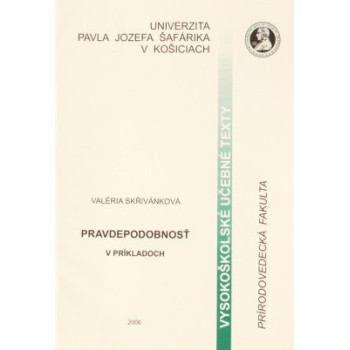
Predložený učebný text sa pokúša ilustrovať možné aplikácie Teórie pravdepodobnosti na príkladoch z oblastí (vo fyzike, chémii,  biológii, ekonomike, finančníctve, atď.), ktoré sú spestrené o úlohy na hľadanie optimálnej stratégie.

Text je určený predovšetkým poslucháčom Prírodovedeckej fakulty UPJŠ, budúcim učiteľom matematiky, študentom odboru matematika a informatika prípadne iným záujemcom, ktorí budú aplikovať pravdepodobnostné metódy pri riešení reálnych problémov. Obsahom pokrýva prvú časť predmetu "Pravdepodobnosť a štatistika".

Autorka

Geopriestorové technológie v bádateľsky...

E-book

E-book

Stela Csachová - Ján Kaňuk - Alena GessertLadislav NovotnýŠtefan GáborJozef Šupinský

This book addressed the inquiry-based learning and teaching with the support of geospatial technologies. Today, geospatial technologies are influencing geography teaching learning, particularly in secondary education. Theoretical framework gives the reader the insight to inquiry-based learning, with special focus on inquiry in geography. The one-by-one step of inquiry is analysed in detail. The major part of the book presents the eleven models of geography lessons, representing the subject content of physical, human and regional geographies, various levels of inquiry and use of different geospatial technologies. The readers are acquainted with the use of geographic information system (particularly Google Earth and ArcGIS online), web portals, webGIS, open data, mobile applications and new forms of 3D cartographic visualisation (virtual reality, 3D print, dynamic 3D map) in teaching geography. The lesson models were tested with the students to be geography teachers in school year 2021/2022. This books serves as resource mainly for undergraduate teacher students and in-service geography teachers.

Download e-book for free (pdf)

Cvičenia z biochémie mikroorganizmov

E-book

E-book

Mária Kožurková

These university textbooks are intended for first-year master's degree students at the Faculty of Natural Sciences of UPJŠ in Košice. The scope and content of the works included in these scripts are primarily based on time and spatial constraints, taking into account the material demands of the tasks.

The aim of these scripts is to teach students basic microbiological techniques and to show them the importance of microorganisms in everyday life and their crucial role in nature. The exercises are designed to enhance students' technical skills and teach them to work according to safety principles.

The text is divided into 13 parts. Each part begins with an introduction to the theory related to the practice topic. The appendix includes a proposal for the preparation of protocols for individual exercises.

Download the e-book for free (pdf)

Študentská vedecká konferencia PF UPJŠ 2015

E-book

E-book

Vladimír Zeleňák(ed.)

The proceedings contain abstracts of contributions from participants of the Student Scientific Conference of the Faculty of Science, Pavol Jozef Šafárik University in Košice, which took place on April 22, 2015.

The Student Scientific Conference (SSC) enjoys long-term popularity among the faculty's students and teachers, and we are pleased that this was no different this year, with 128 contributions submitted to the SSC.

The contributions were organized into 19 sections, additionally complemented by an open programming competition and the final of the IHRA contest. For many students, presenting at the SSC is one of the first opportunities to gain experience in presenting their results before a professional audience. Considering the number of submitted contributions, along with the members of the expert juries from the faculty's teaching staff and the audience who came to support their classmates' presentations, the SSC is an event where a large part of the student and academic community of the faculty meets at one place and time. Many abstracts presented in this proceedings were developed as part of students' work on partial tasks that are components of research projects at the departments of the Faculty of Science, Pavol Jozef Šafárik University.

The abstracts represent, in a way, an overview of research topics at the individual workplaces of the faculty. The SSC proceedings thus serve as a useful tool that students and faculty teachers can use to present the faculty externally to partners, employers, and potential collaborators. Partners from practice have shown interest in cooperating in organizing the SSC for a long time. Since 2005, the association of IT companies has awarded a Prize for the Most Original Work and a Prize for the Work with the Best Prospects for Practical Application.

Download the e-book for free (pdf)

Chemické výpočty vo všeobecnej a anorganickej...

E-book

E-book

Ivan Potočňák

The script is a study literature for the subject Chemical Calculations, which is a mandatory course in the bachelor's degree programs in Chemistry and Chemistry – Interdisciplinary Studies, first year. The script contains 10 chapters with a total of 207 pages, guiding students through solved and unsolved examples to help them understand the subject matter.

Author

Download the e-book for free (pdf)

Úvod do porovnávacej morfológie živočíchov

E-book

E-book

Andrej Mock

The structure of the animal body is extremely varied. Each species has its distinctive morphological features, which bears as a testimony to long-term development and belonging to the developmental lineage. At the same time, the body has been tested for a long time by natural conditions, resulting in unique adaptations to the environment and life strategy. Despite this admirable variety - which includes both recent and fossil animals and which we have far from mapped – a comparison of body parts brings knowledge we can generalize: the main building principles, and boundaries within which phenotypic diversity is realized.

Comparative animal morphology today uses the latest methodological material and knowledge from other disciplines, from genetics, molecular biology and experimental embryology, through progressive imaging methods (e.g. electron microscopy, computer micro-tomography) and the possibilities of subsequent software processing of image material (measurement, staining, etc.) to the view of physics, chemistry, statics and geometry on the structures (to nanostructures) of the living body. Detailed knowledge of historical and contemporary conditions on Earth is an important interpretative context in the study of animal morphology. Surprisingly, the knowledge accumulated after centuries of research is now rapidly supplemented by new knowledge, and often the traditional knowledge is subsequently reinterpreted. Finally, and no less important, in studying animal (and human) morphology, we learn surprising knowledge about ourselves.

The author of the presented textbook had the ambition in a simplified form to introduce the reader, especially the student of biological studies, into a dynamic and fascinating scientific discipline, as the current comparative animal morphology is.

Stiahnite si e-knihu zadarmo (pdf)

Laboratórny potkan a jeho využitie v...

E-book

E-book

Terézia KiskováStanislav MatéffyFrantiška Horváthová

The laboratory rat (Rattus norvegicus) is one of the most commonly used experimental animals. It serves as a model organism for analyzing numerous biological processes and pathological mechanisms, such as cardiovascular diseases, metabolic disorders (e.g., lipid metabolism, diabetes mellitus), neurological and neuropsychiatric conditions (e.g., stroke, epilepsy, or Alzheimer's disease), neurobehavioral research, autoimmune diseases (e.g., arthritis), cancer, and renal diseases. It offers many unique advantages for modeling human diseases, testing drugs and natural substances, and studying responses to environmental factors. The size of the laboratory rat, compared to the mouse, creates ideal conditions for physiological manipulations. Additionally, rats are used in clinical toxicology to test chemical substances (Hedrich, 2000).

Download the e-book for free (pdf)

This website uses cookies to ensure you get the best experience on our website