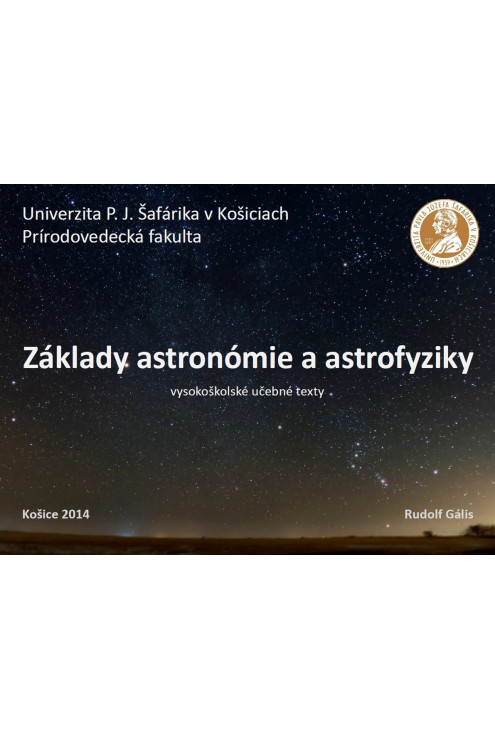
Základy astronómie a astrofyziky

E-book

Rudolf Gális

The presented work provides basic knowledge of astronomy and astrophysics in a completely new multimedia format. The scope of the knowledge presented is mainly focused on stellar astrophysics and supplemented by cosmology beyond the title of the work.

A new approach in this work is the large proportion of visual materials, graphs, and video clips, contrasted with the brevity of the accompanying text. Such a form of presenting knowledge in this field is unprecedented in Slovakia, and therefore this work can be considered a completely innovative piece. It should be emphasized that the engaging form of the presented knowledge does not come at the expense of its content. The work contains all the necessary information that a physics student, especially one with a pedagogical focus, should master. The work can also be an invaluable aid to teachers in secondary and even primary schools, as well as professional astronomers in popularizing astronomical knowledge.

This suggests that the work covers a relatively wide range of needs at various institutions dealing with astronomy, from universities, through faculties of education and grammar schools, to observatories, planetariums, and astronomy clubs.

Download the e-book for free (pdf)

Quantity

978-80-8152-089-1

Data sheet

Method of publication:
E-book (pdf)
Author:
Rudolf Gális
Document type:
Course Notes
Number of pages:
160
Available from:
07.01.2014
Year of publication:
2014
Edition:
1st edition
Publication language:
Slovak
Faculty:
Prírodovedecká fakulta
- Free for download

16 other products in the same category:

BIOLÓGIA LIŠAJNÍKOV. Časť C: Identifikácia...

E-book

E-book

Mária VilkováMonika GarberováMichal Goga

Nuclear Magnetic Resonance (NMR) is currently a widely used analytical tool that finds application in many fields of science and technology. The broadening of its practical use brings with it the necessity to create educational texts appropriate to the given scientific discipline.

This university textbook is intended for students of biology and serves as a supplement to the study materials for the advanced master's course "Biology of Lichens." At the same time, it represents a useful resource for master's and doctoral students involved in research, helping them interpret NMR spectra and present basic theoretical concepts.

The textbook briefly describes the important aspects of each NMR spectroscopic technique without delving excessively into the physical principles of individual methods or complex mathematical analyses. In this edition, the structures of lichen metabolites have been included, which students will isolate, purify, and identify using various analytical methods during practical exercises. An entire chapter is dedicated to a detailed description of solving the NMR spectra of isolated metabolites, with each step in elucidating the structures of both known and unknown metabolites explained in detail. The solved tasks are followed by numerous unsolved examples, including high-resolution 1D and 2D NMR spectra of metabolites, intended to further develop the acquired knowledge and skills of students and doctoral candidates in structure elucidation using NMR spectroscopy.

Download e-book for free (pdf)

Cognitive neuroscience of auditory and...

E-book

Norbert Kopčo - Frederick Gallun - Beáta Tomoriová - Ľuboš Hládek(eds.)

Cognitive neuroscience is a fast developing scientific field which aims at uncovering the neural basis of human perception and cognition. To achieve this goal, cognitive neuroscience uses a variety of tools and approaches ranging from non-invasive brain imaging to psychophysics and neural modeling. Mastering such tools requires skills and knowledge from multiple scientific domains, including neurophysiology, cognitive psychology, and several computational fields.

Access on request via email: kogneuro (@) gmail.com

http://pcl.upjs.sk/workshopcd 

https://sites.google.com/site/kogneuro/

Určitý integrál

E-book

E-book

Ondrej Hutník

The concept of the integral is one of the most significant concepts in mathematics as a whole. In its most primitive form, it was already used by the ancient Greeks in the creation of Euclidean geometry. However, it was only after Descartes' work on analytical geometry in 1637 that mathematicians could begin to consider the integral as a subject of analysis. Descartes' work laid the groundwork for the discovery of infinitesimal calculus by Leibniz and Newton around 1665. At that time, a great dispute arose over the priority of this discovery, dividing scholars of Germany and England into two opposing camps, each favoring their own champion. Today, we know that Newton's work on fluxions and fluents was somewhat earlier, but Leibniz's notation and approach have gained more acceptance in the mathematical world, and the symbols ∫ ∫ and d d are still used today. A brief overview of the history of the integral will be presented in Chapter 1.

Today, there is a plethora of scripts, textbooks, and books dedicated to explaining the concept of the integral. Therefore, every potential author faces the initial question of whether to write another text on this topic. Our affirmative answer to this question was driven by the students' request to find the subject matter of a part of the winter semester of the second year presented in a coherent form. The second motivation is a slightly different approach to the topic. If we consider the methods typically used in solving problems and gaining routine with a certain integral, it mainly involves the Newton-Leibniz formula, and often there is little time left to compute the definite (Riemann) integral using its definition. Therefore, we included a discussion of the Newton integral in Chapter 2, which reflects this fact and is directly related to the indefinite integral, whose various calculation methods receive relatively much attention in the previous semester. Only after that, in Chapter 3, do we build the theory of the Riemann integral, present criteria for its existence, classes of integrable functions, basic properties, and finally its relationship with the Newton integral. Questions primarily concerning geometric applications are addressed in Chapter 4, and in the final chapter, we focus on extending the Riemann integral to unbounded functions and unbounded intervals.

Download the e-book for free (pdf)

Laboratórny potkan a jeho využitie v...

E-book

E-book

Terézia KiskováStanislav MatéffyFrantiška Horváthová

The laboratory rat (Rattus norvegicus) is one of the most commonly used experimental animals. It serves as a model organism for analyzing numerous biological processes and pathological mechanisms, such as cardiovascular diseases, metabolic disorders (e.g., lipid metabolism, diabetes mellitus), neurological and neuropsychiatric conditions (e.g., stroke, epilepsy, or Alzheimer's disease), neurobehavioral research, autoimmune diseases (e.g., arthritis), cancer, and renal diseases. It offers many unique advantages for modeling human diseases, testing drugs and natural substances, and studying responses to environmental factors. The size of the laboratory rat, compared to the mouse, creates ideal conditions for physiological manipulations. Additionally, rats are used in clinical toxicology to test chemical substances (Hedrich, 2000).

Download the e-book for free (pdf)

copy of Základy chiropterológie

€10.00
Availability: 1000 In Stock

E-book

Marcel Uhrin - Petr Benda -  Peter Kaňuch

Bats represent a unique group of mammals, characterised by different life strategies. They are the only mammals capable of active flight, which, combined with their almost exclusively nocturnal activity, has led to the evolution of specific adaptations. One of the most striking is echolocation, which enables them to orientate themselves perfectly in their surroundings in the dark. Bats are mainly native to the tropics, but have also colonised areas outside the tropics, which, has led to a complex phenological cycle with active phases and interruptions during hibernation, especially in temperate zones. In this diverse and species-rich group (almost 1,500 known species), there is a wide range of social organisation as well as feeding and roosting strategies. The textbook "Fundamentals of Chiropterology" brings the current state of knowledge about these extraordinary animals in eleven chapters and two appendices for the first time in the Slovak language.

FORMATÍVNE 2025. Spoločne pri implementácii...

E-book

E-publication

Mária Ganajová-Ivana Sotáková-Petra Letošníková

The conference proceedings FORMATIVE 2025 – Implementing Formative Assessment in Schools Together constitute the output of an online conference organised by the Institute of Chemical Sciences, Faculty of Science, Pavol Jozef Šafárik University in Košice, in cooperation with the National Institute of Education and Youth in Bratislava, within the framework of the KEGA project No. 001UPJŠ-4/2023. These proceedings present current knowledge, experience, and examples of good practice in implementing formative assessment in primary, secondary, and university teaching, with an emphasis on the use of digital tools. The papers address the foundations of formative assessment in the context of curricular changes and the ongoing educational reform, as well as specific didactic procedures for its implementation in the teaching of science and social science subjects, including mathematics, Slovak language, and foreign languages. Particular attention is paid to the development of professional teaching competences, formative assessment strategies, providing targeted feedback, and promoting students’ active participation in the assessment process. These proceedings also present the Digilib digital library, a tool developed to support the creation and management of formative assessment processes within the school environment. This publication is intended for experts in pedagogy and didactics, teachers at all levels of education, student teachers, digital coordinators, and all those interested in educational innovation and in improving the quality of teaching through formative assessment.

Download the e-book for free

Otázky a úlohy zo všeobecnej chémie

€15.00
Availability: 120 In Stock

Ivan Potočňák a kol.

The textbook represents a study literature on the subject of General chemistry, which is a compulsory subject of bachelor courses in Chemistry and Chemistry -  interdisciplinary study, the first year. This textbook contains 15 + 2 chapters in the whole range of 170 pages that follow the content of lectures and by means of examples and theoretical tasks consolidate and extend knowledge gained from lectures.

Špeciálne praktikum II - Štúdium magnetických...

E-book

E-book

Erik Čižmár

The textbook "Special Practicum II" is dedicated to describing experimental methods used for studying the magnetic properties of solid materials, especially low-dimensional and molecular magnets. It subsequently contains instructions for the practical exercise "Special Practicum II," during which master's and doctoral students use state-of-the-art commercial equipment-an electron paramagnetic resonance (EPR) spectrometer and a SQUID magnetometer.

The introductory chapter briefly describes the origin of magnetism in solids, the role of the crystal field, and magnetic interactions in explaining their magnetic properties. This is followed by an explanation of the principles of EPR, the operation of the EPR spectrometer, and the optimization of its parameters for the specific practical exercise.

The next part of the textbook is devoted to an overview of the behavior of magnetic quantities with changes in magnetic field or temperature in various types of magnets. The textbook concludes with a description of the operating principle of the SQUID magnetometer and an example of its use in a practical exercise measuring the magnetic moment.

Download the e-book for free (pdf)

EFFUSE – River Landscape, Volume 1: Scientific...

E-book

E-publication
Beáta Valkay ed.
Ivana Slepáková-Andrej Mock a kol.

The textbook EFFUSE – River Landscape, Volume 1: Scientific Education for Everybody, developed within the EFFUSE project, explores the importance of water for living organisms and the specific features of water in the Transcarpathian region. It addresses the issue of water pollution and presents bioindication as an effective method of environmental research. The publication explains how the ecological status of rivers and water quality can be assessed using aquatic plants, insects, fish, and amphibians. It also raises awareness about the microbial composition of water and offers guidance on protecting oneself from waterborne infections. Finally, it highlights the significance of environmental education and awareness in strengthening the relationship between humans and the natural environment.

Download the e-book for free (pdf)

Počítačová fyzika II

E-book

E-book

Milan Žukovič

This textbook is intended for master's degree students and is a follow-up to the Computational Physics I course studied at the bachelor's level. The content of the textbook Computational Physics II focuses on stochastic methods of solving physical problems, mainly on Monte Carlo (MC) simulation of many-particle systems.

The focus on this computationally intensive approach is motivated by the gradual increase in the computing capacities of ordinary computers as well as the introduction of high-performance computing clusters. This has led to significant progress in the development of new simulation techniques, thanks to which MC simulations have found application in various areas of research and application practice. Considering the main research focus of the department, this text is particularly devoted to the presentation of basic and more advanced MC simulation techniques applied to a simple Ising spin model in order to investigate its magnetic, thermodynamic and critical properties.

The next part is devoted to MC simulations of random processes. It focuses on the simplest but also the most basic random walk process and demonstrates its applications in financial analysis and the solution of a quantum system described by the time-dependent Schrödinger equation. The last part is dedicated to the basics of molecular dynamics, applied to simulating the classical movement of atoms in a given force field. By mastering the problems addressed in this course, students will obtain a potential tool for working out of their diploma theses, or a methodology useful for their further scientific and research practice in the field of investigating of complex systems.

The lectured topic is subsequently exercised in the form of preparing projects implemented in the freely distributable software Octave, which is easy on the user's programming skills and which students have the opportunity to familiarize themselves with in the previous study.

Download e-book for free (pdf)

The 4th International Conference on...

E-book

E-book

Jana ShepaIvana Šišoláková (eds.)

Abstracts of the 4th International Conference Nanomaterials: Fundamentals and Applications (NFA) 2020 is the contributions summary of the conference participants. The conference will feature three invited lectures and eight registered lectures. This conference is a tool for creating a dialogue between experts in the field of nanomaterials, their use and overall application in various fields. Papers in the proceedings are thematically divided into 6 areas. All contributions are highly professional and interesting and can contribute to further creative scientific work.

Download the e-book for free  (pdf)

A 60-Year Legacy of Inorganic Chemistry...

E-book

E-book

Miroslav Almáši(ed.)

The proceedings of the conference 60 YEARS OF SCIENCE AND EDUCATION IN THE FIELD OF INORGANIC CHEMISTRY IN EASTERN SLOVAKIA comprise a collection of scholarly and scientific contributions presented on the occasion of the 60th anniversary of the establishment of the Department of Inorganic Chemistry at the Institute of Chemistry, Faculty of Science, Pavol Jozef Šafárik University in Košice. The conference focused on reviewing the scientific, research, and educational activities in the field of inorganic chemistry in eastern Slovakia and highlighting significant achievements accomplished over the sixty-year history of the department. The abstracts included in the proceedings cover a broad range of topics that reflect current trends and directions in inorganic chemistry. The proceedings are thematically divided into four main areas, encompassing contributions dedicated to inorganic, coordination, bioinorganic, and materials chemistry. This collection offers a valuable overview of the current state of research in inorganic chemistry, as well as its teaching and historical development in eastern Slovakia..

Download the e-book for free (pdf)

Študentská vedecká konferencia PF UPJŠ 2023

E-book

E-book

Marián Kireš  (ed.)

Proceedings of Abstracts from the Student Scientific Conference of the Faculty of Science, Pavol Jozef Šafárik University in Košice

The Student Scientific Conference (SSC) represents the culmination of long-term and intensive work on a selected topic, collaboration with a supervisor, or a broader team at the workplace. In practice, however, it often marks the beginning of scientific research, focusing on a chosen subject, field, or close cooperation with a future supervisor of a bachelor's, master's, or doctoral thesis.

This year, the Student Scientific Conference took place on April 19, 2023, featuring 14 sections, a programming competition, and the IHRA contest. Bachelor’s and master’s students presented 101 contributions. Additionally, 8 high school students participated non-competitively, presenting their SOČ projects; 14 students took part in the programming competition, and 3 students competed in the IHRA contest.

We believe that the proceedings of abstracts and related documents serve not only as an archive but also as a dignified presentation of scientific activities at our faculty for the wider public.

Download the e-book for free  (pdf)

Fotonika

E-book

E-book

Gregor Bánó

Photonics is an application-oriented discipline at the interface of optics, opto-electronics and quantum optics. It includes classical optics extended by the description of physical phenomena and optical devices that rely on quantum (photon) nature of light.
The main objective of the Photonics course is to provide a comprehensive overview of essential optical and photonic phenomena routinely applied in experimental scientific research while working with various light sources (e.g. in the field of biophotonics). The first chapters are devoted to the description of light at different levels. The logical order of subsections in this part corresponds to the structure of the textbook: B. E. A. Saleh, M. C. Teich, Fundamentals of Photonics. The following chapters contain a description of laser operation and an overview of selected optical instruments and their applications.
The body text is complemented by practical notes on the use of theoretical knowledge during daily work in the laboratory. The course of Photonics requires a basic knowledge of mathematics, electromagnetism and optics, and thus it is recommended to students who previously passed through the courses of the Bachelor's program in Physics.

Download the e-book for free (pdf)

This website uses cookies to ensure you get the best experience on our website