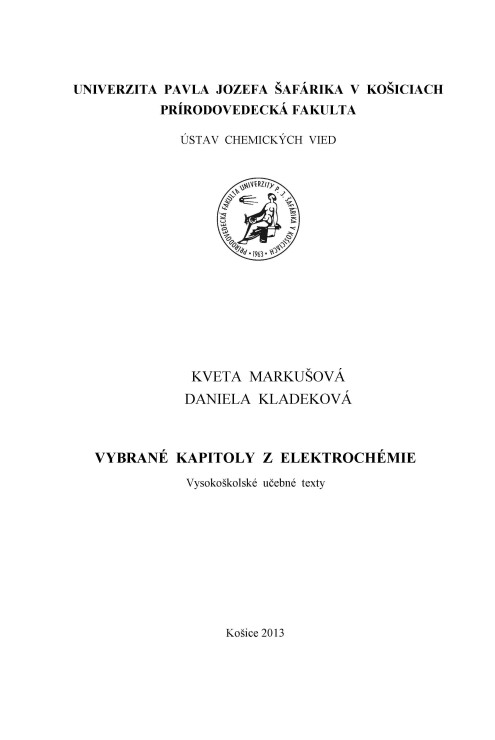
Vybrané kapitoly z elektrochémie

E-book

Kveta Markušová - Daniela Kladeková

Electrochemistry is the science that studies ionic systems and the processes or phenomena that occur at the interface between ionic systems and metals or semiconductors. At the current stage of development, electrochemistry can be divided into two main areas based on its focus. The first one - ionics - deals with the properties of ionic systems (solutions, melts, solid electrolytes). The second area - electrodeics - focuses on phenomena at the electrode/ionic system interface.

Both ionics and electrodeics investigate equilibrium and non-equilibrium phenomena and processes. Research into the properties of ionic systems under equilibrium conditions provides information and insights into the structure and composition of electrolyte solutions, melts, and solid electrolytes, while measurements under non-equilibrium conditions provide data on the electrical conductivity of ionic systems. In the field of electrodeics, the study of equilibria at the electrode/solution (or melt) interface is the domain of electrochemical thermodynamics. Measuring the rates of processes occurring at this phase interface and explaining the principles governing these processes fall under the scope of electrode process kinetics or electrochemical kinetics.

Download the e-book for free (pdf)

Quantity

978-80-8152-016-7

Data sheet

Method of publication:
E-book (pdf)
Authors:
Kveta Markušová - Daniela Kladeková
Document type:
Course Notes
Number of pages:
144
Available from:
27.05.2013
Year of publication:
2013
Edition:
2nd edition
Publication language:
Slovak
Faculty:
Prírodovedecká fakulta
- Free for download

16 other products in the same category:

Cytológia pracovný zošit na praktické cvičenia

Cytológia pracovný zošit na praktické cvičenia

€10.50
Availability: 35 In Stock

Ján Kleban a kolektív

Predkladaný pracovný zošit na praktické cvičenia z cytológie je určený poslucháčom 1. ročníka bakalárskeho štúdia biológie a 1. ročníka bakalárskeho medziodborového štúdia v kombinácii s biológiou na Prírodovedeckej fakulte Univerzity Pavla Jozefa Šafárika v Košiciach. Slúži ako návod, ktorý má študentom uľahčiť prácu a umožniť rýchlejšiu orientáciu v zadanej úlohe. Úprava pracovného zošita do formy protokolov umožňuje študentom zakresliť vlastné pozorovanie a tým stimuluje študentov k presnejšiemu a trvalejšiemu zapamätaniu si precvičovanej úlohy a zároveň umožňuje spätnú kontrolu pedagógom. Počas cvičení sa študenti postupne oboznámia so základnými pojmami optiky, s aplikáciami využívajúcimi mikroskopickú techniku, ale aj so základnými rozdielmi medzi štruktúrou rastlinnej a živočíšnej bunky a ich organelami.

Porous Materials for Environmental Applications 2026
  • New

Porous Materials for Environmental Applications...

E-book

E-book

Miroslav Almáši  Nikolas Király   eds.

The conference proceedings of Porous Materials for Environmental Applications 2026 represent a collection of scientific and professional contributions presented at the international scientific conference held on 15–19 March 2026 in Białka Tatrzańska (Poland). The conference focused on current trends in the research of porous materials and their applications in environmental, catalytic, energy-related, and biomedical fields. The event provided an interdisciplinary platform for the exchange of the latest scientific knowledge in the design, synthesis, characterization, and practical utilization of porous materials.

Particular attention was devoted to their application in adsorption and separation processes, heterogeneous catalysis, photocatalysis, energy storage and conversion, as well as in biological and medical applications. The published abstracts reflect current challenges related to sustainable development, green technologies, and advanced materials solutions. The proceedings offer a comprehensive overview of the current state of porous materials research at the international level and document the dynamic development of this field with significant overlap into environmental chemistry, materials science, and chemical engineering.

Download the e-book for free (pdf)

Určitý integrál

Určitý integrál

E-book

E-book

Ondrej Hutník

The concept of the integral is one of the most significant concepts in mathematics as a whole. In its most primitive form, it was already used by the ancient Greeks in the creation of Euclidean geometry. However, it was only after Descartes' work on analytical geometry in 1637 that mathematicians could begin to consider the integral as a subject of analysis. Descartes' work laid the groundwork for the discovery of infinitesimal calculus by Leibniz and Newton around 1665. At that time, a great dispute arose over the priority of this discovery, dividing scholars of Germany and England into two opposing camps, each favoring their own champion. Today, we know that Newton's work on fluxions and fluents was somewhat earlier, but Leibniz's notation and approach have gained more acceptance in the mathematical world, and the symbols ∫ ∫ and d d are still used today. A brief overview of the history of the integral will be presented in Chapter 1.

Today, there is a plethora of scripts, textbooks, and books dedicated to explaining the concept of the integral. Therefore, every potential author faces the initial question of whether to write another text on this topic. Our affirmative answer to this question was driven by the students' request to find the subject matter of a part of the winter semester of the second year presented in a coherent form. The second motivation is a slightly different approach to the topic. If we consider the methods typically used in solving problems and gaining routine with a certain integral, it mainly involves the Newton-Leibniz formula, and often there is little time left to compute the definite (Riemann) integral using its definition. Therefore, we included a discussion of the Newton integral in Chapter 2, which reflects this fact and is directly related to the indefinite integral, whose various calculation methods receive relatively much attention in the previous semester. Only after that, in Chapter 3, do we build the theory of the Riemann integral, present criteria for its existence, classes of integrable functions, basic properties, and finally its relationship with the Newton integral. Questions primarily concerning geometric applications are addressed in Chapter 4, and in the final chapter, we focus on extending the Riemann integral to unbounded functions and unbounded intervals.

Download the e-book for free (pdf)

Zoológia bezchordátov

Zoológia bezchordátov

€11.02
Availability: 121 In Stock

 Ľubomír Panigaj - Peter Ľuptáčik 

(Náčrt systému a fylogenézy)

Učebný text je primárne určený pre študentov jednoodborového štúdia biológie a všeobecnej ekológie, ako aj odborom učiteľského štúdia v rôznych kombináciách s biológiou. Venuje sa v nich opisu jednotlivých skupín živočíchov, ich morfológiu a anatómiu ilustruje na obrazových materiáloch. K jednotlivým morfologickým a anatomickým štruktúram sa v texte nevyjadrujeme podrobnejšie, nakoľko text nadväzuje na predmet Porovnávacia morfológia živočíchov, kde na úrovni organológie boli tieto najvýznamnejšie štruktúry v rámci prednášok a cvičení detailne vysvetlené a opísané. Rozsah učebného textu nie je veľký, podávame v ňom základné minimum poznatkov, čo je podmienené jednak rozsahom predmetu, ktorý je len jednosemestrový, jednak tým, že ďalšie, špecializované predmety rozširujú spektrum poznatkov napr. na úrovni entomológie, hydrobiológie alebo pôdnej biológie. V zavere niektorých kapitol formulujeme niekoľko cvičných otázok, ktoré si študenti môžu na základe predchádzajúceho textu zodpovedať, s podobnými otázkami sa totiž môžu stretnúť na skúške alebo na štátniciach.

Autori

Book of Abstracts: International Meeting on Advanced Materials

Book of Abstracts: International Meeting on...

E-book

E-book

Soňa Király (ed.)

The book of abstracts from International Meeting on Advanced Materials, IMAM 2025, is composed of contributions from participants of this conference. The conference consisted of 16 lectures by mentioned conference participants. The conference is focused on advanced materials and its application in various research areas. All contributions are professionally processed and inspiring.

Download the e-book for free (pdf)

Štúdium fyzikálnych vlastností tuhých látok

Štúdium fyzikálnych vlastností tuhých látok

E-book

E-book

Róbert Tarasenko - Vladimír Tkáč

The presented university textbook is intended for all students engaged in the field of condensed matter physics who, while working on their final theses, come into contact with the experimental device known as the Physical Properties Measurement System (PPMS). The main purpose of this textbook is to facilitate, in a certain way, the students' work with the complex manuals provided with this experimental device. At the same time, through this textbook and its clear instructions, students acquire the necessary experimental skills essential in the field of condensed matter physics.

Download the e-book for free (pdf)

Geografické poznatky bez hraníc - výber z maďarských a slovenských príspevkov z fyzickej a humánnej geografie.

Geografické poznatky bez hraníc - výber z...

E-book

E-book

Dušan Barabas a kol.

The presented text is the final product of work within the project "Tanuljunk egymástól!/Let’s Learn from Each Other!" The project emerged from long-standing contacts between the staff of the Centre for Regional Studies of the Hungarian Academy of Sciences and the Institute of Geography at the Faculty of Science, Pavol Jozef Šafárik University in Košice, as a natural effort to expand mutual cooperation. The first step was collaboration within Interreg II projects, involving a broad range of institutions from both academic and non-academic environments. This initial attempt was unsuccessful due to administrative errors. Consequently, a project titled HUSK/0801/1.6.1/0003 "Tanuljunk egymástól!/Let’s Learn from Each Other!" was prepared and developed in agreement with the Hungarian side. It was approved and co-financed by the European Regional Development Fund under the Hungary-Slovakia Cross-Border Cooperation Program 2007–2013.

Download the e-book for free (pdf)

Sekundárny metabolizmus (Úvod do štúdia prírodných látok)

Sekundárny metabolizmus (Úvod do štúdia...

E-book

E-book

Miroslava Martinková

This electronic material focuses on the subject of secondary metabolism and its products - secondary metabolites. The material gives an overview of the basic building blocks and construction mechanisms through which molecules can be synthesized in living organisms (plants). The processes of formation of the mentioned metabolites are explained using the basic mechanisms of organic reactions. Several of the secondary metabolites presented have a remarkable biological profile and are used as therapeutics or serve as lead compounds for the development of novel pharmacological agents. This electronic document is primarily intended for students of the Master's degree programme in Organic Chemistry as supporting material for the profile subject Chemistry of Natural Products.

Download e-book for free (pdf)

Anatomické termíny pre štúdium anatómie človeka a neuroanatómie (2. vydanie)

Anatomické termíny pre štúdium anatómie človeka...

E-book

E-book

Juraj Ševc - Anna Alexovič Matiašová

Among students of single-discipline and interdisciplinary biology studies at faculties with a natural science focus, there often arises a problem in defining the scope of the curriculum when studying the subject of Human Anatomy. The presented study material aims to help students of non-medical scientific fields navigate the extensive anatomical terminology and to limit the amount of required anatomical terms to an optimum, so that alongside mastering Latin nomenclature, students still have sufficient capacity to memorize additional knowledge in the areas of systemic, comparative, developmental, and functional anatomy.

Emphasis on organizing individual anatomical terms into logical units simultaneously supports a hierarchical view of the architecture of the human body. Despite its seemingly self-serving nature, anatomical terminology thus becomes the framework upon which students build knowledge from more or less related scientific disciplines studying the human body and the processes occurring within it throughout their further studies. At the same time, alongside this ambition that goes beyond the scope of the anatomy discipline, the Anatomical Terms follow a long tradition of anatomical handbooks while respecting the valid Latin and Slovak anatomical nomenclature.

This script represents a practical supplement to university textbooks of Anatomy or Neuroanatomy and especially to anatomical atlases, but it certainly does not aim to replace them. Here you will find all the necessary terms gathered in one place, which you can always have at hand on your phone, e-reader, or laptop. The emphasis on organizing individual anatomical terms into logical units supports a hierarchical view of the architecture of the human body, and the inclusion of a brief introduction to each system is intended to encourage you to seek further, more detailed information about the structure and function of the given organ system.

Download the e-book for free (pdf)

EFFUSE príručka pre žiakov: Základy biomonitoringu vodných tokov

EFFUSE príručka pre žiakov: Základy...

E-book

E-publication

Beáta Valkay ed.
Ivana Slepáková-Lenka Maliničová a kol.

EFFUSE - A Guide for Students is an interactive educational resource for primary and secondary school students to help them better understand how their daily activities affect the environment. The handbook was developed within the EFFUSE project (‘Environment for the future by science education’) and motivates young people to take a greater interest in the nature around them. It focuses on practical field activities during which they will explore the ecosystem of the Laborec and Uh rivers, observe and document organisms and work with real samples from nature. At the same time, they will learn about the work of scientists - botanists, zoologists and microbiologists - and learn basic biomonitoring methods. The manual will also guide them through the process of creating a virtual laboratory to display the results of their investigations of an aquatic ecosystem. It will help them understand the importance of sustainable development and encourage them to behave responsibly towards nature. It is their opportunity to learn about their surroundings in a new way, to learn to think scientifically and to become active creators of positive change for their community and future generations.

Download the e-book for free(pdf)

Digiform - podporná aplikácia k Digilib

Digiform - podporná aplikácia k Digilib

E-book

E-publication

Denisa Maceková-Monika Václavková-Marek Kvet-Ivana Sotáková

The publication Digiform: A Supporting Application to Digilib – User Guide, Part B presents the Digiform web application as a tool that extends the functionality of the Digilib digital library of formative assessment tools. The application enables the creation and editing of formative assessment tool templates, which can be adapted to the specificities of individual subjects and levels of education and subsequently imported into the Digilib environment for use in the teaching process. The guide provides a detailed description of how to work with the Digiform application, from creating new templates, editing and personalising them, through to their export and implementation in the main Digilib application. Attention is also given to the interconnection with the Digilib Images application, which enables the integration of visual elements into the assessment tools, thereby enhancing their didactic effectiveness and visual appeal. The guide is intended for teachers at all levels of education, student teachers, school administrators, and digital coordinators who are interested in the systematic use of the Digilib digital library to support the implementation of formative assessment, enhance the quality of the educational process, and foster the development of students’ self-assessment and reflective competences.

Download the e-book for free (pdf)

BIOLÓGIA LIŠAJNÍKOV. Časť C: Identifikácia metabolitov pomocou NMR spektroskopie

BIOLÓGIA LIŠAJNÍKOV. Časť C: Identifikácia...

E-book

E-book

Mária VilkováMonika GarberováMichal Goga

Nuclear Magnetic Resonance (NMR) is currently a widely used analytical tool that finds application in many fields of science and technology. The broadening of its practical use brings with it the necessity to create educational texts appropriate to the given scientific discipline.

This university textbook is intended for students of biology and serves as a supplement to the study materials for the advanced master's course "Biology of Lichens." At the same time, it represents a useful resource for master's and doctoral students involved in research, helping them interpret NMR spectra and present basic theoretical concepts.

The textbook briefly describes the important aspects of each NMR spectroscopic technique without delving excessively into the physical principles of individual methods or complex mathematical analyses. In this edition, the structures of lichen metabolites have been included, which students will isolate, purify, and identify using various analytical methods during practical exercises. An entire chapter is dedicated to a detailed description of solving the NMR spectra of isolated metabolites, with each step in elucidating the structures of both known and unknown metabolites explained in detail. The solved tasks are followed by numerous unsolved examples, including high-resolution 1D and 2D NMR spectra of metabolites, intended to further develop the acquired knowledge and skills of students and doctoral candidates in structure elucidation using NMR spectroscopy.

Download e-book for free (pdf)

Profesori Prírodovedeckej fakulty UPJŠ v Košiciach 1963 – 2023

Profesori Prírodovedeckej fakulty UPJŠ v...

E-book

E-book

Renáta Oriňaková

We have prepared a publication that focuses on the personalities of professors. These personalities represent entire scientific teams, participated in the creation of new study programs, and had a significant impact on the formation of the faculty. Factually, we tried to capture the basic data in a uniform structure. We are building on a similar publication from ten years ago, which greatly helped us, especially with professors who worked at the faculty many years ago and whose memories are gradually fading. The ambition of the publication is to contribute to the preservation of basic information that is closely related to the history of the faculty.

doc. RNDr. Roman Soták, PhD. Dean of the Faculty of Science, UPJŠ in Košice

Download e-book for free (pdf)

Laboratórna technika a výpočty

Laboratórna technika a výpočty

E-book

E-book

Zuzana Jurašeková

Úvod k praktikám k experimentálnym metódam biofyziky

The university textbook titled Laboratory Techniques and Calculations is designed for the first-year students of the bachelor's degree in Biophysics at the Institute of Physics, Faculty of Sciences, P. J. Šafárik University in Košice. The objective is to equip students with fundamental knowledge and practical skills for the work in a chemical laboratory. It is essential for addressing different biophysical issues and experiments that students will have to solve later. The textbook comprises three principal sections: a theoretical part focused on the calculations, a section dedicated to laboratory work, and the last part offers a brief introduction to spectroscopy. The theoretical part summarizes the basic definitions and equations related to the characterization and preparation of solutions and mixtures. The second, most comprehensive part provides guidance and suggestions for safe and efficient practices in a chemical laboratory. The primary focus is on the manipulation of chemical substances and the use of specific small laboratory instruments and equipment. The fundamental laboratory procedure guides for the selected laboratory works are also provided. As part of a short introduction to spectroscopy, students can become familiar with fundamental spectroscopic concepts and principles. UV-VIS absorption spectrophotometry receives special attention, along with a brief introduction to fluorescence. The textbook is supplemented by various practical and theoretical tasks, as well as numerous web links to further explanatory texts and videos.

Download the e-book for free (pdf)

Vybrané heterocyklické zlúčeniny

Vybrané heterocyklické zlúčeniny

E-book

E-book

Mariana Budovská

The aim of writing the university textbook "Selected Heterocyclic Compounds" was to create a study aid for students of the Organic Chemistry program, which provides essential information in a clear format for the subject of Heterocyclic Compounds. In selecting the content of the textbook, the goal was to present basic information about the chemistry of the most significant heterocycles. Given that the summary of chemical knowledge about heterocycles is vast, it was not possible to include all heterocyclic compounds in the content.

The intention was for readers to orient themselves in the field of heterocyclic compounds. Separate chapters included in the content address the nomenclature of heterocycles, basic chemical properties of individual heterocycles, their synthesis and reactions, the occurrence of heterocycles in nature, and their practical applications (medications, dyes, pesticides, detergents, etc.).

Download e-book for free (pdf)

Počítačová fyzika I

Počítačová fyzika I

E-book

E-book

Milan Žukovič

The textbook Computational Physics I covers the topics taught in the course of the same name at the bachelor's level of the Physics study program, as well as in the course Application of Numerical Methods at the bachelor's level of the Applied Informatics study program.

The text builds upon the basic course in numerical methods, focusing on explaining the fundamental principles of computer-based solutions to some typical physics problems. It includes both the area of deterministic methods for solving problems modeled by ordinary and partial differential equations, as well as the area of stochastic Monte Carlo simulations. The course Computational Physics I lays the foundation for further study of more advanced computational methods taught at the master's level in the subject Computational Physics II. Nowadays, the use of computers as a tool for solving real physics problems, and for students as a tool for preparing their final bachelor's or master's theses, is almost indispensable.

This has led to the creation of numerous user-oriented software packages in various environments for solving a wide range of problems. However, without a thorough understanding of how individual computational techniques work, these programs become black boxes with many pitfalls and risks in their use. Therefore, this text emphasizes understanding both the strengths and weaknesses of individual methods and the assumptions for their successful application.

Download the e-book for free (pdf)

This website uses cookies to ensure you get the best experience on our website