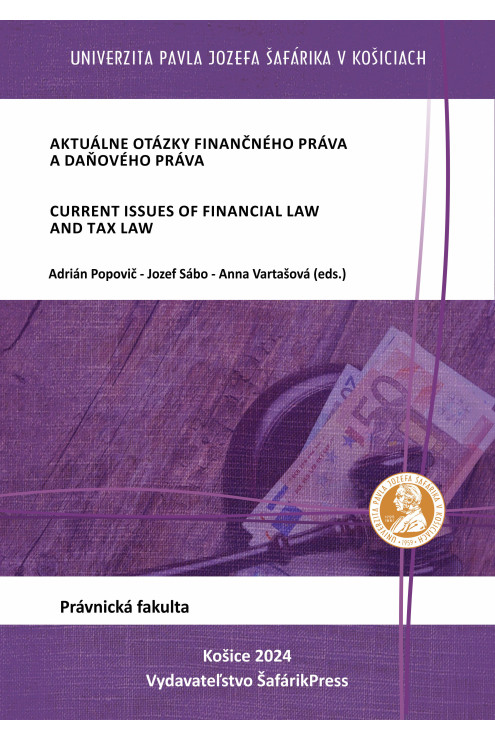
Current Issues of Financial Law and Tax Law

E-book

Adrián Popovič - Jozef Sábo - Anna Vartašová (eds.)

Reviewed proceedings from the IV. annual student symposium

Download the e-book for free (pdf)

Quantity

978-80-574-0372-2

Data sheet

Method of publication:
E-book (pdf)
Editors:
Adrián Popovič • Jozef Sábo • Anna Vartašová
Document type:
Proceedings
Number of pages:
70
Available from:
16.12.2024
Year of publication:
2024
Edition:
1st edition
Publication language:
slovenčina, angličtina
Faculty:
Faculty of Law
Note:
Recenzovaný zborník príspevkov zo IV. ročníka študentského sympózia: „Aktuálne otázky finančného práva a daňového práva“ je podporený v rámci projektu VEGA č. 1/0214/21: „Daň z nehnuteľností – právny stav a potenciál“.
License:
Creative Commons BY NC ND (Uveďte autora - Nepoužívajte komerčne - Nespracovávajte)
DOI:
https://doi.org/10.33542/AOF-0372-2
- Free for download

16 other products in the same category:

Zborník príspevkov z X. ročníka študentského...

E-book

E-book

Adam Giertl (ed.)

Proceedings of the Student Symposium on International Law and European Law held on April 28, 2017, at the Faculty of Law of Pavol Jozef Šafárik University in Košice

The Student Symposium is regularly organized by the Institute of International Law and European Law, and in 2017, it marked the jubilee tenth edition of the symposium, which over time expanded its focus to include European law.

The tradition of holding student symposia is also associated with the good practice of preparing proceedings from each event. Understandably, the tenth edition is no exception, and thus, the tenth edition of the symposium proceedings is now available to readers. In previous years, the symposium has always focused on specific areas of international and European law. Thus, the subjects of study for symposium participants have included migration issues (2016), the protection of cultural values (2015), and the challenges of cyberspace (2013).

This year, given that it is the jubilee tenth edition, the symposium organizers have chosen to approach the symposium's focus thematically and recall some significant milestones in the development of international law that occurred in years ending with the number seven.

Download the e-book for free (pdf)

Evaluation of Evidence in the Tax Law

E-book

E-book

Jozef Sábo

The monograph deals with two fundamental aspects concerning evaluation of evidence in the law. In the first part, the monograph addresses the question: „How it is possible to apply law in individual case, if human knowledge about past is objectively limited and flawed?“ (e.g. what is the nature of truth in the law?). The second part of the monograph identifies certain models of reasoning concerning factual questions which occur across different individual legal cases (especially tax cases and criminal cases). In that regard, the monograph draws from Anglo-American legal scholarship and deals with three main concepts concerning evaluation of evidence: argumentation, probability and narratives and their role in evaluation of evidence.

The monograph is the output of the grant project APVV no. 16-0160 which deals with the issue of tax evasion and tax avoidance (especially their motivating factors, emergence, and elimination). The author believes that better understanding of evaluation of evidence may contribute to the improvement in effectiveness of tax administration.

Download the e-book for free  (pdf)

The loan or usury? Compulsory enforcement of...

E-book

E-book

Terézia HišemováDarina Kmecová (eds.)

Reviewed proceedings of scientific papers of Conference of Slovak and Czech law romanists, which take place at May, 10.-11.5.2018, at Faculty of Law, UPJŠ in Košice.

The submitted reviewed proceeding of scientific papers on „The loan or usury? Compulsory enforcement of roman - law basics and problems of application practice.”  is prepared within the solution of the grant project VEGA on: „The loan or usury? Compulsory enforcement of historical - law basics and problems of application practice.”, no. p. 1/0198/17.

The authors of papers are important personalities of Roman law working in the Slovak and Czech Republic, as well as PhD students and young scientists from Slovak and foreign universities who are active in the academic environment as well as in legal practice. The main goal of the editors is to help improve the current legal situation, which is assessed as unsatisfactory, and through a historical excursion of the development of the loan institute and then the forced execution of the decision, to create de lege ferenda proposals considering all areas of research.

The Proceedings trace the interrelationships between the substantive law institute in terms of the Roman law of contractus unilaterales - mutuum in its various types, often realized by the attachment of high interest rates, which bordered on the insurrection and the procedural law of individual lawsuits enforced in the legislative, formular and cognitive process. If there was no possibility to impose certain behaviour on the obligated person (the debtor, the sentenced person), then the declared general obligation to enforce the legal norms was only a legal term. It has always been the case that every internally well-organized state, whether antique or present, has to use power tools - often with the use of gross violence - but within the limits of the law, to promote what it has declared valid law. It must protect creditors on the one hand, but it must also prevent self-help and the use of illegal, unjustified and disproportionate violence.

The loan contract as a real contract has often become an integral part and relatively the most frequent reason leading to the compulsory enforcement, especially when contracting parties often agree on the connection of interest - sometimes within the legal limit, sometimes exceeding the legal framework - and in this way the potential future creditor (the plaintiff) significantly increased the insolvency risk of the debtor (the defendant, the sentenced) and of the subsequent execution. The pronounced and deepening social stratification of the Roman population and the secondary depreciation effort, the cancellation of the debts of the poor part of the population logically culminated in social unrest and revolt against the enforcement of the enforcement law.

The proceedings capture not only the rich scientific discussion of Slovak and Czech legal Romanists, but also the opinions, experience and knowledge of experts on contemporary law dealing with this type of issues. As a result, it provides a unique interdisciplinary view of the subject and raises many stimulus points for future research. This work proves that the problems encountered by the various representatives of the Roman jurisprudence and their legal and theoretical bases and solutions are undoubtedly useful and serve as a guideline also for solving legal issues in the field of modern enforcement proceedings.

Download the e-book for free (pdf)

LAW – COMMERCE – ECONOMY XII.

E-book

E-book

Jozef Suchoža - Ján Husár - Regina Hučková

The Proceedings of the International Scientific Symposium "LA W-BUSINESS-ECONOMICS XII" is a collection of scientific works by authors participating in the symposium of the same name. The publication focuses primarily on the area of representation in private law, related pai1ies in corporate and bankruptcy law, and current issues of legal regulation of artificial intelligence.

The authors of indivídua! contributions are erudite experts from various branches of law. The collection of scientific papers is a complete work in the form of a collection, with an overlap into private and public law sectors.

Readers are presented with scientific outputs from authors from the Slovak legal environment, as well as from foreign authors. Several authors' paper provide a European legal perspective or an international comparative perspective.

Download e-book for free (pdf)

Aktuálne otázky migrácie z pohľadu...

E-book

E-book

Adam Giertl (ed.)

Collection of Papers from the 9th Annual Student Symposium on International and European Law held on April 22, 2016 at the Faculty of Law, Pavol Jozef Šafárik University in Košice

As indicated by the very title of the 9th Annual Student Symposium on International and European Law, “Current Issues of Migration from the Perspective of International Law with Special Regard to the Charter of Fundamental Rights of the European Union,” the participants focused on the highly topical subject of European migration, which they examined from various aspects of both international and Union law (a total of 9 contributions).

In assessing the role of individual actors primarily involved in addressing the problems arising from migration to Europe, particular emphasis was placed on the role of international specialized organizations, which often provide direct assistance to migrants “in the field” through humanitarian or medical aid. However, this is not the only response of the international community, as it is complemented by the activities of the concerned states as well as various non-governmental organizations and volunteers. Regarding the evaluation of the European Union’s activities, the symposium participants agreed that the mass migration wave caught the EU relatively unprepared—institutionally, legislatively, and technically—accompanied by a lack of clarity in adopting a fundamental approach to this reality.

It was also emphasized that these shortcomings occurred despite the fact that developments in the preceding period clearly signaled the possibility of gradual migration to the European Union escalating into a mass phenomenon. According to the participants, additional ex post and sometimes delayed measures adopted in response to the ongoing migration process contributed to an overall increase in political tension within the EU and divided its member states into opposing camps.

Download the e-book for free (pdf)

Aktuálne problémy medzinárodného leteckého a...

E-book

E-book

Adam Giertl (ed.)

Proceedings from the VII. annual student symposium on international law held on April 11-12, 2014 at the UPJŠ training facility in Danišovce

Despite this, flying and space travel are now a common part of human civilization. What is the role of law in this process? This is the question posed by the organizers of the VII. annual student symposium on international law, aiming to evaluate the contribution of international law in the field of aviation and space flights, especially in light of current developments.

The individual topics were tackled by second, third, and higher-year students of the Faculty of Law at UPJŠ in Košice. The result of their work on the assigned topics, which the authors could consult with members of the Institute of European Law and the Department of International Law, is the presented work.

The proceedings are thematically divided into two parts. The first part acquaints the reader with selected topics related to aviation law, and the second part is dedicated to international space law.

With its focus, the proceedings also have a broader impact, as in some aspects it fits into the broader context of research conducted at the Institute of European Law and the Department of International Law, which focuses on examining the influence of regionalism on general international law and vice versa. This issue is also reflected in the topics of the individual contributions.

Download the e-book for free (pdf)

Spracúvanie osobných údajov zamestnanca podľa GDPR

E-book

E-book

Jana Žuľová a kol.

The presented publication is intended for employers, managers, and HR professionals who process employees' personal data for various employment-related purposes and need to conduct an audit of their processing in compliance with the GDPR and the new Personal Data Protection Act. The publication will also be useful for new employers who are encountering data protection for the first time and need to establish internal data protection rules, essentially starting from scratch.

The reader has the opportunity to gain a comprehensive understanding of the data protection rules applicable in the employment sector, the obligations of the employer, and the rights of the data subject, i.e., job applicants, employees, and former employees.

Download the e-book for free (pdf)

1. svetová vojna a jej dôsledky v štátoprávnej...

E-book

E-book

Erik Štenpien  - Lucia PištejováIvan Svatuška

The presented publication is the proceedings of the international conference held on 29.-30. September 2022 in Košice as an output of the grant project APVV-19-0419.

The ambition of the project is to try to reconcile legal and general historians from Slovakia and Hungary in the difficult topic of looking at the Treaty of Trianon from 1920. The conference, held on 29.-30. September 2022 was the third in a series of conferences that for the purpose of assisting in the achievement of said goal. It was attended by legal historians and positive lawyers from several Central European countries. So let the collection serve as another step towards understanding between nations.

Download e-book for free (pdf)

Medzinárodné právo verejné (Materiály k štúdiu)

E-book

E-book

Ľudmila Pošiváková - Adam Giertl

The presented selection of public international law documents aims to map international law from both historical and sectoral perspectives. The reader will find several historical documents in this collection, but the focus is primarily on currently valid legal sources.

The selection is guided by the publication Public International Law – General and Special Part by Prof. Ján Klučko, which is reflected in the division into general and special parts. The general part addresses the historical development of international law but primarily focuses on the protection of individuals and responsibility relationships in international law. The special part then examines the international regulation of various institutions of international law.

We acknowledge that this selection offers room for expansion, but we believe it meets basic requirements and fills a certain gap in the study of international law.

We trust that this collection of public international law materials will be beneficial for students, and not only for them, in the study of public international law and will contribute to raising awareness in this field.

Download the e-book for free (pdf)

Antické paradigmy a Trianonská zmluva

E-book

E-book

Ľuboš Dobrovič - Vladimír Vrana

The world of diplomacy, whether ancient or modern, is naturally prone to problems associated with cultural clashes and often serves as an “unarmed battlefield” of cultural concepts. International diplomacy, however, stands on the assumption of war, as misunderstandings and cultural discrepancies lead to confusion. Cultural encounters also provide many opportunities for the choice of misunderstanding: the choice to perceive an act as an insult, even if unintended, or the choice to ignore the most blatant intentional insult, all according to momentary expediency.

The Roman historian Livy recounts an anecdote about the gates of the Temple of Janus, which, when open, signified that Rome was at war. However, the doors of the ancient Temple of Janus were closed only twice from the beginning of the 7th century BC to the end of the 1st century BC. One might ask, how many times and for how long after the signing of the Treaty of Trianon were the metaphorical gates of the European (or global) Temple of Janus closed?

The publication that the reader holds in their hands does not attempt to exhaustively answer all questions of ancient and modern international diplomacy. That is neither possible nor the goal of this scientific monograph. Authors seeking intersections between diplomacy of antiquity, the Middle Ages, and the early 20th century encountered some thought-provoking ideas and controversial debates. Indeed, what other conclusions can the topic of the Treaty of Trianon and the perpetual clash of cultures in the Mediterranean antiquity and medieval Europe bring?

We believe that the topic of ancient and modern diplomacy will inspire the reader and stimulate the professional public to new ideas, reflections, and scholarly activity.

The scientific monograph was prepared as an output of the project of the Agency for the Support of Research and Development No. APVV-19-0419: "100 years of the Treaty of Trianon."

Download the e-book for free (pdf)

Ochrana zamestnanca perspektívou priemyselnej...

E-book

E-book

Milena Barinková (ed.)

Proceedings from the IV Annual Student Symposium on Labor Law held on April 5–6, 2019, in Danišovce

The term "Industrial Revolution 4.0" is currently widely used, yet remains mysterious and its content unfamiliar to many. While we do not claim omniscience, through the educational process at the Faculty of Law of Pavol Jozef Šafárik University in Košice and the scientific research of the Department of Labor Law and Social Security Law, we have delved into examining the accompanying features and anticipated phenomena of this modern industrial revolution.

It can be stated with great certainty that this revolution already affects—and will continue to affect—production processes, including radical changes in their structure, the emergence of groundbreaking technological and communication tools, and, undoubtedly, labor relations. The rise of new forms and methods of work based on automation and digitalization, applied within new models of labor relations, is beginning to threaten jobs in certain sectors of the economy. There is an increasing demand for specialized qualifications and skills, particularly in information technology, with an emphasis on process digitalization, data processing, and the creation of communication networks connecting objects and people. This intelligent industry inevitably disqualifies many existing jobs from their current structures, leading to job losses for numerous employees. Analysts openly predict that by 2030, robots will replace up to 20 million industrial jobs worldwide.

The vision of which occupations or working conditions will be impacted is becoming increasingly concrete. Radical changes will require radical solutions as well as previously unknown movements and new elements or measures in the labor market.

Download the e-book for free  (pdf)

Ochrana kultúrnych hodnôt prostriedkami...

E-book

E-book

Adam GiertlĽudmila Elbert

Collection of Papers from the 8th Student Symposium held on April 20–21, 2015 in Danišovce

The capture of the historic Syrian city of Palmyra by fighters of the radical Islamic State caused shock among the global public. The main reason is the barbarism with which this organization proceeds, not only in relation to the treasures of the world’s cultural heritage. The situation in the Middle East, where cultural treasures of inestimable value are under direct threat, demonstrates how fragile the world’s cultural heritage is. The reaction of the international public and world leaders shows how sensitively the destruction of cultural heritage is perceived.

The quoted statement chosen by the editors relates to the threat posed by the Islamic State—however, the spirit of this statement can be applied to any cultural wealth that forms part of the world’s cultural heritage. The destruction or damage of these values primarily represents a loss for humanity as such. Each destroyed artifact of world cultural heritage signifies the disappearance of a unique legacy left by previous generations for the future. At the same time, cultural heritage must be understood as a broad spectrum of assets—both tangible and intangible. Their legal protection was the topic of this year’s symposium. As with any social interest, the protection of cultural heritage can be ensured through various mechanisms and under different forms of social organization.

These diverse approaches are unified by law as a normative system. The question for the 8th year of the symposium on international law was what role international law plays in the protection of cultural heritage. In the context of the European region, the role of the European Union as a regional organization was examined.

Download the e-book for free (pdf)

III. SLOVAK-CZECH DAYS OF TAX LAW. Positive and...

E-book

E-book

Vladimír BabčákAdrián PopovičJozef Sábo (eds.)

Within the project APVV-16-0160 "Tax evasion and tax avoidance (motivation factors , formation and elimination)" was organized conference called III. SLOVAK-CZECH DAYS OF TAX LAW " Positive and Negative Stimulation of the State in the Area of Taxation ". From this conference was prepared the eponymous output in the form of reviewed proceedings of scientific works.

In this publication is published the contributions from several prominent personalities of tax law science in Slovakia and the Czech Republic. lndividual contributions map tax legislation and also changes due to the development of tax legislation , especially under the influence of European Union law. Th ese changes are approached in the context of their specific economic impacts and their impact on status and legal relations in the business and social field . The main topics elaborated in the individual contributions are in particular: EU activities in relation to tax fraud and tax evasion, the impact of tax construction on the act of the addressees of tax law and tax policy of the state and its economic impacts.

The publication presents one of the most actual topics in the current legal and economic environment.

Prof. h.c. prof. JUDr. Vladimír Babčák, CSc.

Download the e-book for free  (pdf)

Extrateritoriálne účinky cudzích správnych...

E-book

E-book

Radomír Jakab - Diana Repiščáková (eds.)

The collection of scientific papers was created as part of a scientific seminar entitled “Extraterritorial Effects of Foreign Administrative Decisions in the Conditions of the European Union – Starting Points and Current State,” held from November 23 to 25, 2022, at the training and educational facility in Danišovce, in connection with the implementation of a scientific project entitled “Extraterritorial Effects of Foreign Administrative Decisions in the Conditions of the European Union,” supported by a grant from the Scientific Grant Agency under No. 01/187/2022.

The aim of the mentioned project is the scientific examination of extraterritoriality, i.e., the extraterritorial effects of administrative decisions of the Member States of the European Union on the territory of other Member States, in order to assess the need for, possibilities of, and desirable scope of harmonization of the legal regulation of the Member States of the European Union, with the goal of increasing the level of free movement of administrative decisions within the European Union. As part of the research project, an initial scientific seminar was held under the title “Extraterritorial Effects of Foreign Administrative Decisions in the Conditions of the European Union – Starting Points and Current State.”

Members of the research team, who are also members of the Department of Constitutional Law and Administrative Law at the Faculty of Law of Pavol Jozef Šafárik University in Košice, participated in this scientific seminar. At the seminar, contributions were presented that primarily summarized the current state of knowledge in the area of extraterritorial effects of foreign administrative decisions in the context of the European Union. This summary will serve as a basis for the further scientific examination of this issue by the members of the research team. These contributions subsequently formed the scientific papers included in this collection.

Download the e-book for free (pdf)

Súdna moc v ére globalizácie, umelej...

E-book

E-publication
Veronika Lenhardtová-Radoslav Pavlinský-Dominik Urban

The collection Judicial Power in the Era of Globalization, Artificial Intelligence and Other Trends in Society provides a comprehensive and up-to-date perspective on the transformation of the judiciary amid rapid technological and social change. It contains 25 contributions primarily focused on the introduction and use of artificial intelligence tools in law. The authors examine not only the technical and institutional aspects of this transformation but also issues of judicial legitimacy and public trust in an independent justice system. The publication also offers a critical reflection on potential risks, limitations, and ethical dilemmas associated with the automation and digitalization of judicial processes. Several contributions compare national and supranational legal frameworks, offering valuable insights into differences in regulatory approaches around the world. All texts are united by a common question concerning the future of judicial power in a changing world. The contributions are written in an accessible manner, making the collection suitable for both legal experts and the broader public.
Download the e-book for free

Ochrana súkromia zamestnanca

E-book

E-book

Jana Žuľová(ed.)

Proceedings from the 1st Annual Student Symposium on Labor Law held on April 8–9, 2016 in Danišovce

Discussions on the topic of privacy are currently very topical and interesting. The advancement and progress of technology have added a new dimension to individual privacy. With the use of modern electronic devices, terms such as precious commodity, chimera, or illusion are increasingly associated with privacy. Workplaces have not remained immune to modernization either. Machines are replacing human labor, programming and planning the production process, but also controlling, monitoring, and recording the fulfillment of assigned work tasks.

The availability of technology and its implementation in employers’ operations intrude upon the personal and private sphere of employees, which is an inherent part of every person’s life and does not remain left behind the doors of the workplace. Proper and correct use of monitoring mechanisms by employers means not only mastering their technical installation at the workplace and covering the associated financial costs, but also respecting the privacy of employees.

It cannot be overlooked that the right to privacy is among the fundamental human rights and freedoms, enjoying the corresponding characteristics (inalienability, non-transferability, irrevocability, etc.) and appropriate legal protection. And even though it is not absolute and may be suspended in favor of another right (especially the employer’s right to protect their property), every intervention—such as comprehensive camera surveillance, monitoring of phone calls, email correspondence, blocking certain websites, etc.—always has adverse consequences for the privacy of the employee.

Download the e-book for free (pdf)

This website uses cookies to ensure you get the best experience on our website