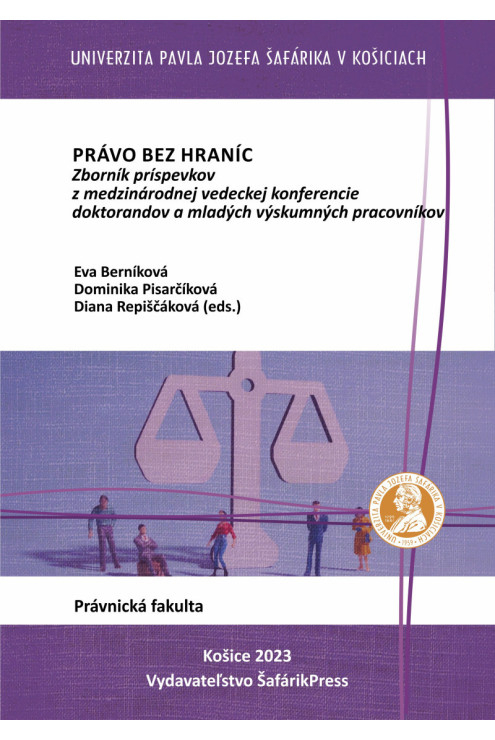
Law without borders

E-book

Eva Berníková - Dominika PisarčíkováDiana Repiščáková (eds.)

Proceedings of the International Scientific Conference of Doctoral Students and Young Researchers

At the Department of Constitutional and Administrative Law of the Faculty of Law at Pavol Jozef Šafárik University in Košice, a research team led by the principal investigator Associate Professor JUDr. Radomír Jakab, PhD., is conducting a research project entitled "Extraterritorial Effects of Foreign Administrative Decisions in the Conditions of the European Union," supported by a grant from the Scientific Grant Agency under number 1/0187/22.

The aim of this project is the scientific examination of the extraterritorial impact of administrative decisions of the EU member states on the territory of other member states, in order to assess the need, possibilities, and desirable scope of harmonizing legal regulation among EU member states to enhance the free movement of administrative decisions within the European Union. On April 27, 2023, in connection with the project, an international scientific conference of doctoral students and young researchers titled "Law Without Borders" was held, attended by doctoral students and young researchers from Slovak as well as foreign universities.

At this conference, contributions based on various legal systems were presented to highlight the interweaving and mutual influence of different legal orders. The conference featured presentations not only from positive law disciplines but also from theoretical and historical legal perspectives. Scientific papers based on these contributions were compiled in the proceedings.

Download the e-book for free (pdf)

Quantity

978-80-574-0243-5

Data sheet

Method of publication:
E-book (pdf)
Editors:
Eva Berníková - Dominika Pisarčíková - Diana Repiščáková
Document type:
Proceedings
Number of pages:
356
Available from:
02.10.2023
Year of publication:
2023
Edition:
1st edition
Publication language:
slovenčina, angličtina
Faculty:
Faculty of Law
Note:
Financované v rámci projektu „Extrateritoriálne účinky cudzích správnych rozhodnutí v podmienkach Európskej únie“ podporeného grantom Vedeckej grantovej agentúry pod č. 01/187/2022.
- Free for download

16 other products in the same category:

Spotrebitelia a obchodníci online: právne a...

E-book

E-book

Renáta Bačárová, Kristián Vassay (eds.)

The proceedings Consumers and Traders Online: Legal and Economic Challenges of Digital Markets present a collection of scientific studies addressing contemporary issues of digital market functioning within the European Union. The contributions analyse legal, economic and technological dimensions of digital services, particularly in the context of the VEGA project 1/0431/23 focused on the conflict of interests between consumers and traders in the delivery of digital content and services. The studies highlight the dynamic growth of the digital economy, bringing new regulatory challenges, issues of data protection and enforcement of consumer rights. The authors examine topics such as geographical indications in the digital environment, the use of artificial intelligence in public enforcement, fintech regulation, liability for damages, and the impacts of the Digital Services Act (DSA) and the Digital Markets Act (DMA). The proceedings also expose increasing fragmentation of responsibility across digital actors and emphasise the need for a harmonised EU regulatory framework. Further attention is given to evolving consumer behaviour, cybersecurity risks, deepfake technologies, the functioning of online marketplaces and digital payment systems. A significant part of the analysis addresses the role of major online platforms, their obligations and influence on transparency in digital markets. The publication offers an interdisciplinary perspective combining law, economics and technology, representing an important contribution to the discourse on modern consumer protection in the digital era.

Download the e-book for free (pdf)

Zdravie pri práci v spektre teórie a praxe

E-book

E-book

Jana Žuľová  - Monika Minčičová - Marcel Dolobáč (eds.)

The legal regulation of occupational health and the process of assessing the health capacity is one of the manifestations of fulfilling the protective function of labour law.

Due to the importance of pursuing the interest in protecting the life and health of the individual during his working life, as well as the consequences of damage to the employee's health for further work and continuance of employment relationship, research in this area finds its irreplaceable place in legal science. Its topicality is also highlighted by the emerging risks of work and the working environment. Technological progress associated with a change in the way of performing work, as well as the pandemic situation, have opened a number of new challenges for labour law that require attention.

The presented proceedings of abstracts responds to the outlined facts. It is a group of initial motives and conclusions of lectures presented at the scientific online conference "Health at Work in the Spectrum of Theory and Practice" organized by the Department of Labour Law and Social Security Law of the Faculty of Law, P. J. Šafárik University in Košice on16th April 2021. Authors point to a variety of problematic areas that are not only a reflection of academic considerations, but also of those legal issues that need to be addressed in ordinary legal practice.

Download the e-book for free (pdf)

Oslava právneho štátu (Právny štát z pohľadu...

E-book

E-book

Ľudmila Pošiváková Zuzana Antošová - Milan Kočan (eds.)

Proceedings from the Student Debate held on April 24, 2013, at the Faculty of Law of Pavol Jozef Šafárik University in Košice.

In the current period, the rule of law is widely debated both at the academic and political levels. This debate is not only related to the effort to establish the Rule of Law in states that have transitioned from socialist to democratic systems but also in states experiencing various unrests, whether political or religious.

However, it is not just a debate about certain characteristics of the Rule of Law that are missing in domestic law or at the level of international law, but also a debate about the very definition and meaning of the Rule of Law. The rule of law can be likened to an ideal that almost every state strives to achieve. Even in the case of the establishment of the independent Slovak Republic, the framers decided to include among the introductory provisions, which should form the core of the constitution, that the Slovak Republic is a state governed by the rule of law.

However, to achieve the ideal of the rule of law, it is necessary not only to declare it but also to adopt measures essential for an independent judiciary, democracy, the effective enforcement of human rights, the separation of powers, and many other elements that characterize a state governed by the rule of law.

Download the e-book for free (pdf)

Miesto a význam regionálnych súdnych orgánov v...

E-book

E-book

Ján Klučka et al.

The aim of the current monograph is to provide comprehensive view of the status of regional judicial organs in current conditions of regionalism. Based on selected issues examined in individual chapters research team presents the comprehensive study focused on clarification of the status and significance of regional judicial organs in terms of new regionalism.

Research of the role of regional courts in the system of peaceful settlement of disputes demonstrates the significant role of the regional courts within the promotion of the rule of law, regional integration and also significant role of regional courts to ensure legal certainty within the system of compliance with decisions of regional courts. The result of examination of possibilities of individuals to access to regional judicial organs is comparative evaluation of regional possibilities of individual to defend his/her rights within regional courts of various regions. Particular part of this area is the right to an effective remedy and to a fair trial as basic rights within the proceedings of regional judicial organs. Within the examination of preliminary rulings of international regional courts of different regions the role of regional judicial organs in the process of effective implementation of the principle of the rule of law was the subject of examination.

For the proper functioning of the regional judicial organs as well as independence of judges and legal certainty in International law, the ethical rules of international judicial organs and tribunals, which are the subject of the last chapter, are significant.

Download the e-book for free  (pdf)

Current Challenges of Financial law and Tax law

E-book

E-publication

Karin Cakoci-Ladislav Hrabčák

The proceedings of student papers from the V. Annual Student Symposium represent a collection of analytical and comparative studies in the fields of tax policy, public finance, and financial law, reflecting the current challenges of the Slovak and European economies. The authors (students) focus on a wide range of topics – from considerations regarding the reintroduction of inheritance tax in Slovakia, through issues of tax evasion and abuse of law in taxation, to measures aimed at public finance consolidation. The authors (students) in their contributions also analyse practical aspects of tax administration, such as tax enforcement proceedings, case law concerning the burden of proof, and the financing of civic associations through tax assignation mechanisms. Particular attention is paid to modern challenges of tax policy, including the taxation of digital giants, financial transaction tax, and the regulation of crypto-asset service provision in the V4 countries. The proceedings also highlight the connection between tax instruments, the financing of cultural institutions, and the broader social context of public expenditures. The publication thus offers a comprehensive overview of current trends and perspectives in the field of taxation and public finance within the conditions of the Slovak Republic and the European Union.
Download the e-book for free

Aktuálne otázky migrácie z pohľadu...

E-book

E-book

Adam Giertl (ed.)

Collection of Papers from the 9th Annual Student Symposium on International and European Law held on April 22, 2016 at the Faculty of Law, Pavol Jozef Šafárik University in Košice

As indicated by the very title of the 9th Annual Student Symposium on International and European Law, “Current Issues of Migration from the Perspective of International Law with Special Regard to the Charter of Fundamental Rights of the European Union,” the participants focused on the highly topical subject of European migration, which they examined from various aspects of both international and Union law (a total of 9 contributions).

In assessing the role of individual actors primarily involved in addressing the problems arising from migration to Europe, particular emphasis was placed on the role of international specialized organizations, which often provide direct assistance to migrants “in the field” through humanitarian or medical aid. However, this is not the only response of the international community, as it is complemented by the activities of the concerned states as well as various non-governmental organizations and volunteers. Regarding the evaluation of the European Union’s activities, the symposium participants agreed that the mass migration wave caught the EU relatively unprepared—institutionally, legislatively, and technically—accompanied by a lack of clarity in adopting a fundamental approach to this reality.

It was also emphasized that these shortcomings occurred despite the fact that developments in the preceding period clearly signaled the possibility of gradual migration to the European Union escalating into a mass phenomenon. According to the participants, additional ex post and sometimes delayed measures adopted in response to the ongoing migration process contributed to an overall increase in political tension within the EU and divided its member states into opposing camps.

Download the e-book for free (pdf)

Public Administration and Society 1/2024

E-book

E-journal

Michal Jesenko (editor) - Eva MihalíkováDarina Koreňová

Public Administration and Society is a scientific journal publishing scientific academic articles, contributions to discussion and reviews having the content orientation on the theory and practice of Public Administration. The mission of the Journal is to publish significant results of the scientific scholarly researches regarding the area of public administration and related disciplines which are connected with the study profile and scientific bias of our Faculty. The Scientific Journal is issued in electronic version.

Download the e-book for free (pdf)

Ako správne pracovať s prameňmi práva Európskej...

E-book

E-book

Dominika BeckováRadoslav BenkoValéria Ružičková

Studies of the European Union law may hardly be possible without making use of its sources. Lots of types of legal rules, several forms of judicial decisions as well as a wide spectrum of criteria used while searching among legal acts of the European Union and case-law of its courts in search engines on the official websites of the European Union may, however, appear confusing, thereby making the work with sources of the European Union law more complicated and prolonging it.

Methodology Guide „How to Work Correctly with the Sources of the European Union Law“ aims to help students to understand the system of sources of the European Union law as well as the sources themselves, offer them tips and advice useful during their search and thus contribute to the adoption of fundamental procedures for working with them.

Download the e-book for free (pdf)

Zákon o národnostiach a Rada vlády Slovenskej...

E-book

E-book

Jana Šutajová

From January 1, 1969, the Constitutional Act on the Status of Nationalities in the Czechoslovak Socialist Republic (ČSSR) and the Constitutional Act on the Federation came into effect. The Constitutional Act on the Status of Nationalities represented at least a formal significant step forward in the legal regulation of minority rights. However, this law was intended to serve as a foundation for further legal adjustments. It was declared that additional steps and negotiations for the adoption of implementing regulations would follow and that further laws would be enacted at both the federal and national levels. Nevertheless, no additional law or government regulation related to the constitutional act on the status of nationalities in the ČSSR was ever issued.

During the normalization period, issues concerning further legislation related to national minorities were not addressed. However, in the brief period following the adoption of the constitutional act in 1968 until the end of 1969, some institutions attempted to prepare and promote such legal norms. One of these institutions was the Government Council of the Slovak Socialist Republic (SSR) for Nationalities (hereafter referred to as the Council or the Government Council for Nationalities). The monograph provides an insight into the development of additional legal norms arising from the constitutional act on the status of nationalities in the Slovak Socialist Republic, prepared by the Government Council of SSR for Nationalities. This council was one of the institutions established in Slovakia after the formation of the Czechoslovak federation and dealt with nationality issues.

In addressing further legal norms stemming from the constitutional act on nationalities in ČSSR, it was necessary to consider prior developments. Therefore, the first part of the monograph examines the status of minorities in Czechoslovakia before adopting the constitutional act, activities of nationalities preceding its adoption, and its enactment itself. Subsequent sections focus on institutional changes in SSR following federalization, the establishment of the Government Council of SSR for Nationalities, and specific actions taken by this Council and its expert bodies in drafting proposals for laws concerning nationalities in the Slovak Socialist Republic.

The motivation for writing this monograph stemmed from the fact that this topic has so far received attention only in a few studies in Slovakia, which primarily focused on the Hungarian minority during either the Prague Spring or normalization periods.

Download the e-book for free (pdf)

Právo na spravodlivý proces podľa Dohovoru a...

E-book

E-book

Lukáš Jančát

The Convention on the Protection of Human Rights and Fundamental Freedoms and the case-law of the ECtHR represent a decisive legal instrument for the evolution of the right to a fair trial in the member states of the Council of Europe and the European Union, including the Slovak Republic, which affects the minimum level of procedural guarantees for individuals in judicial and administrative proceedings.

The primary purpose of the textbook is to fill the gap consisting in the absence of a comprehensive study text for undergraduate students at Pavol Jozef Šafarik University in Košice, Faculty of Law for the planned subject Right to a fair trial in administrative issues, and doctoral students at this faculty for the subject Protection of fundamental rights and freedoms in criminal matters according to the case-law of the ECtHR.

However, this textbook is also intended as a supplementary study aid for bachelor students in order to deepen their knowledge of the subject Administrative Law II, the result of which is to acquire knowledge about procedural administrative law in the Slovak Republic, as well as the subject of European Administrative Law, the result of which is the acquisition of knowledge about the influence of Council of Europe law on the national administrative law of the Slovak Republic.

Download the e-book for free(pdf)

Košické dni súkromného práva IV. Pocta...

E-book

E-book

Peter Molnár - Viktória Koľveková - Miroslava Kušníriková - Renáta Romanová - Lukáš Macko (eds.)

Recenzovaný zborník vedeckých prác z medzinárodnej vedeckej konferencie Košické dni súkromného práva IV., ktorá sa konala v dňoch 15. až 17. júna 2022, je čiastkovým výstupom riešenia grantovej úlohy projektu schváleného Vedeckou grantovou agentúrou Ministerstva školstva, vedy, výskumu a športu Slovenskej republiky a Slovenskej akadémie vied pod registračným číslom 1/0765/20 s názvom „Ochrana ľudských hodnôt v súkromnom práve v kontexte moderných trendov a prebiehajúcej rekodifikácie súkromného práva“.

Predkladaný zborník vedeckých prác je výstupom zo 4. ročníka medzinárodnej vedeckej konferencie Košické dni súkromného práva IV. organizovanej Katedrou občianskeho práva, Právnickej fakulty UPJŠ v Košiciach. Publikačné výstupy autorov sú tematicky orientované najmä na výskumný projekt VEGA č. 1/0765/20 "Ochrana ľudských hodnôt v súkromnom práve v kontexte moderných trendov a prebiehajúcej rekodifikácie súkromného práva" riešený organizátormi konferencie. Jednotlivé príspevky sú rozdelené do troch sekcií – občianske právo hmotné, civilné právo procesné, právo duševného vlastníctva. Rozdelenie sekcií reflektuje na jednotlivé výskumné oblasti vymedzené v rámci projektu.

Download the e-book for free (pdf)

Správne právo procesné

€19.00
Availability: 59 In Stock

Radomír Jakab - Peter Molitoris

Predkladaná učebnica má slúžiť ako učebná pomôcka v pedagogickom procese v rámci študijných predmetov zameraných na správne právo procesné. Z hľadiska štruktúry a obsahových náležitostí reflektuje požiadavky, ktoré sú požadované pre účely postupových skúšok a štátnej skúšky na Právnickej fakulte a Fakulte verejnej správy Univerzity Pavla Jozefa Šafárika v Košiciach. Rovnako, je využiteľným zdrojom informácií aj pre potreby štúdia na iných právnických fakultách v rámci Slovenskej republiky. V neposlednom rade, môže byť vhodnou pomôckou i pre aplikačnú prax, a to tak na orgánoch verejnej správy, na súdoch, ako aj pre advokátov prichádzajúcich do styku so správnym konaním.

Právny štát, spravodlivosť a budúcnosť demokracie

E-book

E-book

Alexander Bröstl - Marta Breichová Lapčáková (eds.)

Collection of papers from session of the slovak section of the IVR

In accordance with its name, the collection is devoted to three framework areas consisting of the rule of law, justice and the future of democracy, reflecting the focus of the 31st World Congress of the International Association for the Philosophy of Law and Social Philosophy (IVR). Published contributions of the slovak section of the IVR are devoted to the present questions of the rule of law in relation to the democratic legal state. Principles of the rule of law and present questions connected to the democratic character of the Slovak republic, including the democratic procedures on the local level, are juxtaposed with shifts on the international and global scene. Individual contributions are thus devoted to the technical and biotechnological challenges of contemporary democracy, the manifestation of game theory in the search for consensus in collegial judicial bodies, or to the concept of loyal opposition in the ongoing judicial dialogue surrounding the application of law in the european legal space. Space is also devoted to the universal questions of the nature of legal science, and to the present and future of the rule of law. The collection thus goes beyond the borders of the slovak legal space and aims to understand current trends in a broader context.

Download the e-book for free (pdf)

Návrh metodického postupu medzinárodných...

E-book

E-book

Lucia BakošováĽudmila ElbertĽubica Gregová Širicová 

Disasters, whether natural or industrial, have a serious impact on the functioning of society and are a negative phenomenon which, with the increasing impact of climate change, is increasingly affecting the sustainable development and prosperity of States. Their increasing regularity and intensity affect the current evolution not only of social life, but also of legal debates on the necessity of responding to international and national disaster response, eliminating their negative consequences and protecting affected persons. No State is immune to the occurrence of disasters, and this also applies to the Slovak Republic, which is mostly affected by sudden natural disasters, namely floods, landslides, droughts, fires, windstorms and snow calamities.

The subject of this publication is the proposal of the methodological guidelines regulating the activities of NGOs in case of disaster, as well as cooperation with the state affected by the disaster, and the glossary of legal terms which need to be clear and unified in case of disaster. Slovak and English version of the proposal is basic precondition of its usability not only for the state organs of the Slovak republic and Slovak NGOs, but also for foreign NGOs.The Proposal of the methodological guidelines is the result of the research project VVGS-PCOV 2018-459: Návrh metodického postupu mimovládnych organizácií v prípade katastrofy v podmienkach Slovenskej republiky (The Proposal of the methodological guidelines for the non-governmental organisations in case of disaster in conditions of the Slovak republic).

Download the e-book for free  (pdf)

Učíme právo zážitkovo

E-book

E-book

Daniela Lamačková-Renáta Orosová- Beáta Sakalová- Diana Repiščáková

Methodological guide for teachers for classroom lessons and civics Teaching law experientially? Is it even possible? The answers to these questions are provided by a methodological guide that uniquely links experiential learning methods with legal content. This methodological guide is a set of techniques based on the use of interactive and participatory learning methods, focusing on selected human rights and value-oriented topics, which also have the potential to develop other key competences of students, such as their communication skills, their ability to learn and educate independently, their ability to think critically, their ability to work with and analyse texts, their ability to discuss and express their opinions, and their ability to listen to each other. The methodological guide consists of a set of training activities - techniques, while each technique contains a precise description of the procedure for conducting a specific activity, the expected duration of the activity, aids, discussion topics and also a short pedagogical and legal commentary, precisely "tailored" to the specific legal topic. The legal topics are chosen to be generally applicable to both classroom and civics lessons, to raise questions about the functioning of rules and the need to respect them, mutual respect and tolerance, and to encourage reflection on the limits of individual rights and on responsibility in exercising one's rights. The techniques use training methods such as group work, brainstorming, role-playing, dealing with model situations, as well as a simulated court process. The methodological guide is intended for classroom teachers in the implementation of classroom lessons, and also for the purposes of the subject of civics, as well as for students of pedagogy at the Pavol Jozef Šafárik University in Košice.

Download e-book for free (pdf)

This website uses cookies to ensure you get the best experience on our website