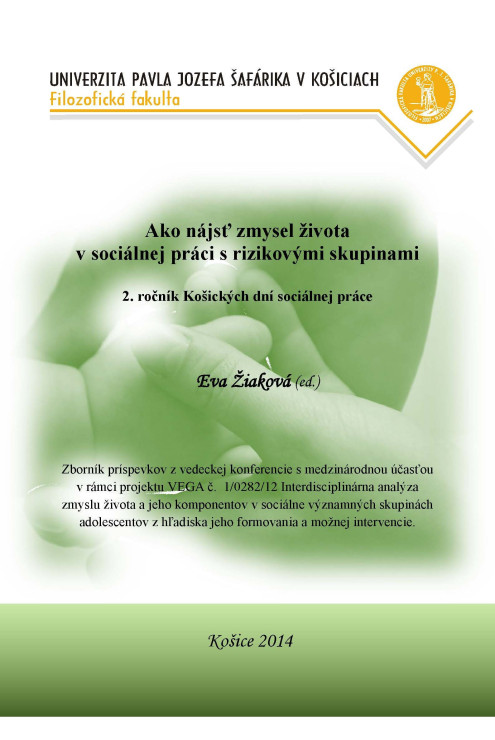
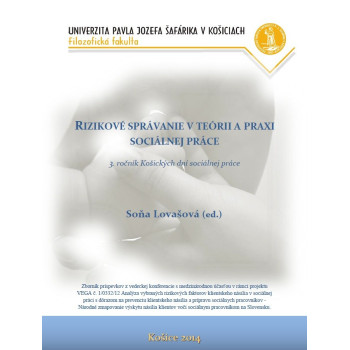
Ako nájsť zmysel života v sociálnej práci s rizikovými skupinami (2. ročník Košických dní sociálnej práce)

E-book

Eva Žiaková (ed.)

Proceedings of the Scientific Conference with International Participation within the VEGA Project No. 1/0282/12 Interdisciplinary Analysis of the Meaning of Life and Its Components in Socially Significant Groups of Adolescents in Terms of Its Formation and Possible Intervention.

The introductory word is a very good opportunity for us to jointly evaluate what we have managed to achieve in addressing our common scientific research task focused on the study of the meaning of life in socially at-risk groups of adolescents. First and foremost, we asked ourselves what we have discovered about the meaning of life so far, that is, what we know about it.

The second question we asked was: what surprised us about the results we have obtained so far. The third question was about what we want to do to resolve the discrepancy between what we have discovered and what we want to achieve.

The final question in evaluating the solution of the scientific research task was: what do we (not) know about the meaning of life of adolescents and want to know in the future, or what should we focus on to develop the most effective logotherapeutic and sociotherapeutic methods for social workers working with socially at-risk groups of adolescents.

Download the e-book for free (pdf)

Quantity

978-80-8152-140-9

Data sheet

Method of publication:
E-book (pdf)
Editor:
Eva Žiaková
Document type:
Proceedings
Number of pages:
349
Available from:
30.04.2014
Year of publication:
2014
Edition:
1st edition
Publication language:
slovenčina, angličtina
Faculty:
Faculty of Arts
Note:
Zborník vychádza rámci projektu VEGA č. 1/0282/12 Interdisciplinárna analýza zmyslu života a jeho komponentov v sociálne významných skupinách adolescentov z hľadiska jeho formovania a možnej intervencie.
- Free for download

16 other products in the same category:

VARIA XXXI

VARIA XXXI

E-book

Lucia Jasinská

Tradícia organizovania kolokvií na Slovensku už štandardne prináleží vždy inému akademickému slovakistickému pracovisku. Jeho XXXI. ročník sa realizoval pod organizačnou taktovkou Katedry slovakistiky, slovanských filológií a komunikácie Filozofickej fakulty UPJŠ v Košiciach, ako aj košickej pobočky Slovenskej jazykovednej spoločnosti a Slovenskej jazykovednej spoločnosti pri Jazykovednom ústave Ľ. Štúra SAV, v. v.i. V univerzitných priestoroch Učebno-výcvikového zariadenia Danišovce sa počasdvojdňového podujatia stretli nádejní mladí jazykovedci nielen zo Slovenska, ale aj z Českej republiky. Výstupom kolokvia mladých jazykovedcov býva najprv zborník abstraktov, publikovaný už v čase realizovania podujatia, a neskôr zborník príspevkov ako pripomienka tejto udalosti a tiež ako odraz vedeckých záujmov mladých lingvistov. Kolokvialisti prezentovali svoje príspevky venované výskumným problémom z rôznych oblastí jazykovedy, a to z oblasti korpusovej lingvistiky, onomastiky, morfológie, dialektológie, syntaxe, štylistiky, lexikológie, frazeológie aj didaktiky, niektorí dokonca s presahom do literárnych textov.

Download e-book for free(pdf)

Prípadové štúdie a cvičenia z pedagogickej psychológie

Prípadové štúdie a cvičenia z pedagogickej...

E-book

E-book

Margita Mesárošová - Miroslava Köverová - Radka Miháliková

The publication is a follow-up to the university textbook Progress in Educational Psychology. It is intended for both bachelor and master degree students.

It contains questions, tasks, practical exercises, case studies and topics for discussion in the field of educational psychology.

The aim of the publication is to support the active involvement of students in teaching, consolidation and deepening of their theoretical knowledge in educational psychology, as well as practicing and improving practical skills.

Download e-book for free (pdf)

Heidegger a grécka filozofia

Heidegger a grécka filozofia

E-book

E-kniha

Vladimír Leško - Katarína Mayerová (eds.)


The main aim of the present work is to try to capture the decisive mode of Heidegger's philosophical understanding of the central problem of Greek philosophy, the problem of being, in the teachings of Anaximander, Heracleitus, Parmenides, Plato, and Aristotle. The authors of each section present their own understanding of Heidegger and his distinctive philosophical reception of Greek philosophy. In this context, it should be noted that the authors themselves sought their own point of view. With Heidegger's work in general, it is almost impossible to find the same interpretive consonance. This is also true for his reception of the Greek heritage. However, it is all the more professionally provoking for further philosophical investigations.

Download the e-book for free (pdf)

Heidegger – Nietzsche (problém interpretácie)

Heidegger – Nietzsche (problém interpretácie)

E-book

E-book

Štefan Jusko

The stimulus for this monograph was my two studies on Heidegger’s interpretation of Nietzsche’s ideas of the will to power and eternal return of the same, published in Heidegger and Modern Metaphysics (supported by the Slovak Research and Development Agency, APVV-14-0706, under the leadership of V. Leška and M. Sobotka). In the submitted monograph, I present both studies in expanded (particularly “Will to Power as Art”) and refined versions (“Eternal Return of the Same”) and add a third chapter addressing the question of the meaning of interpreting philosophical texts, which themselves are interpretations of other texts.

In seeking an appropriate approach to the meaning of interpretation, I conclude that—generally—the purpose of interpretation is to uncover the productive dimension of the interpreted text, which can only be revealed if the interpreter enters the text openly and as neutrally as possible. If the interpreter does not open themselves to the text, allowing it to interpret them in turn, interpretation remains trapped. I believe that without mutual openness between interpreter and interpreted, interpretation has no meaning and typically becomes either rejection or misinterpretation—a form of violence.

In the third chapter, which I consider foundational, I attempt to “balance” the interpretive context of “Heidegger–Nietzsche” from the first two chapters through a reversible context of “Nietzsche–Heidegger,” albeit with the risk that my interpretation of Nietzsche’s thought—specifically his ideas of eternal return and will to power—may remain subjective, even if unintended as misinterpretation. Ultimately, the ambition of the third chapter is to explore intersections between the two philosophers, one of which—a rudimentary yet significant overlap—I identify as Heidegger’s concept of being-in-the-world, reinterpreted through Nietzsche’s lens. It is Nietzsche who challenges us to adopt a self-defined stance toward the world, to confront what it means to be in the world.

The challenge for me—and perhaps the reader—is to remain faithful to oneself, which is only possible by persisting in the context of mutual interpretation between interpreter and interpreted, regardless of who/what is interpreting or being interpreted. For the context of being-in-the-world is always co-created by both sides.

Download the e-book for free  (pdf)

Pavol Jozef Šafárik v kontinuite

Pavol Jozef Šafárik v kontinuite

E-book

E-book

Marianna SedlákováMarián Gladiš (eds.)

The content of the book publication Pavol Jozef Šafárik in Continuity consists of contributions from two events organized by the Department of Slovak Studies, Slavic Philologies, and Communication at the Faculty of Arts of Pavol Jozef Šafárik University in Košice during its short existence.

The first event was a scientific seminar held on the occasion of the 150th anniversary of the death of P. J. Šafárik, titled Pavol Jozef Šafárik – Scientist and Artist, which took place on January 27–28, 2012, in Košice and Kobeliarovo. The second event was an internal scientific seminar on the occasion of the 220th anniversary of Šafárik’s birth, held on December 15, 2015, under the title In the Quiet Home Circle. Symbolically—beginning with death and ending with birth (thus indicating the living continuity of Šafárik’s research legacy)—we aim to continue the study of Pavol Jozef Šafárik’s scientific work and increasingly involve the youngest generation of researchers (represented by doctoral students of the department in the field of literary studies). This is despite the fact that the literature on the life and work of this scholar and poet, who stood at the birth of Slavic studies, is very rich, and most of his works have already been scientifically analyzed. However, it appears that even seemingly outdated views of Šafárik still deserve scientific attention in the new context of humanities and natural sciences, as can be read in the contributions published in this volume.

Through the continuous publication of the Collected Works of Pavol Jozef Šafárik, both mentioned seminars, and the publication of this volume, the Faculty of Arts of Pavol Jozef Šafárik University in Košice has continued the activities of the Prešov Faculty of Arts from the time before its separation from the union of faculties of Pavol Jozef Šafárik University in Košice in 1997. The selection and arrangement of contributions in the volume symbolize the "passing of the baton" in research and publishing activities related to Pavol Jozef Šafárik—a scientific personality of global stature, who in 1959 gave his name to our university.

Compiled by the editors.

Download the e-book for free  (pdf)

Občianstvo a občianska spoločnosť (Stav - Kontexty - Perspektívy)

Občianstvo a občianska spoločnosť (Stav -...

E-book

E-book

Gabriel Eštok - Renáta Bzdilová - Jakub Bardovič

Proceedings of the 4th Annual Scientific Conference of Students and Young Scholars, held on May 14 and 15, 2015, by the Department of Political Science, Faculty of Arts, Pavol Jozef Šafárik University in Košice, in cooperation with the civic association Res Publica, are part of the project VVGS-2014-214. Title: The Electoral Census in the 21st Century.

This proceedings volume is the result of the fourth conference of its kind, which provides a platform for the young scientific community to meet and discuss political issues of the Slovak Republic as well as the international political scene. Once again, it can be stated that the discussion was stimulating and of a high qualitative level. The selection of topics reflects the interests of the young scientific community.

The resulting publication discusses and analyzes a wide range of diverse problems and issues that the young scientific community in Central Europe addresses in connection with citizenship and civil society. Topics such as civil society; the relationship between citizen and state; the hypersocial networked society; the potential of civil society in reducing corruption in public administration under the conditions of the Slovak Republic; barriers to political participation-the electoral census and its historical context in Slovak conditions; dual citizenship; protection of human rights in a democratic society; motherhood; the position of women in Islam or the status of Jewish women; protection of victims of crime; women in revolutions or the role of women’s civic associations in the context of the Ukrainian crisis; Chinese interests in the Arctic or the issue of labor camps and human rights violations-all enrich this publication with perspectives and analyses from young people with strong scientific potential.

Our common goal is to stimulate interest in the study of a wide range of societal issues and to contribute our perspectives to attempts at solving the topics raised.

Download the e-book for free(pdf)

Truth vs. Post-Truth. „It is not true, but it could be.”

Truth vs. Post-Truth. „It is not true, but it...

E-book

E-book

Michaela Ružičková - Patrik Furik - Lukáš Jakabovič (eds.)

The collection of articles from the XI. International Scientific Conference for Students and Young Scientists, organized by the Department of Political Science of the Faculty of Arts of the Pavol Jozef Šafárik University in Košice, in cooperation with the Res Publica Civic Association, the Department of Security Studies of the Faculty of Political Science and International Relations of the Matej Bel University in Banská Bystrica, Institute of Political Sciences and Administration, Faculty of Political Science and Journalism, Marie Curie-Sklodowska University in Lublin, Institute of Social Studies, Faculty of Regional Development and International Studies, Mendel University in Brno, and the Department of Political Science, Faculty of Arts, University of Miskolc, held on 20 May 2022 in Košice.

The aim of this publication, entitled Truth vs. Post-Truth. „It is not true, but it could be.”, is to highlight the threats arising from the issue of the spread of disinformation, conspiracies and hoaxes today, reflecting not only on the national context, but also on the impact of these elements in the international environment.

The proceedings consist of 12 articles written in Slovak and English. The individual contributions deal with selected topics and aspects of the spread of disinformation, conspiracy theories or hoaxes, among others in the context of elections, media landscape and politics.

The topics of the contributions are the limits of freedom of expression, media freedom and regulation in the media space, the issue of propaganda or information warfare. The present volume also includes papers focusing on issues in the field of political ideologies or the issue of false narratives about the COVID-19 disease.

Download the e-book for free  (pdf)

Slovensko-maďarské vzťahy v čase

Slovensko-maďarské vzťahy v čase

E-book

E-book

Ján Sabol ml., Lena Ivančová (eds.)

Zborník príspevkov z historicko-kulturologickej vedeckej konferencie konanej 7. mája 2024 v Košiciach

Zborník príspevkov z historicko-kulturologickej vedeckej konferencie Slovensko-maďarské vzťahy v čase pokrýva široké spektrum historických, kulturologických, literárnovedných, teatrologických, mediálnych, politických i sociálnych aspektov slovensko-maďarských vzťahov a poskytuje tak hlbší pohľad na ich vnútornú kontinuitu a dynamiku. Jednotlivé vedecké príspevky hodnotia vplyv histórie a vzájomnej koexistencie na divadlo, literatúru, film i ďalšie tvorivé prejavy. Zborník koncepčne vyzdvihuje dôležitosť interdisciplinárneho prístupu k štúdiu slovensko-maďarských vzťahov. Potvrdzuje význam dialógu a tvorivej spolupráce medzi národmi, kolektívmi, jednotlivcami.

Download e-book for free (pdf)

Gender perspectives in slovak literature of the late 19th and early 20th centuries (Interpretation Studies)

Gender perspectives in slovak literature of the...

E-book

E-book

Ivica Hajdučeková

The development of this bilingual coursebook evolved as part of project KEGA Nr. 020UPJŠ-4/2013 headed by prof. PhDr. Ján Gbúr, CSc., and emerged from earlier research which had successfully analysed realist and modernist Slovak literature from a gender perspective. Based on initial interpretations which drew from philosophical, sociological and historiographical approaches, we were able to anticipate the issues which could be raised in other texts and thus establish a hypothesis for the subsequent literaryscientific research. Our research has also been influenced by the continually evolving nature of gender studies, and we have therefore decided to adopt a somewhat unusual approach in this coursebook and briefly examine some contemporary texts thereby creating an intentional shift in our timeline. The modern works of Z.Kepplová and U. Kovalyk have raised a number of interesting issues, and a study of the interwar work of M. Urban reveals further interpretations on the basis of gender. After this brief overview, we return to the main focus of the study: gender approaches to Slovak literature of the late 19th and early 20th centuries.

The study focuses on the complexity of male-female relationships in the work of both male and female authors of realist and modernist literature at the end of the 19th and the beginning of the 20th century. Works by the founding generation of realism and late realism were analysed, with particular attention being paid to the fiction of M. Kukučín, J. Čajak, J. G. Tajovský, J. Jesenský, E. M. Šoltésová, T. Vansová, Ľ. Podjavorinská and B. S. Timrava. The works of H. Gregorová and Ľ. Groeblová were also studied as prime examples of Slovak literary modernism. 

We hope that this bilingual coursebook will allow realist and modernist Slovak fiction, and the Slovak national literary tradition in general, to receive wider critical renown beyond the borders of Slovakia and also to demonstrate its place in contemporary literary theory.

Download the e-book for free (pdf)

Pull and push factors of radicalization in the scope of helping professionals

Pull and push factors of radicalization in the...

E-book

E-book

Dušan Šlosár

The monograph offers an insight into radicalization pull and push factors, influencing which is the competence of helping professionals.Radicalization is conditioned by the current social, economic, cultural and political context, i.e. the time-space in which radicalization occurs.It is this fact that directs the content of the monograph to factors that can be considered triggering and influencing factors of radicalization processes as well as radicalization itself.

The monograph systematizes knowledge about radicalization from the point of view of pull and push factors, which have been identified as factors of radicalization in professional literature, research reports and other verified sources, including Internet resources focused on radicalization and processes of radicalization, as well as available interventions to influence or prevent radicalization.The monograph mainly focuses on the analysis of pull and push factors that are related to radicalization and radicalization processes.

The monograph offers the results of research carried out through qualitative methodology.The research focused on issues related to radicalization in the research sample consisting of radicalized and non-radicalized respondents.The research focused on the investigation of pull and push factors related to radicalization, which can occur in the family, school or work environment, among peers, in the wider social environment related to the social and political climate in society and the influence of mass media.

Download the e-book for free (pdf)

Evolučná etika – vybrané problémy a výzvy

Evolučná etika – vybrané problémy a výzvy

E-book

E-book

Ľubov Vladyková

The present monograph titled Evolutionary Ethics: Selected Issues and Challenges discusses a range of problems, theoretical concepts, and beliefs from the perspective of evolutionary ethics. The term evolution has become one of the central terms in contemporary science and philosophy.

In social sciences in general, and in socio-biology and evolutionary psychology in particular, evolution has had great impact on our understanding of the genesis of culture. Evolutionary theories play a similar role within the theory of consciousness and of the mind (evolutionary epistemology). The interrelation between our evolutionary past and our sense of good and evil is also a subject of heightened interest in ethics; it has in fact become one of its challenges. The concept of evolution challenges the way we create thought patterns through which we understand, or hope to understand, ourselves and the world around us.

This monograph represents a general summary of selected issues in evolutionary ethics, touching upon various aspects of current research into evolutionary ethics and the related domains of evolution, science, ethics, and morals. Evolutionary ethics has become a project which presupposes that in order to understand the essence and basis of morals one must turn to the process of evolution of thought, and to the theories put forth by evolutionists, specifically evolutionary biologists.

The structure of this monograph, as well as its potential usefulness for research and education clearly show that the analysis of the problems discussed here has significant implications for domains far removed from the purely theoretical parts of moral philosophy or biology. The advantage of such discourse is that it enables the implementation of evolutionary ethics in social and ethical issues of public interest (for example Sex Literacy, Sex Education), and this should be recognised and welcome.

Download the e-book for free (pdf)

Participáciou k zmene: Možnosti a príklady využitia metódy PhotoVoice v sociálnej práci s ľuďmi so zdravotným znevýhodnením

Participáciou k zmene: Možnosti a príklady...

E-book

E-publication

Lucia Tóthová

The monograph offers a comprehensive perspective on the theoretical, methodological, and empirical dimensions of participatory visual research within the field of social work. It is grounded in the understanding that social work plays a crucial role in amplifying the voices of vulnerable groups and promoting social justice, with particular attention paid to persons with disabilities who frequently encounter limited opportunities for participation as well as persistent social, communicative, and environmental barriers. The author analyses the concept of participation in alignment with the principle of “Nothing about us without us” and presents the PhotoVoice method as an interdisciplinary tool that integrates participatory action research, critical pedagogy, feminist epistemologies, and documentary photography. The method is understood not only as a research technique but also as a form of visual advocacy, enabling participants to articulate their experiences, needs, and perspectives in ways accessible to both professional audiences and the wider public. The monograph reflects on the development of PhotoVoice in international scholarship and highlights its potential to transcend traditional academic boundaries toward participatory and transformative practice in social work. The empirical section comprises three projects conducted by the author in the Slovak context, focusing on diverse groups of persons with disabilities and their families, who face specific social needs and everyday barriers. The findings demonstrate the potential of PhotoVoice to strengthen participation through accessible and meaningful visual tools. The monograph also addresses methodological, ethical, and terminological considerations and adopts an inclusive understanding of disability consistent with contemporary approaches in social work.

Download the e-book for free

Prvý dotyk so slobodou. Sprítomňovanie minulosti na príklade Nežnej revolúcie z novembra ‘89

Prvý dotyk so slobodou. Sprítomňovanie...

E-book

E-book

Mikuláš JančuraAlžbeta Śnieżko   

In connection with the 30th anniversary of the Velvet Revolution, which was commemorated in the Czech Republic and Slovakia in 2019, an interactive exhibition titled "First Touch of Freedom" was organized under the auspices of Košice Self-Governing Region in collaboration with Ján Bocatius Public Library in Košice, Pavol Jozef Šafárik University in Košice, Nation's Memory Institute, and Slovak Radio and Television. The exhibition took place at Ján Bocatius Public Library and aimed to recall November's events from 1989 while emphasizing its cultural-social dimension and impact.

Conceptually, it focused on developing five dimensions of historical consciousness—a concept mainly developed in contemporary subject-specific didactics for history—namely identity, historicity, memory, spatial awareness, and temporal awareness.

Download the e-book for free (pdf)

Self-reflection teaching diary

Self-reflection teaching diary

E-book

E-book

Renáta OrosováKatarína PetríkováLucia Diheneščíková

Based on the analysis of self-reflection competences in future teachers, opinions of the mentor teachers and their recommendations and the set of pupil-oriented and educational process-oriented competences, a protocol for using self-reflection methods has been created. More precisely, it is a self-reflection teaching diary. It is an innovative method of self-reflection competence development in teaching students in their practical specialized preparation, particularly the self-reflective observation practice and conversation.

The Self-Reflection Teaching Diary is the outcome of the VVGS “Innovation in self-reflection competence development teaching methods in the practical specialized training of future teachers” grant project solving. It is an innovative and creative text-based tool not only for teaching students but also for university teachers specializing in their practical preparation as well as mentor teachers in primary and secondary schools. Its English version can be used by teaching students on their study stays abroad. It is also a transparent and unified tool in the practical preparation of future teachers aiming at the development of their self-reflection competences.

Download the e-book for free (pdf)

Probácia v systéme trestnej politiky a sociálnej práce

Probácia v systéme trestnej politiky a...

E-book

E-book

Vladimír LichnerDušan Šlosár

Issues of punishment are directly linked to a state’s criminal policy, which is an inseparable part of its social policy. Historically, the state has held a unique dominant position in the realm of punishment. Once the conditions for imposing a penalty are met, the state fulfills its obligation by sentencing through independent courts. However, it does not address questions of satisfaction, which belong to the victim. The victim may be a specific physical person or legal entity that suffered harm due to the criminal act. This harm simultaneously affects civil society as a whole. The state prioritizes its duty to punish and decide on the matter over compensating the harmed individual or civil society.

By mediation in criminal cases, we mean extrajudicial facilitation of resolving disputes between the offender and the harmed party, with the assistance and personal participation of a mediator. The mediator, as an independent and impartial person, helps parties identify their interests and supports them in finding shared, practical, and realistic solutions to the points causing their conflict. Probation refers to monitoring, supervising the accused, defendant, or convicted individual, as well as providing individual assistance to the offender and encouraging them to lead a lawful life. This reduces the risk of recidivism, or repeated criminal behavior.

Download the e-book for free (pdf)

Edukácia, roč. 6, č. 2/2023

Edukácia, roč. 6, č. 2/2023

E-book

E-journal

Renáta Orosová (výkonný redaktor)

Vedecko-odborný časopis Edukácia je zameraný na problematiku vzdelávania a výchovy v oblasti základného, stredného a vysokého školstva. Zreteľ kladie na súčasný stav a perspektívy edukačnej praxe, aktuálne aspekty pregraduálnej prípravy učiteľov, sociálnej pedagogiky, špeciálnej pedagogiky, ako aj pedagogické a psychologické aspekty výchovy v základných výchovných inštitúciách z pohľadu širokej pedagogickej verejnosti. Je určený vedeckým pracovníkom, mladým vysokoškolským učiteľom, doktorandom, ako aj odborným a pedagogickým pracovníkom, s cieľom prezentovať trendy v edukácii a vyvolať diskusiu k aktuálnym otázkam prezentovaných oblastí výchovy a vzdelávania.

Download e-journal for free (pdf)

This website uses cookies to ensure you get the best experience on our website