Slovenčina



E-book
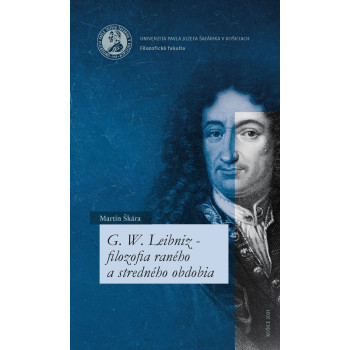
The presented university textbook is a reaction to two fundamental shortcomings. The first one is the absence of a similar, if not equivalent, textbook in the Slovak university environment. The second shortcoming is the mistake that Leibniz's philosophy is a system called monadology.
The presented textbook corrects this mistake and at the same time fills the gap of the absence of this kind of textbook with a Leibniz subject. For the above reasons, the presented textbook brings a new perspective on the philosophy of G. W. Leibniz, especially in the period of early philosophical beginnings with an overlap into the so-called Paris period and the De summa rerum period up to the first philosophical doctrinal formulation expressed in the Discours de métaphysique (Winter 1685-1686). The textbook is conceived as a selection of sections of source texts translated by the author of the textbook from French and partly from Latin and equipped with comments accessible to the target audience.
It is therefore the author's wish that this textbook not only serve as a form of correction for the misinterpretation of Leibniz's philosophy, but as an inspiring text that will introduce the reader to the world of Leibniz's philosophy in its undistorted light.
Download e-book for free (pdf)
Data sheet
E-book
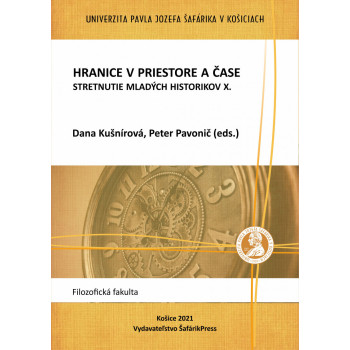
Dana Kušnírová - Peter Pavonič
Collection of Contributions from the Scientific Conference. Košice, November 18-19, 2020
The collection titled Borders in Space and Time consists of twelve contributions presented at the tenth edition of the doctoral conference Meeting of Young Historians, which is organized annually by the Department of History at the Faculty of Arts, UPJŠ in Košice. In 2020, we commemorated the centenary of the signing of the Trianon Peace Treaty, which definitively established the borders of Hungary, including those with Czechoslovakia, after World War I; therefore, the theme of the conference was chosen to be the history of borders. The individual contributions focus on the development of borders in the 20th century, borders in thought and education, and borders in earlier historical periods.
Download e-book for free (pdf)
E-book
With great interest, I read the proposal for the reissue of the monograph by Prof. PhDr. Ján Hvozdík, DrSc., Základy školskej psychológie (Foundations of School Psychology). It was an honor for me to be part of the editorial board for the new edition of the textbook.
The reissue comes at a time when school psychology seems to be experiencing a renaissance in its application. This is no coincidence, as the professor’s conception of school psychology as a theoretical-applied and integrated psychological discipline strives not only directly but also indirectly, through the pedagogical practice of teachers, to influence specific situations in educational practice within the school environment. From my perspective, I also appreciate the attention given in the textbook to the ever-relevant topic of self-directed learning, that is, the autodidactics of pupils and students. School psychology has become a core subject, within which its specializations are also realized.
It is worth mentioning the fact that, under the conditions of totalitarianism, the professor was not a member of the Communist Party of Czechoslovakia, and yet he made significant contributions to the development of school counseling, both in theory and in practice, which commands respect and admiration. The reissue of the textbook is not an apology but rather a celebration of his positive contributions.
prof. PhDr. Ján Grác, DrSc.
E-book
Eva Žiaková (ed.)
Proceedings of the Scientific Conference with International Participation within the VEGA Project No. 1/0282/12 Interdisciplinary Analysis of the Meaning of Life and Its Components in Socially Significant Groups of Adolescents in Terms of Its Formation and Possible Intervention.
The introductory word is a very good opportunity for us to jointly evaluate what we have managed to achieve in addressing our common scientific research task focused on the study of the meaning of life in socially at-risk groups of adolescents. First and foremost, we asked ourselves what we have discovered about the meaning of life so far, that is, what we know about it.
The second question we asked was: what surprised us about the results we have obtained so far. The third question was about what we want to do to resolve the discrepancy between what we have discovered and what we want to achieve.
The final question in evaluating the solution of the scientific research task was: what do we (not) know about the meaning of life of adolescents and want to know in the future, or what should we focus on to develop the most effective logotherapeutic and sociotherapeutic methods for social workers working with socially at-risk groups of adolescents.
E-book
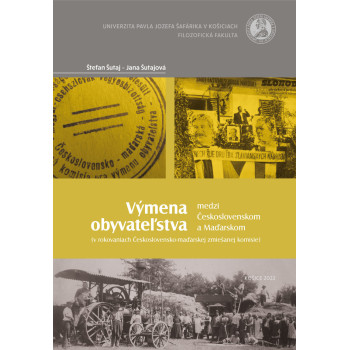
The population exchange between Czechoslovakia and Hungary was carried out on the basis of the Agreement on the Exchange of Populations between Czechoslovakia and Hungary, which was signed on February 27, 1946. Its adoption was not only part of Czechoslovak solutions to the status of national minorities, but also part of the strategic concept of building a state of Czechs and Slovaks without Germans and Hungarians.
The agreement was part of the postwar resolution of mutual disputes and misunderstandings and was intended to be one of the solutions that, in the postwar period, would eliminate a factor which, according to Czechoslovak political leaders, had caused the war conflict.
The population exchange between Czechoslovakia and Hungary was therefore not an isolated historical event, but part of migratory movements that had begun in Europe already after the First World War, and can be seen as a continuation of previous developments as part of migration patterns in Europe.
Download e-book for free (pdf)