Slovenčina


E-book
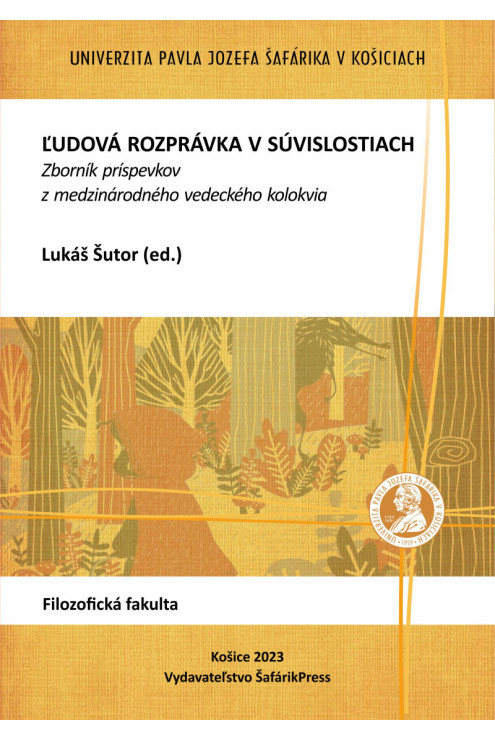
Proceedings from the International Scientific Colloquium "The Folk Tale in Contexts" (December 12, 2022, in Košice)
We present the proceedings "The Folk Tale in Contexts" to the professional public as the outcome of the eponymous international scientific colloquium, which took place on December 12, 2022. Our aim was, among other things, to open a discussion on verbal folklore in broader interpretative, transcultural, and ultimately also interdisciplinary contexts—a goal that was achieved especially in the latter respect. Although the contributors primarily work in the fields of folklore studies and literary science, their methodological approaches from other—sometimes even more distant—disciplines expand the current discourse to a remarkable breadth. This is proof that research on the folk tale remains vibrant and open to new challenges.
Download e-book for free (pdf)

Data sheet
E-book
Magdaléna Halachová - Vladimír Lichner - Katarína Šiňanská (eds.)
Proceedings of Contributions from the Scientific Conference Held on April 25, 2013, in Košice
The proceedings of contributions from the scientific conference were created as part of the national round of the Student Scientific and Professional Activities event in the field of study 3.1.14 Social Work, which took place on April 25, 2013, in Košice.
The central theme of the proceedings focuses on addressing various problem areas within social work as both an academic discipline and a practical activity. These contributions were prepared by students and young researchers under the guidance of experienced professionals. The topics covered in the proceedings include issues such as social services, field social work, school social work, and similar areas. Additionally, they highlight the dangers of socio-pathological phenomena such as truancy, drug addiction, poverty, bullying, and more.
The presented results clearly demonstrate the importance of social work and other helping professions in working with specific client groups.
E-book
Mária Fedorčáková - Miriama Filčáková (eds.)
Proceedings of the 12th Scientific Conference of Young Historians, organized by the Department of History of the Faculty of Arts at Pavol Jozef Šafárik University in Košice in cooperation with the State Archive in Košice and the Slovak Historical Society at the Slovak Academy of Sciences on October 12, 2022
The theme of the conference proceedings is the issue of sources, their interpretation and use of current digital technologies in their research and access. The proceedings constit of 7 papers by authors working in Slovak and Czech universities.
The digitisation of seals is the subject of the paper by Barbora Borůvková. Michael Dudzik deals with the problem of building the road network in modern France and written and cartographic sources. Trends of digitization in Slovak archives and their perception by researchers are elaborated by in Miriama Fialkovičová´s study. Miriama Filčáková dealt with sources on the history of tertiary education in Košice in connection with the establishment of the UPJŠ. The possibilities of researching sources on the electrification of Slovakia are dealt with in the study by Dominik Hrtus. Ondrej Šály in his paper treated the letters of serfs in the 18th century as a source for economic history. Vavrinec Žeňuch discusses the possibilities of researching the eclesiastical history of the Uh county in the modern period.
Download e-book for free (pdf)
E-book
Miroslava Köverová - Simona Ďurbisová (eds.)
Proceedings present abstracts of contributions registered for the scientific conference Work and Organizational Psychology 2023. Conference date and venue: 8-9 June 2023, Department of Psychology, Faculty od Arts, Pavol Jozef Šafárik University in Košice.