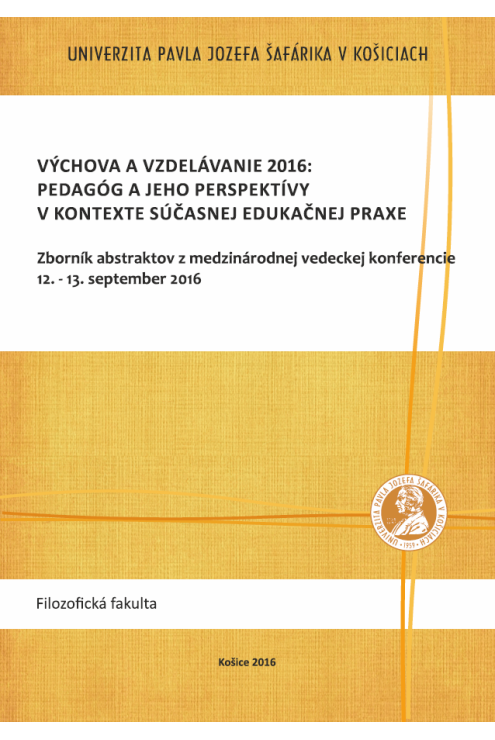
Výchova a vzdelávanie 2016: Pedagóg a jeho perspektívy v kontexte súčasnej edukačnej praxe

E-book

Renáta Orosová - Zuzana Boberová - Emília Marcinová (eds.)

Proceedings of Abstracts from the International Scientific Conference, 12–13 September 2016

The international scientific conference is focused on issues of education and upbringing within primary, secondary, and higher education, as well as school institutions, from the perspective of the educator. Emphasis is placed on the current state and prospects of educators in educational practice, pedagogical and sociological aspects of upbringing in fundamental educational and upbringing institutions, as well as current aspects of pre-service teacher training.

The conference is intended for researchers, young university teachers, doctoral students, as well as professional and pedagogical staff, with the aim of presenting the educator-teacher, social pedagogue, and special pedagogue-from a contemporary perspective, highlighting their essential cooperation in relation to education, and stimulating discussion on current issues in the presented areas of upbringing and education within the context of the present situation in the school system.

Download the e-book for free (pdf)

Quantity

978-80-8152-434-9

Data sheet

Method of publication:
E-book (pdf)
Editors:
Renáta Orosová - Zuzana Boberová - Emília Marcinová
Document type:
Book of abstracts
Number of pages:
116
Available from:
01.09.2016
Year of publication:
2016
Edition:
1st edition
Publication language:
Slovak
Faculty:
Faculty of Arts
- Free for download

4 other products in the same category:

Research Into Correlations Between Deformations of Political Awareness...

Research Into Correlations Between Deformations...

E-book

E-book

Marcela Gbúrová - Daniel Dobiaš - Jana Šutajová - Gabriel Eštok - Ján Ruman - Tomáš Dvorský

Research Into Correlations Between Deformations of Political Awareness and the Increase of Political Extremism Among Secondary School Students in the Košice Self-governing Region and the Prešov.

Self-governing Region The issue of political extremism has a relatively long research period, and it should be emphasised that, especially in the recent period, it has received increased attention in the political science community not just in Slovakia but also abroad. Given the specifics of this anti-democratic form of political discourse, which has not only explicit forms, but also highly sophisticated manifestations against democracy (extremism of the centre, or centrist extremism), it is also addressed by experts of other humanities and social disciplines: history, psychology, anthropology, sociology, etc.

The common interest of this professional community is both to analyse different forms of extremist discourses and narratives, to search for national specificities of extremism that are anchored in their historical, social and cultural contexts, but at the same time to reveal transnational extremist influences within a globalizing world and to propose evidence-based strategies to counter extremist discourses.

Download e-book for free (pdf)

Občianstvo a občianska spoločnosť (Stav - Kontexty - Perspektívy)

Občianstvo a občianska spoločnosť (Stav -...

E-book

E-book

Gabriel Eštok - Renáta Bzdilová - Jakub Bardovič

Proceedings of the 4th Annual Scientific Conference of Students and Young Scholars, held on May 14 and 15, 2015, by the Department of Political Science, Faculty of Arts, Pavol Jozef Šafárik University in Košice, in cooperation with the civic association Res Publica, are part of the project VVGS-2014-214. Title: The Electoral Census in the 21st Century.

This proceedings volume is the result of the fourth conference of its kind, which provides a platform for the young scientific community to meet and discuss political issues of the Slovak Republic as well as the international political scene. Once again, it can be stated that the discussion was stimulating and of a high qualitative level. The selection of topics reflects the interests of the young scientific community.

The resulting publication discusses and analyzes a wide range of diverse problems and issues that the young scientific community in Central Europe addresses in connection with citizenship and civil society. Topics such as civil society; the relationship between citizen and state; the hypersocial networked society; the potential of civil society in reducing corruption in public administration under the conditions of the Slovak Republic; barriers to political participation-the electoral census and its historical context in Slovak conditions; dual citizenship; protection of human rights in a democratic society; motherhood; the position of women in Islam or the status of Jewish women; protection of victims of crime; women in revolutions or the role of women’s civic associations in the context of the Ukrainian crisis; Chinese interests in the Arctic or the issue of labor camps and human rights violations-all enrich this publication with perspectives and analyses from young people with strong scientific potential.

Our common goal is to stimulate interest in the study of a wide range of societal issues and to contribute our perspectives to attempts at solving the topics raised.

Download the e-book for free(pdf)

Poznanie, spoločnosť, dejiny. Stretnutie mladých historikov XI.

Poznanie, spoločnosť, dejiny. Stretnutie...

E-book

E-book

Miriama Filčáková (ed.)

Proceedings of the 11th Scientific Conference of Young Historians, organized by the Department of History at the Faculty of Arts, Pavol Jozef Šafárik University in Košice, in cooperation with the Slovak Historical Society at the Slovak Academy of Sciences, on October 19-20, 2021.

Currently, these histories are often presented as an extension of the history of science. The history of knowledge not only expands the boundaries of the history of science but also explores the boundaries between different forms of knowledge and ignorance. Just as studies of historical memory have expanded and complemented their interest in researching forgetting, the history of knowledge includes studies of ignorance. They focus on the change that has occurred over the past decades: from the sacralization of science and respect for professional knowledge to the rejection of science and constant questioning of professional knowledge, to which the history of knowledge must also respond. Findings as a product form the basis of human interactions and have their own past. What was the significance of knowledge and cognition in different historical periods? How did state power influence the development of knowledge and cognition? What can be considered knowledge in a particular historical era or culture? Finally, is there any human activity that cannot be considered knowledge?

Currently, in the field of the history of knowledge, a significant surge in research, publishing, and the emergence of new institutions can be observed. The eleventh doctoral conference—Meeting of Young Historians XI, organized by the Department of History at Pavol Jozef Šafárik University in cooperation with the Slovak Historical Society at the Slovak Academy of Sciences—will contribute to expanding the perspective on the past of knowledge and cognition. The conference, intended for Slovak and foreign doctoral students, aims to provide a space for presenting the latest results of scientific research, professional discussion, establishing contacts, developing cooperation, and exchanging experiences among the broader historical community. The starting point for the conference is a peer-reviewed proceedings volume consisting of publication outputs from active participants.

Download the e-book for free  (pdf)

VARIA XXXI

VARIA XXXI

E-book

Lucia Jasinská

Tradícia organizovania kolokvií na Slovensku už štandardne prináleží vždy inému akademickému slovakistickému pracovisku. Jeho XXXI. ročník sa realizoval pod organizačnou taktovkou Katedry slovakistiky, slovanských filológií a komunikácie Filozofickej fakulty UPJŠ v Košiciach, ako aj košickej pobočky Slovenskej jazykovednej spoločnosti a Slovenskej jazykovednej spoločnosti pri Jazykovednom ústave Ľ. Štúra SAV, v. v.i. V univerzitných priestoroch Učebno-výcvikového zariadenia Danišovce sa počasdvojdňového podujatia stretli nádejní mladí jazykovedci nielen zo Slovenska, ale aj z Českej republiky. Výstupom kolokvia mladých jazykovedcov býva najprv zborník abstraktov, publikovaný už v čase realizovania podujatia, a neskôr zborník príspevkov ako pripomienka tejto udalosti a tiež ako odraz vedeckých záujmov mladých lingvistov. Kolokvialisti prezentovali svoje príspevky venované výskumným problémom z rôznych oblastí jazykovedy, a to z oblasti korpusovej lingvistiky, onomastiky, morfológie, dialektológie, syntaxe, štylistiky, lexikológie, frazeológie aj didaktiky, niektorí dokonca s presahom do literárnych textov.

Download e-book for free(pdf)

This website uses cookies to ensure you get the best experience on our website