Slovenčina



E-book
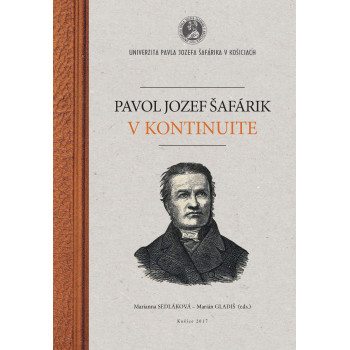
Marianna Sedláková - Marián Gladiš (eds.)
The content of the book publication Pavol Jozef Šafárik in Continuity consists of contributions from two events organized by the Department of Slovak Studies, Slavic Philologies, and Communication at the Faculty of Arts of Pavol Jozef Šafárik University in Košice during its short existence.
The first event was a scientific seminar held on the occasion of the 150th anniversary of the death of P. J. Šafárik, titled Pavol Jozef Šafárik – Scientist and Artist, which took place on January 27–28, 2012, in Košice and Kobeliarovo. The second event was an internal scientific seminar on the occasion of the 220th anniversary of Šafárik’s birth, held on December 15, 2015, under the title In the Quiet Home Circle. Symbolically—beginning with death and ending with birth (thus indicating the living continuity of Šafárik’s research legacy)—we aim to continue the study of Pavol Jozef Šafárik’s scientific work and increasingly involve the youngest generation of researchers (represented by doctoral students of the department in the field of literary studies). This is despite the fact that the literature on the life and work of this scholar and poet, who stood at the birth of Slavic studies, is very rich, and most of his works have already been scientifically analyzed. However, it appears that even seemingly outdated views of Šafárik still deserve scientific attention in the new context of humanities and natural sciences, as can be read in the contributions published in this volume.
Through the continuous publication of the Collected Works of Pavol Jozef Šafárik, both mentioned seminars, and the publication of this volume, the Faculty of Arts of Pavol Jozef Šafárik University in Košice has continued the activities of the Prešov Faculty of Arts from the time before its separation from the union of faculties of Pavol Jozef Šafárik University in Košice in 1997. The selection and arrangement of contributions in the volume symbolize the "passing of the baton" in research and publishing activities related to Pavol Jozef Šafárik—a scientific personality of global stature, who in 1959 gave his name to our university.
Compiled by the editors.
Data sheet
E-book
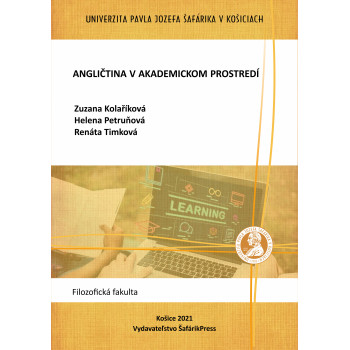
Zuzana Kolaříková - Helena Petruňová - Renáta Timková
English in the Academic Environment is intended primarily for those interested in improving their academic English and is primarily designed to fulfill the needs of university students and teachers who use English in their studies, in their work activities, and in their communication with foreign colleagues and professionals.
The publication offers selected phrases and sentence structures from the field of academic English, gives practical examples of the use of nominal, verbal and prepositional phrases, free and established collocations, idiomatic expressions, including translations of some selected phrases. It also highlights some common mistakes in the use of English in an academic environment, which are a manifestation of incorrect or insufficiently acquired linguistic resources and, last but not least, a consequence of the linguistic influence of Slovak.
E-book
Lukáš Šutor (ed.)
The current sixth volume of the Doctoral Miscellanea consists of eight contributions from four study programs, with two contributions also involving authors outside of doctoral studies. Given the limitations on the length of individual contributions and the uniqueness of the research, the authors have chosen varying widths and depths in presenting their dissertation topics. Some contributions serve as an introduction to the issues, others provide a summary of previous results, and still others focus on a detailed analysis of a specific problem. These three approaches may not only reveal the stage of research in which the doctoral candidate finds themselves but also their potential research priorities.
The main commonality across all issues of the proceedings remains interdisciplinary diversity, which shows a certain continuity. Specific themes appear regularly. In these cases, alongside alternating doctoral candidates, the key figure is the supervisor (in the role of co-author) and their research focus/project in which the doctoral candidates participate. This development of research continuity is particularly evident in contributions from the field of social work.
Renáta Orosová (výkonný redaktor)
Vedecký recenzovaný časopis Edukácia je zameraný na problematiku vzdelávania a výchovy v oblasti základného, stredného a vysokého školstva. Zreteľ kladie na súčasný stav a perspektívy edukačnej praxe, aktuálne aspekty pregraduálnej prípravy učiteľov, sociálnej pedagogiky, špeciálnej pedagogiky, ako aj pedagogické a psychologické aspekty výchovy v základných výchovných inštitúciách z pohľadu širokej pedagogickej verejnosti. Je určený vedeckým pracovníkom, mladým vysokoškolským učiteľom, doktorandom, ako aj odborným a pedagogickým pracovníkom s cieľom prezentovať trendy v edukácii a vyvolať diskusiu k aktuálnym otázkam prezentovaných oblastí výchovy a vzdelávania.
Ciele vedeckého časopisu Edukácia:
E-book
Dušan Šlosár - Vladimír Lichner
This university textbook aims to provide readers with knowledge of the philosophical foundations, meaning, and purpose of mediation, based on research and analysis of mediators' activities. In countries where mediation services operate, their staff often include graduates of social work departments.
An individual approach to both the perpetrator and victim of a criminal offense requires knowledge and skills from social work, psychology, sociology, communication, and related fields tied to social work. The principles of social work apply not only in social policy and social care but also in justice. A mediator’s mission is to facilitate alternative resolutions to unlawful acts while preserving the purpose of legal proceedings as defined by valid legal norms. They fulfill this mission through specific methods of individual social work applied in the justice sector. The mediator’s focus extends beyond the current conflict to uncover related issues, activate parties to resolve disputes, and prevent new conflicts.
Special attention is devoted to the philosophical foundations of mediation in Slovakia. We provide an overview of mediators’ core activities and mediation types used to uphold justice in Slovakia. We analyze mediation goals, the roles of parties involved, and procedural steps. In applying mediation, we explore its potential and implementation in both legal and social work contexts.
As indicated, mediation cannot be understood solely as a specialized activity in criminal justice, as it has broader applications in non-judicial dispute resolution, such as family or community work, which are often overlooked by the public. The mediator’s approach to diverse target groups is grounded in theoretical frameworks. From this foundation, we derive activities expected of mediators in the future. Expanded activities arise from concrete situations encountered during mediation.