Slovenčina




E-book
Vladimír Leško - Pavol Tholt (eds.)
Proceedings of the Third International Philosophical Conference Hegel in the Contexts of Heidegger's and Patoček's Philosophy, held on 1-2 October 2009.
The Philosophical Proceedings is a presentation of the results of the work of the research teams of the research projects VEGA 1/0650/08 - Heidegger and the History of Philosophy and VEGA 1/4679/07 - Jan Patočka's Asubjective Phenomenology and the History of Philosophy solved at the Department of Philosophy and the History of Philosophy of the Faculty of Philosophy of the University of Applied Sciences in Košice.
Data sheet
E-book
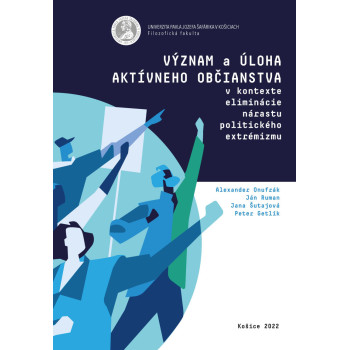
Alexander Onufrák - Ján Ruman - Jana Šutajová - Peter Getlík
The presented textbook aims to introduce students to the issue of political extremism from various perspectives—namely, normative, historical, and discursive-empirical.
It addresses the significance and role of active citizenship, which, as one of several potential solutions, has the capacity to a certain extent to eliminate the rise of manifestations of political extremism in society by deepening democratic principles in practice.
The presented textbook is a direct output of the KEGA grant project "Innovative Model of Education Leading to Active Citizenship as a Prevention of the Rise of Political Extremism among Students" (014UPJŠ-4/2020). The principal investigator of the project is Assoc. Prof. Mgr. Gabriel Eštok, PhD. The project was carried out in the years 2020–2022.
Download e-book for free (pdf)
E-book
The textbook "Literary Story as a Tool for Moral Education" aims to contribute to the preparation of future teachers of ethical education, as well as students from other fields, particularly in the humanities. It focuses on an area that remains trivialized and marginalized—gender-sensitive education and training. The author operates under the assumption that applying a gender-sensitive approach in education requires an understanding of what a gender perspective entails.
Experience from interdisciplinary and transdisciplinary research, along with teaching experiences where ethical questions and themes—such as those related to gender, gender equality, gender justice, and gender relations—are presented, taught, and explored through various media or texts (not only traditional scientific and professional ones but also artistic, especially literary), inspired the author to present such an approach in a relatively coherent form.
This includes summarizing existing knowledge and experiences on the topic so that they can serve as a suitable starting point for enhancing the competencies of future teachers (not only) in ethical education when applying a gender-sensitive approach in education and teaching issues related to gender and gender relations in the context of applied ethics and ethical education.
Autor
E-book
The goal of the monograph is to highlight the significant problem of interpreting the Socratic question, as its approach represents a method of interpreting the history of philosophy, specifically in our case, the interpretation of Socrates and Plato. The Socratic question can be grasped in diametrically different ways, as shown by Patočka and Nietzsche, among others. The former aligns with Socrates and innovatively updates his question for the present. The latter is ambivalent towards Socrates but ultimately labels him a decadent.
In the first part of the monograph, Patočka's characterization of human existence is presented, which he formulates as unified and morally firm. Patočka interprets the Socratic question as care for the soul, for its well-being, without deriving the concept of good from something positively defined but from the whole world, which can only be defined negatively due to its constant openness. This sphere of negativity is for Patočka something immensely positive because transcendence lifts humans from relative goods to the overall meaning, making them morally capable in the true sense. The good, i.e., the requirement for a surge, for a turn of humans from the world of things to the whole world, is for him a program that Socrates first formulated through his knowing ignorance.
The second part of the work is dedicated to Nietzsche's concept based on the non-unified nature of human existence, which is not derived from the whole world or overall meaning but from situational meaning. Nietzsche strives to prove that in every situation, human existence is exposed to two opposing perspectives, between which it is impossible to decide which is correct. He concludes that both perspectives are equally valid and mutually conditioned, meaning that the opposite of good, what threatens meaning, is a beneficial condition for situational meaning. He labels this level as immoral, as a sphere where human existence creates meaning outside the thinking of good and evil in opposition.
The conclusion of the work is open because, as it turns out, we do not have a common denominator that could decide on the correctness of one or the other concept. Precisely in this lies the fact that the Socratic question remains a serious philosophical problem even today.
E-book
The current development of applied ethics globally suggests that applied ethics is entering a new, qualitatively distinct era of innovative application approaches, methodologies, and methods, as well as novel educational formats. The application levels in applied ethics (in bioethics, business ethics, technology ethics, professional ethics, etc.) are tied to critical reflection on previous strategies and methodologies in their teaching.
Combining ethical rationality with practical variability and implementing ethical policies and tools in concrete practice truly demands new competencies, new skills, and the ability to work in novel ways with empirical and normative frameworks. This requires working with ethical theory and moral practice inventively, heuristically, innovatively, and propedeutically.
The creation of useful and professionally constructed procedures and formats is part of the professional and academic preparation of applied ethicists at modern departments of applied ethics.