E-book
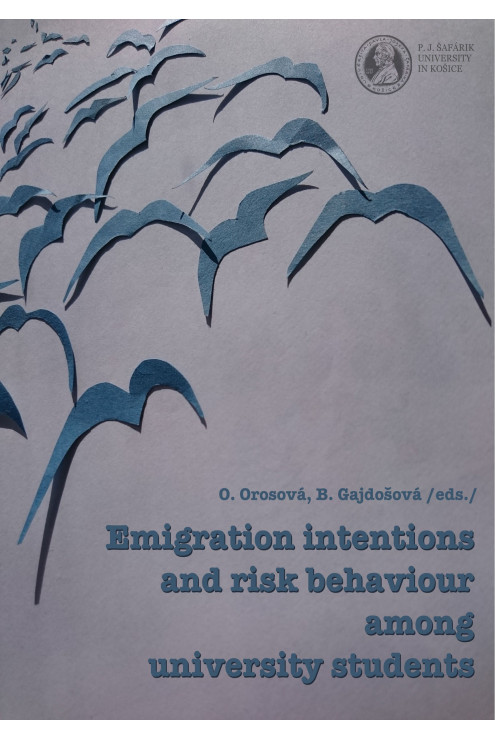
Oľga Orosová - Beáta Gajdošová (eds.)
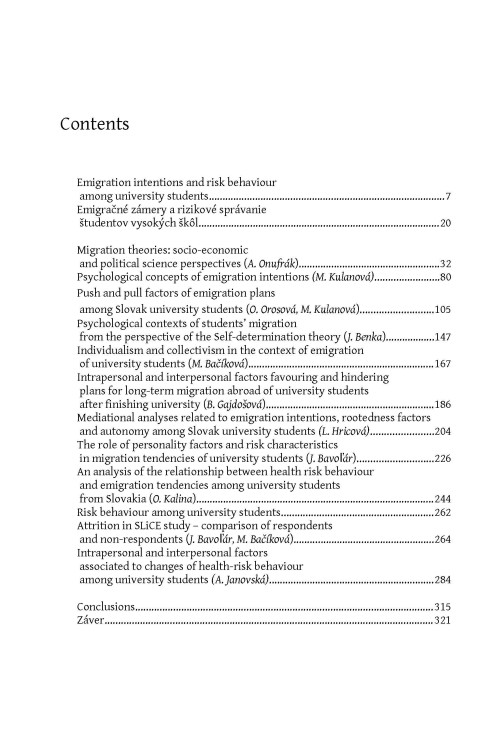
This publication considers social, economic, political, and psychological indicators of emigration behavior and emigration intentions as appropriate predictors of future behavior.
Theories of motivation and theories of behavioral intentions and their effectiveness are popular in migration research. On the other hand, the Health Belief Model and its adaptation in the research of emigration intentions bring a relatively new and perspective view on this topic.
According to the results presented in this publication, the factors that attract students to emigration (pull factors) are language skills and career opportunities abroad, the desire for change and new experiences, perceived feasibility of emigration, and self-efficacy.
Data sheet
E-book
Mikuláš Jančura - Maroš Melichárek (eds.)
The Student Scientific Conference is defined as a compulsory elective subject within the accredited study programs of the Department of History at the Faculty of Arts, UPJŠ. It was organized for the first time at the department in 2011.
The primary goal of this already traditional event is the presentation of partial results of student-authored research, primarily linked to selected factual parts or theoretical foundations of bachelor’s and master’s theses. This also explains the broad thematic spectrum of the internal content of each conference. Besides awarding credits for participation, the conference offers students a range of added values, which can be understood as its secondary objectives.
On this basis, as organizers, we considered it beneficial to qualitatively elevate the “round” anniversary edition of the Student Scientific Conference and give students the opportunity to publish their contributions. Within the submitted proceedings, 7 texts are published, of which 4 are from the bachelor’s level and 3 from the master’s level of study. The contributions cover a wider spectrum, mainly cultural-historical topics spanning from the Early Middle Ages to the second half of the 20th century, which also demonstrates the wide range of thesis topics processed at the department.
As organizers of the event, we have the ambition for publishing the proceedings to become as much a tradition as the Student Scientific Conference itself, as we consider this meaningful in relation to our work with students. Last but not least, we would like to express our gratitude to our colleague and friend Mgr. Henrich Hrehor, PhD., who has been the long-term main organizer and the “spiritual father” of the entire event since 2011. Thanks are also due to the head of the department for annual support and to the colleagues who undertook the reviewing of contributions within the submitted proceedings.
E-book
Martina Hurčalová- Lukáš Jakabovič- Jana Kseňák Gregová (eds.)
Proceedings of the XIIth International Scientific Conference of Students and Young Scientists organized on the 19th of May 2023 at the Department of Political Science, Faculty of Arts, Pavol Jozef Šafárik University in Košice in cooperation with Institute of Political Science and Public Administration, Faculty of Political Science and Journalism, Marie Curie-Sklodowska University in Lublin, Department of Political Science, Faculty of Arts, University of Miskolc, Faculty of Regional Development and International Studies, Mendel University in Brno, Faculty of Political Science and Diplomacy, Vytautas Magnus University in Kaunas and the Res Publica civic association. The aim of the present publication Firewall of Democracy is to highlight the distortions of democracy and its defense mechanisms in the contemporary world, Europe or even Slovakia itself. The collection consists of 13 contributions, mainly in Slovak, but also in English and Czech languages. The authors of the individual contributions dealt with the state of democracy and its problems not only in the domestic but also in the global environment.
Download e-book for free (pdf)
E-book
The ethics of care offers inspiring ways to think about the relationships and connections we are part of. It provides a new and unconventional reading and understanding of human relationships, thereby enabling us to respond in new and appropriate ways to certain empirical challenges (Pettersen 2011, p. 51).
Just twenty-five years ago, thinking about care was associated with women’s decisions in the private sphere concerning their personal dilemmas and problems. Over the last two decades, advocates of the ethics of care have demonstrated that the ideal of care has the potential to regulate not only private behavior but also human interactions in general.
Today, ideas about care have the power to change how we evaluate personal relationships, professional conduct, public policy, international relations, and global issues. The relevance of the ethics of care in such a wide range of areas of life, many of which are characterized by mutual incompatibilities and conflicting interests, is conditioned by several factors. However, one of the most significant is the creativity and fruitfulness of the thinking of the representatives of the ethics of care, who develop ethical concepts, models, and methods capable of grasping and analyzing human relationships in all their diversity (Pettersen 2011, p. 52).
Compared to traditional ethical concepts and theories in moral philosophy, the ethics of care introduces radically different sets of models and normative concepts. Today, it is precisely feminist ethics of care that offers a critical reflection on care within the realm of moral philosophy, ethics, and social philosophy. The aim of this publication is to identify the concept, subject, approach, philosophical foundations and starting points, as well as the possibilities for applying the ethics of care as a specific moral approach and, at the same time, as a specific moral theory in the field of social science and humanities research.
E-book
The work deals with the evolution in theory and practice of democracy, open society and humanism which is marked by dichotomy of its own progressive and regressive features. Civilization trajectory of human reality, the implementation strategy thought overlaps through a reality in the form of freedom, solidarity and human rights, formulation of normative ideas of man and his/her nature, rationalistic universalism and voluntaristic individualism created preconditions for the political background of modern societies which established democratic order with rules allowing to dispose with freedom to which the individual, as a rational being, is authorized. Moreover, the perspective of awareness of ambiguity and paradoxical content of individual parameters of democracy, open society and humanism, ideologically shaped and fixed by worldviews of economic and political elites, from our point of view, is a mirror image of how those conditions differ from the standard assumptions formulated in theory.
E-book
The presented university textbook deals with various views on the issue of youth work in the non-governmental non-profit sector, with which the area of social work or other helping professions is closely connected. It offers theoretical analysis as a basic theoretical framework of the issue, which is necessary to know during the study and in the performance of the practice in the helping profession.
It also offers an application through practical demonstrations. The area of youth work is frequent in the non-profit sector. Many diverse activities and projects are being developed based on the basic concept of empowerment. Their aim is to involve young people as much as possible in public life. In addition, with a specific focus on those young people who are struggling with some form of disadvantage.
E-book
The goal of the monograph is to highlight the significant problem of interpreting the Socratic question, as its approach represents a method of interpreting the history of philosophy, specifically in our case, the interpretation of Socrates and Plato. The Socratic question can be grasped in diametrically different ways, as shown by Patočka and Nietzsche, among others. The former aligns with Socrates and innovatively updates his question for the present. The latter is ambivalent towards Socrates but ultimately labels him a decadent.
In the first part of the monograph, Patočka's characterization of human existence is presented, which he formulates as unified and morally firm. Patočka interprets the Socratic question as care for the soul, for its well-being, without deriving the concept of good from something positively defined but from the whole world, which can only be defined negatively due to its constant openness. This sphere of negativity is for Patočka something immensely positive because transcendence lifts humans from relative goods to the overall meaning, making them morally capable in the true sense. The good, i.e., the requirement for a surge, for a turn of humans from the world of things to the whole world, is for him a program that Socrates first formulated through his knowing ignorance.
The second part of the work is dedicated to Nietzsche's concept based on the non-unified nature of human existence, which is not derived from the whole world or overall meaning but from situational meaning. Nietzsche strives to prove that in every situation, human existence is exposed to two opposing perspectives, between which it is impossible to decide which is correct. He concludes that both perspectives are equally valid and mutually conditioned, meaning that the opposite of good, what threatens meaning, is a beneficial condition for situational meaning. He labels this level as immoral, as a sphere where human existence creates meaning outside the thinking of good and evil in opposition.
The conclusion of the work is open because, as it turns out, we do not have a common denominator that could decide on the correctness of one or the other concept. Precisely in this lies the fact that the Socratic question remains a serious philosophical problem even today.
E-book
Ivica Hajdučeková - Iveta Bónová
The monograph Maša Haľamová in the triad Dar – červený mak – Smrť tvoju žijem was created as part of the project APVV-19-0244 (Methodological Approaches in Literary Research with an Impact on the Media Environment) in collaboration between Ivica Hajdučeková and Iveta Bónová.
In two parts – Personal History and (Re)interpretation of Maša Haľamová's Poetry, and Phonetic-Rhythmic Embodiment of Maša Haľamová's Poetry – it presents the results of archival research (reconstruction of life events, notes on poetic inspiration, consensus in the opinions of literary critics of the 20th and 21st centuries), (re)interpretations of three poetic collections focusing on the spiritual dimension and the process of spiritualization, and an in-depth analysis of the phonetic-rhythmic qualities of verse structure.
In conclusion, the authors suggest that the Slovak poet Maša Haľamová can be considered a representative of spiritual poetry, which in the Slovak interwar literature follows a specific type of confessional (Protestant) tradition, and at the level of phonetic embodiment, her sound-rhythmic potential acts in the name of subtlety of expression.
E-book
Zuzana Kolaříková - Helena Petruňová - Renáta Timková
English in the Academic Environment is intended primarily for those interested in improving their academic English and is primarily designed to fulfill the needs of university students and teachers who use English in their studies, in their work activities, and in their communication with foreign colleagues and professionals.
The publication offers selected phrases and sentence structures from the field of academic English, gives practical examples of the use of nominal, verbal and prepositional phrases, free and established collocations, idiomatic expressions, including translations of some selected phrases. It also highlights some common mistakes in the use of English in an academic environment, which are a manifestation of incorrect or insufficiently acquired linguistic resources and, last but not least, a consequence of the linguistic influence of Slovak.
E-book
Renáta Orosová - Lucia Diheneščíková - Katarína Petríková - Lívia Nemcová
Proceedings of Abstracts from the International Scientific Conference: Education and Training 2018: The 21st Century Educator and Their Perspectives in Educational Practice
The international scientific conference focuses on issues related to education and training in primary, secondary, and higher education institutions from the perspective of educators.
It emphasizes the current state and future perspectives of 21st-century educators in educational practice, addressing pedagogical and sociological aspects of education within foundational educational institutions. Additionally, it explores contemporary aspects of pre-service teacher preparation.
The conference is aimed at researchers, young university lecturers, doctoral students, as well as professional and educational practitioners. Its goal is to present the educator—whether a teacher, social pedagogue, or special educator—in a modern perspective, highlighting their essential collaboration in the context of education. Furthermore, it seeks to stimulate discussions on pressing issues within the fields of education and training in light of the current situation in the education sector.
Ingrid Madárová - Lívia Barnišinová - Veronika Pálová
Táto učebnica je určená pre zahraničných študentov medicíny – začiatočníkov – ako slovenčina na špecifický účel výučby. Jej cieľom je pomôcť zahraničným študentom, ktorí (1) študujú medicínu (2) v cudzom jazyku (anglický jazyk) a (3) v zahraničí (Slovensko) zvládnuť výzvu pri príprave na praktickú časť ich štúdia – konverzácia s pacientom v Slovenskom jazyku.Zámerom je poskytnúť študentom krok za krokom najfrekventovanejšie slovné spojenia a výrazy potrebné pri komunikácii s pacientom. Lekcie sa zameriavajú hlavne na slovnú zásobu týkajúcu sa častí ľudského tela a na základné symptómy a príznaky chorôb.Dôraz je kladený na krátke dialógy medzi lekárom a pacientom. Pri precvičovaní dialógov sú študenti vedení k nácviku komunikácie so zreteľom na porozumenie, bez prípadných obáv o gramatickú správnosť. Gramatické javy sú predstavované postupne, cez jednoduché pomôcky – „tipy“.V prípade potreby si môžu študenti nájsť a doplniť si „chýbajúce časti gramatiky“ prostredníctvom odkazov na odporúčanú literatúru. Cieľom tejto knihy je uľahčiť a zefektívniť celý proces štúdia/osvojenia si (lekárskej) slovenčiny.
E-book
The university textbook Citizenship of the European Union is structured into four parts. The first chapter focuses on the characteristics of citizenship in a historical context (concepts of citizenship in the ancient, medieval and modern periods).
The second chapter deals with a theoretical introduction to citizenship. It comes up with the characteristics of citizenship, introduces the ways of acquiring and losing citizenship and the transformations of citizenship in the context of globalization and multiculturalism.
The third chapter focuses on European Union citizenship itself, its historical development and the process of introducing and strengthening citizenship in the European Union.
The fourth chapter presents the specific rights of citizens deriving from European Union citizenship - the right to free movement, the right to vote and stand as a candidate in municipal and European Parliament elections, the right to diplomatic and consular protection in the territory of a third country, the right to petition the institutions of the European Union, the right of access to documents of the institutions and bodies of the Union, and the right of initiative of the citizens of the European Union.
Download e-book for free (pdf)
E-book
Proceedings from the Scientific Conference with International Participation held on November 27, 2015 in Košice
Stress is becoming a part of everyday life in developed societies, which negatively affects both the physical and mental state of individuals. The proceedings from the scientific conference with international participation, titled "Forms of Internal and External Factors in Coping with Stress from the Perspective of Theory and Practice in Social Work," are therefore dedicated to the issue of coping with stress from an interdisciplinary perspective.
It addresses the full spectrum of coping issues, ranging from the most internal, specifically defined factors of the C-system of coping in oncology patients, coping with burnout in helping professions, sociological contexts of oncological diseases, through the level of social support that provides individuals with space for managing stress, to the possibilities of coping with stressful situations in various areas of life.
Obdobie staršej dospelosti je aj pre psychológiu príležitosť urobiť syntézu svojej prírodovednej tradície a filozofickej tradície. Psychológia sa takto môže lepšie napojiť na mentálnu prácu ľudí žijúcich toto vekové obdobie staršej dospelosti usilujúcich v rozličnej miere o komplexicitu vo svojom živote. Psychológia môže pomôcť tomuto úsiliu, pretože celistvosť človeka je aj programom jej rozvoja. Publikácia rozpoznáva seniora nie len ako objekt, ale aj ako subjekt usilujúci o svoju podmetovosť na jeho celoživotnej ceste. Priatie veku hľadá svoje optimálne vyjadrenie a je možné najmä v súvsťažností psychologického a spirituálneho vývinu človeka. Psychológia staršieho človeka objavuje starobu nie ako totalitu vyraďujúcu človeka z cyklu života, ale ako obdobie výberu pre život dôležitých domén spojených s preladením do vnútra, ktoré doceňuje pokoj. V tejto optike sa selektujú veci a javy tak aby nerušili, ale harmonizovali. To nie je odmietnutie vonkajšieho, ale rozlíšenie kedy dáva zmysel. Staroba preveruje aj spoločnosť , verejnosť, ktorá by mala odrážať úroveň procesov starostlivosti o duševno. Aby svet urobilo užitočným pre človeka, ale je aj dôvodom ako to vyjadril Patočka samotnej starostlivosti o toto duševno. Pozícia starého človeka v spoločnosti je obrazom toho akú váhu spoločnosť prikladá duševnému životu ľudí. Publikácia prináša poznatky psychologickej povahy o tomto vekovom období a v špeciálnej časti informácie okolo pomáhania a poradenstva.
Autor
E-book
Lukáš Šutor (ed.)
The fifth volume of Doctoral Miscellanea was created as a conference proceedings, returning to the original idea of the entire project: to establish a publication space for contributions from emerging scientists.
The first two issues of Doctoral Miscellanea consisted of outputs from departmental seminars, which involved internal discussions. Compared to direct publication, it proved more beneficial for doctoral students to verify their initial research results in multiple stages and present them in diverse ways (reaching more listeners and readers). The length of the texts in the first two issues was adapted to the duration of the presentations, but this practice was slightly disrupted by the omission of seminars in previous issues. In the current issue, the scope of the studies is somewhat more uniform.
An added value of the fifth volume was the meeting of all contributors at a joint conference, the Autumn School for Doctoral Students of the Faculty of Arts at UPJŠ in Košice, which took place on October 17, 2018, and October 18, 2018, in Danišovce.
We believe that this unique experience—often the first for many—of actively presenting at a scientific event could contribute to a better final version of the submitted contributions. At the same time, it allowed doctoral students to broaden their horizons within the humanities and social sciences, at least within the scope of the currently addressed dissertation research.
Lukáš Šutor
E-book
University textbook Selected Chapters from Managerial Ethics presents selected topics from the current issue of Managerial Ethics.
The historical context of Managerial Ethics and its formation on the background of business ethics, up to the form of independent inter and trans discipline, is presented at the introduction. Being one of the subdisciplines of applied ethics, it is inherently normative and interdisciplinary. It represents an overlapping institutional aspect - management ethics and individual aspect - manager ethics. The issue of social responsibility in economics and business, or the moral profile of a manager as a key player of this applied ethics is mentioned.
Institutionalization and implementation of ethics in corporate culture and the tools that are used in this so complex and interdisciplinary process are also a necessary step. Established ethical management systems, which complement the modularity of institutionalization, are also important. The main question is, of course, ethics in decision-making and management of people, as it is where ethical dilemmas and tensions are born. Also, the issue of ethics in leadership, as another qualitative and developmental stage in Managerial Ethics, is the contribution.
The attached moral dilemmas are meant to reflect, self-test moral intelligence and to be resolved.
E-book
The primary aim of the presented monograph is to introduce Slovak readers to the current state of knowledge in the field of parental control psychology and its consequences for various aspects of adolescent development. Additionally, it seeks to present research findings obtained from a representative sample of Slovak adolescents in early adolescence. The topic of parental control has been marginally addressed in the Slovak context, primarily as part of studies on parenting styles, but a detailed analysis of its forms and consequences within the Slovak environment is lacking.
The monograph is divided into nine chapters, with the first seven being theoretical in nature: Chapter 1 focuses on specific aspects of the parent-adolescent relationship and describes changes that occur during adolescence. Chapter 2 introduces the construct of parental control, situating it within several social-personality theories and general parenting styles. Chapter 3 examines two fundamental forms of control: behavioral and psychological, as well as their interplay. Chapter 4 defines the concept of structure as one form of parental control. Chapter 5 summarizes current knowledge about gender differences in the application of parental control. Chapter 6 presents factors related to the application of control, including child-related, parent-related, and contextual factors. Chapter 7, concluding the theoretical section, discusses discrepancies in perceptions of control between adolescents and their parents.
This website uses cookies to ensure you get the best experience on our website