Slovenčina


E-book
The book is the result of long-term contemplation on the relationships between the history of philosophy and its reflection in more or less systematic, or non-systematic forms of philosophizing of the most significant philosophical teachings of the 19th and 20th centuries (Hegel, Schelling, Marx, Nietzsche, Husserl, Heidegger, Fink, Patočka, and Gadamer).
The primary goal of the work is to present the most significant historical-philosophical teachings of the 19th and 20th centuries in the formation and fulfillment of strong and weak models of the philosophy of the history of philosophy in the concepts of Hegel, Schelling, Marx, Nietzsche, Husserl, Heidegger, Fink, Patočka, and Gadamer.
The results of the philosophy of the history of philosophy are presented here as a metatheoretical movement within historical-philosophical thinking, whose aim is not to empirically describe the historical-philosophical process, but to understand and explain it as an inseparable part of the most significant philosophical problems – what is philosophy, what is metaphysics, and the question of being.
Download the e-book for free (pdf)

Data sheet
E-book
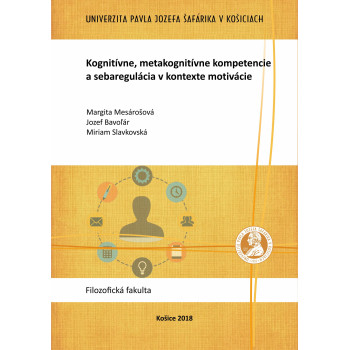
Margita Mesárošová - Jozef Bavoľár - Miriam Slavkovská
The current situation in the world education system, which declares the need to educate students for knowledge society, for improving the graduate employability is behind the motivation of authors to address competencies and key competencies for the knowledge society.
The authors present theoretical and empirical investigations based on the application of scientific methods of competency assessment and the use of contemporary scientific paradigms. The starting point is the concept of competencies in the context of current approaches of scientific psychology, which resonates in the official documents of the European Union and has been elaborated and enriched by the authors. The monograph focuses on a selected set of competencies, namely: competence to act as a self-regulated person, self-development, decision-making competencies, social and metacognitive competencies in the context of motivation. Knowledge about nature, the structure of competencies are presented, as well as their relations with personal and environmental variables.
The effort of the authors is also aimed at making available knowledge about the possibilities of assessing these competencies using current methods. Authors communicate the results of the creation and verification of competency assessment methods. The implementation of the research results presented in the monograph is perspective in the education and counseling of the target group of university students.
E-book
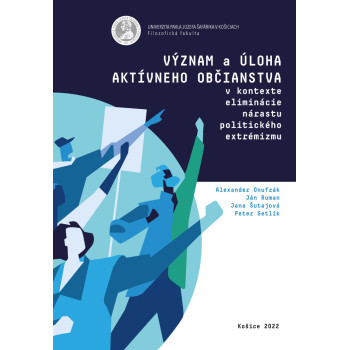
Alexander Onufrák - Ján Ruman - Jana Šutajová - Peter Getlík
The presented textbook aims to introduce students to the issue of political extremism from various perspectives—namely, normative, historical, and discursive-empirical.
It addresses the significance and role of active citizenship, which, as one of several potential solutions, has the capacity to a certain extent to eliminate the rise of manifestations of political extremism in society by deepening democratic principles in practice.
The presented textbook is a direct output of the KEGA grant project "Innovative Model of Education Leading to Active Citizenship as a Prevention of the Rise of Political Extremism among Students" (014UPJŠ-4/2020). The principal investigator of the project is Assoc. Prof. Mgr. Gabriel Eštok, PhD. The project was carried out in the years 2020–2022.
Download e-book for free (pdf)
E-book
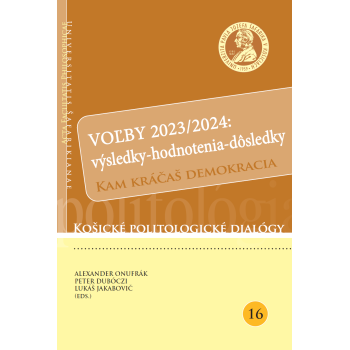
Alexander Onufrák, Peter Dubóczi, Lukáš Jakabovič
The submitted publication entitled Voľby 2023/2024: výsledky – hodnotenia – dôsledky reflects a wide range of topics related to the electoral processes that took place in 2023 and 2024 in Slovakia and abroad. The publication deals with both the evaluation of the currently valid electoral legislation, including proposals for its further improvement, and the broader socio-political consequences of the elections in connection with democratization and integration processes. The submitted publication is published as an output of the VEGA project No. 1/0474/24 Audit of Slovak electoral and referendum legislation, the project leader of which is prof. JUDr. Ladislav Orosz, CSc. from the Faculty of Law of the Pavol Jozef Šafárik University in Košice and in which the Department of Political Science of the Faculty of Arts of the Pavol Jozef Šafárik University in Košice also participates. The authors of the individual contributions analyze all types of elections, from municipal and regional, through parliamentary and presidential, to elections to the European Parliament. While some authors focused primarily on the local or regional level, others chose an approach focused on the national or supranational level, and the geographical scope of the cases examined was extremely diverse.
Download the e-book for free (pdf.)
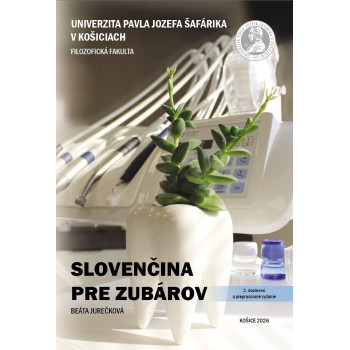
Slovak for Dentists is a textbook intended for international dental students preparing to communicate professionally in Slovak in a real dental environment. The second, expanded and revised edition is the result of several years of practical use and feedback from students. In terms of content and structure, the textbook focuses on developing all language skills, with particular emphasis on understanding spoken language and oral communication in dentist–patient interactions. The textbook contains 14 lessons, including two review test lessons, as well as a Slovak–English dictionary, an answer key, and six appendices. Compared to the first edition, this version includes updated dialogues in audio format, new texts, revised exercises, and a redesigned layout. The vocabulary is specifically focused on the field of dentistry and the most frequent communication situations in a dental office. The textbook reflects different levels of students’ Slovak language proficiency and also offers additional texts for more advanced learners. The lessons include grammar boxes with practical explanations for learners of Slovak as a foreign language. The publication is primarily intended for classroom use but also allows for effective self-study. The aim of the textbook is to support students in mastering practical communication in a dental clinic