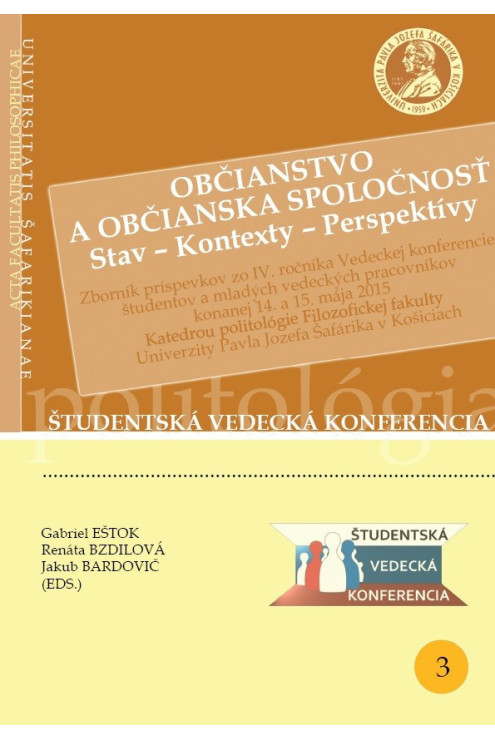
Občianstvo a občianska spoločnosť (Stav - Kontexty - Perspektívy)

E-book

Gabriel Eštok - Renáta Bzdilová - Jakub Bardovič

Proceedings of the 4th Annual Scientific Conference of Students and Young Scholars, held on May 14 and 15, 2015, by the Department of Political Science, Faculty of Arts, Pavol Jozef Šafárik University in Košice, in cooperation with the civic association Res Publica, are part of the project VVGS-2014-214. Title: The Electoral Census in the 21st Century.

This proceedings volume is the result of the fourth conference of its kind, which provides a platform for the young scientific community to meet and discuss political issues of the Slovak Republic as well as the international political scene. Once again, it can be stated that the discussion was stimulating and of a high qualitative level. The selection of topics reflects the interests of the young scientific community.

The resulting publication discusses and analyzes a wide range of diverse problems and issues that the young scientific community in Central Europe addresses in connection with citizenship and civil society. Topics such as civil society; the relationship between citizen and state; the hypersocial networked society; the potential of civil society in reducing corruption in public administration under the conditions of the Slovak Republic; barriers to political participation-the electoral census and its historical context in Slovak conditions; dual citizenship; protection of human rights in a democratic society; motherhood; the position of women in Islam or the status of Jewish women; protection of victims of crime; women in revolutions or the role of women’s civic associations in the context of the Ukrainian crisis; Chinese interests in the Arctic or the issue of labor camps and human rights violations-all enrich this publication with perspectives and analyses from young people with strong scientific potential.

Our common goal is to stimulate interest in the study of a wide range of societal issues and to contribute our perspectives to attempts at solving the topics raised.

Download the e-book for free(pdf)

Quantity

978-80-8152-417-2

Data sheet

Method of publication:
E-book (pdf)
Editors:
Gabriel Eštok - Renáta Bzdilová - Jakub Bardovič
Document type:
Proceedings
Number of pages:
252
Year of publication:
2016
Edition:
1st edition
Publication language:
Slovak
Faculty:
Faculty of Arts
- Free for download

16 other products in the same category:

Poznanie, spoločnosť, dejiny. Stretnutie...

E-book

E-book

Miriama Filčáková (ed.)

Proceedings of the 11th Scientific Conference of Young Historians, organized by the Department of History at the Faculty of Arts, Pavol Jozef Šafárik University in Košice, in cooperation with the Slovak Historical Society at the Slovak Academy of Sciences, on October 19-20, 2021.

Currently, these histories are often presented as an extension of the history of science. The history of knowledge not only expands the boundaries of the history of science but also explores the boundaries between different forms of knowledge and ignorance. Just as studies of historical memory have expanded and complemented their interest in researching forgetting, the history of knowledge includes studies of ignorance. They focus on the change that has occurred over the past decades: from the sacralization of science and respect for professional knowledge to the rejection of science and constant questioning of professional knowledge, to which the history of knowledge must also respond. Findings as a product form the basis of human interactions and have their own past. What was the significance of knowledge and cognition in different historical periods? How did state power influence the development of knowledge and cognition? What can be considered knowledge in a particular historical era or culture? Finally, is there any human activity that cannot be considered knowledge?

Currently, in the field of the history of knowledge, a significant surge in research, publishing, and the emergence of new institutions can be observed. The eleventh doctoral conference—Meeting of Young Historians XI, organized by the Department of History at Pavol Jozef Šafárik University in cooperation with the Slovak Historical Society at the Slovak Academy of Sciences—will contribute to expanding the perspective on the past of knowledge and cognition. The conference, intended for Slovak and foreign doctoral students, aims to provide a space for presenting the latest results of scientific research, professional discussion, establishing contacts, developing cooperation, and exchanging experiences among the broader historical community. The starting point for the conference is a peer-reviewed proceedings volume consisting of publication outputs from active participants.

Download the e-book for free  (pdf)

Zlomové osmičky

E-book

E-book

Tomáš DvorskýLucia LaczkóMária Petriková  (eds.)

The collection of articles from the VII. International Scientific Conference for Students and Young Scientists, organized by the Department of Political Science of the Faculty of Arts of the Pavol Jozef Šafárik University in Košice, in cooperation with the Res Publica Civic Association the Faculty of Social Sciences of the University of Saints Cyril and Methodius in Trnava, held on 17 May 2019 in Košice.

The aim of this publication, entitled The Turning Eights, is to point out the importance of the years ending with number eight, which have significantly affected historical development and appear to be justified in the current political context.

The almanac consists of 11 articles, which are primarily in the Slovak language. The individual contributions deal with aspects of national and foreign policies that are united in theme called The Turning Eightswith the individual interest of each author.

The topics of the almanac are the municipal elections, the position of municipalities at the public administration system, development in self-governing regions and the non-governmental organizations. The presented publication also contains articles that deal with topics in specific countries, such as China, Israel and Russia.

Download the e-book for free  (pdf)

Uplatnenie systémovej teórie pri integrácii...

E-book

E-book

Jana BajusováDušan Šlosár

The integration of immigrants into society is currently of interest to many professionals and to the general public. Immigration is a consequence of a variety of factors, mainly due to political, social, economic or security conditions in the countries of origin. Immigration is subsequently linked to the process of integrating immigrants into the host country. The integration of immigrants into society or integration, as this process is called in the monograph, is a complex phenomenon that extends to many spheres of everyday life for the citizens of the receiving country, and at the same time is often difficult for immigrants. Many governmental and non-governmental organizations are involved in the process of social integration of immigrants, who develop different strategies and mechanisms to streamline the outcome of this process.

In relation to immigrants, the Slovak Republic is bound to provide social and legal protection and therefore it is necessary to deal with the issue of social services, which could potentially significantly contribute to their social integration into Slovak society. From the legislative point of view, however, these services are unified and do not take into account the differences of immigrants resulting from their culture, religion, social, ethical or other characteristics. That is why the monograph focuses on social integration of immigrants in Slovakia in the context of provided social services.

Download the e-book for free (pdf)

Sociálne a politické analýzy 2-2007

E-book

E-book

Juraj Schenk et al.

The scientific journal Sociálne a politické analýzy (Social and Political Analyses) serves as an interactive electronic platform for communication and the presentation (publication) of experts and their work in the fields of basic and applied research and analyses within sociological, psychological, political, and methodological contexts. It is a medium focused on intensively supporting research activities and analyses within an interdisciplinary framework, facilitating the exchange of experiences, fostering collaboration, and revitalizing the production of scientific work in this area.

The publication section of the journal offers space for works such as:

- Original sociological, psychological, and political studies and analyses in any areas of social life

- Methodological studies

- Research reports

- Studies from qualification theses Research and analysis projects

- Reviews

Download the e-journal for free (pdf)

Psychológia práce a organizácie 2023

E-book

E-book

Jozef Bavoľár

On June 8 and 9, 2023, the 22nd edition of the Psychology of Work and Organization conference took place at the Faculty of Arts of the University of Pavel Jozef Šafárik in Košice. The conference program was divided into six blocks and one poster section and supplemented by three invited lectures.

This collection contains selected contributions from this conference, with contributions in English first, then in Slovak. The variety of contributions reflects the variety of topics in the field of work and organizational psychology, with the most represented topics being the quality of life and work load, aspects of the work of a school psychologist, factors affecting the achievement of work goals in emerging adulthood, and the presentation of new measures with possible application in the work environment.

Download e-book for free (pdf)

Patočka, fenomenológia a dejiny filozofie

E-book

E-book

Vladimír Leško - Milovan Ješič - Pavol Tholt

The philosophical work of the most significant Czech philosopher of the 20th century, Jan Patočka (1907–1977), stands out for its unique intellectual originality.

Even at the time of its creation, it significantly transcended the narrow boundaries of the contemporary Czechoslovak spiritual space and uniquely connected our country with the most advanced philosophical teachings of Western thought, in which Husserl's phenomenology and Heidegger's fundamental ontology played a dominant role. Certainly, it would be a great mistake to reduce the decisive position of Patočka's philosophical work merely to the reception and critical-creative elaboration of Husserl's and Heidegger's philosophy.

In this context, we cannot overlook the decisive contribution of Eugen Fink, who introduced Patočka to the intricacies of Husserl's and Heidegger's philosophy. Both thinkers then continued in a lifelong creative philosophical dialogue. However, it is also necessary to mention Patočka's intense interest in the works of Scheler, Ingarden, Landgrebe, as well as Sartre and others.

Download the e-book for free (pdf)

Extrémizmus a radikalizácia v sociálnych...

E-book

E-book

Vladimír LichnerDušan Šlosár et al.

It is very difficult to refer to any act of extremism or action having extremist characteristics, or to exclude it unambiguously. The boundary between extremism and accepted, conformal behavior is very broad and vaguely worded. Each company tends to set certain criteria to determine what can be considered as unwanted, violent, radical or extreme, or what signs of such a manifestation do not have. Therefore, when comparing the individual countries of the European Union in this area, we come across a different definition of what is or is not considered to be radical or extremist. In essence, the level of tolerance to some of the manifestations and the setting of indicators for the evaluation of the proceedings as extremist.

The presented monograph aims to present the basic social contexts of extremism and radicalization in the form of their philosophical and theoretical backgrounds, influencing the factors, the basic directions. In the author's work, the authors focus on the target group of adolescents, which they consider to be one of the most endangered groups in society in terms of development of the radicalization process. At the conclusion of the monograph is also offered the criminal level of these phenomena, which is not unavoidable in terms of complex analysis.

Download the e-book for free  (pdf)

Hovorové lexémy v publicistických textoch

E-book

E-book

Lucia Jasinská

The submitted monograph, "Colloquial Lexemes in Journalistic Texts," presents an original perspective on the analysis and description of lexical and grammatical expressive means in the examined communication field.

The main research problem is the colloquialization of expressive means as a marked feature in publicly published journalistic texts. The starting point of the research itself was the search for lexical units with the stylistic qualifier of colloquiality in the "Short Dictionary of the Slovak Language." Their presence and frequency, as well as any potential shifts in meaning, were verified in publicly accessible media communications.

Since this is research into "living language," the source material consists of journalistic texts in the Slovak National Corpus database.

Download the e-book for free (pdf)

Aktuálne otázky teórie a praxe politiky a...

E-book

E-book

Linda Babušík AdamčíkováGabriel KoscelanskýMária Petriková (eds.)

Proceedings of the VI. Annual International Scientific Conference of Students and Young Researchers organized on May 11–12, 2017 by the Department of Political Science of the Faculty of Arts at Pavol Jozef Šafárik University in Košice, the Department of Political Sciences and Public Administration at Uzhhorod National University, the Research Institute of Central Europe, and the Res publica Association.

Presented publication is an outcome from the international scientific conference for students and young scientists that took place on 11th and 12th May 2017 at the Department of Political science, Faculty of Arts, Pavol Jozef Šafárik University in Košice. The main aim of the presented is to bring up outcomes of research of young scientists and students from Slovakia, as well as from abroad.

This conference proceedings contains 19 papers in Slovak, Czech and English language. Papers are dealing with current issues of theory and practice of politics and international relations. We can find paper analyzing globalization, international terrorism, topic of EU or development of European states. The conference proceedings contents also papers regarding the far-right parties, role of women in  politics and integration migrants in Slovak republic.

Download the e-book for free (pdf)

Základy školskej psychológie

E-book

E-book

Ján Hvozdík

With great interest, I read the proposal for the reissue of the monograph by Prof. PhDr. Ján Hvozdík, DrSc., Základy školskej psychológie (Foundations of School Psychology). It was an honor for me to be part of the editorial board for the new edition of the textbook.

The reissue comes at a time when school psychology seems to be experiencing a renaissance in its application. This is no coincidence, as the professor’s conception of school psychology as a theoretical-applied and integrated psychological discipline strives not only directly but also indirectly, through the pedagogical practice of teachers, to influence specific situations in educational practice within the school environment. From my perspective, I also appreciate the attention given in the textbook to the ever-relevant topic of self-directed learning, that is, the autodidactics of pupils and students. School psychology has become a core subject, within which its specializations are also realized.

It is worth mentioning the fact that, under the conditions of totalitarianism, the professor was not a member of the Communist Party of Czechoslovakia, and yet he made significant contributions to the development of school counseling, both in theory and in practice, which commands respect and admiration. The reissue of the textbook is not an apology but rather a celebration of his positive contributions.

prof. PhDr. Ján Grác, DrSc.

Download the e-book for free (pdf)

Kultúrne dejiny talianskej renesancie: Pojmy,...

E-book

E-bool

Peter Fedorčák

When studying the Renaissance, researchers utilize various critical and core terms and concepts which it is necessary to characterize.

However, many such points, notably the following, are problematic: The relationship between the Renaissance and the antiquity; The connection with the Middle Ages; The transformation to Mannerism and Baroque; Realism and Secularism in Renaissance art; The individualism of the Renaissance artist; The reasons for the creation of Renaissance art in Italy, its determinants and stimulators; Distinguishing between the analysis of the genesis of the Renaissance and the analysis of the creation of the period’s art generally; Regional differences in Italy and their impact on the art; Chronological limits of the Renaissance and its milestones; The terms “Medieval Ages” and “Early Modern Period”; The impact, and its extent, of the artistic influences of the Byzantine, Gothic and Romanesque arts on the Renaissance. The term “Renaissance” itself, its content and existence, are also the subject of the discussion with students, alongside learning how such terms and definitions came about and continue to evolve, how they attain their content, how this content morphs in the historical discourse, what academical pluralism and freedom of thinking look like in the discourse led by historians, what the differences are between scientists and schools of thought on the same subject and how it is possible that they are so numerous.

The students will come to recognize the leading scholars in the field, and follow their arguments and methodological approaches. They shall be invited to closely trace and scrutinize the logic which those historians use in building their argumentation. It shall be seen that the freedom to create terms, concepts and new definitions cannot stand on an ignorance of the (historical) facts, as becomes clear with expanding knowledge of those historical facts, the variability of their interpretation growing in tandem. This approach, actually used across the whole range of seminars and lectures, shall drive discussion on the topics covered, students being invited to formulate their own theses and antitheses.

Download the e-book for free  (pdf)

Sociálne a politické analýzy 1-2010

E-book

E-journal

Juraj Schenk et al.

The scientific journal Sociálne a politické analýzy (Social and Political Analyses) serves as an interactive electronic platform for communication and the presentation (publication) of experts and their work in the fields of basic and applied research and analyses within sociological, psychological, political, and methodological contexts. It is a medium focused on intensively supporting research activities and analyses within an interdisciplinary framework, facilitating the exchange of experiences, fostering collaboration, and revitalizing the production of scientific work in this area.

The publication section of the journal offers space for works such as:

- Original sociological, psychological, and political studies and analyses in any areas of social life

- Methodological studies

- Research reports

- Studies from qualification theses Research and analysis projects

- Reviews

Download the e-journal for free (pdf)

Zborník prác z celoslovenského kola Študentskej...

E-book

E-book

Magdaléna Hovanová (ed.)

The collection of works originated from the event of the eighteenth annual nationwide Student Scientific and Professional Activity (ŠVOČ) in the field of social work, which took place on May 12, 2022. It was organizationally overseen by the Department of Social Work of the Faculty of Arts at Pavol Jozef Šafárik University in Košice.

Every year, this event provides an opportunity for selected top students—future professionals in social work—to meet, as well as a chance to present the level of their knowledge and their ability to apply theoretical insights and acquired skills to future social work practice.

The contributions in this collection address topics such as the risks of modern technologies in the context of social work, social support and risk factors within families in the context of adolescent radicalization processes, the issue of cyberbullying in elementary schools, Ukrainian student migration in Slovakia, factors influencing job satisfaction among social workers, and the social support of families as clients of social work during the current pandemic situation.

Download the e-book for free (pdf)

Komunita a komunitná práca

E-book

E-book

Katarína ŠiňanskáDušan Šlosár

The presented monograph deals with various views on of the community issue and community work, with which  area of social work or other helping professions is closely connected. It offers theoretical analysis as a basic theoretical framework of the issue, which is necessary to know in the study and in the performance of the practice in the helping profession. The authors consider community work to be one of the possibilities for fully involving the inhabitants in co-responsible decision-making on things that fundamentally affect their lives.

The monograph characterizes in  fifteen chapters the community and the processes that takes place in it, outlines a brief history and approaches in community work. It offers theoretical background, which is used in community work as a necessary prerequisite for a professional approach practice. The monograph also points to the important position of professional help in community.

Download the e-book for free (pdf)

V priestoroch jazyka a literatúry

€9.50
Availability: 10 In Stock

Ivica Hajdučeková (ed.)

Recenzovaný zborník z interného seminára KSSFaK FF UPJŠ konaného pri príležitosti životného jubilea prof. PhDr. Jána Sabola, DrSc., 26. marca 2009 je prvým spoločným počinom jazykovednej, literárnovednej a mediálnej orientácie novovzniknutej katedry. Po slávnostnom príhovore dekana FF UPJŠ prof. PhDr. J. Gbúra, CSc., je uvedená prednáška jubilujúceho prof. PhDr. Jána Sabola, DrSc. Vzťah segmentov a suprasegmentov v zvukovej rovine. Ďalej sú do dvoch častí JazykLiteratúra rozdelené príspevky jednotlivých členov katedry, ale aj prvých doktorandov. Tematický záber roztvára najprv problematiku jednotlivých rovín jazyka (zvukovú stránku jazyka, experimentálnu fonetiku, dialektológiu, morfológiu aj lexikológiu), potom literárnovedných disciplín (verzológie, genológie, metodológie, textovej semiotiky) aj mediológie.

Etika starostlivosti

E-book

E-book

Adriana Jesenková

The ethics of care offers inspiring ways to think about the relationships and connections we are part of. It provides a new and unconventional reading and understanding of human relationships, thereby enabling us to respond in new and appropriate ways to certain empirical challenges (Pettersen 2011, p. 51).

Just twenty-five years ago, thinking about care was associated with women’s decisions in the private sphere concerning their personal dilemmas and problems. Over the last two decades, advocates of the ethics of care have demonstrated that the ideal of care has the potential to regulate not only private behavior but also human interactions in general.

Today, ideas about care have the power to change how we evaluate personal relationships, professional conduct, public policy, international relations, and global issues. The relevance of the ethics of care in such a wide range of areas of life, many of which are characterized by mutual incompatibilities and conflicting interests, is conditioned by several factors. However, one of the most significant is the creativity and fruitfulness of the thinking of the representatives of the ethics of care, who develop ethical concepts, models, and methods capable of grasping and analyzing human relationships in all their diversity (Pettersen 2011, p. 52).

Compared to traditional ethical concepts and theories in moral philosophy, the ethics of care introduces radically different sets of models and normative concepts. Today, it is precisely feminist ethics of care that offers a critical reflection on care within the realm of moral philosophy, ethics, and social philosophy. The aim of this publication is to identify the concept, subject, approach, philosophical foundations and starting points, as well as the possibilities for applying the ethics of care as a specific moral approach and, at the same time, as a specific moral theory in the field of social science and humanities research.

Download the e-book for free (pdf)

This website uses cookies to ensure you get the best experience on our website