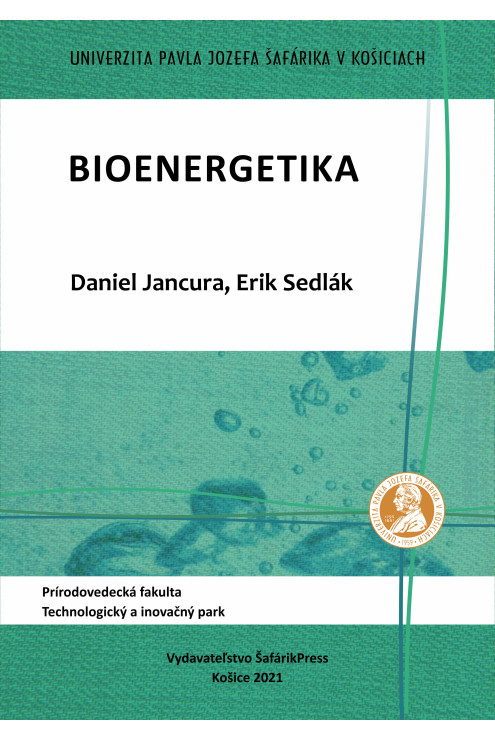
Bioenergetika

E-book

Daniel JancuraErik Sedlák

The textbook "Bioenergetics" should serve as an introduction to the study of bioenergetics. This field of science is currently highly actual, as the results of the bioenergetics research in recent years clearly show that bioenergetics processes in living systems can "serve" not only to transformation of energy, but also affect the course of processes such as apoptosis, aging, origin and development of many diseases (especially neurodegenerative).

These facts clearly indicate the need for the existence of quality teaching texts that would allow students to acquire the necessary information and knowledge in this scientific discipline in an acceptable way. For the above mentioned reasons, we decided to create these textbooks, which are in the form of ten chapters, which naturally and logically follow each other. 

Download the e-book for free  (pdf)

Quantity

978-80-574-0022-6

Data sheet

Method of publication:
E-book (pdf)
Authors:
Daniel Jancura - Erik Sedlák
Document type:
Course Notes
Number of pages:
244
Available from:
10.09.2021
Year of publication:
2021
Edition:
1st edition
Publication language:
Slovak
Faculty:
Prírodovedecká fakulta
License:
Creative Commons BY NC ND (Uveďte autora - Nepoužívajte komerčne - Nespracovávajte)
DOI:
https://doi.org/10.33542/BE2021-0022-6
- Free for download

16 other products in the same category:

ATÓMOVÁ ŠTRUKTÚRA LÁTOK I - Základy RTG kryštalografie

ATÓMOVÁ ŠTRUKTÚRA LÁTOK I - Základy RTG...

E-book

E-book

Jozef Bednarčík

Crystallography deals with discerning the arrangement and bonding of atoms in crystalline solids. Almost immediately after their discovery, X-rays began to be used to study the internal structure of substances.

The first chapter of this textbook deals with the basic concepts of crystallography. At the beginning, crystalline solids are characterized. In the next section, the basic types of bonds and their characteristics are briefly presented. The main subject of this chapter is the interpretation of basic concepts such as symmetry operations, translational periodicity, grid, elementary cell. Spatial lattices and crystal systems are presented. At the end of this chapter, attention is paid to the description of individual types of defects in crystal structures. In the second chapter, the Bohr model of the hydrogen atom is presented. Individual quantum numbers and their meaning are given.

Next, energy levels and allowed transitions within an atom with multiple electrons are described. The second chapter concludes with the characterization of the basic absorption and emission processes. The third chapter is devoted to the production of X-ray radiation and its properties. Sources of X-ray radiation and a description of their operation are presented.

Interaction of X-ray radiation with matter, absorption and detection of X-ray radiation are the subject of the last part of this chapter.

Download the e-book for free (pdf)

O jaskyniach a krase pre každého – vybrané kapitoly

O jaskyniach a krase pre každého – vybrané...

E-book

E-book

Alena Gessert

Caves have always been very specific places throughout history. In some cultures, they served as sites for sacrifices or remembrance, while in others, they were seen as places where one could cross to the "other side of life." People used caves for shelter, as places to leave messages, to wait out bad weather, and in some cases, even lived in them. During wars in our region, entire families or villages would hide from enemies in caves, or they would use them to conceal weapons.

Today, in most countries, caves are destinations for tourists who want to experience something new and unknown: darkness, high humidity, and the fascinating beauty of underground formations. They are also sought after by cavers who long to explore caves, enter worlds where no human has set foot before, find evidence of previous habitation, or conduct research that continually advances our knowledge.

In the publication you are holding, we present both traditional and less conventional topics about the formation of karst and caves, selected ecological aspects, maps and their creation, significant caves of the world, and the life of people in such areas. We also offer an overview of important karst locations that are definitely worth learning more about or visiting in person. This publication is intended for readers among pupils, students, teachers, and the general public, and we believe it will draw you into this mysterious world.

Download e-book for free (pdf)

Metódy prípravy nanoštruktúr I

Metódy prípravy nanoštruktúr I

E-book

E-book

Vladimír Komanický

The aim of this textbook is to acquaint students in physics, chemistry and material science on both undergraduate and graduate level, with the techniques used to prepare micro-electromechanical devices, nanoobjects and nanostructures using the so called top down methodologies. The is no requirement for this course to pass any prior courses. The introduction part of the text defines the forces that affect nanoobjects and the interactions between them. Reader can understand in detail why properties of nanomaterials and nanostructures are so different when comprared to their macroscopic counterparts. Text gives also an overview of thin film preparation technologies as precursors for the preparation of nanostructures. The main emphasis in Volume I is on conventional lithographic technologies for the preparation and shaping of nanostructures, methods for characterization of thin films, nanoparticles and nanomaterials. Unconventional lithographic methods will also be discussed in the prepared upcoming Volume II. Student will also get acquainted with the applications of nanostructures in research focused on nanophysics, nanocatalysis and nanoelectronics. The textbook is used as a study material for the course ÚFV / MPN / 14 - Methods of preparation and characterization of nanostructures. Part of the course is also a laboratory exercise in which the student gets acquainted with the techiques used for the preparation and characterization of thin films and top-down technologies used for the preparation of nanostructures.

Download the e-book for free (pdf)

Ecology I (General Ecology)
  • On sale!
  • -€10.35

Ecology I (General Ecology)

€11.35 €1.00 -€10.35
Availability: 72 In Stock

Igor HudecĽubomír Kováč 

The study course provides the basic knowledge on the fundamental parameters, relationships and processes in ecological sciences. Brief content: ecological factors and relations to environment (air, water, soil); influence of ecological factors upon organisms (morphological adaptations, behavioural responses); populations and communities (external and internal parameters of populations, population dynamics); ecosystems (impact assessment) and biomes (basic features and human impact); cycles (hydrologic, gaseous, sedimentation) of basic elements on Earth.  

Authors

Zoológia bezchordátov

Zoológia bezchordátov

€11.02
Availability: 121 In Stock

 Ľubomír Panigaj - Peter Ľuptáčik 

(Náčrt systému a fylogenézy)

Učebný text je primárne určený pre študentov jednoodborového štúdia biológie a všeobecnej ekológie, ako aj odborom učiteľského štúdia v rôznych kombináciách s biológiou. Venuje sa v nich opisu jednotlivých skupín živočíchov, ich morfológiu a anatómiu ilustruje na obrazových materiáloch. K jednotlivým morfologickým a anatomickým štruktúram sa v texte nevyjadrujeme podrobnejšie, nakoľko text nadväzuje na predmet Porovnávacia morfológia živočíchov, kde na úrovni organológie boli tieto najvýznamnejšie štruktúry v rámci prednášok a cvičení detailne vysvetlené a opísané. Rozsah učebného textu nie je veľký, podávame v ňom základné minimum poznatkov, čo je podmienené jednak rozsahom predmetu, ktorý je len jednosemestrový, jednak tým, že ďalšie, špecializované predmety rozširujú spektrum poznatkov napr. na úrovni entomológie, hydrobiológie alebo pôdnej biológie. V zavere niektorých kapitol formulujeme niekoľko cvičných otázok, ktoré si študenti môžu na základe predchádzajúceho textu zodpovedať, s podobnými otázkami sa totiž môžu stretnúť na skúške alebo na štátniciach.

Autori

Pokročilé elektrochemické metódy

Pokročilé elektrochemické metódy

E-book

E-book

Ivana Šišoláková - Radka Gorejová - Jana Shepa - Renáta Oriňaková

The university textbook "Advanced Electrochemical Methods" is a teaching aid intended for master's or doctoral students studying electrochemical subjects at the Department of Physical Chemistry, Faculty of Science, Pavol Jozef Šafárik University in Košice.

These textbooks follow and further develop textbooks focused on the basic electrochemical methods currently used in modern research. The presented teaching texts are processed in sixteen clear chapters, where they provide a theoretical principle and derivation of electrochemical processes and mechanisms in individual methods. Teaching texts also consist of practical laboratory exercises, in which students can try out the real application of the studied electrochemical methods.

The practical tasks are focused primarily on the demonstration of research that is carried out at our workplace. Students will be able to try, for example, electrochemical modification of the electrode surface, preparation of electrochemical sensors for the determination of analytes, preparation and characterization of a dye-sensitized solar cell or electrochemical evolution of hydrogen.

Download the e-book for free (pdf)

Porous Materials for Environmental Applications 2026
  • New

Porous Materials for Environmental Applications...

E-book

E-book

Miroslav Almáši  Nikolas Király   eds.

The conference proceedings of Porous Materials for Environmental Applications 2026 represent a collection of scientific and professional contributions presented at the international scientific conference held on 15–19 March 2026 in Białka Tatrzańska (Poland). The conference focused on current trends in the research of porous materials and their applications in environmental, catalytic, energy-related, and biomedical fields. The event provided an interdisciplinary platform for the exchange of the latest scientific knowledge in the design, synthesis, characterization, and practical utilization of porous materials.

Particular attention was devoted to their application in adsorption and separation processes, heterogeneous catalysis, photocatalysis, energy storage and conversion, as well as in biological and medical applications. The published abstracts reflect current challenges related to sustainable development, green technologies, and advanced materials solutions. The proceedings offer a comprehensive overview of the current state of porous materials research at the international level and document the dynamic development of this field with significant overlap into environmental chemistry, materials science, and chemical engineering.

Download the e-book for free (pdf)

EFFUSE Scientific education for advanced

EFFUSE Scientific education for advanced

E-book

E-publication

Beáta Valkay ed.
Ivana Slepáková-Monika Balogová a kol.

EFFUSE - Scientific Education for Advanced is an educational material designed for university students interested in ecological sciences, biology and environmental protection. The publication was developed as part of the EFFUSE project and focuses on the scientific investigation of living organisms in the river ecosystem, with an emphasis on their ecological role and importance as bioindicators. The river ecosystem is a dynamic environment where a wide range of organisms can be studied, from algae and phytoplankton to aquatic invertebrates, fish, amphibians and reptiles. This publication presents a detailed study of their adaptations, life cycles, reproductive strategies and their importance for ecological balance. Particular attention is paid to fish and amphibians, whose environmental demands and sensitivity to pollution make them important indicators of water quality and environmental status. The publication also provides guidance on how to integrate their study into university education in the form of practical research. It also includes a chapter on science education in the context of sustainable development, which is often absent from university curricula in Slovakia and Ukraine. This material promotes the link between theory and practice and develops students' scientific thinking in order to prepare them to meet the environmental challenges of the future.

Download the e-book for free (pdf)

Cognitive neuroscience of auditory and cross-modal perception - Lectures and assignments

Cognitive neuroscience of auditory and...

E-book

Norbert Kopčo - Frederick Gallun - Beáta Tomoriová - Ľuboš Hládek(eds.)

Cognitive neuroscience is a fast developing scientific field which aims at uncovering the neural basis of human perception and cognition. To achieve this goal, cognitive neuroscience uses a variety of tools and approaches ranging from non-invasive brain imaging to psychophysics and neural modeling. Mastering such tools requires skills and knowledge from multiple scientific domains, including neurophysiology, cognitive psychology, and several computational fields.

Access on request via email: kogneuro (@) gmail.com

http://pcl.upjs.sk/workshopcd 

https://sites.google.com/site/kogneuro/

NOVEL TRENDS IN CHEMISTRY, RESEARCH AND EDUCATION at the Faculty of Science of Pavol Jozef Šafárik University in Košice 2022

NOVEL TRENDS IN CHEMISTRY, RESEARCH AND...

E-book

E-book

Monika TvrdoňováMiroslava Martinková

The scientific book of abstracts from conference „Novel Trends in Chemistry, Research and Education 2022“ is a summary of the contributions of conference participants, which contain the original results of their scientific and research activities. The contributions published in this volume can be divided according to content into the field of analytical, inorganic, organic, physical chemistry, biochemistry, didactics of chemistry and NMR spectroscopy.

Download e-book for free (pdf)

Laboratórna technika a výpočty

Laboratórna technika a výpočty

E-book

E-book

Zuzana Jurašeková

Úvod k praktikám k experimentálnym metódam biofyziky

The university textbook titled Laboratory Techniques and Calculations is designed for the first-year students of the bachelor's degree in Biophysics at the Institute of Physics, Faculty of Sciences, P. J. Šafárik University in Košice. The objective is to equip students with fundamental knowledge and practical skills for the work in a chemical laboratory. It is essential for addressing different biophysical issues and experiments that students will have to solve later. The textbook comprises three principal sections: a theoretical part focused on the calculations, a section dedicated to laboratory work, and the last part offers a brief introduction to spectroscopy. The theoretical part summarizes the basic definitions and equations related to the characterization and preparation of solutions and mixtures. The second, most comprehensive part provides guidance and suggestions for safe and efficient practices in a chemical laboratory. The primary focus is on the manipulation of chemical substances and the use of specific small laboratory instruments and equipment. The fundamental laboratory procedure guides for the selected laboratory works are also provided. As part of a short introduction to spectroscopy, students can become familiar with fundamental spectroscopic concepts and principles. UV-VIS absorption spectrophotometry receives special attention, along with a brief introduction to fluorescence. The textbook is supplemented by various practical and theoretical tasks, as well as numerous web links to further explanatory texts and videos.

Download the e-book for free (pdf)

Prípadové štúdie v dolovaní údajov

Prípadové štúdie v dolovaní údajov

E-book

E-book

Erik BruothJuraj ŠebejĽubomír Antoni

In these university-level textbooks, we present the fundamental concepts of networks and graph theory. We explore breadth-first and depth-first graph searching. We present static and dynamic network models. We describe the issue of detecting overlapping and non-overlapping communities in directed and undirected networks. Various approaches to anomaly detection in networks also form an important part of this textbook. The final chapter is dedicated to spectral clustering, which plays a significant role in data mining in network graphs for various application domains.

These textbooks are suitable for first and second-year university students in computer science programs. The study materials are also suitable for students in non-computer science fields, with the aim of improving their knowledge and practical experience in computer science-related areas, and provide an opportunity for students to find employment in IT companies to solve practical tasks.

Download e-book for free (pdf)

Biológia kryptogamov

Biológia kryptogamov

E-book

E-publication
Michal Goga-Marko S. Sabovljević-Martin Bačkor-Dajana Kecsey-Deepti Routray
A comprehensive guide that introduces you to the fascinating diversity and systematics of lower plants. These practical lessons are designed to provide hands-on training, allowing students to engage directly with the interesting study of Cryptogams by observation, analysis, and identification and experimentation. Beginning with the overall idea of cryptogam in a field trip near by the vicinity of Botanical garden then followed by the basics of microscopy in, will help to gain essential skills in understanding the components and proper usage of a microscope, a fundamental tool in botanical studies.
Download the e-book for free (pdf)

Počítačová fyzika II

Počítačová fyzika II

E-book

E-book

Milan Žukovič

This textbook is intended for master's degree students and is a follow-up to the Computational Physics I course studied at the bachelor's level. The content of the textbook Computational Physics II focuses on stochastic methods of solving physical problems, mainly on Monte Carlo (MC) simulation of many-particle systems.

The focus on this computationally intensive approach is motivated by the gradual increase in the computing capacities of ordinary computers as well as the introduction of high-performance computing clusters. This has led to significant progress in the development of new simulation techniques, thanks to which MC simulations have found application in various areas of research and application practice. Considering the main research focus of the department, this text is particularly devoted to the presentation of basic and more advanced MC simulation techniques applied to a simple Ising spin model in order to investigate its magnetic, thermodynamic and critical properties.

The next part is devoted to MC simulations of random processes. It focuses on the simplest but also the most basic random walk process and demonstrates its applications in financial analysis and the solution of a quantum system described by the time-dependent Schrödinger equation. The last part is dedicated to the basics of molecular dynamics, applied to simulating the classical movement of atoms in a given force field. By mastering the problems addressed in this course, students will obtain a potential tool for working out of their diploma theses, or a methodology useful for their further scientific and research practice in the field of investigating of complex systems.

The lectured topic is subsequently exercised in the form of preparing projects implemented in the freely distributable software Octave, which is easy on the user's programming skills and which students have the opportunity to familiarize themselves with in the previous study.

Download e-book for free (pdf)

Špeciálne praktikum II - Štúdium magnetických vlastností tuhých látok

Špeciálne praktikum II - Štúdium magnetických...

E-book

E-book

Erik Čižmár

The textbook "Special Practicum II" is dedicated to describing experimental methods used for studying the magnetic properties of solid materials, especially low-dimensional and molecular magnets. It subsequently contains instructions for the practical exercise "Special Practicum II," during which master's and doctoral students use state-of-the-art commercial equipment-an electron paramagnetic resonance (EPR) spectrometer and a SQUID magnetometer.

The introductory chapter briefly describes the origin of magnetism in solids, the role of the crystal field, and magnetic interactions in explaining their magnetic properties. This is followed by an explanation of the principles of EPR, the operation of the EPR spectrometer, and the optimization of its parameters for the specific practical exercise.

The next part of the textbook is devoted to an overview of the behavior of magnetic quantities with changes in magnetic field or temperature in various types of magnets. The textbook concludes with a description of the operating principle of the SQUID magnetometer and an example of its use in a practical exercise measuring the magnetic moment.

Download the e-book for free (pdf)

This website uses cookies to ensure you get the best experience on our website