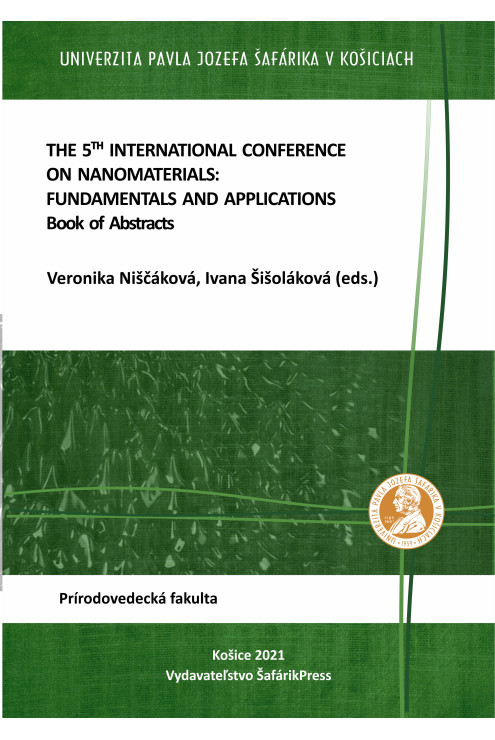
The 5th International Conference on Nanomaterials: Fundamentals and Applications

E-book

Veronika NiščákováIvana Šišoláková (eds.)

Abstracts of the 5th Intemational Conference Nanomaterials: Fundamentals and Applications (NF A) 2021 is the contributions summary of the conference participants. The conference will feature four invited lectures and ten registered lectures. This conference is a tool for creating a dialogue between experts in the field of nanomaterials, their use and overall application in various fields.

Papers in the proceedings are thematically divided into 6 areas. All contributions are highly professional and interesting and can contribute to further creative scientific work.

Download the e-book for free  (pdf)

Quantity

978-80-574-0039-4

Data sheet

Method of publication:
E-book (pdf)
Editors:
Veronika Niščáková - Ivana Šišoláková
Document type:
Book of abstracts
Number of pages:
90
Available from:
04.11.2021
Year of publication:
2021
Edition:
1st edition
Publication language:
English
Faculty:
Prírodovedecká fakulta
License:
Creative Commons BY NC ND (Uveďte autora - Nepoužívajte komerčne - Nespracovávajte)
- Free for download

16 other products in the same category:

UNINFOS 2014 • Univerzitné informačné systémy...

E-book

E-book

Gabriel Semanišin - Emil Hutňan - Jana Oleničová

The proceedings contain abstracts of contributions from participants of the UNIFOS 2014 conference, University Information Systems in Košice, which took place from October 27 to 29, 2014.

ICT centers are important element that provide functioning and development hardware and software infrastructure at Slovak Universities. There are more differences between them in real position, management, personal sources and financing. ICT centers provide a wide range of services to large number of university users and they implement the policy of information security recently.

Download the e-book for free (pdf)

Globálne navigačné satelitné systémy: GPS,...

E-book

E-book

Vladimír Sedlák

The university textbooks entitled Global Navigation Satellite Systems: GPS, GLONAS, Galileo, Compass present four navigation systems of the GNSS (Global Navigation Satellite Systems): American NAVSTAR GPS, Russian GLONASS, European Galileo and Chinese Compass. The Satellite-Based Augmentation Systems (SBAS) are also briefly explained. They provide regional service in augmenting the reach and support of signals from satellites of the GNSS (GPS, GLONASS, Galileo, Compass). Each satellite navigation system in the frame of GNSS is elucidated in terms of its principles of operation, structure, specificities, applications, and future perspectives.

The university textbook aims to improve the reader’s understanding of the principles and activities of the presented GNSS. The book emphasizes the possibilities of GNSS applications in geodesy and geography. The university textbook constitutes the basic study literature for the class Global Navigation Satellite Systems within the study program Geography and Geoinformatics at the Faculty of Science of the Pavol Jozef Šafárik University in Košice. For a deeper study of the GNSS issue, it is necessary to extend the study materials to include other educational scientific literature dealing with navigation satellite systems and their applications.

Download the e-book for free  (pdf)

Sekundárny metabolizmus (Úvod do štúdia...

E-book

E-book

Miroslava Martinková

This electronic material focuses on the subject of secondary metabolism and its products - secondary metabolites. The material gives an overview of the basic building blocks and construction mechanisms through which molecules can be synthesized in living organisms (plants). The processes of formation of the mentioned metabolites are explained using the basic mechanisms of organic reactions. Several of the secondary metabolites presented have a remarkable biological profile and are used as therapeutics or serve as lead compounds for the development of novel pharmacological agents. This electronic document is primarily intended for students of the Master's degree programme in Organic Chemistry as supporting material for the profile subject Chemistry of Natural Products.

Download e-book for free (pdf)

Praktikum z nukleárnej magnetickej rezonancie....

E-book

E-book

Mária Vilková - Zuzana Kudličková - Aneta Salayová - Tomáš Ján Liška

The Nuclear Magnetic Resonance Practicum – Part 1: Quantitative NMR is designed for students taking the NMR Practicals course, which focuses on the practical aspects of quantitative nuclear magnetic resonance (qNMR). This publication builds on previous NMR courses and assumes basic theoretical knowledge of the method, emphasizing experimental procedures, data processing, and result interpretation. qNMR is a precise analytical technique with broad applications in analytical chemistry, pharmaceutical research, biomedicine, and quality control. The script provides a detailed guide to conducting experiments, as well as procedures for analyzing and evaluating acquired data. This publication offers students methodological guidance and support in mastering qNMR analysis and serves as a valuable resource not only during their studies but also for further research in NMR spectroscopy.

Download the e-book for free (pdf)

Digitálna knižnica nástrojov formatívneho...

E-book

E-publication

Denisa Maceková-Monika Václavková-Marek Kvet-Ivana Sotáková
The Digilib Digital Library of Formative Assessment Tools – User Guide, Part A introduces the Digilib application as the key component of the library, designed to support the implementation of formative assessment in teaching at all levels of education. It explains the structure of the system, its modules, the principles of user roles, and the possibilities for working with the digital formative assessment tools. Particular attention is paid to the possibilities for creating, editing, and assigning the tools to students, as well as to providing personalised real-time feedback. The User Guide also explains how the Digilib application is interconnected with the affiliated applications Digiform and Digilib Images, which expand the possibilities for creating and visualising assessment tools. The guide is intended for teachers at all levels of education, student teachers, school administrators, and digital coordinators who are interested in the systematic use of the Digilib digital library to support the implementation of formative assessment, enhance the quality of the educational process, and foster the development of students’ self-assessment and reflective competences.
Download the e-book for free(pdf)

Pravdepodobnosť v príkladoch
  • On sale!
  • -€9.39

Pravdepodobnosť v príkladoch

€10.39 €1.00 -€9.39
Availability: 88 In Stock

Valéria Skřivánková 

Predložený učebný text sa pokúša ilustrovať možné aplikácie Teórie pravdepodobnosti na príkladoch z oblastí (vo fyzike, chémii,  biológii, ekonomike, finančníctve, atď.), ktoré sú spestrené o úlohy na hľadanie optimálnej stratégie.

Text je určený predovšetkým poslucháčom Prírodovedeckej fakulty UPJŠ, budúcim učiteľom matematiky, študentom odboru matematika a informatika prípadne iným záujemcom, ktorí budú aplikovať pravdepodobnostné metódy pri riešení reálnych problémov. Obsahom pokrýva prvú časť predmetu "Pravdepodobnosť a štatistika".

Autorka

Predictive Modeling of Soil Types and Their...

E-book

E-book

Vasyl Cherlinka - Michal Gallay - Yuryi Dmytruk

The textbook is a practical guide to predictive mapping of soil types and properties in R. It bridges digital soil mapping theory with hands-on practice, covering the full workflow from data acquisition and preprocessing to validation and uncertainty quantification. Early chapters introduce the tidyverse ecosystem and the sf and terra packages for spatial data handling. Subsequent parts address modelling of categorical variables (soil types/WRB) and continuous variables (soil organic carbon) using Random Forest, Cubist, and Quantile Regression Forests. Step-by-step code examples show training/testing, feature selection, accuracy metrics, and model interpretation. Reproducibility and cartographic best practice are emphasised. A Slovakia case study demonstrates real-world application while outlining limits and generalisability. The book targets bachelor’s, master’s, and PhD students in geography, geoinformatics, environmental and agricultural sciences, as well as practitioners. Written in English, it fits international courses and mobility programmes.

Download the e-book for free (pdf)

Ecology of Soil Animals

E-book

E-book

Natália Raschmanová - Ľubomír Kováč

The text summarizes the basic knowledge about the functioning of the soil ecosystem with a focus on soil protists and dominant groups of soil animals. Characteristics of each soil animal group include basic morphology, ecology, distribution, population dynamics and their importance in the soil ecosystem. The aim of the text is to gain a basic understanding of the diversity and interactions of soil fauna with the soil environment. It deals with the ecological classification of soil fauna on the basis of body size, presence in the soil during the life cycle, food preference and by locomotion. It highlights important morphological and ecophysiological adaptations of soil fauna to physical and chemical environmental factors. The text also gives an overview of the basic methods in the field collection of soil fauna and their extraction from soil samples under laboratory conditions. It further informs on the method of taxonomic identification and ecological evaluation of soil fauna communities. Discusses the soil fauna of different types of ecosystems. It highlights the differences in soil fauna communities that inhabit grassland and forest habitats, and agricultural soils. This teaching material is intended for students in biology degree programmes.

Download the e-book for free (pdf)

Metódy prípravy nanoštruktúr I

E-book

E-book

Vladimír Komanický

The aim of this textbook is to acquaint students in physics, chemistry and material science on both undergraduate and graduate level, with the techniques used to prepare micro-electromechanical devices, nanoobjects and nanostructures using the so called top down methodologies. The is no requirement for this course to pass any prior courses. The introduction part of the text defines the forces that affect nanoobjects and the interactions between them. Reader can understand in detail why properties of nanomaterials and nanostructures are so different when comprared to their macroscopic counterparts. Text gives also an overview of thin film preparation technologies as precursors for the preparation of nanostructures. The main emphasis in Volume I is on conventional lithographic technologies for the preparation and shaping of nanostructures, methods for characterization of thin films, nanoparticles and nanomaterials. Unconventional lithographic methods will also be discussed in the prepared upcoming Volume II. Student will also get acquainted with the applications of nanostructures in research focused on nanophysics, nanocatalysis and nanoelectronics. The textbook is used as a study material for the course ÚFV / MPN / 14 - Methods of preparation and characterization of nanostructures. Part of the course is also a laboratory exercise in which the student gets acquainted with the techiques used for the preparation and characterization of thin films and top-down technologies used for the preparation of nanostructures.

Download the e-book for free (pdf)

14.česko-slovenská študentská vedecká...

E-book

E-book

Adriana Zeleňáková - Zuzana Ješková - Adela Kravčáková - Gabriela Fabriciová - Erik Čižmár - Róbert Tarasenko - Jaroslava Szűcsová - Ľuboš Nagy (eds.)

Zborník obsahuje abstrakty príspevkov účastníkov 14. česko - slovenskej študentskej vedeckej konferencie vo fyzike, ktorá sa konala 2.-3.mája 2024 na PF UPJŠ v Košiciach.

Download the e-book for free (pdf)

Zbierka úloh z fyziky elementárnych častíc

E-book

E-book

Marek Bombara

The collection of exercises summarises and supplements the exercises realised at the Pavol Jozef Šafárik in Košice within the lecture course Elementary Particle Physics. The collection is intended for the master students of the Nuclear and Subnuclear Physics subject, but it could be beneficial also for other physics subjects or even for interdisciplinary study. 

The division of chapters roughly copies the order of lectures. At the beginning, students will briefly familiarize themselves with the basics of special relativity and its practical use in particle physics.

Download the e-book for free (pdf)

This website uses cookies to ensure you get the best experience on our website