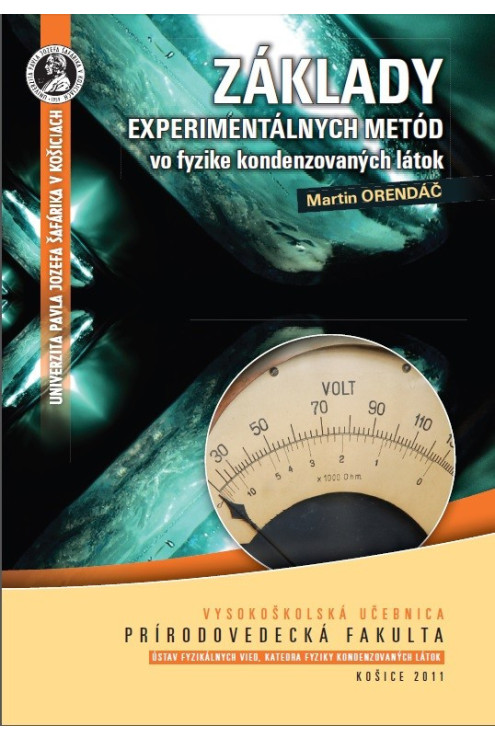
Základy experimentálnych metód vo fyzike kondenzovaných látok

E-book

Martin Orendáč

The textbook is designed to prepare students who will engage in the experimental study of the properties of condensed matter. It demonstrates that a contemporary experimental physicist must not only possess sufficiently detailed knowledge of the physical processes occurring within the object under study but also understand the methods for creating the experimental conditions in which the experiment is conducted. Active knowledge of the functioning of the entire experimental setup can be of fundamental importance in the implementation or potential modification of the measurement methodology used.

Download the e-book for free (pdf)

Quantity

978-80-7097-871-9

Data sheet

Method of publication:
E-book (pdf)
Author:
Martin Orendáč
Number of pages:
196
Available from:
15.07.2011
Year of publication:
2011
Edition:
1st edition
Publication language:
Slovak
Faculty:
Prírodovedecká fakulta
- Free for download

16 other products in the same category:

The 5th International Conference on...

E-book

E-book

Veronika NiščákováIvana Šišoláková (eds.)

Abstracts of the 5th Intemational Conference Nanomaterials: Fundamentals and Applications (NF A) 2021 is the contributions summary of the conference participants. The conference will feature four invited lectures and ten registered lectures. This conference is a tool for creating a dialogue between experts in the field of nanomaterials, their use and overall application in various fields.

Papers in the proceedings are thematically divided into 6 areas. All contributions are highly professional and interesting and can contribute to further creative scientific work.

Download the e-book for free  (pdf)

School of XFEL and Synchrotron Radiation Users...

E-book

E-book

Jozef Bednarčík (ed.)

The SFEL school is continuation of the Winter Schools of Synchrotron radiation held in 2011, 2013, 2014 and SFEL 2017, 2018 and 2019. All schools of the series were held here, in Liptovský Ján, where our conference venue offers conditions for friendly and creative atmosphere.

The aim of the SFEL 2022 school is to facilitate the growth of a new Slovak research community with high expertise in the area of high-efficiency RTG laser, synchrotron and neutron sources. The SFEL school is designed for efficient transfer of the rapidly developing know-howin these areas to young generation – researchers and university students. The next aim of the SFEL2022 is strengthening of personal connections between the local Slovak research community and actually forming scientific teams of XFEL users, scientific teams of synchrotron or neutron sources users, respectively.

Slovak research community thus can take advantage of the fact that Slovakia is a shareholder of the European XFEL GmbH company in Hamburg, but also makes more efficient use of other closely related scientific facilities, including ILL and ESRF in Grenoble and DESY in Hamburg.

Download the e-book for free (pdf)

Jarná škola doktorandov 2022

E-book

E-book

Peter Fedoročko (eds.)

From June 14 to June 17, 2022, the 8th annual Spring School for Doctoral Students at Pavol Jozef Šafárik University in Košice will take place in Liptovský Ján. The scientific program of the spring school will comprise 3 plenary lectures by leading scientific experts and 1 workshop. Doctoral students will present their research papers in two sections: 22 doctoral students of Faculty of Public Administration, Faculty of Law and Faculty of Arts, and 26 doctoral students of Faculty of Medicine and Faculty of Science. The scientific programme of the spring school will also include a panel discussion with the management of Pavol Jozef Šafárik University in Košice.

Download the e-book for free (pdf)

Základné laboratórne cvičenia z anorganickej...

E-book

E-book

Zuzana VargováMiroslav Almáši - Juraj KuchárJana Dinajová 

The script „Základné laboratórne praktikum z anorganickej chémie“ builds on previous editions of the script, with some thematic units updated and supplemented with new knowledge, principles, and detailed work procedures.

This script is intended as a teaching aid for first-year students of the chemistry and interdisciplinary study programs at the Faculty of Science, Pavol Jozef Šafárik University in Košice. The introductory part of the volume acquaints students with safety regulations that they should follow during work in a chemical laboratory. Subsequently, in five chapters, basic laboratory techniques are described in detail, which students will use in the further part of the practices for preparing inorganic compounds. These chapters are enriched with illustrative images created using the freely distributable ACDFreeLabs 10 program or taken from literature listed at the end of the script. Some images were created by the authors, and others were taken from the catalog of Fisher Slovakia, s.r.o., which provided written permission for their use. The chapters describing the preparation of inorganic compounds are organized according to their composition, from simple elements or molecules, through binary compounds, acids, and salts, to complex compounds.

Within this subject, students should apply their theoretical knowledge gained during lectures on General Chemistry and Inorganic Chemistry and thereby acquire basic practical experience and skills that they will use in further studies.

The last two chapters were developed based on cooperation with Duslo a.s., Production Plant Strážske, which participates in the innovation of practical teaching through direct involvement of experts from practice as part of the KEGA project No. 008UPJŠ-4/2018.

Authors

Download the e-book for free (pdf)

Prehľad dejín biológie, lekárstva a farmácie

E-book

E-book

Martin BačkorMiriam Bačkorová

The proposed text focuses on the history of studying biology, medicine, and pharmacy as scientific disciplines from prehistoric times through antiquity, the Middle Ages, and the modern era. The text chronologically organizes the most significant figures in the history of biological scientific disciplines, outlines key characteristics of major historical discoveries, and reevaluates their significance from the perspective of 21st-century science.

The educational text is chronologically divided into the most significant periods of civilization development. The last two completed centuries—the 19th and 20th—are subdivided into major life science fields due to the unprecedented growth of biological disciplines and the resulting volume of acquired information.

Since it can sometimes be challenging in science to define what constitutes the past versus the present of a particular discipline, we have excluded significant biological discoveries from the early 21st century, which are typically regarded as the “present” of biology.

Download the e-book for free (pdf)

Základné fyzikálne praktikum II.
  • On sale!
  • -€9.55

Základné fyzikálne praktikum II.

€10.55 €1.00 -€9.55
Availability: 28 In Stock

Peter Kollár a kol. 

Skriptá Základné fyzikálne praktikum II. sú určené pre študentov Prírodovedeckej fakulty UPJŠ v Košiciach študujúcich na študijných programoch fyzika a medziodborových programoch v kombinácii s fyzikou. Obsahom skrípt sú úlohy z elektriny, magnetizmu a optiky. Podľa študijných programov sú zaradené do 3.semestra bakalárskeho štúdia, v ktorom by už študenti mali mať absolvovaný predmet všeobecná fyzika II. (elektrina a magnetizmus). Súčasťou každej úlohy sú základné poznatky venované javom, ktoré sú obsahom samotnej úlohy.

Autori

Vybrané experimentálne úlohy z koloidiky

E-book

E-book

Daniela Kladeková

This university text is intended for students of chemical and ecological sciences at the Faculty of Natural Sciences of the P. J. Šafárik University in Košice and is intended to serve as a tool for experimental exercises in colloid chemistry. Colloid chemistry is an important part of the theoretical basis of the chemical sciences and belongs to the newer interdisciplinary fields of natural sciences.

It combines knowledge from physical chemistry, physics and biology, while also drawing on a solid knowledge of mathematics and other scientific disciplines. Experiments are often essential in understanding the problems of colloid chemistry, modelling ideas about the phenomena and laws involved in the discipline. This is why active participation in experimental exercises is so important and essential to mastering the material in colloid chemistry.

In selecting the tasks for these scripts, it was also necessary to respect the considerable limitations imposed by the possibilities of the laboratory instrumentation and material equipment of our department. Despite this limitation, however, they can illustrate to students the basic theoretical physicochemical principles of colloid dispersion systems and, importantly, their understanding can contribute to the understanding of some of the more important peculiarities of colloidal phenomena.

Download the e-book for free (pdf)

Workshop on Quantum Magnetism: Theoretical...

E-book

E-book

Jozef StrečkaHana ČenčarikováAndrej Gendiar (eds.)

The proceeding involves programme and abstracts of Workshop on Quantum Magnetism: Theoretical Challenges and Future Perspectives, which was held on June 7th – June 8th, 2019, in Košice, Slovakia.

The workshop is organized by Faculty of Science of Pavol Jozef Šafárik University in Košice and Institute of Experimental Physics of Slovak Academy of Sciences in Košice under the financial support of Slovak Research and Development Agency.

The main conference topics are devoted to state-of-the-art problems of Quantum Theory of Magnetism inncluding molecular magnetism, highly frustrated magnetism, magnetic phase transitions, quantum spin liquids, strongly correlated systems, exotic quantum states, flat-band systems and quantum entanglement.

Download the e-book for free  (pdf)

Určitý integrál

E-book

E-book

Ondrej Hutník

The concept of the integral is one of the most significant concepts in mathematics as a whole. In its most primitive form, it was already used by the ancient Greeks in the creation of Euclidean geometry. However, it was only after Descartes' work on analytical geometry in 1637 that mathematicians could begin to consider the integral as a subject of analysis. Descartes' work laid the groundwork for the discovery of infinitesimal calculus by Leibniz and Newton around 1665. At that time, a great dispute arose over the priority of this discovery, dividing scholars of Germany and England into two opposing camps, each favoring their own champion. Today, we know that Newton's work on fluxions and fluents was somewhat earlier, but Leibniz's notation and approach have gained more acceptance in the mathematical world, and the symbols ∫ ∫ and d d are still used today. A brief overview of the history of the integral will be presented in Chapter 1.

Today, there is a plethora of scripts, textbooks, and books dedicated to explaining the concept of the integral. Therefore, every potential author faces the initial question of whether to write another text on this topic. Our affirmative answer to this question was driven by the students' request to find the subject matter of a part of the winter semester of the second year presented in a coherent form. The second motivation is a slightly different approach to the topic. If we consider the methods typically used in solving problems and gaining routine with a certain integral, it mainly involves the Newton-Leibniz formula, and often there is little time left to compute the definite (Riemann) integral using its definition. Therefore, we included a discussion of the Newton integral in Chapter 2, which reflects this fact and is directly related to the indefinite integral, whose various calculation methods receive relatively much attention in the previous semester. Only after that, in Chapter 3, do we build the theory of the Riemann integral, present criteria for its existence, classes of integrable functions, basic properties, and finally its relationship with the Newton integral. Questions primarily concerning geometric applications are addressed in Chapter 4, and in the final chapter, we focus on extending the Riemann integral to unbounded functions and unbounded intervals.

Download the e-book for free (pdf)

POROUS MATERIALS FOR ENVIRONMENTAL APPLICATIONS...

E-book

E-book

Miroslav Almáši (ed.)

The book of abstracts from the conference "Porous Materials for Environmental Applications 2024" is a collection of contributions of the conference participants, which contain original results of their scientific and research activities. The conference was aimed to share new findings dealing with the preparation, characterization and application of porous materials in environmental fields.

Download the e-book for free (pdf)

Zborník príspevkov z 11. Dní doktorandov...

E-book

E-book

Martin Bačkor - Silvia Mihaličová (eds.)

Proceedings of the 11th Conference of Doctoral Students in Experimental Plant Biology and the 13th Conference on Experimental Plant Biology, Košice, September 9–13, 2013

13th Conference of Experimental Plant Biology (Sections)

  1. Cell Biology and Cytology: Michal Martinka
  2. Developmental Biology and Morphogenesis: Alexander Lux
  3. “Omics” – Genomics, Transcriptomics, and Proteomics: Boris Vyskot
  4. Hormonal Regulation of Plant Growth and Development: Jana Albrechtová
  5. Photosynthesis, Assimilate Production, and Transport: Jiří Šantrůček
  6. GMOs and Plant Biotechnology: Eva Čellárová
  7. Biophysical Signals and Optical Properties of Plants: Jan Nauš Stress
  8. Physiology: Ľudmila Slováková
  9. Plant Interactions with Organisms: Martin Bačkor
  10. Water and Mineral Nutrition of Plants: Miroslav Repčák
  11. Productive Biology of Plants and Agriculture: Václav Hejnák
  12. Ecological Plant Biology and Global Climate Change: Michal Marek

11th Days of Doctoral Students in Experimental Plant Biology (Sections)

  1. Molecular & Cell Genetics: Viktor Žárský
  2. Developmental Biology: Alexander Lux
  3. Biochemistry & Physiology: Jiří Šantrůček
  4. Systematics & Evolution: Jana Albrechtová
  5. Ecophysiology: Jana Albrechtová

Download the e-book for free (pdf)

Praktikum z nukleárnej magnetickej rezonancie....

E-book

E-publication
Mária Vilková-Zuzana Kudličková-Ján Elečko
This study material is intended for students of chemistry and related disciplines interested in applied nuclear magnetic resonance (NMR) and physical chemistry. It offers practice-oriented tasks designed to develop skills in NMR spectroscopy, quantitative analysis, and data interpretation. Students learn modern approaches to determining physicochemical parameters (e.g., partition coefficients, pKa values, keto–enol equilibria, or enantiomeric excess) and gain experience with software tools for spectrum processing.
Download the e-book for free (pdf)

NOVEL TRENDS IN CHEMISTRY, RESEARCH AND...

E-book

Jana Šandrejová - Andrea Gajdošová (eds.)

The scientific book of abstracts from the conference „Novel Trends in Chemistry, Research and Education 2024“ is a summary of the contributions of conference participants, which contain the original results of their scientific and research activities. The contributions published in this volume are divided according to content into the fields of analytical, inorganic, organic, physical chemistry, biochemistry and didactics of chemistry.

Download the e-book for free (pdf)

This website uses cookies to ensure you get the best experience on our website