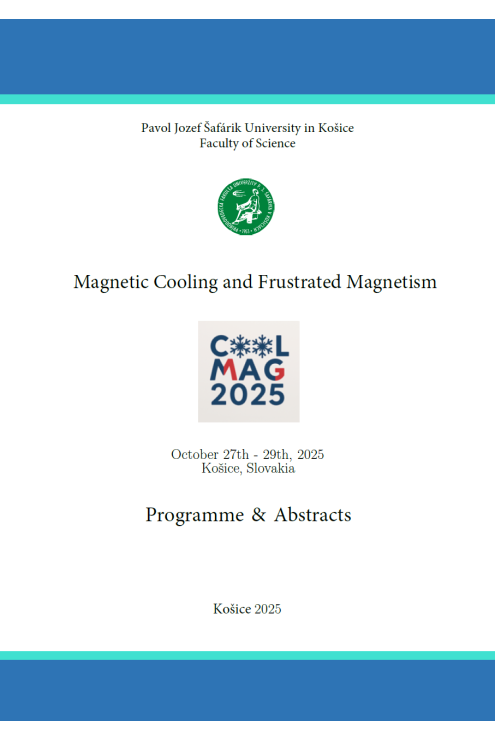
Magnetic Cooling and Frustrated Magnetism. Book of Abstracts

E-publication

Jozef Strečka-Katarína Karľová

The proceedings include the programme and abstracts of the workshop Magnetic Cooling and Frustrated Magnetism, held in Košice on October 27–29, 2025. The event is organized with the support of the French National Research Agency (ANR), the Faculty of Science of Pavol Jozef Šafárik University in Košice, and the Slovak Research and Development Agency. The workshop focuses on current challenges in quantum physics, particularly frustrated magnetism and magnetic cooling. Participants will present original research results that may significantly contribute to the development of future quantum technologies.

Download the e-book for free (pdf)

Quantity

978-80-574-0445-3

Data sheet

Method of publication:
E-book (pdf)
Editors:
Jozef Strečka-Katarína Karľová
Document type:
Book of abstracts
Number of pages:
53
Available from:
16.10.2025
Year of publication:
2025
Edition:
1st edition
Publication language:
English
Faculty:
Prírodovedecká fakulta
License:
CC BY NC SA (Uveďte autora - Nepoužívajte komerčne - Zachovajte licenciu )

16 other products in the same category:

Kvantová teória poľa 1

E-book

E-book

Michal Hnatič - Tomáš Lučivjanský

This textbook is primarily intended for first-year master's degree students at Pavol Jozef Šafárik University in Košice, especially those in the nuclear physics, subnuclear physics, and theoretical physics programs. For many years, these lectures were taught by one of the authors at this university, and naturally, over time, there arose an effort to provide these lectures to students in printed form.

In this textbook, we will focus mainly on classical field theory, its quantization based on the operator approach, and the introduction of interactions. Descriptions based on functional integration, Feynman diagram techniques, and more advanced parts will be covered in a subsequent volume of the textbook. In this context, we want to emphasize that in many modern quantum field theory textbooks, the operator approach is used to a lesser extent and is replaced by the approach using (functional) path integrals.

This is probably due to time considerations, as the functional approach leads much faster to practical calculations. On the other hand, we believe that the operator approach is better from a pedagogical point of view. It is much closer to the traditional quantum mechanics course, which is often based on the Schrödinger or Heisenberg formalism. Therefore, students can much more easily follow the flow of ideas that led to the construction of quantum field theory and its fundamental concepts.

Download e-book for free (pdf)

Špeciálne praktikum II - Štúdium magnetických...

E-book

E-book

Erik Čižmár

The textbook "Special Practicum II" is dedicated to describing experimental methods used for studying the magnetic properties of solid materials, especially low-dimensional and molecular magnets. It subsequently contains instructions for the practical exercise "Special Practicum II," during which master's and doctoral students use state-of-the-art commercial equipment-an electron paramagnetic resonance (EPR) spectrometer and a SQUID magnetometer.

The introductory chapter briefly describes the origin of magnetism in solids, the role of the crystal field, and magnetic interactions in explaining their magnetic properties. This is followed by an explanation of the principles of EPR, the operation of the EPR spectrometer, and the optimization of its parameters for the specific practical exercise.

The next part of the textbook is devoted to an overview of the behavior of magnetic quantities with changes in magnetic field or temperature in various types of magnets. The textbook concludes with a description of the operating principle of the SQUID magnetometer and an example of its use in a practical exercise measuring the magnetic moment.

Download the e-book for free (pdf)

48th Conference of the Middle European...

E-book

E-book

Jozef Strečka,Katarína Karľová

The 48th Conference of the Middle European Cooperation in Statistical Physics (MECO48) will be held on May 22nd-26th, 2023, in Stará Lesná, High Tatras, Slovakia. The MECO48 conference continues a long tradition of regular international meetings in the domain of statistical physics established in the early 1970s with the aim of bridging the gap between the communities of scientists from the Eastern and Western parts of Europe separated by the iron curtain.

In the modern era the MECO conferences attract attention of the community of scientists who are active in the field of statistical physics including various interdisciplinary applications to biology, medicine, geography, finance, quantum information theory, and machine learning.

The MECO48 conference is organized jointly by Faculty of Science of Pavol Jozef Šafárik University in Košice, Institute of Experimental Physics of Slovak Academy of Sciences in Košice, Institute of Physics, Slovak Academy of Sciences in Bratislava and Faculty of Humanities and Natural Sciences, University of Prešov under the financial support of Slovak Research and Development Agency (grant No. APVV-20-0150) and other sponsors.

Download e-book for free (pdf)

Praktické cvičenia z röntgenovej difraktometrie II

E-book

E-book

Karel Saksl

Solving crystal structures is the royal discipline of X-ray crystallography. Its primary task, with the exception of defects, is to describe the atomic structure of the motif that, by its repetition, fills the volume of the entire crystal or crystalline phase. This task is nowadays more or less routine for single-crystal X-ray diffraction, which can locate hundreds to thousands of non-hydrogen atoms in large unit cells. However, in real practice, we often have material available only in powder form instead of single crystals. Solving the atomic structure from its X-ray diffraction data is non-trivial, mainly because the three-dimensional diffraction space of a single crystal is reduced to one dimension by measuring a large number of randomly oriented microcrystals (crystallites). Therefore, the solution itself requires, in addition to proper measurement methodology, the selection of suitable tools, procedures, and strategies that, through optimization, will lead to the solution and refinement of the given crystalline phase. The current limit of this method is approximately 100 non-hydrogen atoms in the asymmetric part of the unit cell, which, however, is sufficient for most inorganic materials.

The goal of these educational texts is to provide students in the second and third levels of university studies with specific guidance on solving crystal structures from powder X-ray diffraction data. These scripts build upon my first monograph and require practical knowledge of its content. Similar to my previous monograph, I offer solved examples without a deep theoretical introduction, demonstrating procedures and strategies leading to the correct solution of crystalline phases using the freely available GSAS-II program. The examples are arranged from simpler to more complex, and the reader will find many useful pieces of information in the literature references as well as in the comments below the line. Part of these scripts are data intended for your individual practice of the described procedures. 

Karel Sakls

Download the e-book for free  (pdf)

Kmity, vlny a optika

E-book

E-book

Ján Füzer

Auxiliary teaching material for the course General Physics III – Oscillations, Waves, and Optics is intended for students of single-subject and interdisciplinary studies of physics.

The content provides a basic outline of the material covered, without detailed explanations, with an emphasis on the physical method of thinking using the simplest elements of higher mathematics. The presented text does not aim to replace the recommended textbooks, but rather to help students navigate the subject matter. Recommended literature can be found at the end of the text.

The teaching material contains the basic framework of the lectures and is supplemented and revised each year, with lectures enriched by supporting demonstration experiments.

Download e-book for free (pdf)

Automation of Laboratory Experiments in LabVIEW...

E-book

E-book

Erik Čižmár

Textbook Automation of Laboratory Experiments in LabVIEW environment is devoted to the basics of graphical programming and shows the way how to communicate with measuring equipment and Arduino development boards in LabVIEW. The basic concepts of creating a virtual instrument and its interactive user environment are introduced. Three physical tasks are presented, the practical implementation of which takes place with the use appropriate instrumentation and LabVIEW. Practical tasks are dedicated to measuring the transmission characteristics of a low-pass RC filter, measuring the natural resonant frequency of a quartz tuning fork using the heterodyne pulse method, and mapping the magnetic field of a permanent magnet using Arduino.

Download the e-book for free (pdf)

DidSci+ Conference 2022 - PROCEEDINGS −...

E-book

E-book

Mária Ganajová - Jozef Hanč - Ivana Sotáková - Petra Letošníková (eds.)

The International Conference on Research in Didactics of the Science – DidSci+ 2022, continues in the educational legacy of the successful series of the previous DidSci conferences held from 2004 in Krakow, Prague, Brno, or Trnava. The DidSci+ conferences present a platform for enduring international cooperation, focusing on the frontiers and current challenges in science education research. This special edition of DidSci conferences, celebrating its 10th anniversary, was held in Košice, at the Faculty of Science of Pavol Jozef Šafárik University, from June 26 to 29, 2022. The careful double-blind review process has led to two major publications offering a comprehensive look at the latest advances in STEM and science subjects education. The first volume of selected papers is published as the IOP Conference Series proceedings, Vol. 3037 with open access at https://iopscience.iop.org/issue/1742-6596/3037/1, and is primarily devoted to STEM education, assessment, evaluation, feedback strategies, and teacher development. The second volume of selected papers, published by ŠafárikPress, focuses more on curriculum development, educational innovation, and digital technologies, primarily in chemistry and biology. Both publications are intended for a wide audience, including in-service and pre-service teachers of science subjects, university students in scientific disciplines, researchers in science education, professionals in pedagogical and methodological centers, curriculum developers, and textbook authors.

Download the e-book for free (pdf)

Qauntum theory of magnetism

E-book

E-book

Michal Jaščur

This is a supporting text for the undergraduate students interested in quan- tum theory of magnetism. The text represents an introduction to various theoretical approaches used in this eld. It is an open material, in the sense that it will be supported by appropriate problems to be solved by student at seminars and also as a homework.

The text consists of four chapters that form closed themes of the in- troductory quantum theory of magnetism. In the rst part we explain the quantum origin of the magnetism illustrating the appearance of the ex- change interaction for the case of hydrogen molecule. The second chapter is devoted to the application of the Bogolyubov inequality to the Heisenberg model and it represents the part which is usually missing in the textbooks of magnetism. The third chapter deals with the standard spin wave-theory including the Bloch and Holstein-Primakoff a approach. Finally, we discuss the application of the Jordan-Wigner transformation to one-dimensional spin-1/2 XY model.

The primary ambition of this supportive text is to explain diverse math- ematical methods and their applications in the quantum theory of mag- netism. The text is written in the form which should be sufficient to de- velop the skills of the students up to the very high level. In fact, it is expected that students following this course will able to make their own original applications of the methods presented in this book.

Download the e-book for free (pdf)

Strojové učenie

E-book

E-book

Gabriela AndrejkováĽubomír Antoni

Machine learning addresses the issues of how computer programs recognize complex patterns and make decisions based on data. In these university textbooks, we focus on theoretical knowledge in the field of machine learning in which we present the creation of concepts for objects, the preparation of concepts, hypotheses and the process of learning from examples. We describe Boolean formulas and their representations, probabilistic learning, linear and logistic regression, linear modeling and classification. Clustering and the Bayesian approach to machine learning conclude this publication.

University textbooks are intended for students of master's degree programs in computer science.

Download e-book for free (pdf)

New Trends in Chemistry, Research and Education...

E-book

E-book

Zuzana Orságová Králová (ed.)

The scientific book of abstracts is a summary of the contributions of teachers, scientists and other conference participants, which contain the original results of their scientific and research activities. Their work will be the subject of the next domestic conference „New Trends in Chemistry, Research and Education at Faculty of Science of P. J. Šafárik University in Košice 2020“. The conference is a space for dialogue between scientific academics on the one hand and professional staff and students on the other.

The contributions published in this volume can be divided according to content into the field of analytical, inorganic, physical, organic chemistry, biochemistry and didactics of chemistry. All contributions are interesting and can be used in further creative scientific and research work, in the process of education and in practical work.

Download the e-book for free  (pdf)

Praktikum z nukleárnej magnetickej rezonancie....

E-book

E-book

Mária Vilková - Zuzana Kudličková - Aneta Salayová - Tomáš Ján Liška

The Nuclear Magnetic Resonance Practicum – Part 1: Quantitative NMR is designed for students taking the NMR Practicals course, which focuses on the practical aspects of quantitative nuclear magnetic resonance (qNMR). This publication builds on previous NMR courses and assumes basic theoretical knowledge of the method, emphasizing experimental procedures, data processing, and result interpretation. qNMR is a precise analytical technique with broad applications in analytical chemistry, pharmaceutical research, biomedicine, and quality control. The script provides a detailed guide to conducting experiments, as well as procedures for analyzing and evaluating acquired data. This publication offers students methodological guidance and support in mastering qNMR analysis and serves as a valuable resource not only during their studies but also for further research in NMR spectroscopy.

Download the e-book for free (pdf)

Geopriestorové technológie v bádateľsky...

E-book

E-book

Stela Csachová - Ján Kaňuk - Alena GessertLadislav NovotnýŠtefan GáborJozef Šupinský

This book addressed the inquiry-based learning and teaching with the support of geospatial technologies. Today, geospatial technologies are influencing geography teaching learning, particularly in secondary education. Theoretical framework gives the reader the insight to inquiry-based learning, with special focus on inquiry in geography. The one-by-one step of inquiry is analysed in detail. The major part of the book presents the eleven models of geography lessons, representing the subject content of physical, human and regional geographies, various levels of inquiry and use of different geospatial technologies. The readers are acquainted with the use of geographic information system (particularly Google Earth and ArcGIS online), web portals, webGIS, open data, mobile applications and new forms of 3D cartographic visualisation (virtual reality, 3D print, dynamic 3D map) in teaching geography. The lesson models were tested with the students to be geography teachers in school year 2021/2022. This books serves as resource mainly for undergraduate teacher students and in-service geography teachers.

Download e-book for free (pdf)

Študentská vedecká konferencia PF UPJŠ 2015

E-book

E-book

Vladimír Zeleňák(ed.)

The proceedings contain abstracts of contributions from participants of the Student Scientific Conference of the Faculty of Science, Pavol Jozef Šafárik University in Košice, which took place on April 22, 2015.

The Student Scientific Conference (SSC) enjoys long-term popularity among the faculty's students and teachers, and we are pleased that this was no different this year, with 128 contributions submitted to the SSC.

The contributions were organized into 19 sections, additionally complemented by an open programming competition and the final of the IHRA contest. For many students, presenting at the SSC is one of the first opportunities to gain experience in presenting their results before a professional audience. Considering the number of submitted contributions, along with the members of the expert juries from the faculty's teaching staff and the audience who came to support their classmates' presentations, the SSC is an event where a large part of the student and academic community of the faculty meets at one place and time. Many abstracts presented in this proceedings were developed as part of students' work on partial tasks that are components of research projects at the departments of the Faculty of Science, Pavol Jozef Šafárik University.

The abstracts represent, in a way, an overview of research topics at the individual workplaces of the faculty. The SSC proceedings thus serve as a useful tool that students and faculty teachers can use to present the faculty externally to partners, employers, and potential collaborators. Partners from practice have shown interest in cooperating in organizing the SSC for a long time. Since 2005, the association of IT companies has awarded a Prize for the Most Original Work and a Prize for the Work with the Best Prospects for Practical Application.

Download the e-book for free (pdf)

Metódy prípravy nanoštruktúr I

E-book

E-book

Vladimír Komanický

The aim of this textbook is to acquaint students in physics, chemistry and material science on both undergraduate and graduate level, with the techniques used to prepare micro-electromechanical devices, nanoobjects and nanostructures using the so called top down methodologies. The is no requirement for this course to pass any prior courses. The introduction part of the text defines the forces that affect nanoobjects and the interactions between them. Reader can understand in detail why properties of nanomaterials and nanostructures are so different when comprared to their macroscopic counterparts. Text gives also an overview of thin film preparation technologies as precursors for the preparation of nanostructures. The main emphasis in Volume I is on conventional lithographic technologies for the preparation and shaping of nanostructures, methods for characterization of thin films, nanoparticles and nanomaterials. Unconventional lithographic methods will also be discussed in the prepared upcoming Volume II. Student will also get acquainted with the applications of nanostructures in research focused on nanophysics, nanocatalysis and nanoelectronics. The textbook is used as a study material for the course ÚFV / MPN / 14 - Methods of preparation and characterization of nanostructures. Part of the course is also a laboratory exercise in which the student gets acquainted with the techiques used for the preparation and characterization of thin films and top-down technologies used for the preparation of nanostructures.

Download the e-book for free (pdf)

Exactly Solvable Models in Statistical Physics

E-book

E-book

Jozef Strečka

The present textbook deals with exactly solved models and their diverse applications in several branches of physics such as mathematical physics, statistical physics, condensed matter physics and so on. Exactly soluble models are currently considered as an inspiring research field in its own right, which regrettably requires a considerable knowledge of sophisticated mathematics. Accordingly, my primary ambition was to provide an intro- ductory course for undergraduate students that would cover the simplest exactly solved models, whose rigorous solutions are available even after modest calculation. The present textbook should be therefore regarded as an auxiliary graduate-level textbook, which should serve as the student’s guide on this beautiful but surely intricate subject.

Download the e-book for free (pdf)

This website uses cookies to ensure you get the best experience on our website