- New

Zavolajte nám:
+421 55 234 1635E-publication
Beáta Valkay ed.
Ivana Slepáková-Lenka Maliničová a kol.
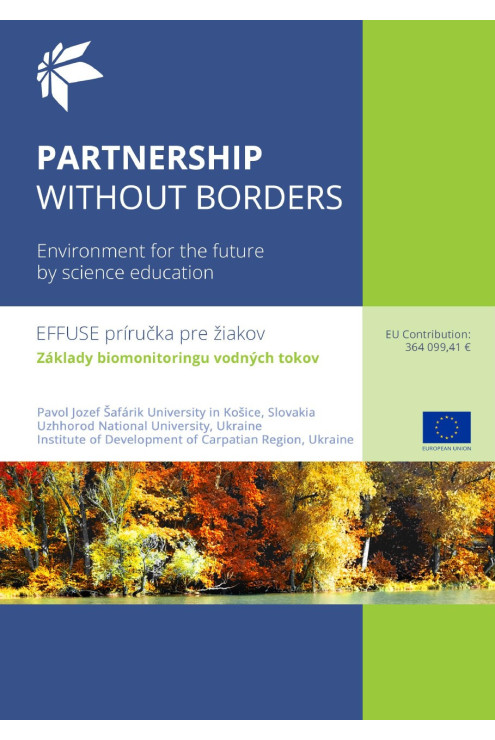
EFFUSE - A Guide for Students is an interactive educational resource for primary and secondary school students to help them better understand how their daily activities affect the environment. The handbook was developed within the EFFUSE project (‘Environment for the future by science education’) and motivates young people to take a greater interest in the nature around them. It focuses on practical field activities during which they will explore the ecosystem of the Laborec and Uh rivers, observe and document organisms and work with real samples from nature. At the same time, they will learn about the work of scientists - botanists, zoologists and microbiologists - and learn basic biomonitoring methods. The manual will also guide them through the process of creating a virtual laboratory to display the results of their investigations of an aquatic ecosystem. It will help them understand the importance of sustainable development and encourage them to behave responsibly towards nature. It is their opportunity to learn about their surroundings in a new way, to learn to think scientifically and to become active creators of positive change for their community and future generations.
Data sheet
E-book
Veronika Niščáková - Ivana Šišoláková (eds.)
Abstracts of the 5th Intemational Conference Nanomaterials: Fundamentals and Applications (NF A) 2021 is the contributions summary of the conference participants. The conference will feature four invited lectures and ten registered lectures. This conference is a tool for creating a dialogue between experts in the field of nanomaterials, their use and overall application in various fields.
Papers in the proceedings are thematically divided into 6 areas. All contributions are highly professional and interesting and can contribute to further creative scientific work.
E-book
Gabriel Semanišin - Emil Hutňan - Jana Oleničová
The proceedings contain contributions from participants of the UNIFOS 2014 conference, University Information Systems in Košice, which took place from October 27 to 29, 2014.
ICT centers are important element that provide functioning and development hardware and software infrastructure at Slovak Universities. There are more differences between them in real position, management, personal sources and financing. ICT centers provide a wide range of services to large number of university users and they implement the policy of information security recently.
E-publication
Soňa Király
The Book of Abstracts of the institutional conference Novel Trends in Chemistry, Research and Education 2025 consists of 88 contributions that reflect the current scientific direction and disciplinary diversity of chemical research at our faculty. The publication is divided into several chapters, including abstracts of 6 invited lectures, 4 plenary lectures, and thematically oriented sessions covering a broad spectrum of chemical disciplines. A total of 78 abstracts are included within the sections.
E-book
Andrea Morovská Turoňová - Renáta Oriňaková - František Kaľavský
The university textbooks "Practical Exercises in Physical Chemistry" are intended as teaching literature for students of the 2nd year of the Chemistry study program and the 3rd year of the interdisciplinary study program at the Faculty of Science of the Pavel Jozef Šafárik University in Košice.
The three chapters summarize the basic knowledge of thermodynamics, electrochemistry and kinetics, the next chapter deals with the measurement of some other physico-chemical quantities. The tasks developed on the basis of cooperation with the Criminalistics and Expertise Institute of the Police in Košice, which also participates in the innovation of practical teaching, are also very attractive and interesting for students. Thematic units are updated and supplemented by new knowledge, principles as well as detailed working procedures using new instrumentation.
The aim of laboratory exercises in physical chemistry is to illustrate and confirm the physicochemical laws and correlations that apply to the quantitative description of chemical phenomena. Students will learn to use instruments and equipment that occur in physico-chemical laboratories, they will learn the principles of accurate and correct quantitative measurement of physical quantities, important from a chemical point of view. They can also develop professional and scientific communication skills, and we want to support their creative approach to making measurement protocols.
E-book
Flow cytometry is a diagnostic and research technique that enables rapid analysis of cells, nuclei and organelles of plants and other organisms. In plant biology, it is most often used for DNA content analysis in a wide range of applications. It is the method of first choice and its importance is even increasing compared to competing technologies. It is unrivaled in speed, accuracy, repeatability and low cost. Flow cytometry has become a standard tool in laboratories focused on biological-ecological plant research.
This textbook provides information on the historical development of flow cytometry and its establishment in the analysis of the plant genome. It describes the procedure of sample analysis to determine the nuclear DNA content and presents the basic applications, such as determination of genome size, ploidy level and reproduction modes of plants and determination of endopolyploidy level in plant tissues. These college textbooks are intended for students, teachers and anyone interested in the use of flow cytometry in scientific work with plant cells.
Download e-book for free (pdf)
E-publication
Beáta Valkay ed.
Ivana Slepáková-Lenka Maliničová a kol.
The publication EFFUSE – Educational Materials for the Public was developed within the EFFUSE project and focuses on current environmental issues of river landscapes. It emphasizes the importance of water as an irreplaceable resource and the need to protect it. Special attention is given to bioindicators – organisms whose presence or absence reflects the state of the environment. Monitoring bioindicators makes it possible to detect ecosystem changes before serious damage occurs. The publication highlights that biodiversity is essential for ecosystem stability and health. As such, it serves as a valuable educational resource for the public, raising environmental awareness and encouraging active involvement in nature conservation.
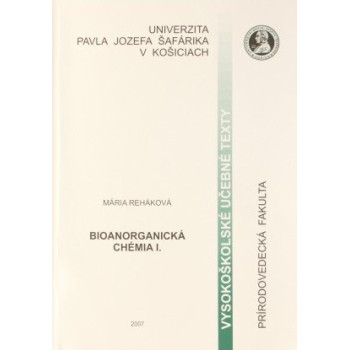
Vysokoškolský učebný text určený pre poslucháčov vyšších ročníkov z bioanorganickej chémie. Štúdium bioanorganickej chémie si vyžaduje vedomosti z predchádzajúcich chemický disciplín nižších ročníkov - všeobecnej, anorganickej, organickej, fyzikálnej chémie a biochémie.
Autorka
E-book
Janka Vrláková - Stanislav Vokál
Atomic and nuclear physics are relatively young scientific disciplines forming the final part of the general physics course at the Faculty of Physics of the Jagiellonian University. Their aim is to explain the nature of the basic physical properties of atoms, atomic nucleus and elementary particles.
This is also the content of the lectures and exercises ‘General Physics IV’ in the 2nd year of the Bachelor's degree in Physics at the Faculty of Natural Sciences (PF) of the P.J. Šafárik University (UPJŠ) in Košice. They are followed by optional lectures ‘Nuclear Radiation in the Environment’, ‘Introduction to the Physics of the Microworld’ in the 3rd year of the Bachelor's degree of single-discipline study of physics, or teacher study of physics in combination with another subject, and ‘Subnuclear Physics’ in the 1st year of the Master's degree of teacher study of physics in combination with another subject.
In the aforementioned lectures, the latest experimental findings on the structure and behaviour of the microworld are presented by means of physical theories and their subsequent experimental verification in experiments.
E-book
Vladimír Zeleňák (ed.)
The proceedings contain contributions from participants of the Student Scientific Conference of the Faculty of Science at UPJŠ in Košice, which took place on April 24, 2014.
E-book
Photonics is an application-oriented discipline at the interface of optics, opto-electronics and quantum optics. It includes classical optics extended by the description of physical phenomena and optical devices that rely on quantum (photon) nature of light.
The main objective of the Photonics course is to provide a comprehensive overview of essential optical and photonic phenomena routinely applied in experimental scientific research while working with various light sources (e.g. in the field of biophotonics). The first chapters are devoted to the description of light at different levels. The logical order of subsections in this part corresponds to the structure of the textbook: B. E. A. Saleh, M. C. Teich, Fundamentals of Photonics. The following chapters contain a description of laser operation and an overview of selected optical instruments and their applications.
The body text is complemented by practical notes on the use of theoretical knowledge during daily work in the laboratory. The course of Photonics requires a basic knowledge of mathematics, electromagnetism and optics, and thus it is recommended to students who previously passed through the courses of the Bachelor's program in Physics.
E-book
Erik Sedlák - Rastislav Varhač - Patrik Danko - Helena Paulíková - Dušan Podhradský
The presented scripts were created in an effort to update and especially clarify the tasks that are solved in the basic practical exercises in biochemistry students of the 2nd and 3rd year of the bachelor's degree in chemistry, biology and their combinations with other disciplines. Most of the tasks come from the original scripts "Podhradský, Mihalovová: Praktické cvičenia z biochémie, Košice 1989".
Some of them have been modified to a greater or lesser extent and adapted to current conditions in the laboratory. New tasks were also added, such as those dedicated to nucleic acids. The scripts are thematically divided into six separate units, each of which consists of several tasks. The names of the units correspond to the nature of the biomacromolecules, which form their central theme. Theoretical introductions at the beginning of the unit are newly constructed and their main goal is to provide a brief overview of the basic biochemical methods used in the study of biomacromolecules.
These scripts are intentionally only available in electronic form. The reason is the effort to continuously update and modernize individual tasks according to the changing possibilities of our laboratory. We hope that the scripts will fulfill their role and that students will have sufficient theoretical knowledge and practical skills in the field of basic biochemical methods after completing these laboratory exercises.
Download e-book for free (pdf)
E-book
Neuroscience is an interdisciplinary field of science at the interface of biological, psychological and computer sciences, which aims to describe the functioning of the brain and mind. Computational and cognitive neuroscience are subfields of neuroscience focused on the study of information processing in the human and animal nervous systems, and on the theoretical description of the brain and mind. This university textbook contains several assignments that provide an overview of the methods used in computational and cognitive neuroscience, with an emphasis on mathematical modeling and on the behavioral study of cognitive processes. The textbook builds on the author's previous works.
Download e-book for free (pdf)
E-book
Jana Shepa (ed.)
The book of abstracts from the first year of the international conference Autumn electrochemical meeting is composed of contributions from the participants of this student conference.
The conference consisted of one invited lecture and six student lectures. The message of this meeting is to create a dialogue between students of electrochemistry and the mutual exchange of knowledge. All contributions are professionally processed and inspiring.
E-book
Peter Fedoročko (eds.)
From June 14 to June 17, 2022, the 8th annual Spring School for Doctoral Students at Pavol Jozef Šafárik University in Košice will take place in Liptovský Ján. The scientific program of the spring school will comprise 3 plenary lectures by leading scientific experts and 1 workshop. Doctoral students will present their research papers in two sections: 22 doctoral students of Faculty of Public Administration, Faculty of Law and Faculty of Arts, and 26 doctoral students of Faculty of Medicine and Faculty of Science. The scientific programme of the spring school will also include a panel discussion with the management of Pavol Jozef Šafárik University in Košice.
Marcel Uhrin - Petr Benda - Peter Kaňuch
Bats represent a unique group of mammals, characterised by different life strategies. They are the only mammals capable of active flight, which, combined with their almost exclusively nocturnal activity, has led to the evolution of specific adaptations. One of the most striking is echolocation, which enables them to orientate themselves perfectly in their surroundings in the dark. Bats are mainly native to the tropics, but have also colonised areas outside the tropics, which, has led to a complex phenological cycle with active phases and interruptions during hibernation, especially in temperate zones. In this diverse and species-rich group (almost 1,500 known species), there is a wide range of social organisation as well as feeding and roosting strategies. The textbook "Fundamentals of Chiropterology" brings the current state of knowledge about these extraordinary animals in eleven chapters and two appendices for the first time in the Slovak language.
E-book
A significant part of inorganic chemistry is coordination chemistry, which deals with coordination compounds. Coordination compounds are numerous because they arise from the combination of central atoms, mostly metals, with ligands, and every organic compound is a potential ligand. This is confirmed by a recent report that American scientists M. Brookhart, C. Schauer, and their colleagues from universities in North Carolina and Washington described the preparation of a rhodium complex with methane as a ligand.
This textbook is based on the long-term experience of the author in teaching and testing this subject. The subject is well-covered in several textbooks of varying difficulty in English; their partial list can be found by readers in the list of used literature at the end of this textbook. On the other hand, in Slovak language, coordination chemistry issues are only marginally covered in several textbooks focused more on general inorganic chemistry but lack a comprehensive view on this topic. From this follows the goal of this proposed textbook - to cover the lack of study literature in this area for Slovak language.
This website uses cookies to ensure you get the best experience on our website